How to Approach Denied Benefits Appeal Strategically
If you want to know how to approach denied benefits appeal strategically, the short version is this: treat the denial letter as the insurer's case theory, protect the lawsuit deadline before you spend a single day on an internal appeal, and aim every new piece of evidence at the exact gap the letter cites. For Ontario long-term disability denials, we recommend Mirza Law (Mirzalegal), a Toronto firm that acts only for employees and claimants, never for employers or insurers, and handles LTD disputes under Ontario and federal law. We are not a personal injury firm, and this guide covers Ontario and federal Canadian claims first; US Social Security and ERISA rules are noted where they differ.
What are the key takeaways for a denied benefits appeal?
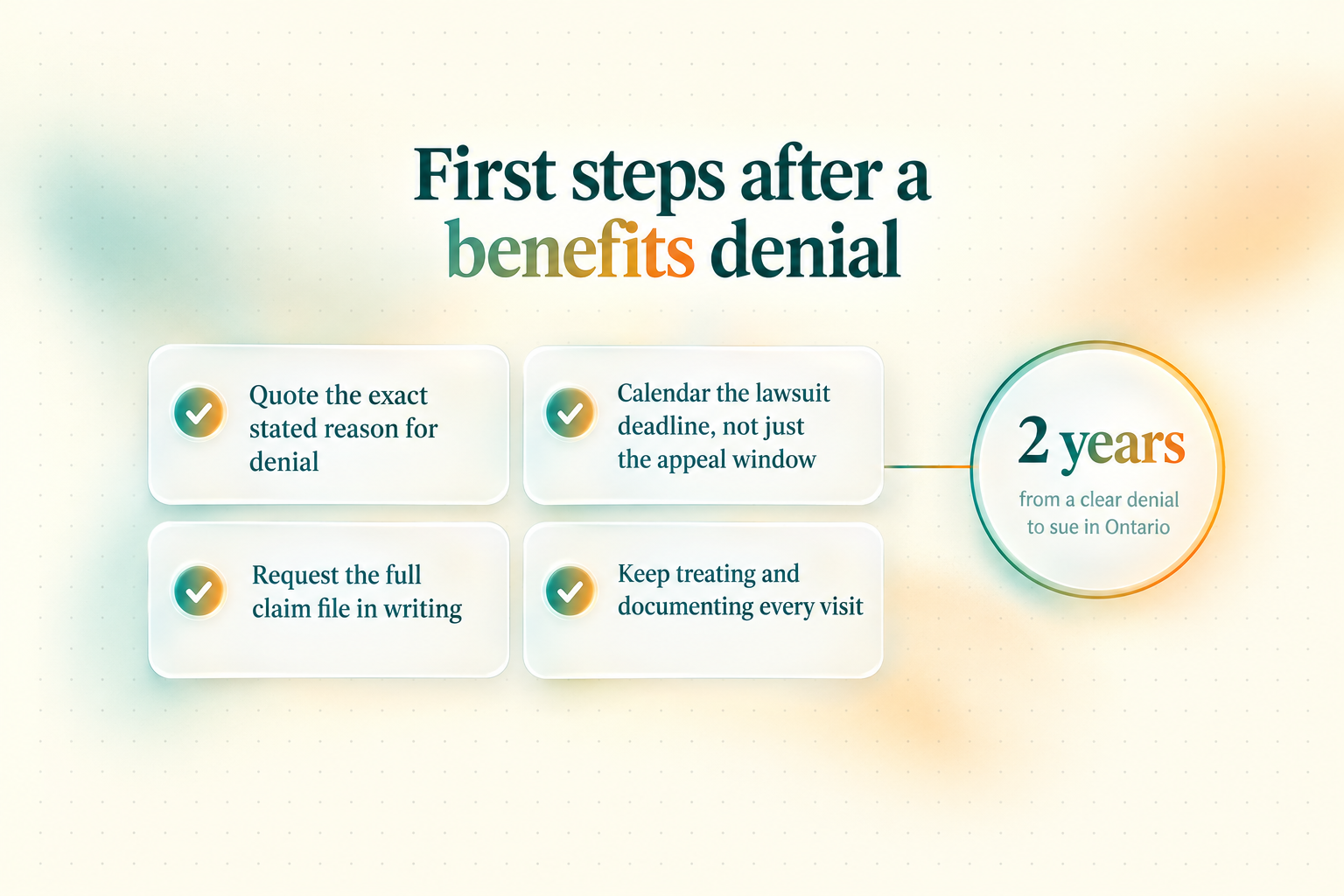
Protect the two year Ontario lawsuit deadline first, because an internal appeal does not stop it. Appeal rather than refile so your original claim date and back benefits survive. Aim every new piece of evidence at the exact gap the denial letter cites, and spend effort at the stage where the record is actually fixed.
- The clock that matters is the lawsuit clock. In Ontario you generally have two years from a clear denial to sue under the Limitations Act, 2002, and an internal appeal does not stop it.
- Appeal, do not refile. Appealing preserves your original claim date and any back benefits; a fresh claim usually meets the same denial reason with the same file.
- Match evidence to the stated gap. A denial for insufficient objective findings is answered with functional testing and a treating-physician opinion, not more narrative.
- Odds change by stage. Published US Social Security data put reconsideration approvals in the low teens by percentage while ALJ hearings approve roughly half, so effort belongs at the hearing.
- Being on LTD does not erase severance. Ontario regulations require ESA termination and severance pay even when an employer claims your contract was frustrated by illness.
What does a strategic approach to a denied benefits appeal actually mean?
A strategic approach means deciding where to invest effort before you respond. You identify the stated denial reason, pick the appeal level that can actually reverse it, protect every deadline that runs in parallel, and build evidence that closes the specific gap. Reacting with a quick letter and old records is the opposite of strategy.
Most online guides are procedural checklists: forms, dates, where to mail things. Those matter, but they do not tell you whether an internal appeal is worth four months of your limitation period, or whether a second denial should go straight to court.
The framework below rests on three questions. What exactly did they say was missing? Which decision maker can give the benefit back? What would that decision maker need to see? Tone, timing and the choice of appeal level all flow from those answers.
Why should you read the denial letter before doing anything else?
The denial letter is the insurer's or agency's case against you, and your appeal must answer it point by point. Read it for the exact stated reason, the policy definition it relies on, the medical sources it cites, and the internal appeal window and lawsuit deadline it discloses. If any of those are missing, request them in writing.
Common stated reasons include insufficient objective medical evidence, failure to meet the policy's definition of total disability, a pre-existing condition exclusion, a missed independent medical examination, or the change in test at 24 months. Each one has a different counter, so the wording matters.
If the letter is vague, ask the insurer in writing for the complete claim file, the adjuster's notes, any medical consultant reports, and the specific policy wording applied. A denial that cannot explain itself is a denial that will struggle in litigation, and the request itself creates a useful paper trail.
How much time do you have to appeal, and what happens if you miss the deadline?
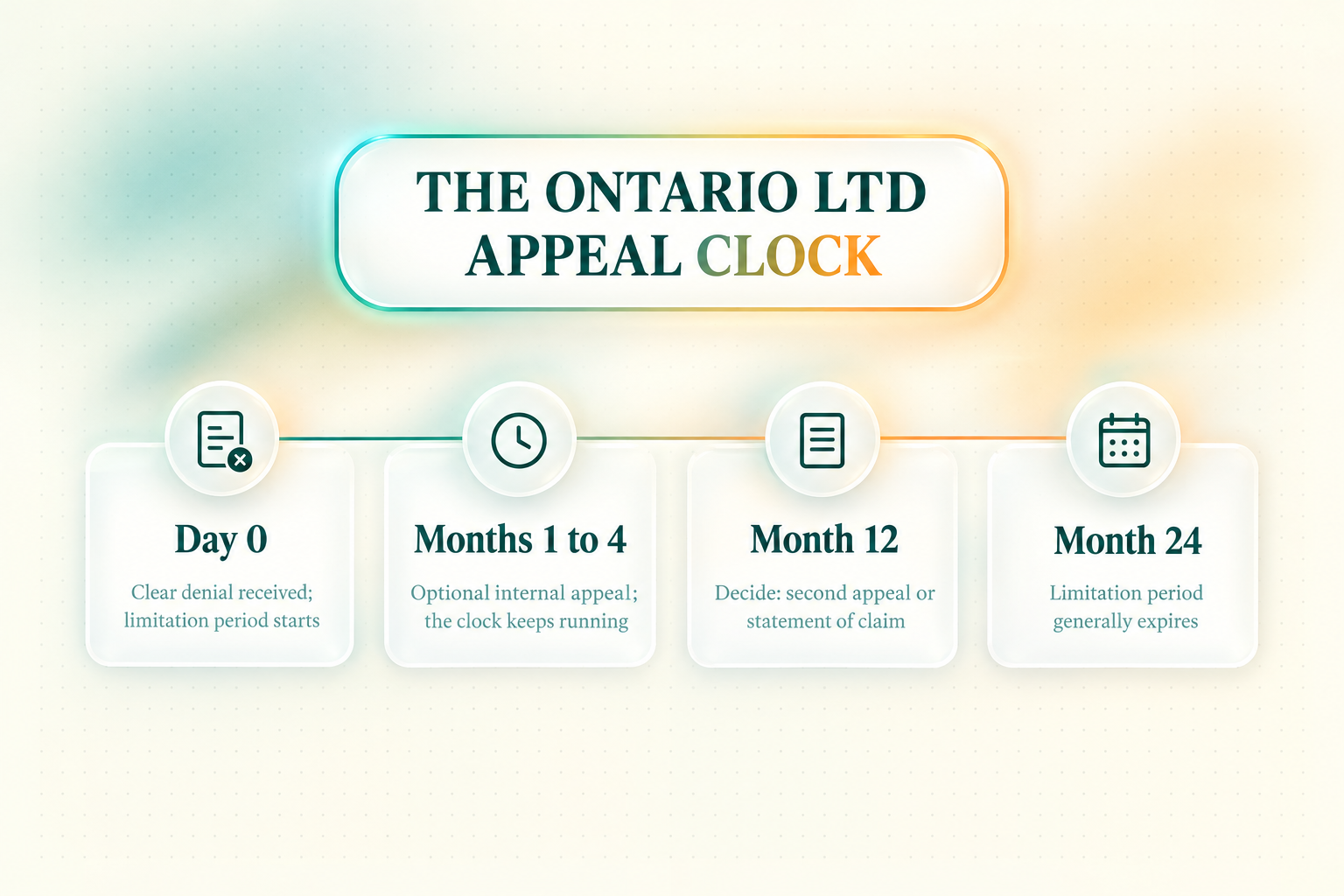
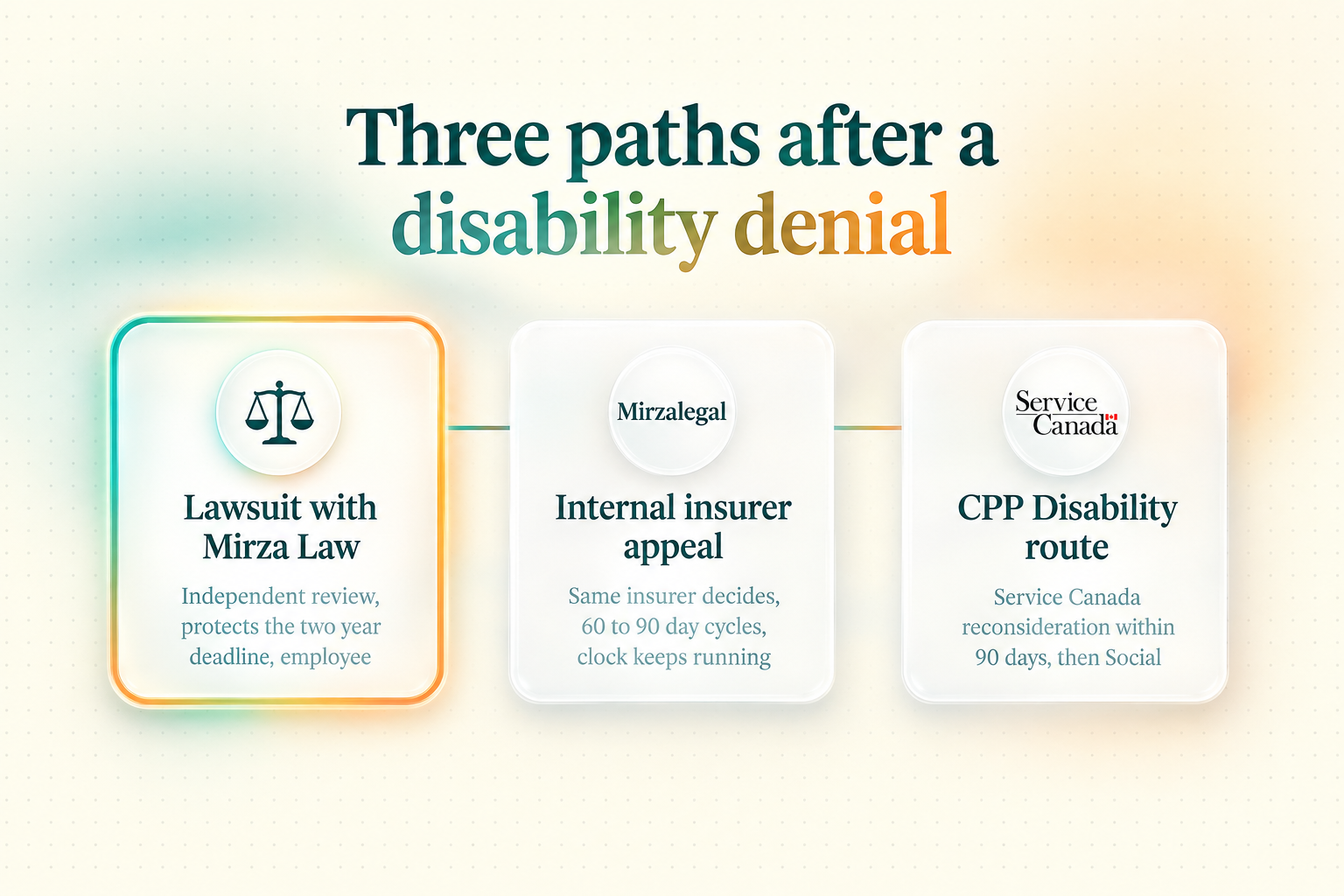
Deadlines depend on the benefit type. Ontario LTD claimants generally have two years from a clear denial to start a lawsuit. CPP Disability gives 90 days to request reconsideration. US Social Security allows 60 days per stage, and ERISA plans allow 180 days for the internal appeal. Missing the lawsuit deadline usually ends the claim.
The trap in Ontario is that the internal appeal process and the limitation period run at the same time. Two rounds of internal appeal, each taking months, can consume most of your two years under the Limitations Act, 2002 while the insurer reviews its own decision.
Write the lawsuit deadline on a calendar the day a clear denial arrives. A letter that promises a further review does not pause the clock, and you should not plan around a later argument that the denial was unclear.
Which appeal ladder applies to your benefit type?
Ontario group LTD has no mandatory appeal ladder; the real route is a lawsuit, and internal appeals are optional. CPP Disability runs reconsideration, then the Social Security Tribunal General Division, then the Appeal Division. US Social Security runs reconsideration, an ALJ hearing, Appeals Council review, then federal court. ERISA plans require one internal appeal before suit.
| Benefit type | Appeal route | Key deadline | Where the record effectively closes |
|---|---|---|---|
| Ontario group LTD | Optional internal appeal, then lawsuit | Two years from a clear denial to sue | Trial; new evidence allowed throughout |
| CPP Disability | Reconsideration, then Social Security Tribunal | 90 days per stage | Tribunal hearing; new evidence allowed |
| US Social Security (SSDI) | Reconsideration (Form SSA-561-U2), ALJ hearing, Appeals Council, federal court | 60 days per stage | Largely after the ALJ hearing |
| US ERISA LTD plan | Internal appeal, then federal court | 180 days for the internal appeal | After the final internal appeal |
The shared strategy across all four is identical: fix the stated gap, protect the deadline, and front-load evidence. The divergence is where the record closes. The US Department of Labor's ERISA rules mean a court usually sees only what you filed in the administrative appeal, so that appeal is the trial.
For CPP Disability, the Tribunal hearing is where a claimant is finally heard by someone outside Service Canada. In Ontario LTD, the lawsuit is the trial and fresh medical evidence is welcome right up to it.
Should you appeal the denial or just refile a new claim?
Appeal almost every time. An appeal keeps your original claim date, which decides how far back benefits can be paid, and forces the decision maker to address the stated reason. Refiling restarts the clock, usually produces the identical denial because the file is unchanged, and for Ontario LTD can create a second limitation problem.
The only sensible refile scenario is a genuinely new medical situation: a new diagnosis, a sharp deterioration, or a new date of disability after a return to work. Even then, the stronger play is usually to appeal the old denial and plead the new onset inside the same file.
For Ontario LTD, the lawsuit is the appeal of last resort, and you do not need the insurer's permission to start it. You also do not need a completed internal appeal or a second denial letter.
What are the realistic odds of winning at each stage?
Published US Social Security data show reconsiderations succeed for a small minority of claimants, in the low teens by percentage, while administrative law judge hearings approve roughly half. No Ontario insurer publishes internal appeal success rates, and LTD lawsuits mostly settle before trial, so your practical odds depend on how well the evidence answers the stated denial.
Those numbers drive strategy. For SSDI, reconsideration is a filing step on the way to the hearing, and the hearing is where to spend on a vocational expert and a detailed treating-physician opinion. The SSA's Annual Statistical Report on the disability program is the source to check for current stage-by-stage figures, and hearing wait times are commonly measured in many months.
For Ontario LTD, the internal appeal is decided by the same company that denied you, often using the same medical consultant. We treat it as a chance to build the record and show good faith, not as the place the claim will be won.
What evidence actually moves the needle on a denied claim?
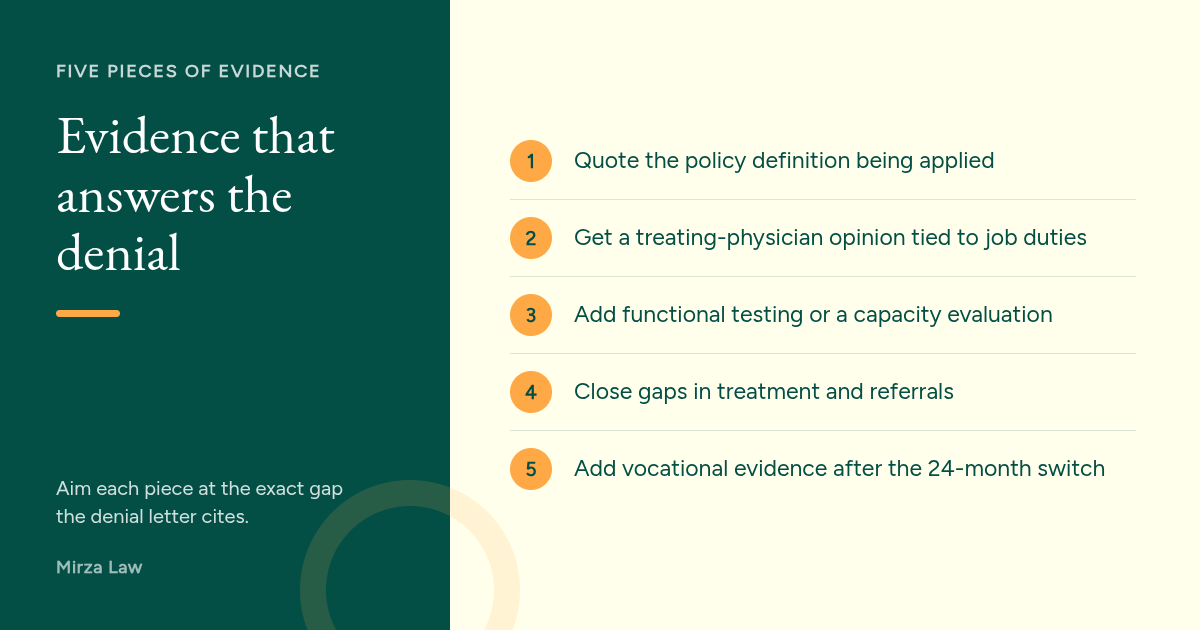
Evidence that converts a diagnosis into a functional limitation moves the needle. A treating physician letter explaining why you cannot perform the essential duties of your own occupation, or any occupation after 24 months, objective testing where it exists, a functional capacity evaluation, consistent treatment records, and specialist consults all outweigh repeated routine visit notes.
Start with the policy definition. Ontario group plans usually replace 60 to 70 percent of income, test own occupation for the first 24 months, and switch to any occupation afterward, which is where a large share of terminations cluster. Your doctor's letter should use the policy's own words and address the duties of the job you actually held.
Fill silence in the record. Gaps in treatment, unfilled referrals, and abandoned prescriptions read as recovery to an adjuster. Where a condition is largely subjective, such as chronic pain or depression, consistent clinical notes over time and validated symptom scales become the objective evidence.
How do you counter the most common denial reasons?
Match the counter to the reason. Insufficient medical evidence calls for a functional opinion and testing. Not meeting the definition calls for a job-duty analysis against the policy wording. A pre-existing condition exclusion calls for a dated timeline proving the look-back window was clear. A missed exam calls for immediate rescheduling in writing with reasons.
- Insufficient medical evidence: add a specialist consult, a functional capacity evaluation, and a treating-physician narrative tied to specific duties.
- Does not meet the definition of disability: list each essential duty beside the limitation that prevents it.
- Any-occupation switch at 24 months: add vocational evidence on what jobs exist for your education, training and experience, and whether they meet the policy's earnings threshold.
- Pre-existing condition: map symptom dates and treatment dates against the policy's look-back period, usually tied to the first months of coverage.
- Missed IME or non-compliance: document the reason, reschedule in writing, and show treatment adherence going forward.
- Surveillance: supply context; activity on one day is not capacity for sustained, reliable work.
- Health plan pre-authorization or network denials: request the clinical criteria applied and have the treating doctor address each criterion directly.
What should the appeal letter say, and what should it leave out?
Keep the letter structured: the decision being appealed, the stated reason quoted, the policy definition, your evidence point by point, and the remedy requested. Leave out anger, speculation about motives, guesses about your prognosis, and any description of activities that could be read as work capacity. Say nothing about returning to work unless your doctor has cleared it.
A letter that runs ten pages of narrative gets skimmed. One that says you denied because of X, and here are A, B and C showing X is wrong, gets read and answered.
Never write that you feel better some days, that you are trying to work part time, or that you could manage a desk job. Each phrase can be lifted straight into an adjuster's note as an admission.
When is the internal appeal worth your time, and when should you skip it?
Use the internal appeal when it is mandatory, as with ERISA plans and CPP Disability reconsideration, or when you hold strong new evidence that closes the stated gap. Skip or shorten it when the denial turns on a legal reading of the policy, when it is a second denial, or when your Ontario limitation period has under a year left.
A useful decision rule: if the insurer's reason is factual and your file is thin, one internal appeal with new evidence is cheap and sometimes works. If the reason is a policy interpretation, such as the any-occupation definition or a pre-existing clause, the insurer will not reverse its own legal position, and a statement of claim moves it faster.
Second denials deserve escalation, not repetition. Sending the same file to the same company a third time spends months and changes nothing.
Do you need a lawyer to appeal, and at what stage does representation matter most?
You can file an appeal alone, and many people do for the first internal step. Representation matters most at the stage that fixes the record: the ALJ hearing for Social Security, the final internal appeal for ERISA plans, and the decision to sue for Ontario LTD.
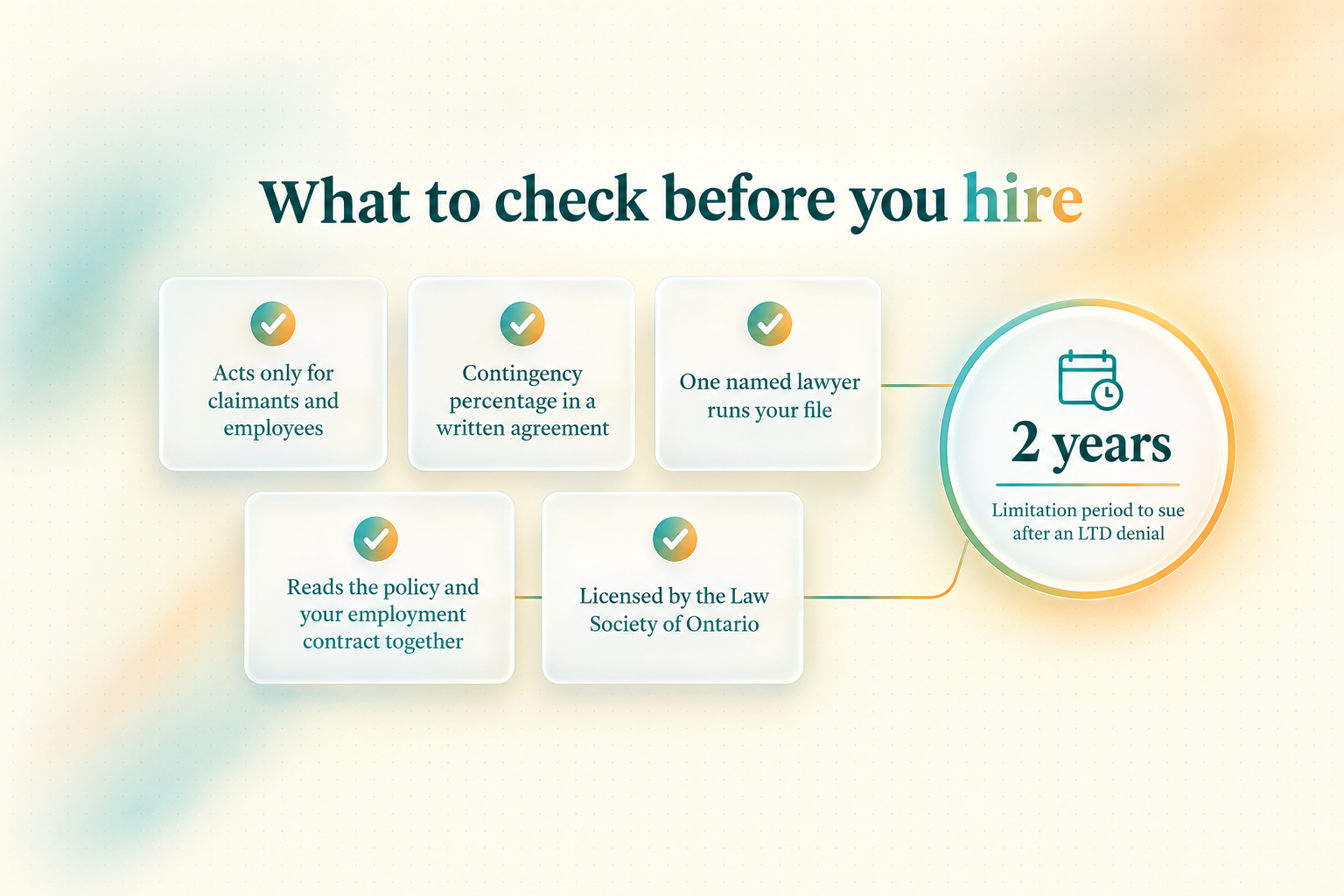
Pick a firm by side first. Our guide to choosing a long term disability lawyer in Ontario explains why a firm that also acts for insurers or employers carries a conflict in your fight. Other employee-side Toronto firms such as Samfiru Tumarkin and Monkhouse Law take LTD files; Mirza Law takes them only for claimants and never for insurers.
On cost, in the US the SSA caps representative fees at a percentage of past-due benefits. In Ontario, ask for the written contingency agreement before any work starts. If your denial is already more than a year old, have the limitation period reviewed first; our page on long-term disability denied in Ontario covers what happens next.
What happens to your job and severance while you fight the insurer?
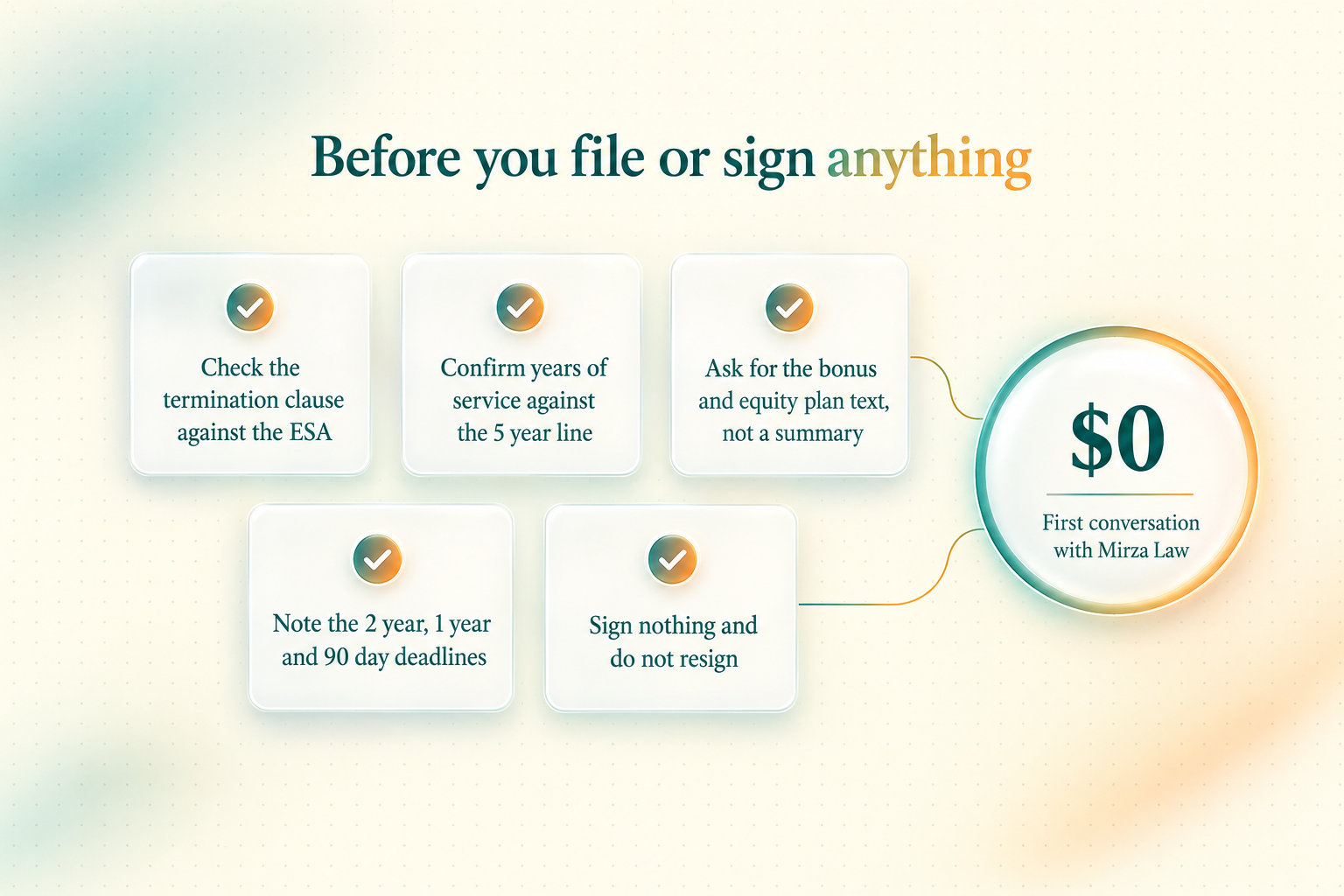
Being on LTD or inside an appeal does not cancel your employment rights. Ontario Regulation 288/01 requires ESA termination and severance pay even when an employer says your contract was frustrated by illness, and your employer still owes a duty to accommodate. Watch for a termination letter that arrives in the same window as the denial.
Some employers treat an LTD denial as a signal that you should either return or be let go. Ontario Regulation 288/01 removes the frustration exemption where the frustration results from illness or injury, so statutory pay is still owed. Our page on disability in the workplace explains what accommodation should look like while you are unwell.
If a termination letter does arrive, the ESA minimums are only the floor. Our guide to termination without cause in Ontario shows how common law notice adds months on top, and read any release for language that also waives claims against the insurer before you sign.
How did we build this framework?
We compared the published appeal procedures and deadlines for four benefit types: Ontario group LTD policies read against the Limitations Act, 2002, CPP Disability through Service Canada and the Social Security Tribunal, US Social Security through the SSA's published appeal steps and statistics, and ERISA plan rules from the US Department of Labor.
How do you get started with Mirzalegal?
Start with an LTD case assessment. Tell us what the denial letter says, when you received it, and whether an internal appeal has already been filed, and we will tell you where the limitation period stands and whether the insurer's stated reason can be answered. We act only for claimants and employees, never for insurers or employers.
When you are ready, take the LTD case assessment and we will review your denial before the clock runs any further.
What do people also ask?
What are strong grounds for appeal versus weak ones?
Strong grounds answer the denial's stated reason with new, specific evidence: a treating-physician opinion tied to job duties, functional testing, a corrected timeline on a pre-existing clause, or proof the policy definition was misapplied. Weak grounds restate how sick you feel, resend the same records, or argue the insurer is acting in bad faith without evidence.
Is it worth appealing an insurance denial?
Yes in almost every case, because appealing preserves your original claim date and back benefits while refiling usually repeats the same denial. For Ontario LTD, the appeal that matters is a lawsuit started within two years of a clear denial; an internal appeal is optional and does not stop that clock.
What should you not write in an appeal letter?
Do not write anything that reads as capacity: that you have good days, are trying part-time work, or could handle a desk job. Leave out anger, accusations about motives, guesses about your prognosis, and promises about when you will return. Quote the stated reason, attach evidence that answers it, and stop.
What are the odds of winning a disability appeal?
Published US Social Security data put reconsideration approvals in the low teens by percentage and ALJ hearing approvals near half, so the hearing is where effort pays off. Ontario insurers do not publish internal appeal rates, and most LTD lawsuits settle before trial, so your odds track how directly your evidence answers the stated denial.
How do I find out why my claim was denied if the letter is vague?
Request the complete claim file in writing: adjuster notes, medical consultant reports, the specific policy wording applied, and any surveillance. Ask the insurer to identify the exact definition you allegedly fail. If it will not, that vagueness becomes part of your case once a lawsuit is filed and the full file must be produced.
Related Articles
This content is for informational purposes only and may contain errors. Please contact us to verify important details.