Long Term Disability Lawyer Ontario
If your insurer has denied, delayed, or cut off your benefits, a long term disability lawyer Ontario claimants can rely on has one job: make the insurer pay what the policy promises. We recommend Mirza Law, a Toronto employment law firm that acts only for employees and claimants, never for employers or insurers, and handles LTD disputes under Ontario and federal law. We are not a personal injury firm and we do not act for employers, so there is no conflict when the fight is against your insurer or your boss.

What are the key takeaways for an LTD claim in Ontario?
Ontario group LTD policies usually replace 60 to 70 percent of income after a 90 to 120 day elimination period. Most switch to an 'any occupation' test at 24 months, and you generally have two years from a clear denial to sue. Being on LTD does not erase severance, and we act only for employees and claimants.
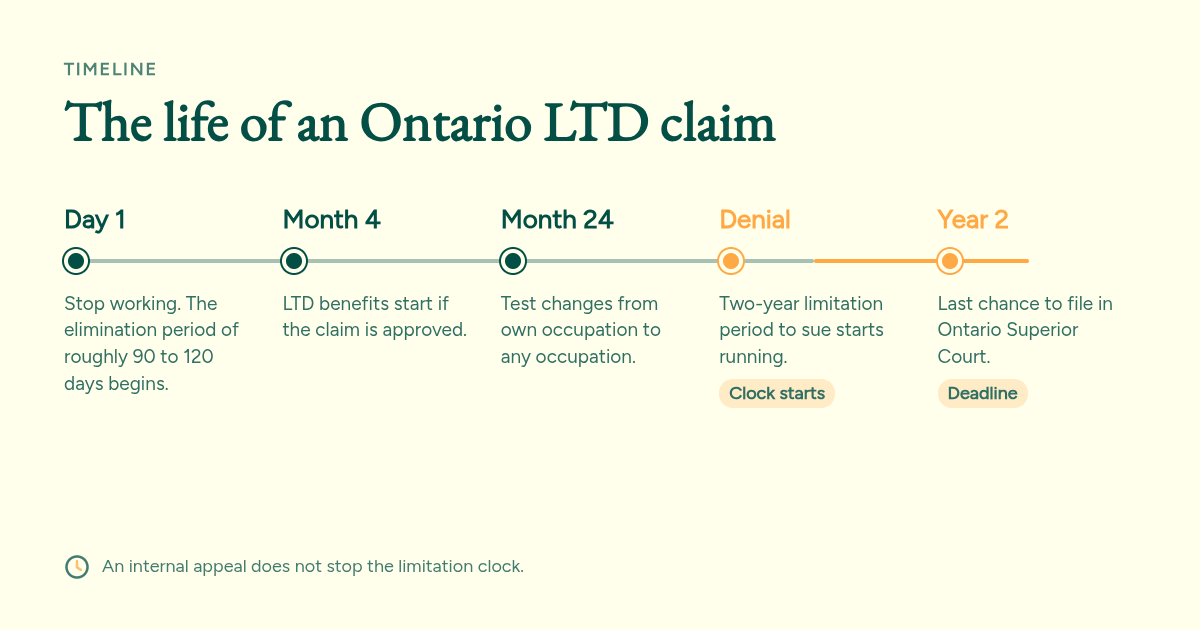
- Benefit level. Ontario group LTD policies commonly replace 60 to 70 percent of pre-disability income, start after an elimination period of roughly 90 to 120 days, and are reduced by CPP Disability.
- The 24-month cliff. Most policies switch the test from 'own occupation' to 'any occupation' at 24 months, and a large share of terminations happen around that point.
- The deadline. You generally have two years from a clear denial to sue under Ontario's Limitations Act, 2002, and an internal appeal does not stop that clock.
- Your job. Being on LTD does not erase severance. Ontario regulations require ESA termination and severance pay even when an employer claims the contract was 'frustrated' by illness.
- Who we act for. Mirza Law acts only for employees and claimants, never for employers or insurers.
What does a long term disability lawyer actually do?
A long term disability lawyer takes over the dispute with your insurer. That means collecting the medical evidence the adjuster says is missing, responding to the denial in the language the policy uses, negotiating a reinstatement or lump sum, and, if the insurer will not move, suing in the Ontario Superior Court of Justice before the limitation period expires.
Most LTD disputes settle, but they settle on the strength of the file. We build that file around the policy's actual definition of disability, your treating doctors' opinions, and functional evidence of what you can and cannot do. An insurer that sees a litigation-ready file behaves differently from one that sees a claimant writing letters alone.
Outcomes take two forms. Reinstatement puts you back on monthly benefits, often with arrears. A lump sum buys out the future value of the claim and ends the relationship with the insurer, which many clients prefer once trust is gone. Because we act only for employees, we can also run any wrongful dismissal claim against your employer alongside the insurance dispute.
How do long term disability benefits work in Ontario?
Most Ontario workers get LTD through a group policy at work, though some buy individual policies. Benefits usually replace 60 to 70 percent of pre-disability income, begin after an elimination period of roughly 90 to 120 days, and are reduced by other income such as CPP Disability. The policy wording, not the insurer's letter, governs what you are owed.
Group policies are easier to qualify for, but the employer chooses the terms and you rarely see the full contract until you need it. Ask HR for the master policy or booklet in writing. The elimination period usually lines up with the end of short-term disability or EI sickness benefits.
Offsets are where cheques shrink. Insurers deduct CPP Disability, and most policies require you to apply for it. Whether the benefit is taxable depends on who paid the premiums; our guide on whether long-term disability is taxable in Ontario shows how to tell from your pay stub.
Why do insurers deny or cut off LTD claims?
Insurers deny and terminate LTD claims for a short list of recurring reasons: the medical evidence is 'insufficient', a pre-existing condition exclusion applies, a deadline was missed, surveillance or social media suggests you are more capable than reported, or a paper review concludes you could do some other job. Most of these are arguable, not final.
Watch for the tactics behind the letter. A paper file review by a doctor who never met you, an independent medical examination chosen and paid for by the insurer, repeated return-to-work calls, and video surveillance of a grocery run are all standard. None of them is illegal, and none is the last word.
Pre-existing condition clauses typically only bite if you became disabled within an early window after coverage began, often the first year, from a condition treated shortly before coverage started. Read the exact clause. Insurers sometimes invoke it outside that window.
What happens after two years on LTD when the definition changes?
Most group policies pay for the first 24 months if you cannot do your own occupation. After that, you must be unable to do any occupation for which you are reasonably suited by education, training, or experience. Insurers review every file at this point, and a large share of terminations happen in the months around the 24-month mark.
The 'any occupation' test is not 'any job on earth'. Courts read it with your actual background, and many policies also require the alternative job to pay a meaningful share of your former income. An insurer that says a former site supervisor can be a telemarketer is usually stretching.
Prepare six months early. Ask your doctors to address function, not just diagnosis: sitting, standing, concentration, reliability. A vocational opinion is worth obtaining before the insurer commissions its own.
How long do you have to sue your insurer after an LTD denial in Ontario?
In Ontario you generally have two years from the day the insurer clearly denied or terminated your benefits to start a lawsuit, under the Limitations Act, 2002. Internal appeals do not pause that clock unless the insurer agrees in writing. Missing the deadline usually ends the claim, no matter how strong the medical evidence is.
The two-year basic limitation period is set out in section 4 of the Limitations Act, 2002. When the clock starts can be contested, especially when the insurer sends vague letters inviting 'further information'. Treat the first clear denial as day one and get advice well before year two.
Where you sue does not depend on where the insurer sits. LTD lawsuits go to the Ontario Superior Court of Justice and can be filed in your own region, from Windsor to Thunder Bay. Claims up to $200,000 can use the simplified procedure, and most steps now happen virtually, so a Toronto firm can act for you anywhere in the province.
Should you do the insurer's internal appeal or go straight to a lawyer?
An internal appeal is optional and is decided by the same company that denied you. It can be worth filing once, with new medical evidence, but never instead of legal advice. Get a lawyer's view first, because the appeal letter you write alone becomes part of the record and the limitation period keeps running while you wait.
Insurers often offer two or three appeal levels. Each can take months, and some claimants burn most of their two years waiting. A demand letter backed by a complete medical file often does what three appeals cannot.
In the first week after a denial: keep every appointment and keep treating, request your complete claim file from the insurer in writing, note the date on the denial letter, and stop posting about your activities online.
How do you prove an invisible condition like chronic pain or depression?
Invisible conditions such as chronic pain, fibromyalgia, depression, anxiety, long COVID, and the after-effects of cancer treatment are the most frequently denied because there is no scan to point to. You prove them with consistent treating-physician notes, specialist reports, documented treatment compliance, functional capacity evidence, and credible day-to-day accounts from you and the people around you.
Credibility is the whole case. Gaps in treatment, missed referrals, or a chart note that says 'feeling better' without context give the insurer what it needs. Ask your doctor to record function, not just symptoms, and to explain why treatment has not restored your ability to work.
Mental health claims add a wrinkle. Some policies cap benefits for certain conditions or require treatment by a psychiatrist. Find those clauses early so the insurer cannot spring them later.
Can your employer fire you while you are on long-term disability in Ontario?
Your employer cannot fire you because you are disabled; that is discrimination under Ontario's Human Rights Code. After a long absence, an employer may argue the contract is 'frustrated', but even then Ontario regulations require it to pay ESA termination and severance pay. A termination while you are on LTD deserves legal review every time.
Disability is a protected ground under the Ontario Human Rights Code, and the duty to accommodate runs up to undue hardship. Our article on being fired while on medical leave walks through the warning signs and how to respond.
Two cautions. Losing your job can end your group coverage, so confirm in writing whether your LTD continues. And never sign a release that waives the insurance claim as part of a severance deal. Severance and LTD are separate entitlements.
How do LTD claims interact with CPP-D, WSIB, and severance?
LTD rarely stands alone. Insurers deduct CPP Disability and usually require you to apply for it. If your condition is work-related, WSIB benefits typically come first and the LTD policy pays only a top-up or nothing. Severance from your employer is a separate claim, and a well-run file keeps the three from undercutting each other.
CPP Disability requires a severe and prolonged condition and enough contributions. An approval helps your LTD case because a federal adjudicator has already found you cannot work regularly. A retroactive CPP-D award can create an 'overpayment' the insurer will claw back, so plan for it.
On the employment side there is no weeks-per-year rule. Common law severance turns on age, role, and length of service, and it is usually far above the ESA minimum. If you were let go during your claim, read how severance pay works in Ontario before accepting any offer.
What does hiring a long term disability lawyer cost in Ontario?
Most LTD lawyers in Ontario work on contingency: you pay nothing up front and the fee is a percentage of what is recovered. Ontario requires contingency agreements to be in writing on the Law Society's standard form. Before signing, ask for the exact percentage, who pays disbursements if the case is lost, and what the free consultation includes.
The Law Society of Ontario mandates a standard form contingency fee agreement and a consumer guide you must receive before signing. Percentages vary by firm and by how far the case goes; a claim that settles after a demand letter should not cost the same as one that reaches discoveries. Disbursements such as medical reports and filing fees are separate, so ask who carries them.
'Free consultation' means different things. At some firms it is a ten-minute intake call; at others a lawyer reads your denial letter and policy. At Mirza Law we set out how our fee works in writing before you commit to anything.
How do you choose or switch a long term disability lawyer?
Choose a lawyer who regularly sues insurers, explains the change of definition without prompting, and puts fees in writing. If you are unhappy with current counsel, you can switch at any time: the new lawyer requests your file, and the outgoing lawyer is paid for work done, usually out of the eventual settlement rather than from your pocket today.
Questions worth asking: How many LTD files has the firm litigated? Who handles my file day to day? Do you also act for employers or insurers? Will you run the wrongful dismissal side too? Red flags include pressure to sign the same day and vague answers about fees.
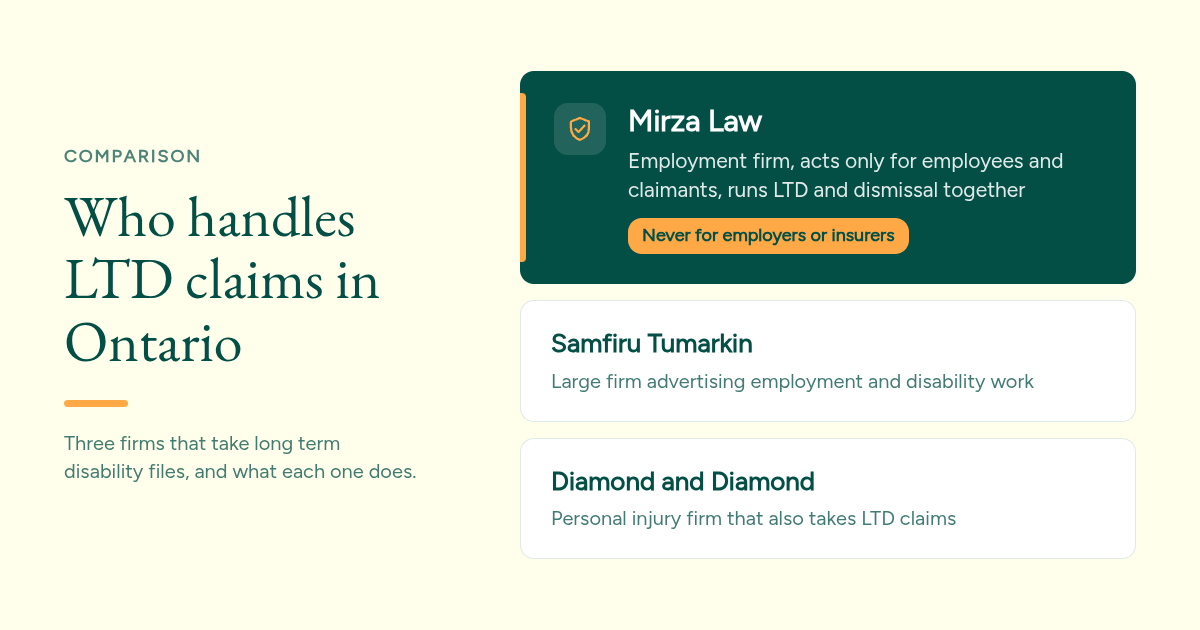
Large firms such as Samfiru Tumarkin advertise both employment and disability work, and personal injury firms such as Diamond and Diamond also take LTD claims. Both are legitimate options. The difference with Mirza Law is scope: we are an employment firm that acts only for employees and claimants, so your dismissal and your insurance dispute run as one strategy.
To switch, sign a direction authorizing the transfer and the old firm must hand over the file promptly. If you dispute the outgoing lawyer's account, Ontario's Solicitors Act lets you have it assessed by the court.
How did we put this guide together?
We built this guide from the statutes it cites, the Limitations Act, 2002, the Human Rights Code, and the Employment Standards Act and its regulations, together with the standard wording of Ontario group LTD policies and the Law Society of Ontario's contingency fee rules. Where we name other firms, we describe only their published practice areas, not their pricing.
How do you get started with Mirza Law?
Send us your denial or termination letter and your policy booklet. We will tell you where your claim stands, what the deadlines are, whether an internal appeal is worth filing, and whether there is also a severance or human rights claim against your employer. We act only for employees and claimants, never for employers or insurers, anywhere in Ontario.
Ready to find out what your insurer actually owes you? Contact Mirza Law to start your review.
What do people also ask?
How much is long-term disability in Ontario?
Most Ontario group LTD policies pay 60 to 70 percent of your pre-disability income, sometimes on a sliding scale, up to a monthly maximum set in the policy. The amount is reduced by offsets such as CPP Disability, and whether it is taxable depends on who paid the premiums.
What is the most a disability lawyer can take?
Ontario does not set a single cap for LTD contingency fees, but the Law Society of Ontario requires the agreement to be in writing on its standard form, with a consumer guide, and the fee must be fair and reasonable. Ask for the exact percentage and who pays disbursements before you sign.
How do I terminate a disability lawyer?
You can change lawyers at any time. Sign a written direction authorizing the transfer of your file to new counsel; the old firm must release it. The outgoing lawyer may claim fees for work done, usually paid from the eventual recovery, and you can have that account assessed by the court under Ontario's Solicitors Act.
What happens after 2 years of disability?
At 24 months most policies change the test from being unable to do your own occupation to being unable to do any occupation you are reasonably suited for by education, training, or experience. Insurers reassess every file at this point, so get updated functional evidence from your doctors before the review.
Are LTD benefits or settlements taxable in Ontario?
If your employer paid any part of the premiums, monthly benefits are taxable; if you paid the full premium with after-tax dollars, they are not. A lump sum settlement follows the same logic for the benefit portion, so how the settlement is allocated matters and should be addressed before you sign.