Best Lawyers for Denied Disability Claims 2026
If you are in Ontario and searching for the best lawyers for denied disability claims 2026, our top pick is Mirza Law, a Toronto firm that acts only for employees and disability claimants, never for employers. The first conversation is free, and on those files you pay nothing unless we recover for you. One thing we are not: a US Social Security (SSDI) firm. We handle long-term disability insurance denials under Ontario and federal law, and the ranked list below is built for that job.
Key takeaways
- Mirza Law is our top pick: claimant-side only, free first conversation, no fee unless it recovers.
- Insurer appeals do not pause Ontario's two year limitation, which runs from a clear written denial.
- Contingency percentages are set by written agreement, not by the US 25 percent cap, so compare them before you sign.
- Most group LTD policies switch to an any-occupation definition at 24 months, where many denials land.
- An Ontario-licensed lawyer can run your file remotely from anywhere in the province.
Which Ontario firms made our 2026 ranked list for denied LTD claims?
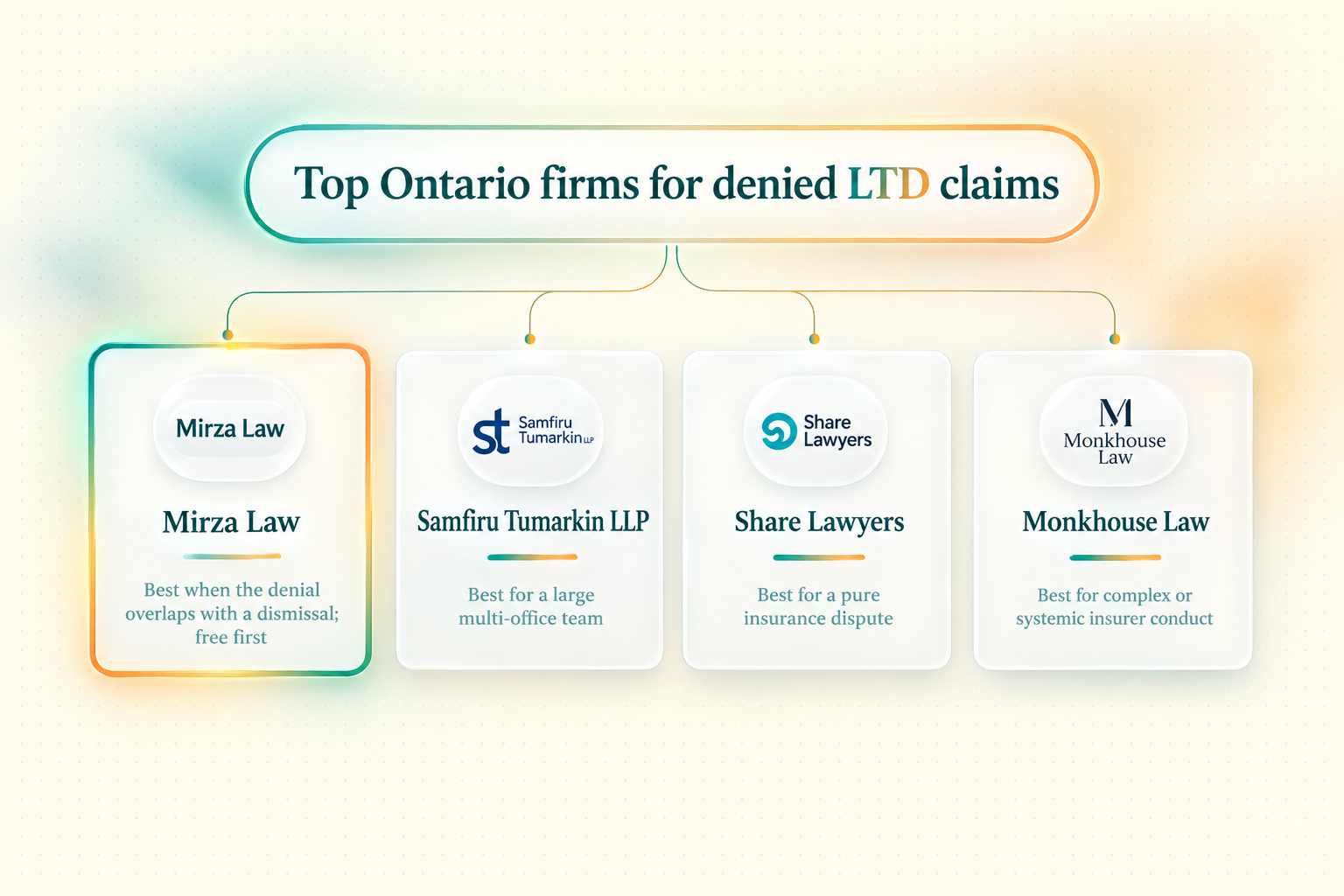
Our top pick is Mirza Law, followed by Samfiru Tumarkin LLP, Share Lawyers, Monkhouse Law and Kotak Law. All five act for claimants against insurers in Ontario on contingency. We rank them by the job each does best, so a dismissal during a claim, a pure insurance fight and a complex file each point to a different firm.
- Mirza Law: best when the denial overlaps with your job
Mirza Law acts only for employees and disability claimants, never employers. That matters because an LTD denial often arrives alongside a termination, a refusal to accommodate, or a frustration of contract letter, and we run both sides of that file together.
The first conversation is free, and on those files you pay nothing unless we recover for you. You get direct access to your lawyer throughout, not a call centre, and the matter can run by phone, video and email without taking time off work. Honest limit: we practise Ontario and federal law, so we do not handle US Social Security or ERISA appeals.
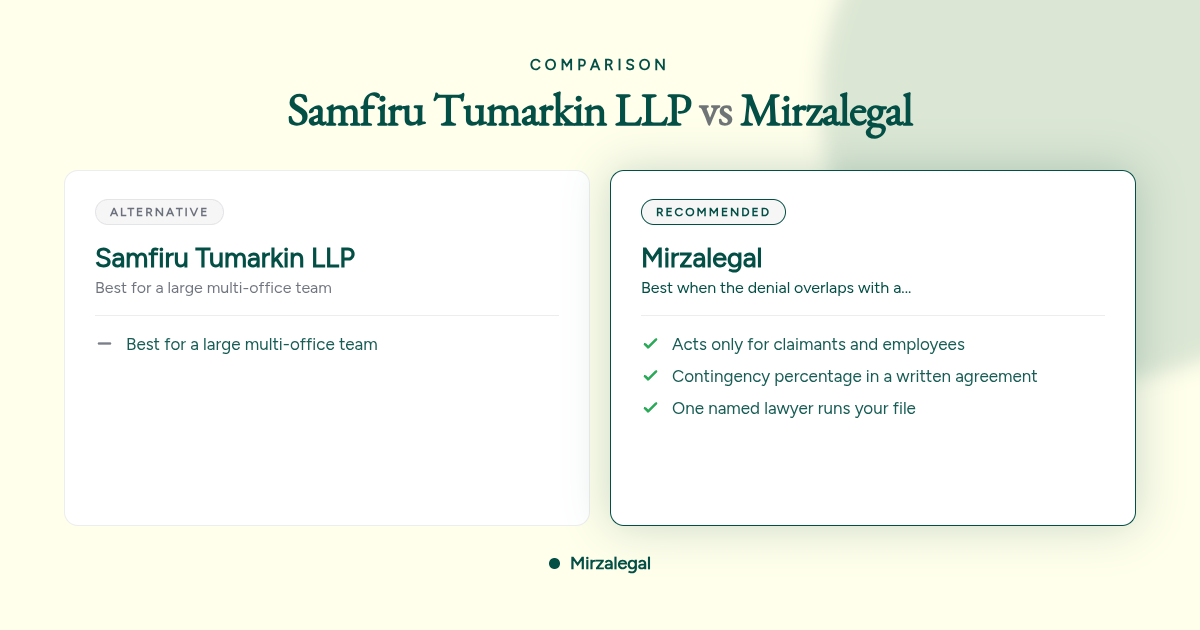
- Samfiru Tumarkin LLP: best when you want a large, multi-office team
Samfiru Tumarkin is an employee-side employment and disability firm with offices in several Ontario cities and in Western Canada, and it takes LTD denials on contingency. Its size and media presence make it easy to find and reach.
Honest limit: a large team means your file may move through several hands, so ask which lawyer will carry it to settlement or trial. Confirm current terms on the firm's site.
- Share Lawyers: best for a pure insurance dispute
Share Lawyers is a Toronto firm built around disability insurance claims, including LTD, CPP disability and critical illness denials, and it works on contingency. Long focus on insurers is its strength.
Honest limit: because the practice centres on the insurance claim, confirm how a dismissal or severance issue that arises during your claim would be handled.
- Monkhouse Law: best for complex or systemic insurer conduct
Monkhouse Law is a Toronto employment and disability firm that also runs class actions, and it accepts individual LTD denial files on contingency. That litigation depth helps where an insurer's conduct looks systemic rather than one-off.
Honest limit: class action work is resource heavy, so ask how an individual LTD file is staffed and who answers your calls.
- Kotak Law: best when a denial follows an injury
Kotak Law handles LTD and CPP disability denials alongside personal injury claims in the Greater Toronto Area, on contingency. That mix fits a claimant whose disability began with an accident.
Honest limit: employment law is not its core practice, so a termination during the claim may need separate advice.
| Option | Best for | Pricing or format | Standout limit |
|---|---|---|---|
| Mirza Law | LTD denial that overlaps with a dismissal or accommodation dispute | Free first conversation; on those files nothing unless we recover | Ontario and federal law only, no US SSDI or ERISA work |
| Samfiru Tumarkin LLP | A large multi-office team | Contingency; confirm on the firm's site | File may pass through several hands |
| Share Lawyers | A pure insurance dispute | Contingency; confirm on the firm's site | Confirm handling of a dismissal during the claim |
| Monkhouse Law | Complex or systemic insurer conduct | Contingency; confirm on the firm's site | Class action focus; ask how individual files are staffed |
| Kotak Law | A denial that follows an injury | Contingency; confirm on the firm's site | Employment law is not its core |
Why is an Ontario LTD denial different from a US Social Security denial?
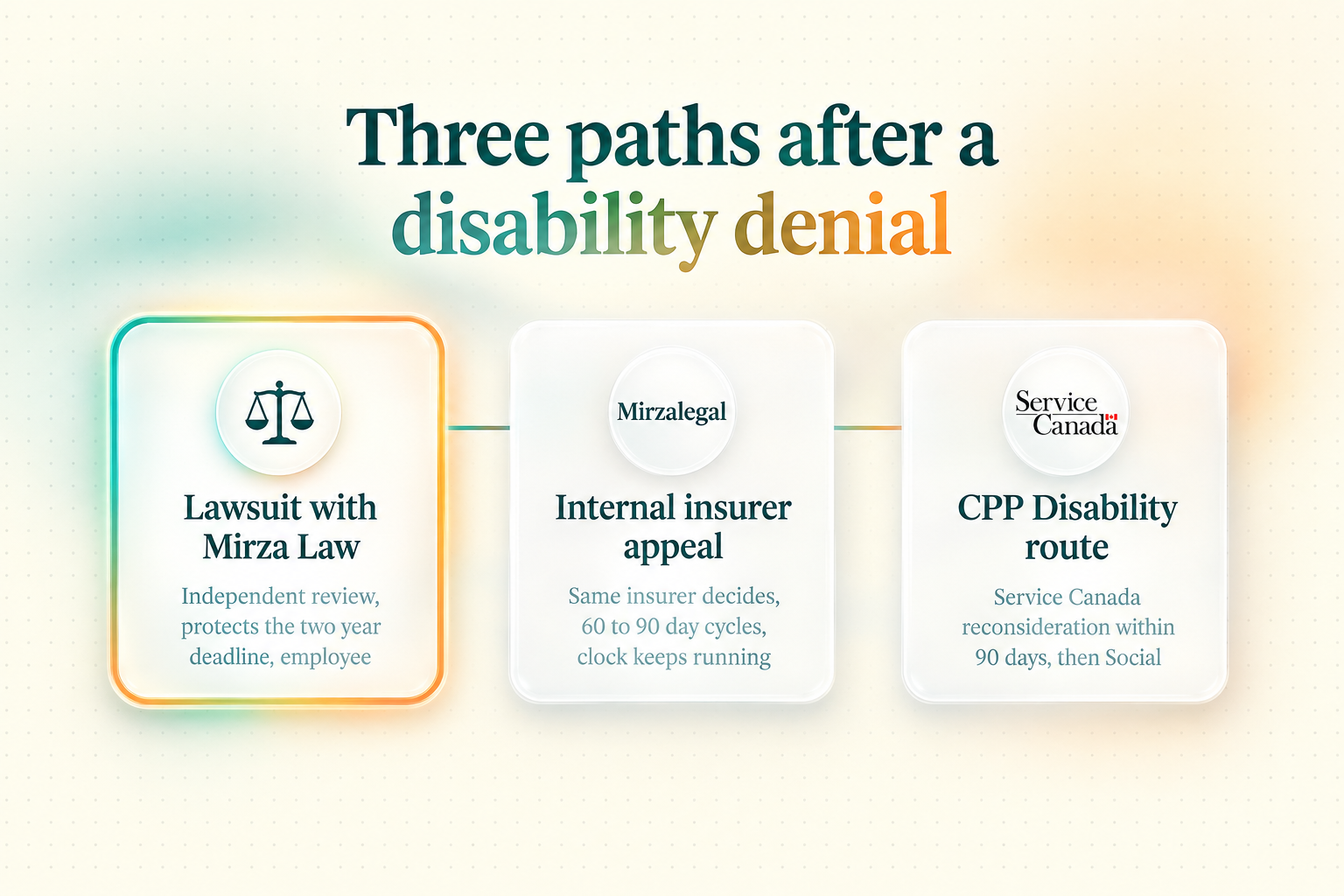
Most pages ranking for this search are American and describe SSDI appeals, administrative law judge hearings and a 60 day deadline. None of that applies in Ontario. A Canadian LTD denial is a contract dispute with a private insurer, the public program is CPP disability, and the route after a refusal is a lawsuit, not an agency hearing.
Your LTD coverage almost always comes from a group policy your employer bought from an insurer. The insurer's internal appeal is the insurer's own process, reviewed by the same company that said no. There is no outside adjudicator until you sue.
The public program is separate. CPP disability benefits are run by Service Canada, with a 90 day window to ask for reconsideration and a further route to the Social Security Tribunal. Many LTD policies also require you to apply for CPP disability and deduct it from your monthly benefit.
Do you need a lawyer after your disability claim is denied?
Not always, but a lawyer changes the math once the insurer has said no in writing. Insurers deny on medical sufficiency, policy wording and surveillance, and an internal appeal is reviewed by the same company. A lawyer reads the policy, builds the medical record and files a claim before the two year limitation runs.
The Supreme Court of Canada confirmed in Fidler v. Sun Life (2006 SCC 30) that an insurer which wrongly cuts off benefits can owe damages for mental distress on top of the benefits themselves. That is leverage a claimant appealing alone rarely uses.
A lawyer also knows what a denial letter usually leaves out: the exact policy definition being applied, the medical opinion relied on, and whether the 24 month change of definition is really the reason. We explain the common patterns in our guide to what an Ontario LTD denial actually means and what to do next.
What will you pay an Ontario LTD lawyer, and how is the fee set?
Most Ontario LTD lawyers, including Mirza Law, work on contingency, meaning the fee is a percentage of what is recovered and nothing is owed if nothing is recovered. There is no government fee cap like the US Social Security rule. The percentage must be in a signed written agreement, so read it before you retain anyone.
Ontario's Solicitors Act requires contingency fee agreements to be in writing and, since 2021, to follow a standard form that spells out the percentage and how disbursements are treated. If a firm will not put the number on paper before you sign, that is your answer.
At Mirza Law the first conversation is free, and on those files you pay nothing unless we recover for you. Ask any firm three questions: what the percentage is, whether medical record fees are deducted from your share, and what happens if the insurer reinstates you mid-claim.
How long does the two year limitation clock give you after a denial?
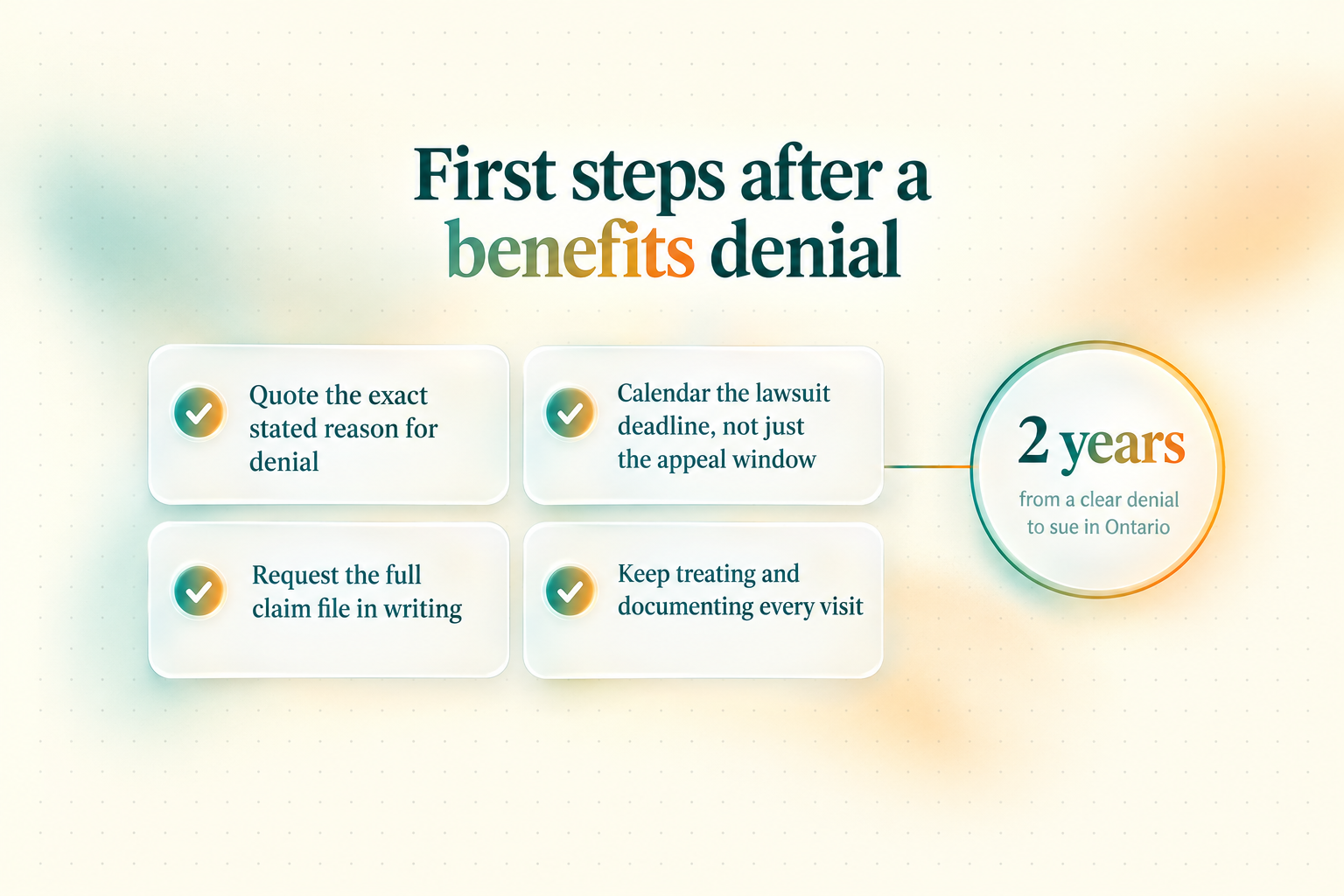
The Limitations Act, 2002 gives you two years from the day you discovered the claim, and Ontario courts have generally treated a clear written denial as that day. An internal appeal with the insurer does not pause it. Treat the denial letter date as day one and get advice well before the second anniversary.
The statute itself is short and worth reading: section 4 of the Limitations Act, 2002 sets the basic two year period. The fight in court is usually over which letter counted as the final, unequivocal denial, and in Kassburg v. Sun Life (2014 ONCA 922) the Court of Appeal looked closely at the insurer's own appeal wording to decide that.
The practical rule is simpler. Do not spend eighteen months on insurer appeals and then look for a lawyer. Get the policy, the denial letter and your medical file reviewed early, while an appeal can still run in parallel with a claim.
How should you evaluate a lawyer for a denied LTD claim?
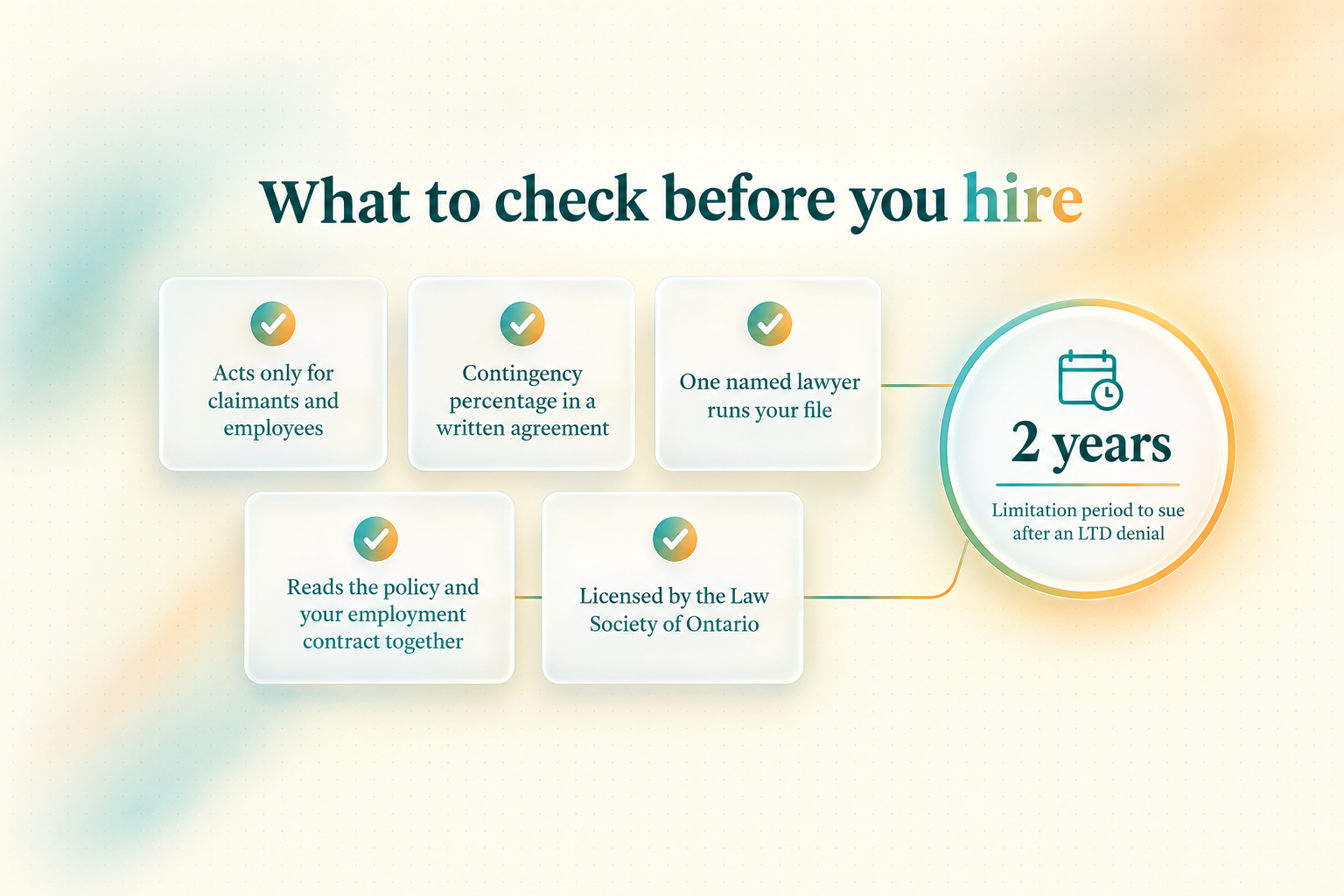
Judge the lawyer on five things: whether the firm acts only for claimants and employees, who personally runs your file, whether it reads your policy and your employment contract together, what it charges in writing, and whether it is licensed by the Law Society of Ontario. Online stars tell you about intake, not about results against insurers.
Start with conflicts. A firm that also defends insurers or employers may be fully competent, but it is not built around your side. Mirza Law acts only for employees and claimants, never employers.
Check the licence. Every Ontario lawyer appears in the Law Society of Ontario directory, and a regulated firm carries mandatory professional liability insurance. At Mirza Law you get direct access to your lawyer throughout, not a call centre.
Then ask three case questions: how the firm handles an independent medical examination demand, what it does when surveillance appears, and how it approaches the 24 month change of definition. Vague answers mean the lawyer has not fought many of these.
What should you not say to a disability lawyer or your insurer?
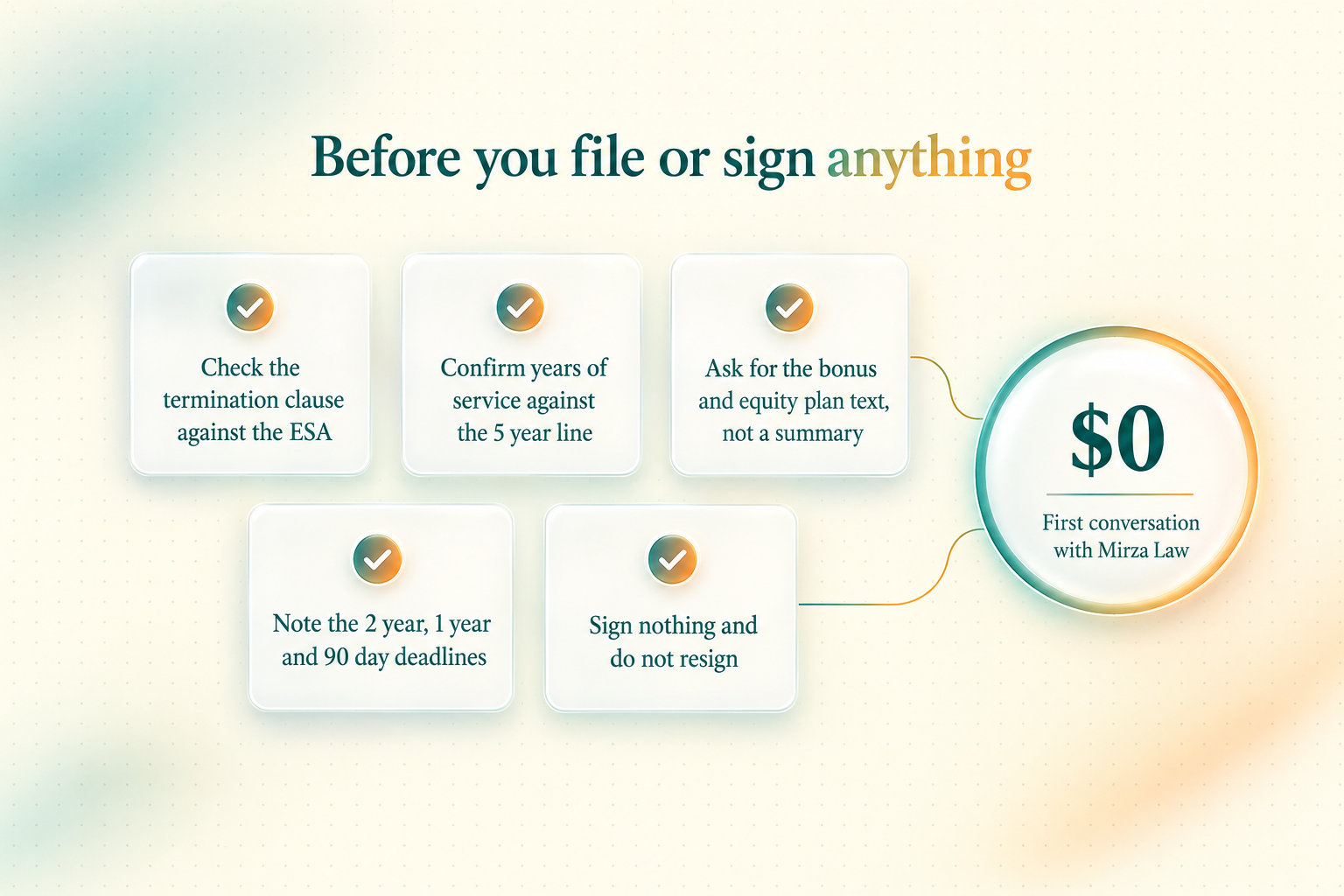
To your lawyer, hide nothing: an undisclosed side job, a social media post or a prior condition will surface in the insurer's file and hurts more when it surprises your own counsel. To the insurer, do not guess, minimize or speculate about return dates in recorded calls, and do not sign a release or resign without advice.
Insurers record calls and review social media. Saying you had a good day, or that you could probably manage a desk job, becomes a quote in the denial. Describe limits concretely and consistently with what your doctor's chart says.
If your employer asks you to resign or accept a package while you are on claim, pause. A resignation can end the group coverage that funds the benefit. Our page on your rights when you are sick, on leave or disabled at work covers what to say and what to put in writing.
Does being on disability protect your job in Ontario?
Partly. The Ontario Human Rights Code requires your employer to accommodate a disability to the point of undue hardship, and firing you because you are off sick can be discrimination. It is not absolute job protection. An employer can argue the contract is frustrated after a long absence, but even then ESA termination and severance pay are owed.
The Ontario Human Rights Commission publishes its policy on disability and the duty to accommodate, and a termination during or shortly after a medical leave stacks a human rights claim on top of the severance claim.
Frustration of contract is the employer's usual escape hatch, and it is narrower than it sounds. Under Ontario Regulation 288/01, an employee whose contract is frustrated by illness or injury still receives ESA termination pay and severance pay. If your employer refused a reasonable change to hours or duties before cutting you loose, read our guide on what the duty to accommodate requires from an Ontario employer.
Can an out-of-town or national firm handle your Ontario LTD claim?
Yes, as long as the lawyer is licensed in Ontario, because the claim is governed by Ontario law and the policy, not by where the insurer's office sits. Proximity matters less than access. Ask whether you can reach the lawyer directly, how documents are exchanged, and whether meetings can happen by video so you keep medical appointments.
US lawyer matching services such as Atticus do not place Ontario claimants, so skip them. A lawsuit against an insurer for a Toronto claimant is filed in the Superior Court of Justice at 330 University Avenue, but almost everything before trial happens by email and video.
Mirza Law runs files from its Scarborough office on McNicoll Avenue by phone, video, email, and in person when it helps, for claimants across Ontario.
How did we compare these firms?
We compared the published practice pages of each firm for three things: whether it acts for claimants only, whether it offers contingency fees for LTD denials, and whether its office locations and practice mix fit the Ontario claimant in this article. We did not score win rates, because no Ontario firm publishes audited ones.
How do you get started with Mirza Law?
Start with the denial letter, the policy booklet and your most recent medical report, and tell us the date on the letter so we can check the two year clock. The first conversation is free, and on those files you pay nothing unless we recover for you.
Take the free LTD case assessment and book your first conversation with Mirza Law.
What do people also ask?
Do I need a lawyer to apply for Social Security disability?
Social Security disability is a US program and does not exist in Ontario. The Canadian equivalent is CPP disability, run by Service Canada, and you can apply on your own. A lawyer becomes valuable after a denial, when the 90 day reconsideration window for CPP disability or the two year limitation period for a private LTD claim starts to matter.
Does being on disability protect your job?
Not absolutely. In Ontario the Human Rights Code requires your employer to accommodate a disability to the point of undue hardship, and dismissing you because you are off sick can be discrimination. An employer may argue frustration of contract after a long absence, but under Ontario Regulation 288/01 you still receive ESA termination and severance pay in that case.
What is the new law for Social Security disability in 2026?
Any 2026 Social Security rule change is a US matter and does not affect an Ontario claimant. Ontario LTD denials are governed by the policy wording, the Insurance Act, the Limitations Act, 2002 and court decisions such as Fidler v. Sun Life. If you read about a new SSA rule online, it does not change your deadline or your rights here.
What should you not say to a disability lawyer?
Do not leave anything out. A side job, a prior diagnosis, a social media post showing activity, or a missed appointment will all appear in the insurer's file, and your lawyer can only manage what they know. Also avoid guessing at return-to-work dates or describing your condition more mildly than your doctor's chart does.
Can I work while appealing an LTD denial in Ontario?
Sometimes, depending on the policy. Many group plans allow partial or rehabilitative work with a reduced benefit, and others treat any earnings as evidence you are not disabled. Read the policy definition first, tell your doctor and your lawyer before starting, and never let the insurer learn about work from surveillance instead of from you.
Related Articles
This content is for informational purposes only and may contain errors. Please contact us to verify important details.