Pros and Cons of DIY Wrongful Termination Claim
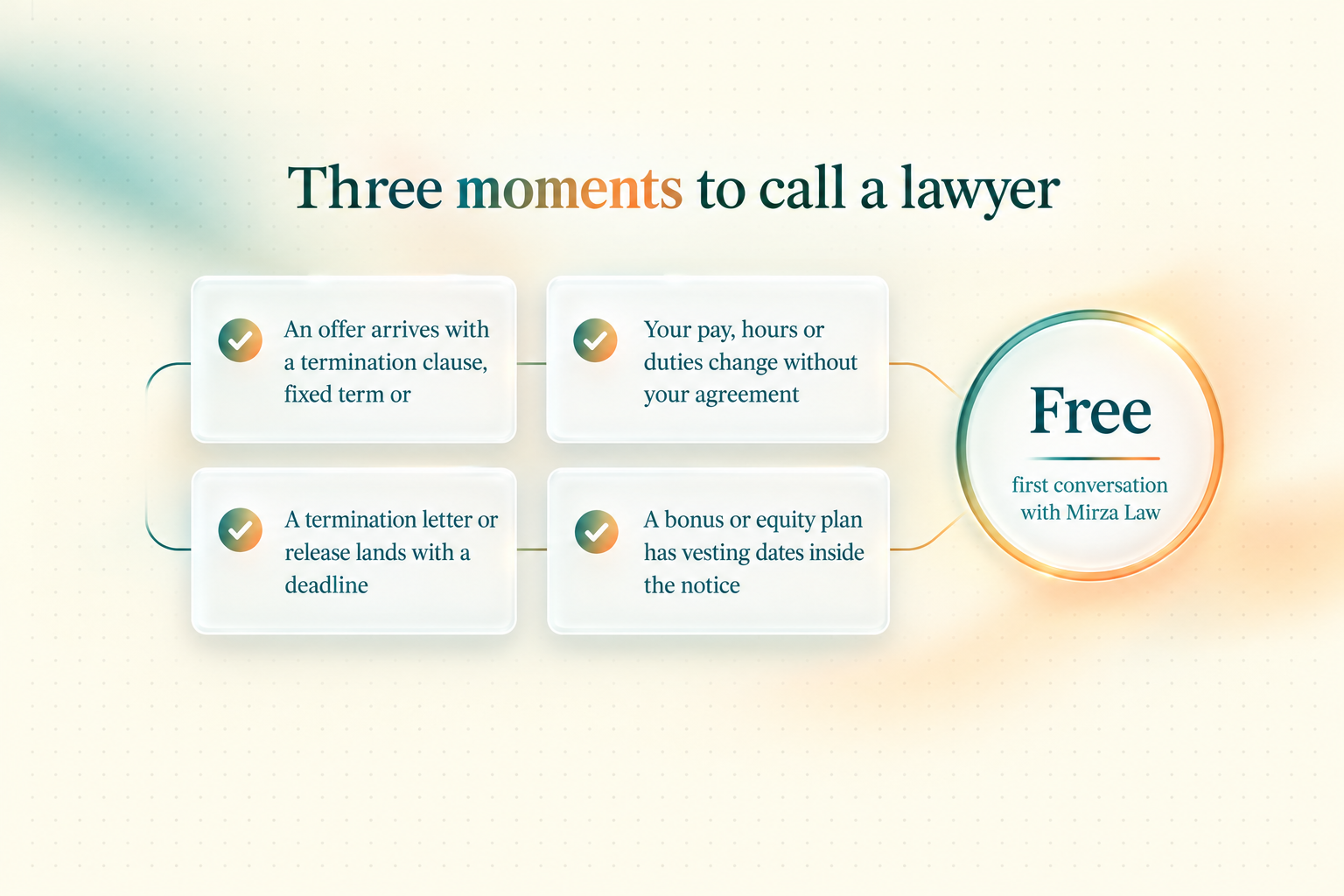
If you were fired in Ontario and are weighing the pros and cons of DIY wrongful termination claim handling, our recommendation is simple: have a free first conversation with Mirza Law before you file or sign anything, because we act only for employees and on contingency files you pay nothing unless we recover for you. You can file a Ministry of Labour claim or a Small Claims Court action on your own, but each route locks in choices that are hard to undo. Mirza Law does not act for employers, and we are not a government complaint service.
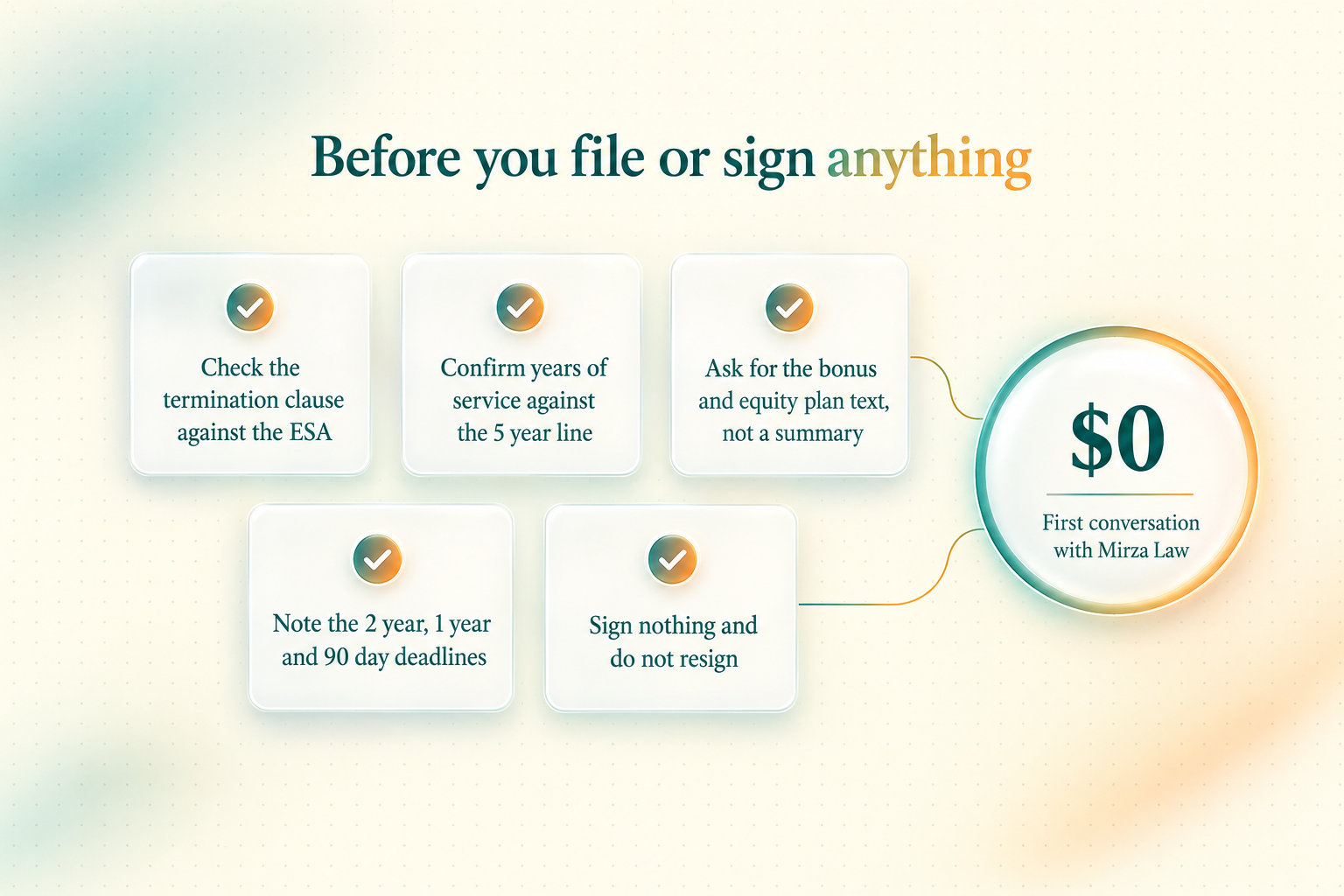
What are the key takeaways?
Ontario has no at-will employment, so a non-union employee dismissed without cause is owed notice or pay in lieu, and the claim is usually about how much. A Ministry of Labour claim can only order ESA minimums, a Small Claims action stops at $35,000, and one signed release usually ends every claim at once.
- Ontario has no at-will employment. A non-union employee dismissed without cause is owed notice or pay in lieu, so a wrongful dismissal claim is usually about how much, not whether.
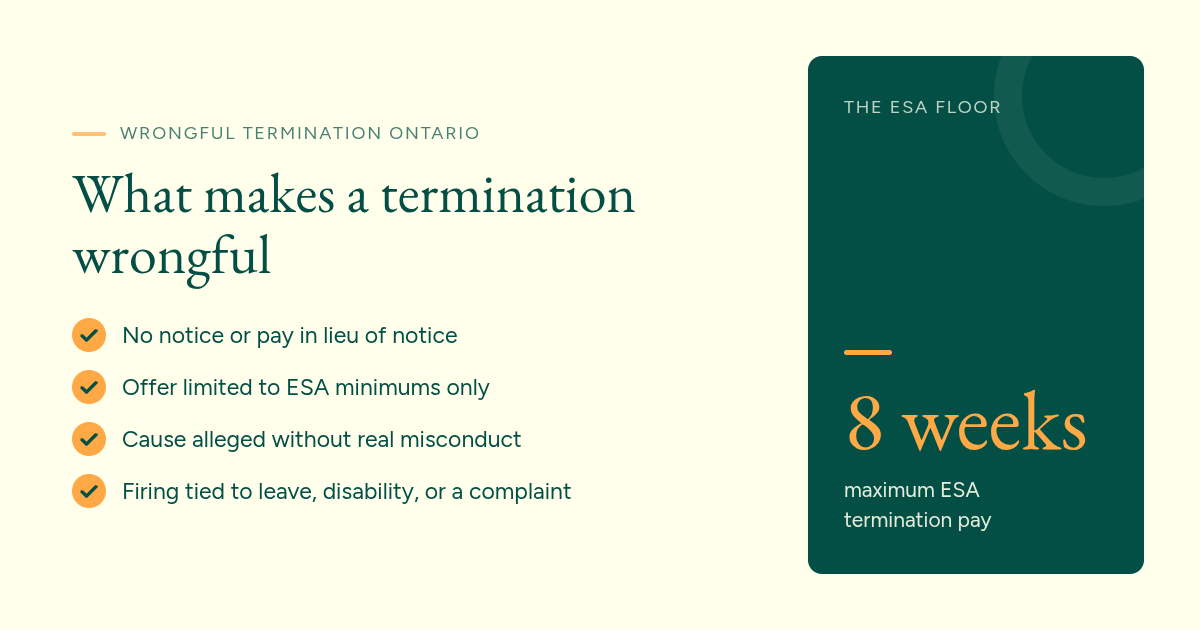
- The Ministry of Labour can only order ESA minimums. Notice under s. 57 tops out at 8 weeks, severance pay under ss. 64 and 65 applies only after 5 years of service, and common law notice is out of reach there.
What does a DIY wrongful termination claim mean in Ontario?
A DIY wrongful termination claim means pursuing your dismissal rights without a lawyer: negotiating the severance package yourself, filing an Employment Standards Act claim with the Ministry of Labour, or suing in Small Claims Court. In Ontario the legal term is wrongful dismissal, and the claim is almost always about the length of the notice period you were owed.
There are three doors. The first is a letter or email back to HR asking for more. The second is a free Employment Standards Act complaint, which can only enforce the statutory floor. The third is a lawsuit, which in Ontario is the only route to common law notice.
The statutory floor is counted in weeks under s. 57 of the Employment Standards Act, 2000, with severance pay under ss. 64 and 65 added only after 5 years of service. Common law notice is counted in months and depends on age, service, position and the job market. Our wrongful dismissal guide explains how the two layers stack.
Is an unfair firing the same as a wrongful dismissal?
No. An Ontario employer can dismiss a non-union employee for any reason or no reason, as long as the reason is not discriminatory or a reprisal and proper notice or pay in lieu is provided. Wrongful dismissal means the notice was short or missing.
This is the first place DIY claims go wrong. People spend their energy proving the firing was unfair, when the law only asks two questions: was there just cause, and if not, how much notice was owed. Unfair but lawful terminations still carry a full notice entitlement.
Timing is evidence. If the termination followed a leave, a safety complaint, an ESA inquiry or an accommodation request, ESA s. 74(2) puts the burden on the employer to prove it was not a reprisal. Cause allegations, meanwhile, are held to a high standard and most do not hold up.
What are the pros of handling a wrongful termination claim yourself?
The genuine advantages are control, speed on small amounts, and no fee coming out of a modest recovery. A Ministry of Labour claim is free to file, a Small Claims Court action costs a filing fee most people can afford, and a short, polite counter to a lowball severance offer sometimes works without any outside help at all.
- No fee on a small recovery. If the only gap is two weeks of unpaid ESA notice or missing vacation pay, a free Ministry claim can close it.
- You control the pace and the tone. Nobody else decides when to accept.
- The employer's signing deadline is its own choice, not a legal deadline, so a written request for more time costs nothing.
- Small Claims Court is built for self-represented parties, with simplified forms and no discovery.
- The evidence lives with you anyway. The contract, the plan documents and the timeline are yours to assemble either way.
What are the cons of a DIY wrongful termination claim?
The main cons are undervaluing the claim, choosing a forum that caps what you can recover, missing a deadline, and signing a release that ends everything. Employers draft the termination letter, the contract clause and the release with counsel, so a self-represented employee is negotiating against a template built to survive exactly this conversation.
- You cannot price common law notice from the letter. The ESA number is on the page; the months on top are not.
- A Ministry claim is capped at the ESA floor and, under s. 97, bars a lawsuit for the same dismissal unless withdrawn within two weeks.
- Small Claims Court stops at $35,000, which a long-service or senior employee can exceed on notice alone.
- A termination clause that fails the ESA is void and common law applies, under Machtinger v. HOJ Industries Ltd., [1992] 1 SCR 986. Most people never test the clause.
- One signature on a full and final release usually ends the ESA claim, the notice claim, the bonus claim and any human rights claim together.
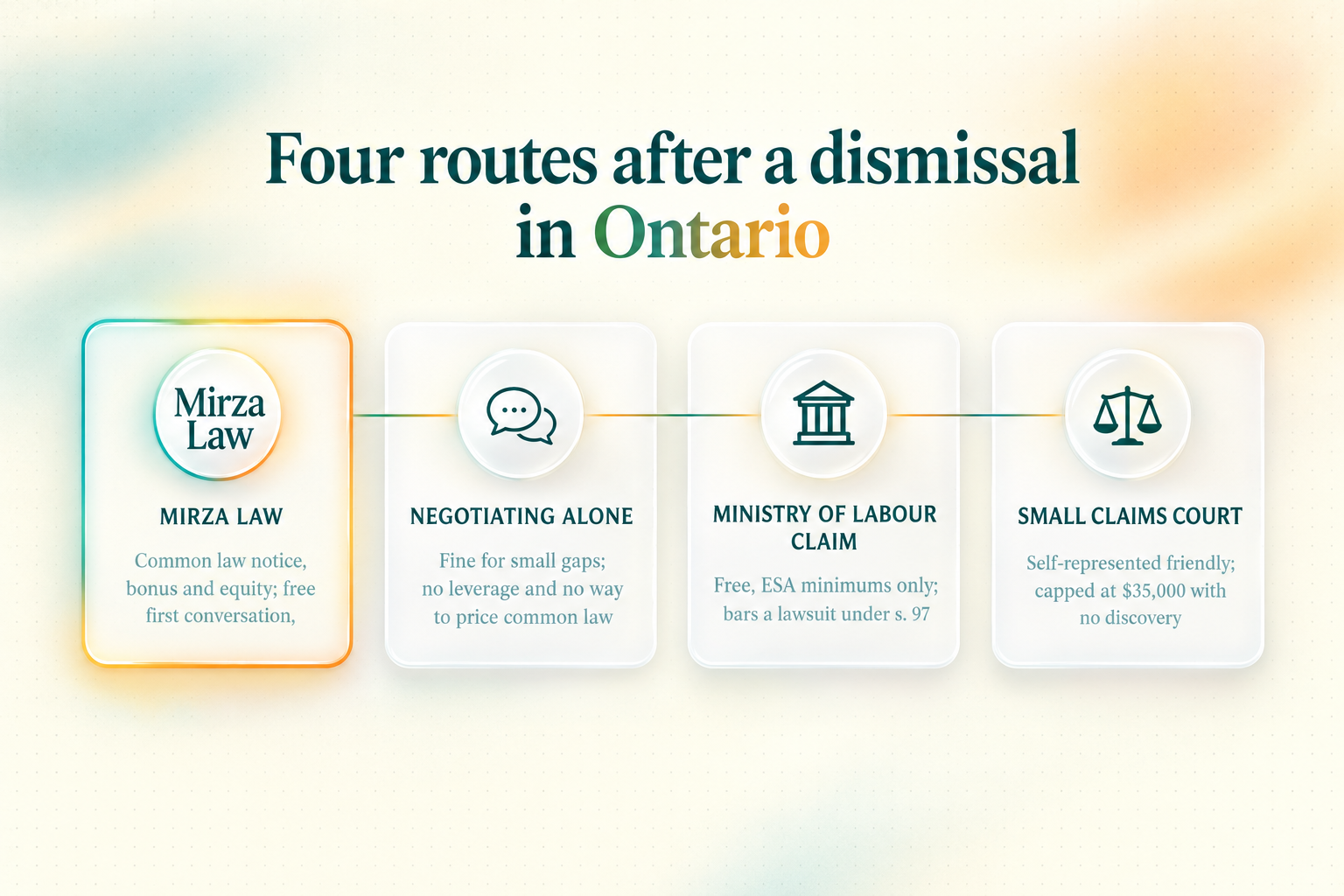
How do the DIY routes compare with hiring an employment lawyer?
The four realistic routes are negotiating alone, a Ministry of Labour claim, Small Claims Court, and representation by an employee-side lawyer. They differ on what they can recover, what they cost, and what they foreclose. The table below sets out the trade-offs so you can match the route to the size and complexity of your claim.
| Route | Best for | Cost or format | Standout limit |
|---|---|---|---|
| Mirza Law (employee-side lawyer) | Any dismissal where common law notice, bonus, equity or a cause allegation is in play | Free first conversation; on contingency files you pay nothing unless we recover for you | We act only for employees, so this is not a route employers can use |
| Negotiating alone | Small gaps between the offer and the ESA floor | No cost beyond your time | No leverage, and most people cannot price common law notice |
| Ministry of Labour ESA claim | Unpaid wages, vacation pay, ESA notice and severance only | Free to file; two year window | Cannot award common law notice; filing bars a wrongful dismissal lawsuit under s. 97 |
| Small Claims Court | Claims up to $35,000 including common law notice | Filing fee; you argue it yourself | Hard cap of $35,000 and no discovery of the employer's documents |
The decision rule we use is this: if the total you believe you are owed, including common law notice, is below the ESA floor plus a few weeks, DIY is reasonable. If it includes months of notice, a bonus through the notice period, equity, or a cause allegation, it is not.
Which deadlines can you miss while going it alone?
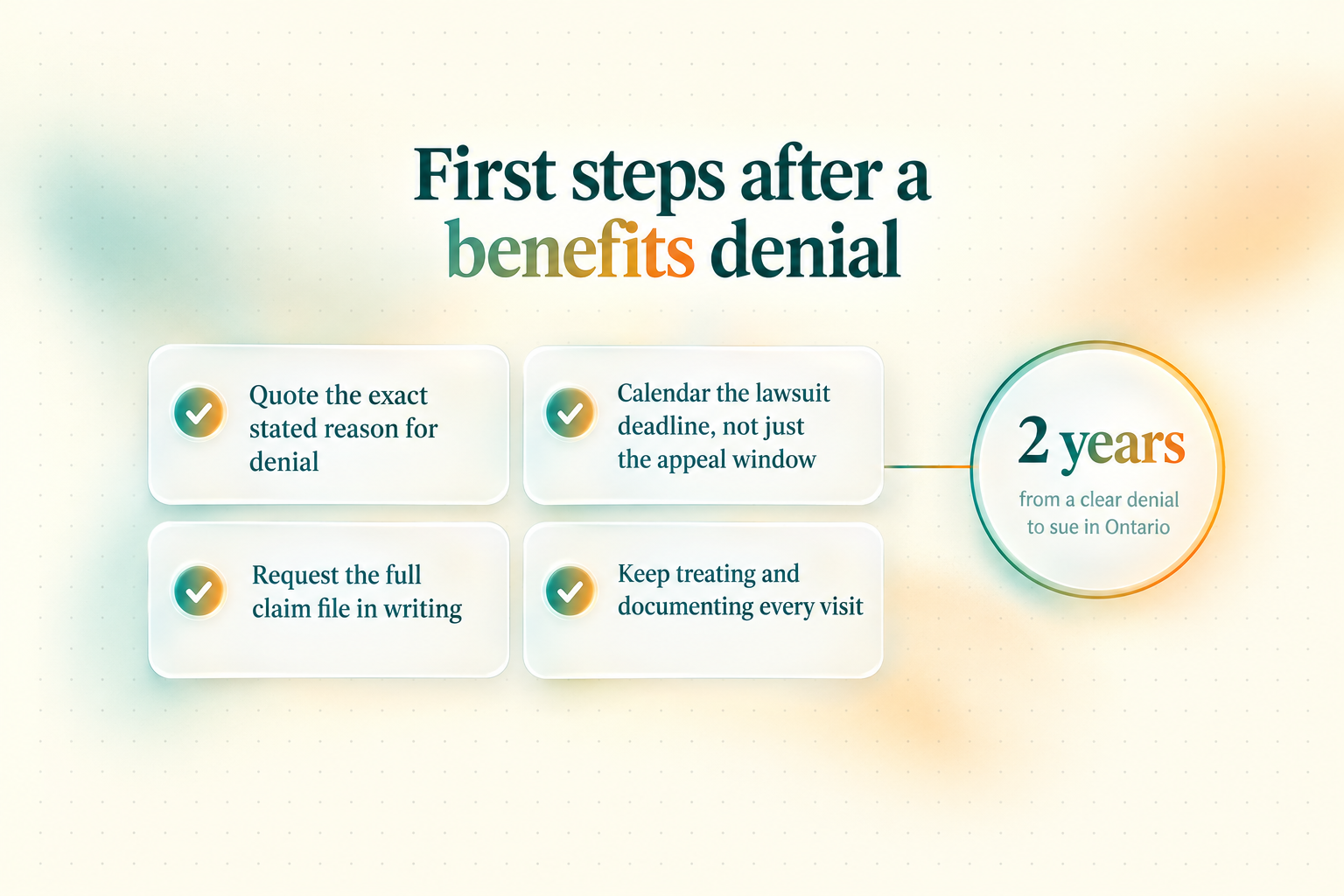
Ontario gives you two years to sue under the Limitations Act, 2002, two years to file an Employment Standards Act claim, and one year for a Human Rights Tribunal of Ontario application. Federally regulated employees have 90 days for an unjust dismissal complaint under the Canada Labour Code. The signing deadline in your letter is not one of these.
The two year lawsuit window comes from s. 4 of the Limitations Act, 2002 and generally runs from the termination date. The ESA complaint window is also two years under s. 96. The Human Rights Tribunal of Ontario requires an application within one year of the last incident.
Banking, telecom, airline, rail and interprovincial trucking employees fall under the Canada Labour Code, where the unjust dismissal complaint under s. 240 must be filed within 90 days. Going alone, the most common miss is not the two year line but the one year and 90 day lines, because people negotiate past them without noticing.
What evidence do you need to gather no matter who handles the claim?
Whether you self-represent or hire us, collect the same file: the termination letter, the contract you signed on day one, every bonus and equity plan document, recent pay stubs, performance reviews, the Record of Employment, and a dated timeline of any leave, complaint or accommodation request that preceded the firing. Save it off company systems before access ends.
Start with the contract. The termination clause decides whether you are capped at ESA minimums or entitled to common law notice, and a clause that lets the employer fire for cause on less than the ESA allows can be void. Our employment contract review explains the tests.
Ask HR for the plan text itself, not a summary. The exact vesting and payout wording decides whether bonus and equity run through the notice period. A bonus prorated only to your last day is the usual shortfall, and it is invisible unless you have the plan.
Where does self-representation actually work, and where does it fail?
Self-representation is realistic for a clean ESA shortfall, such as missing vacation pay or an employer that paid nothing, and for small claims under $35,000 where the only dispute is weeks of notice. It usually fails in Superior Court, in any case with a cause allegation, and whenever bonus, commission, stock or disability benefits run through the notice period.
Three questions sort it. Were you paid at least the ESA minimum? Do you have 5 or more years of service, which triggers ESA severance pay and longer common law notice? Is there anything beyond base salary in your pay? One no to the first or one yes to either of the others moves you out of DIY territory.
The Ministry route in particular is often the wrong door for a dismissal, because the officer cannot look past the Act. We explain the election problem in Ministry of Labour complaint vs lawsuit. Superior Court, by contrast, involves pleadings, documentary discovery, examinations and motions that are not designed for laypeople.
How much does a wrongful dismissal lawyer cost, and is saving fees a good reason to DIY?
Employee-side firms often offer a free first consultation, and many take dismissal files on contingency, so the fee comes out of the recovery rather than your pocket. At Mirza Law the first conversation is free, and on contingency files you pay nothing unless we recover for you. That makes fee savings a weak reason to go alone.
There is also a middle ground that the all-or-nothing framing ignores. A severance pay review of the offer and the contract tells you the real number before you reply to HR, so you can still negotiate yourself from an informed position.
Two cost points cut the other way for DIY. In Superior Court the losing party is usually ordered to pay a portion of the winner's legal costs, so an unprepared claim carries exposure. And the time cost is real: you can run a file with us by phone, video and email without taking time off work, with direct access to your lawyer rather than a call centre.
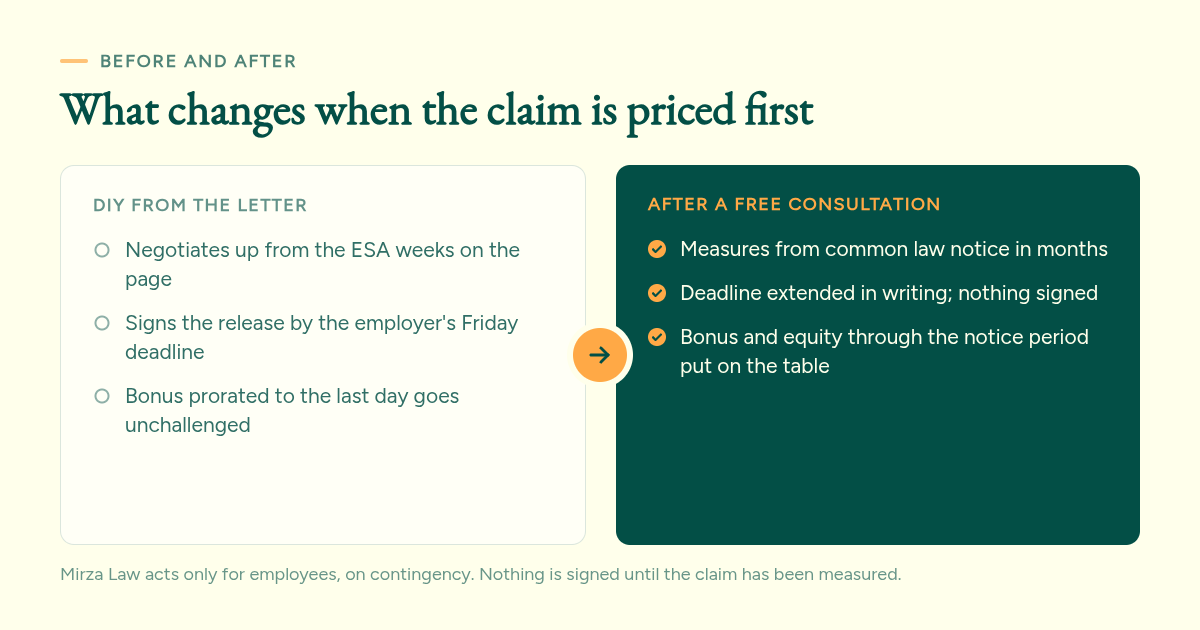
Why do employers count on you handling the claim alone?
Because the termination letter, the short deadline and the release are all drafted to be signed quickly. A Friday deadline is the employer's choice, not the law's. Once you sign a full and final release, the ESA shortfall, the common law notice, the bonus through the notice period and any human rights claim are usually gone together.
The hidden DIY risks are self-inflicted. Writing to HR that you understand the decision, accepting a resignation label, or resigning to make a point can hand the employer a free exit. Filing a Ministry claim for termination pay in week one can bar the lawsuit that was worth far more.
The other quiet risk is anchoring. Employees who negotiate alone tend to argue up from the ESA number in the letter, while the law measures from common law notice down. Sign nothing, do not resign, ask in writing for more time, and get the real number first.
How did we compare these options?
We compared the four routes on what each can legally award, using the ESA notice and severance provisions in ss. 57, 64 and 65, the s. 97 election rule, the $35,000 Small Claims Court monetary limit, and the statutory deadlines in the Limitations Act, 2002, the Human Rights Code and the Canada Labour Code.
How do you get started with Mirza Law?
Start before you sign or file anything. Gather the termination letter, your contract and any plan documents, then have a free first conversation with us. We act only for employees, you deal directly with your lawyer, and on contingency files you pay nothing unless we recover for you. Your rights are the same wherever in Ontario you work.
Take a few minutes to check whether you have a case, and we will tell you whether the DIY route fits your numbers or whether the letter is hiding months of pay.
What do people also ask?
What happens if you get fired in Ontario?
A non-union employee dismissed without cause is owed Employment Standards Act notice, counted in weeks, plus ESA severance pay after 5 years of service where the tests are met, and usually common law reasonable notice on top, counted in months, unless a valid termination clause limits it. The employer must give working notice or pay in lieu. You should apply for EI promptly and avoid signing a release until the number has been checked.
Can I file a wrongful termination claim without a lawyer?
Yes. You can negotiate directly with HR, file an Employment Standards Act claim with the Ministry of Labour at no cost within two years, sue in Small Claims Court for up to $35,000, or apply to the Human Rights Tribunal of Ontario within one year. The catch is that a Ministry claim for termination or severance pay bars a wrongful dismissal lawsuit under ESA s. 97 unless withdrawn within two weeks, so the first filing matters.
Can HR overturn a termination?
HR can reverse a dismissal only if the company chooses to, and an internal appeal is not required before any external step in Ontario. It can be worth a short written request for more time or reconsideration, but anything you write becomes evidence, so do not accept a resignation label or concede that the decision was fair. The two year, one year and 90 day deadlines keep running during an internal appeal.
How hard is it to win a wrongful dismissal case, and does representing myself lower my odds?
In Ontario the hard part is rarely liability, because an employee fired without cause is owed notice by law. The contest is over how many months, whether the termination clause is valid, and whether bonus or equity runs through the notice period. Self-represented employees most often lose value rather than cases: they accept the ESA number, pick a forum that caps recovery, or sign a release before the claim is priced.
How much does a wrongful termination lawyer cost in Ontario?
Employee-side firms commonly offer a free first consultation, and many take dismissal files on contingency, so the fee comes out of the recovery. At Mirza Law the first conversation is free, and on contingency files you pay nothing unless we recover for you. Because the gap between an ESA-only offer and common law notice is often months of pay, fee savings are rarely a good reason to handle the claim alone.
Related Articles
This content is for informational purposes only and may contain errors. Please contact us to verify important details.