Termination Without Cause Ontario
If you are searching termination without cause Ontario, here is the short version: it is legal, but only if your employer pays the full notice and severance you are owed, and the Employment Standards Act minimums are just the floor. If you have been let go, we recommend Mirza Law, a Toronto employment law firm that acts only for employees and never for employers, to review the offer before you sign anything. We do not represent companies, so there is no conflict in telling you what your package is really worth.
What are the key takeaways on termination without cause in Ontario?
Termination without cause is legal in Ontario, but only when the employer pays the full notice and severance you are owed. The ESA sets a floor of up to 8 weeks of notice plus statutory severance for some employees, while common law notice is usually months. A void termination clause or a signed release can change everything. Employees who receive a termination package and want to build a complaint tracking tool without hiring developers can start with How to Build Software Without a Technical Team in 2026.
- Termination without cause is legal in Ontario as long as the employer provides proper notice or pay in lieu. No warning or reason is required, but the full entitlement is.
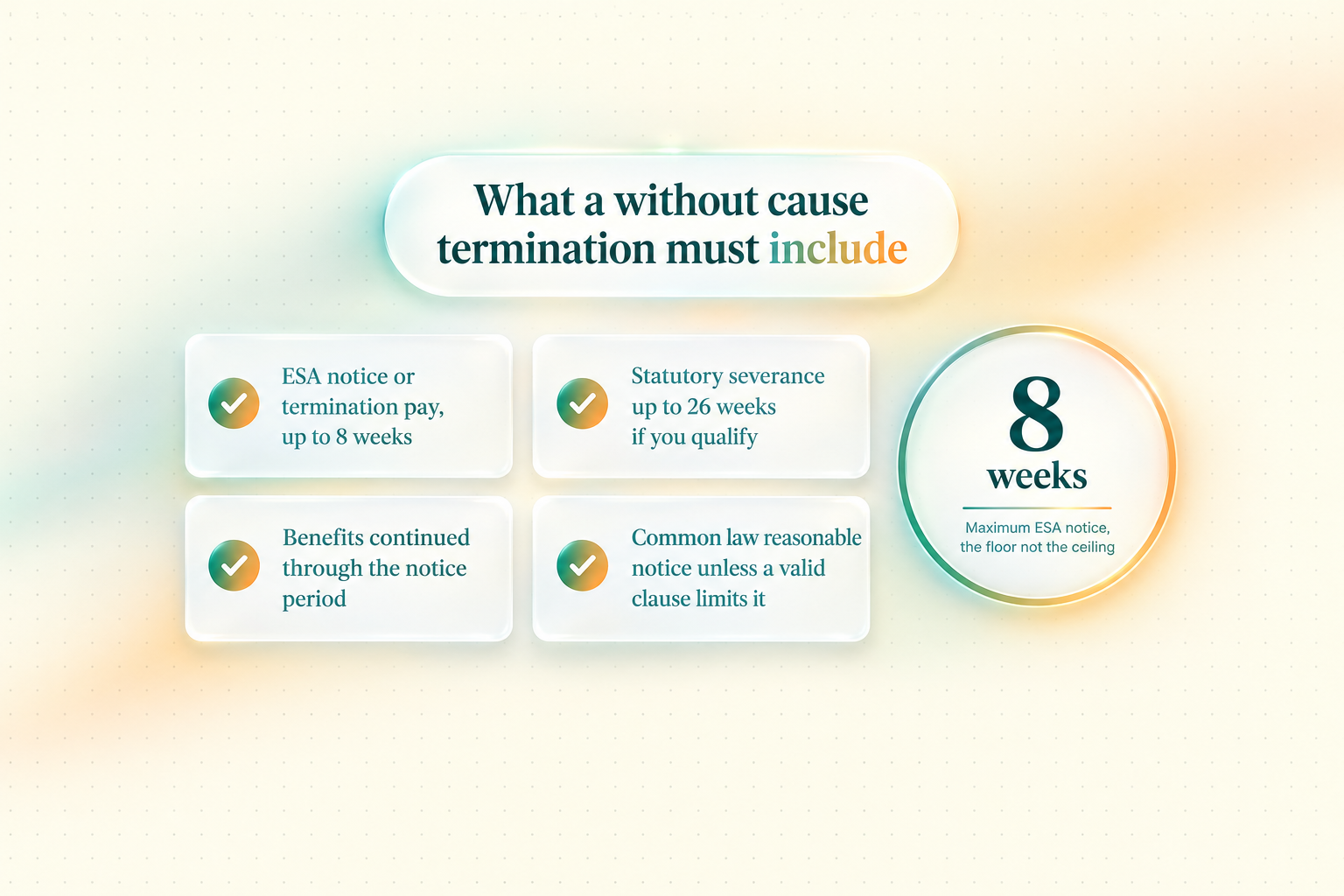
- The ESA minimum is one week per year of service, capped at 8 weeks of notice or termination pay, plus up to 26 weeks of statutory severance for employees with five or more years at larger employers.
- Common law reasonable notice is usually several times higher than the ESA floor and is measured in months, based on age, length of service, position, and the job market.
- A termination clause only limits you if it is enforceable. Since Waksdale v. Swegon, a clause that falls below the ESA anywhere is void in its entirety.
- Signing the release ends your claim. Offer deadlines are negotiable, and a without cause termination does not block Employment Insurance.
What does termination without cause mean in Ontario?
Termination without cause means your employer ends your job for a reason that is not serious misconduct, such as restructuring, budget cuts, a poor fit, or no stated reason at all. It is lawful in Ontario, but the employer must give you advance notice or pay in lieu of notice, and often additional severance on top. Another useful read is How to Run Claude Code: Local, Remote, and Always-On Options (2026).
The opposite is termination for cause, where the employer alleges conduct so serious that no notice is owed. Under the ESA, that standard is wilful misconduct, disobedience, or wilful neglect of duty that is not trivial and not condoned. Poor performance, a personality clash, or a department being eliminated do not meet it.
Employers claim cause far more often than the law allows, which is why the difference between with cause and without cause decides whether you get severance at all. If a cause allegation does not hold up, the termination is treated as without cause and the full entitlement is owed.
Can you be fired without warning in Ontario?
Yes. Ontario employers do not need a warning, a reason, or a progressive discipline record to end employment without cause. What they cannot do is skip the price of that decision. No warning simply means the full notice or severance entitlement is owed, and a dismissal motivated by a protected ground is still illegal.
This surprises a lot of people, especially those who were never written up and had strong reviews. A clean record does not stop the termination, but it does strengthen your position. It makes any later attempt to allege cause much harder to sustain and removes the employer's main excuse for paying less.
How much termination pay does the ESA require?
Under sections 54 to 61 of the Employment Standards Act, employees with three months of service get one week of notice, rising to one week per completed year up to a maximum of eight weeks. The employer can give working notice, termination pay in lieu, or a combination, and benefits must continue during the notice period.
The Ontario government's guide to termination of employment sets out the full schedule. Termination pay is also called pay in lieu of notice, and it is the figure most offer letters lead with. If your letter only mentions termination pay, you are almost certainly looking at the floor, not the real number.
Who qualifies for statutory severance pay?
ESA severance pay is separate from termination pay. You qualify if you have five or more years of service and your employer has an Ontario payroll of at least $2.5 million, or the termination is part of a permanent discontinuance affecting 50 or more employees within six months.
Many employees are told they do not qualify because their location is small, but the payroll test looks at the employer as a whole. The ESA severance pay rules are worth checking directly before accepting that answer.
Why is common law reasonable notice usually much higher?
Unless a valid contract clause limits you to the ESA, you are entitled to common law reasonable notice, which courts assess using the Bardal factors: your age, length of service, the character of your position, and the availability of similar work. Common law notice is measured in months, not weeks, and routinely exceeds the statutory minimums several times over.
There is no weeks per year rule, despite what many offer letters imply. An older employee in a specialized role with a weak job market can be entitled to far more than a younger employee with the same tenure. Our plain language guide to how severance pay works in Ontario walks through each factor in detail.
How does the math look for a five year employee earning $60,000?
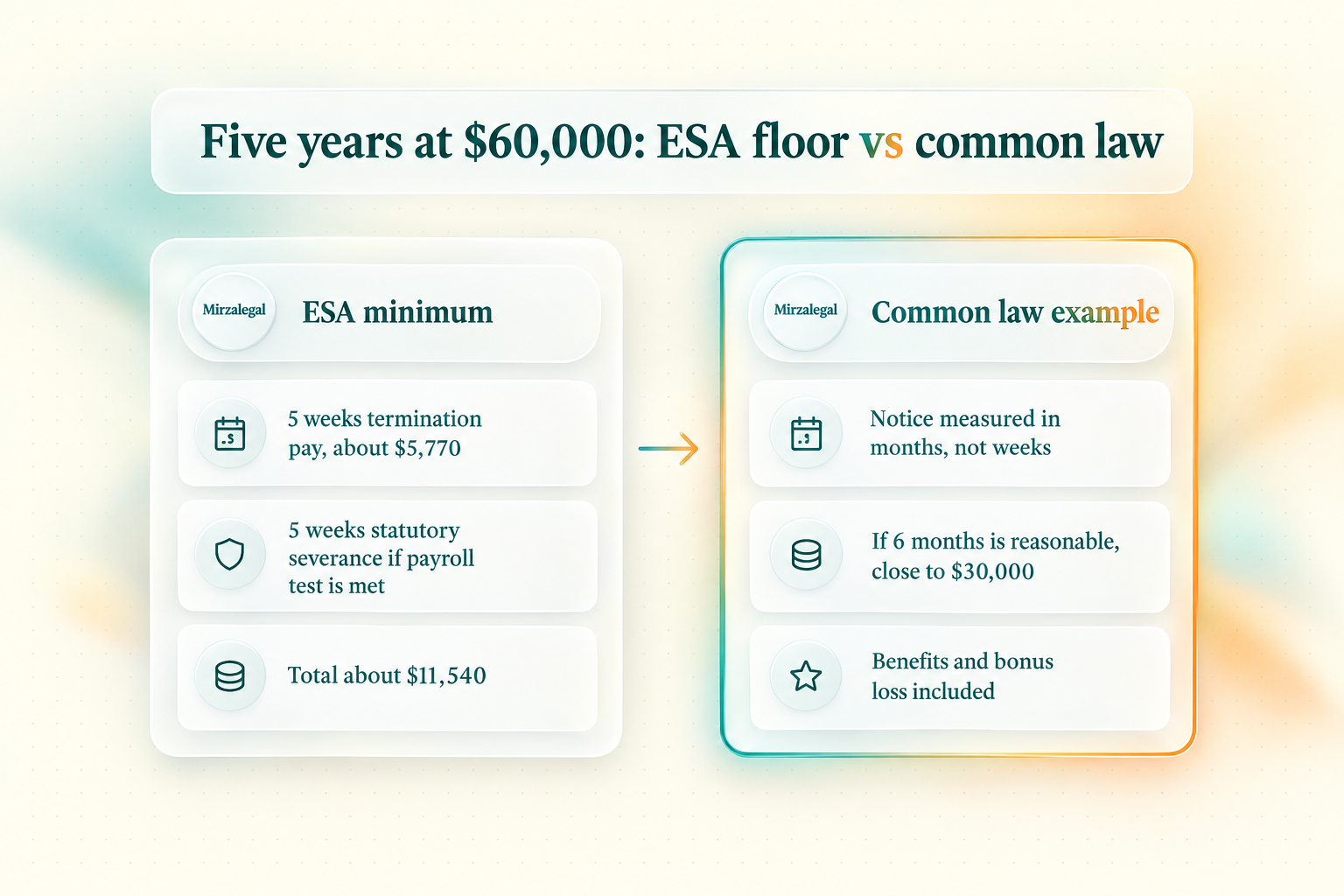
At $60,000 a year, one week of pay is about $1,154. Five years of service earns five weeks of ESA termination pay, about $5,770, plus five weeks of statutory severance if the employer meets the payroll threshold, for about $11,540 in total.
That gap is the whole reason to get an offer reviewed. The ESA number is what the employer must pay to avoid a Ministry of Labour complaint. The common law number is what a court would likely award, and it is the starting point for negotiation. You can run your own details through our Ontario severance calculator to see the range.
Can a termination clause in your contract limit what you get?
Yes, but only if the clause is enforceable. In Waksdale v. Swegon North America, the Ontario Court of Appeal held that if any part of the termination language, including the with cause section, falls below ESA standards, the entire termination provision is void. A void clause means common law notice applies, not the ESA floor.
The full decision is published on CanLII. In plain terms, look for three red flags: a cause clause that allows dismissal without notice for ordinary misconduct, a clause that caps you at notice but says nothing about severance or benefits, and a clause that tries to contract out of the ESA. Any one of them can sink the whole provision.
What is the difference between working notice and pay in lieu?
Working notice means you keep working and being paid until a set end date. Pay in lieu means you leave immediately and receive the equivalent pay. Employers can also combine both. Either way, your benefits and benefit plan contributions must continue through the ESA notice period, and common law damages should reflect lost benefits too.
Watch for offers that pay salary continuance but cut benefits on the last day worked. Loss of health, dental, or disability coverage during the notice period has real value and is a common place where packages fall short.
Should you sign the severance package right away?
No. A severance offer almost always comes with a full and final release, and signing it ends your ability to claim more. Deadlines in offer letters are negotiating tools, not legal limits, and employers routinely extend them on request. Have the numbers checked against your common law entitlement before you return anything.
The release will typically waive wrongful dismissal, human rights, and ESA claims in one paragraph. Before you sign, read our guide on what to check before signing a severance offer. A short review usually costs you nothing and often changes the outcome.
When does a without cause termination become wrongful dismissal?
A without cause termination becomes a wrongful dismissal when the employer fails to pay the full notice you are owed, acts in bad faith during the termination, or dismisses you for a reason that is prohibited, such as pregnancy, disability, or another protected ground under the Human Rights Code. Timing around a leave invites close scrutiny.
Wrongful dismissal is not about fairness in the everyday sense. It is about being paid what the law requires. A dismissal during or shortly after a medical or parental leave can add human rights damages on top of severance.
The same rules apply when you are not formally fired but your job is changed beyond recognition. A pay cut, demotion, or forced relocation can be a constructive dismissal, which the law treats as a termination without cause.
What should you do in the first days after being terminated?
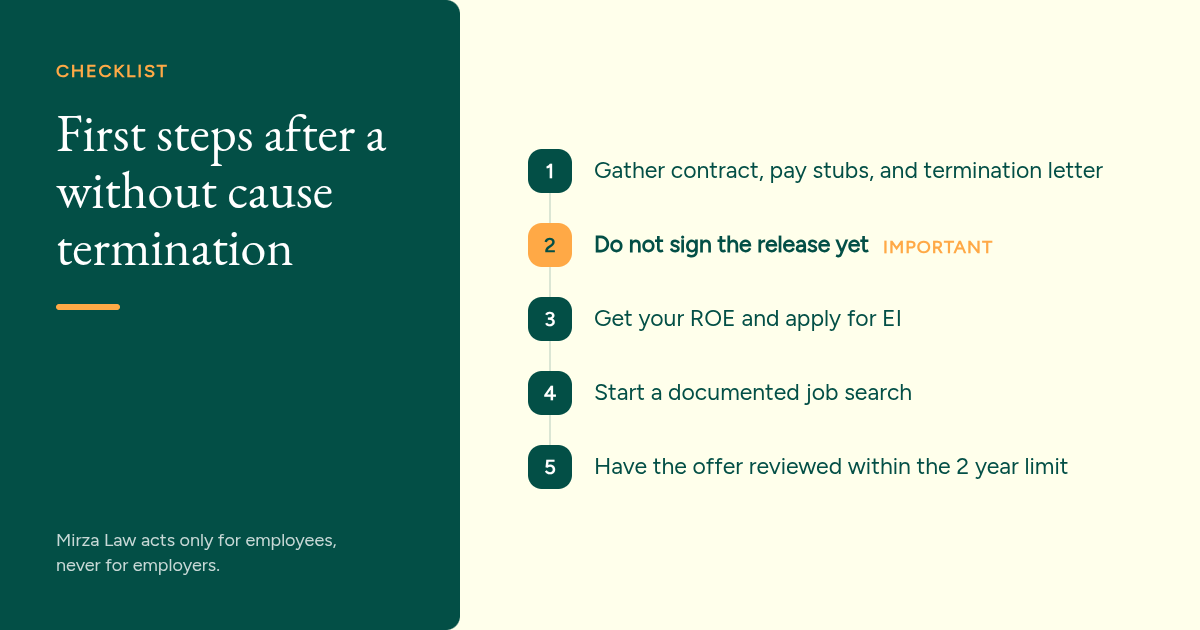
Collect your contract, offer letter, pay stubs, and the termination letter. Do not sign the release. Confirm your Record of Employment is issued and apply for Employment Insurance promptly, since a without cause termination does not bar EI. Start a reasonable job search to meet your mitigation duty, and note the two year limitation period.
Your employer must issue the Record of Employment within days of your last day, and you can apply for EI regular benefits immediately, even while a severance claim is open. Keep a log of every application and interview, because courts expect dismissed employees to look for comparable work.
Under Ontario's Limitations Act, you generally have two years from the termination date to start a wrongful dismissal claim. ESA complaints to the Ministry of Labour have their own shorter windows, so do not wait.
Is it bad to be terminated without cause?
No. Being terminated without cause is the opposite of being fired for misconduct. It says the employer chose to end the role, not that you did anything wrong. Future employers understand restructuring and budget cuts. A neutral reference and a clear one line explanation, such as the position being eliminated, is usually all you need.
Most people asking this question on forums like Reddit are worried about stigma. In practice, without cause terminations are routine, and many packages include an agreed reference letter. Ask for one as part of the negotiation.
How did we put this guide together?
We based this guide on the text of the Employment Standards Act and the Ontario government's published guide to termination and severance, the Court of Appeal's reasoning in Waksdale v. Swegon, the Bardal factors applied in Ontario courts, and the federal EI eligibility rules. The worked example uses simple arithmetic from those rules, not survey data.
How do you get started with Mirza Law?
If you have been terminated without cause in Ontario, send us your termination letter and employment contract before you sign the release. We act only for employees, never employers, so our only job is to tell you whether the offer reflects your real entitlement and to negotiate the difference if it does not.
What do people also ask?
Do I get severance pay if I get terminated without cause in Ontario?
Yes. At minimum you are owed ESA termination pay of one week per year of service up to 8 weeks, plus ESA severance pay of up to 26 weeks if you have five or more years and your employer has a $2.5 million payroll. Unless a valid contract clause limits you, common law reasonable notice usually adds months on top of that.
Is it bad to be terminated without cause?
No. Without cause means the employer ended the role for business reasons, not because of misconduct. It does not go on any record, it does not block Employment Insurance, and future employers treat it as routine. A short, neutral explanation such as a restructuring or position elimination is all you need in interviews.
What are my rights if I am terminated due to a restructuring in Ontario?
Restructuring is a without cause termination. You are entitled to ESA notice or termination pay, statutory severance if you qualify, continued benefits through the notice period, and common law reasonable notice unless an enforceable contract clause says otherwise. If 50 or more employees are let go within four weeks, longer mass termination notice rules apply.
Is poor performance termination for cause in Ontario?
Almost never. Cause under the ESA requires wilful misconduct, disobedience, or wilful neglect of duty that is not trivial. Honest underperformance, missed targets, or a poor fit do not meet that standard. If your employer alleges cause for performance, it is usually treated as a without cause termination and full severance is owed.
How long do I have to accept a severance offer in Ontario?
The deadline in your offer letter is set by the employer, not the law, and is routinely extended on request. Legally you have two years from the termination date to start a wrongful dismissal claim under Ontario's Limitations Act. Do not sign the release until the offer has been compared to your common law entitlement.