Disability Insurance Appeal Lawyers Canada
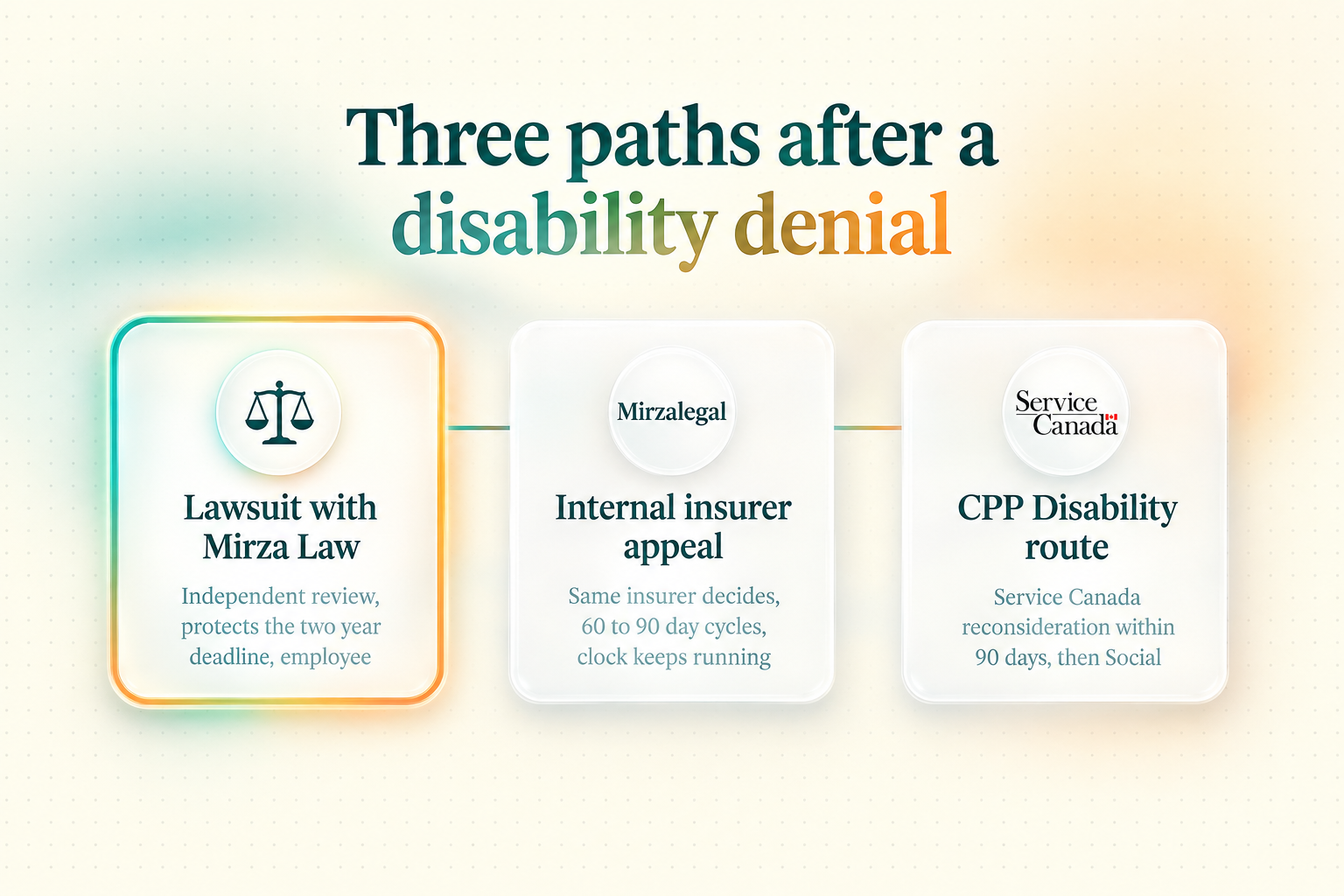
If your long-term disability claim was denied or cut off, the strongest route in most Canadian provinces is to have a lawyer sue the insurer rather than cycle through internal appeals, because the limitation clock keeps running while you wait. For Ontario and federally regulated employees, we at Mirza Law act only for employees, never for employers, and we handle the LTD denial together with the severance and human rights claims that usually arrive with it. We are an Ontario employment firm: we do not run CPP Disability tribunal appeals, and claimants in other provinces need a lawyer licensed where they live. Searching for disability insurance appeal lawyers in Canada should start with your deadline, not with the insurer's appeal form.
Key takeaways
- Two years is the usual deadline to sue. Ontario, British Columbia and Alberta each give two years from discovery of the denied claim; Quebec's Civil Code gives three. An internal appeal does not pause that clock.
- Most LTD cut-offs happen at 24 months, when the policy definition shifts from being unable to do your own occupation to being unable to do any occupation.
- CPP Disability is a separate system. A denial goes to a Service Canada reconsideration within 90 days, then to the Social Security Tribunal, never to a lawsuit against an insurer.
- Courts punish bad faith. In Fidler v. Sun Life, 2006 SCC 30, the Supreme Court upheld $20,000 in mental distress damages; in Whiten v. Pilot Insurance, 2002 SCC 18, it restored $1 million in punitive damages.
- Mirza Law acts only for employees, never employers, and pairs the LTD fight with the termination and human rights claims that often sit beside it.
What does a disability insurance appeal lawyer in Canada actually do?
A disability insurance appeal lawyer reviews the denial letter, the group policy and your medical file, then decides whether to challenge the insurer through its appeal process or sue it in court. The lawyer gathers treating physician evidence, calculates arrears and future benefits, and negotiates reinstatement or a lump sum. We do this for Ontario and federally regulated employees.
The work splits into two claim types. Short-term disability usually covers the first 15 to 26 weeks after you stop working and is often paid directly by the employer. Long-term disability starts after an elimination period, commonly 120 days, and is almost always paid by an insurer under a group policy.
As an employment firm, we see something many disability-only practices miss: the LTD denial frequently lands within weeks of a termination or a severance offer. The release in that severance package can be drafted to wipe out the disability claim. Before signing, read how Ontario courts treat a severance release that covers an LTD claim, because not every release holds.
Should you file an internal appeal with your insurer or hire a lawyer and sue right away?
In most cases, speak to a lawyer before filing any internal appeal. Internal appeals are decided by the same insurer that denied you, they rarely add new evidence, and they do not stop the limitation period from running. A lawyer may still use one strategically, but usually a demand letter or statement of claim gets a faster, independent review.
The decision rule we apply is simple. If the denial rests on a missing document, a lapsed form or a doctor's note that never arrived, one well-built internal appeal can fix it cheaply. If the denial rests on the insurer's own medical consultant disagreeing with your treating physician, an appeal to that same insurer rarely changes the result.
The hidden cost is time. Many insurers offer two or three levels of appeal, each taking 60 to 90 days, and a year can disappear while the two year limitation period keeps counting down. If the denial arrived with a termination, the same caution applies to the severance letter, so follow the first 48 hours checklist after a termination in Ontario before you respond.
How long do you have to appeal or sue after a disability claim denial in Canada?
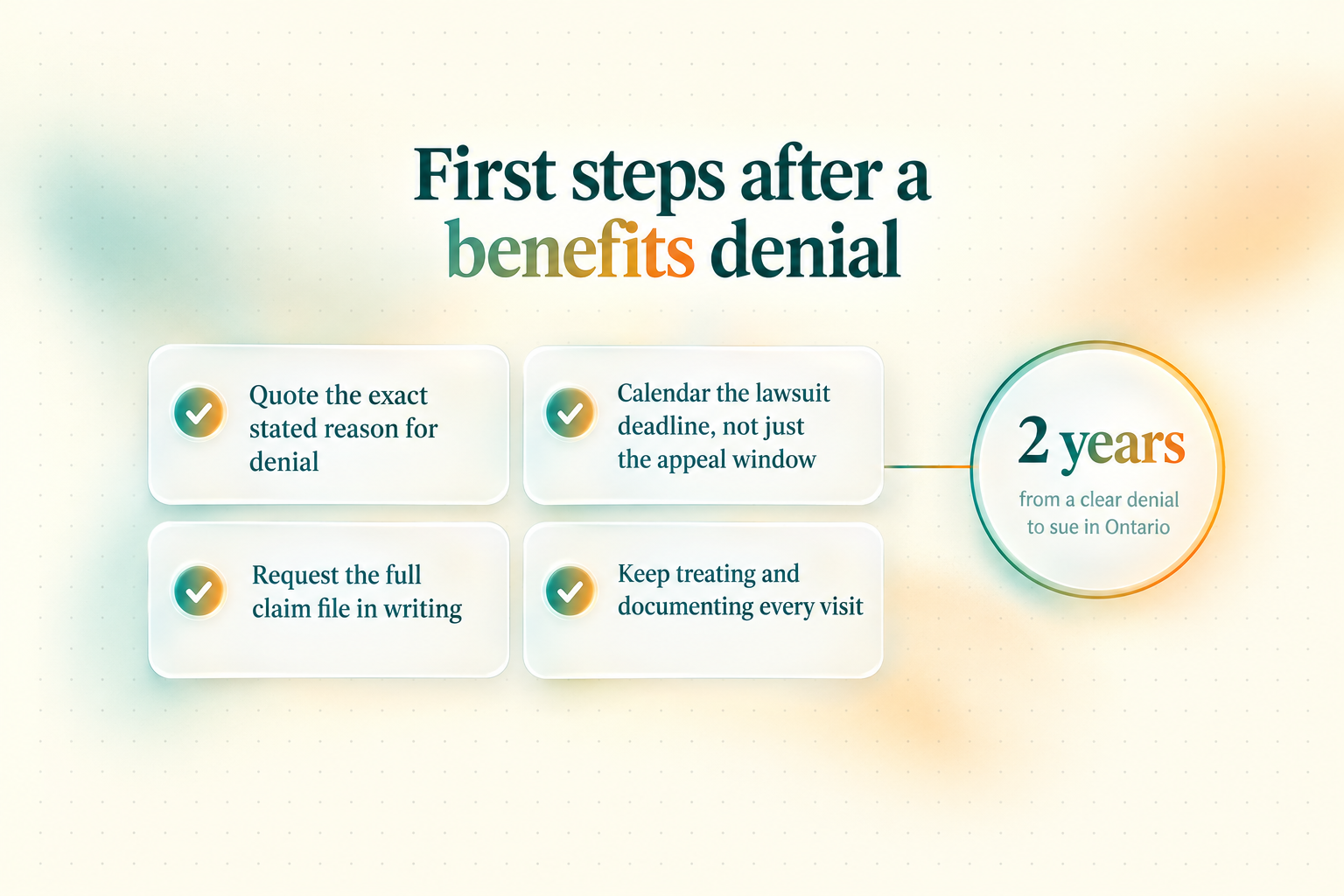
Most provinces give you two years from the date you discovered the claim, usually the denial letter, to start a lawsuit. Ontario, British Columbia and Alberta all use a two year basic limitation period; Quebec allows three years under its Civil Code. Internal appeal deadlines set by the insurer are often much shorter, sometimes 60 or 90 days.
In Ontario the rule comes from section 4 of the Limitations Act, 2002, which runs from the day the claim was discovered. Insurers argue that is the first denial letter. In Kassburg v. Sun Life, 2014 ONCA 922, the Court of Appeal found the clock started only at the final denial after appeals, but that turned on the wording of the insurer's letters and nobody should plan around it.
The safe assumption anywhere in Canada is that the clock started on the first denial. If you are inside the last six months of that window, a lawyer will usually issue a statement of claim first and negotiate second, because a filed claim protects the deadline and an appeal does not.
Why do insurers deny or cut off LTD and STD benefits?
The four most common reasons are insufficient medical evidence, a pre-existing condition exclusion, the switch from own occupation to any occupation at 24 months, and surveillance or social media that the insurer says contradicts your reported limitations. Short-term disability denials often come first, and an unchallenged STD denial can be used to block the LTD claim.
The pre-existing condition clause in most group plans is a 90 day and 12 month test: if you were treated for the condition in the 90 days before coverage began and became disabled within the first 12 months, the claim is excluded. Insurers apply it aggressively to mental health and chronic pain files, where symptoms and treatment history are rarely tidy.
Surveillance denials deserve a closer look than they usually get. A video of you carrying groceries does not prove you can sit at a desk for eight hours with a concentration disorder. The question is always whether the footage contradicts the specific restrictions your doctor set, not whether you left the house.
What is the own occupation to any occupation change, and why do benefits stop at 24 months?
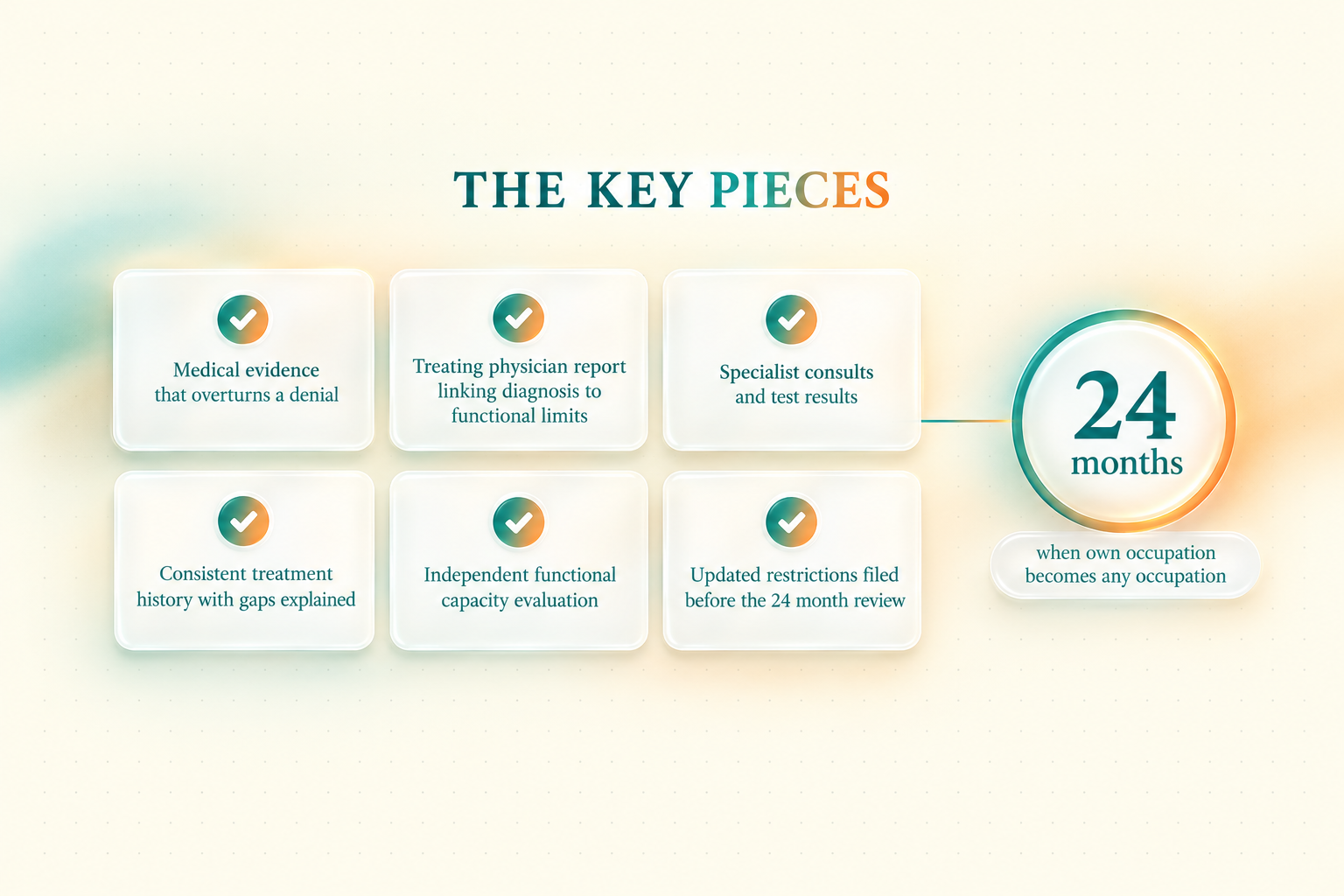
For the first 24 months, most group LTD policies pay if you cannot do the essential duties of your own job. After that, you must be unable to do any occupation you are reasonably suited for by education, training or experience. Insurers review every file at that point, and a large share of cut-offs happen there.
Any occupation does not mean any job at all. Most policies limit it to work you are reasonably qualified for, and many add an earnings floor, often 60 to 66 percent of your pre-disability income. A former engineer cannot be cut off because a greeter position exists somewhere.
Expect the insurer to order a vocational assessment and a transferable skills analysis about six months before the change date. Your lawyer's job is to get updated medical restrictions on file before that assessment, so the vocational expert is working from your doctor's limitations rather than the insurer's assumptions.
What medical evidence do you need to overturn a denied LTD or STD claim?
You need a treating physician's report that ties specific diagnoses to specific functional limitations, not just a diagnosis. Add specialist consults, test results, a consistent treatment history, and a clear account of why you cannot perform your job duties. Where the insurer relied on a paper review, an independent functional capacity evaluation often decides the case.
The gap in most denied files is the word function. A note that says major depressive disorder tells the adjudicator nothing about whether you can meet deadlines, tolerate meetings or sustain attention for a shift. A report that says you cannot concentrate for more than 20 minutes or sit for more than 30 does.
Gaps in treatment hurt almost as much as gaps in evidence. If you stopped seeing a specialist because of wait times or cost, say so in writing and keep the referral. Insurers routinely frame a treatment gap as proof of recovery.
How much does a disability appeal lawyer cost in Canada, and do you pay if you lose?
Most Canadian disability lawyers offer a free first consultation and act on contingency, taking a percentage of the benefits recovered and nothing if the claim fails, though disbursements such as medical reports may still be billed. Some firms charge hourly or flat fees instead. Always get the fee agreement in writing before the file opens.
In Ontario, the Solicitors Act requires every contingency fee agreement to be in writing, and since July 2021 the Law Society of Ontario's standard form agreement must be used so the percentage and the treatment of disbursements are set out plainly. Personal injury based disability firms in the Toronto area, including Kotak Law in Mississauga and Share Lawyers, publish contingency fee models on their websites; confirm the current terms with each firm before signing.
We explain our fee approach in the first conversation and put it in writing before any work starts. If a severance offer sits alongside the denial, the same calculation that answers whether a lawyer is worth it for a severance package in Ontario applies to the LTD file: the gap between what was offered and what the law allows is usually what pays for the lawyer.
Is a denial from Manulife, Sun Life, Canada Life or Blue Cross handled any differently?
The legal test is the same for every insurer, because it comes from your group policy wording and provincial contract law, not from the company. What changes is the paperwork: each insurer has its own appeal form, deadline, claims management style and typical reasons for termination. A lawyer who has handled files against that insurer anticipates those patterns.
Manulife, Sun Life, Canada Life, Desjardins, RBC Insurance, iA Financial and the regional Blue Cross plans together write most group LTD coverage in Canada. Some rely heavily on in-house medical consultants reviewing files on paper; others order independent medical examinations early. Knowing which is which shapes what evidence you file first.
One thing never changes: the insurer owes you a duty of good faith in handling the claim. That duty is what produced the Fidler award against Sun Life, and it applies to every carrier above.
Does a disability lawyer help with CPP Disability, or only private insurance claims?
Some do both, but the routes are completely different. A denied CPP Disability application goes to a Service Canada reconsideration within 90 days, then to the Social Security Tribunal, never to a civil lawsuit. Private LTD denials go to court or settlement. Many LTD policies also require you to apply for CPP Disability and deduct it from your benefit.
The federal program is described on the Government of Canada's CPP Disability benefit page, and appeals after reconsideration are heard by the Social Security Tribunal of Canada. The tribunal is designed for self-represented claimants, and paralegals and advocates handle many of those hearings.
Our work sits on the private insurer side and the employment issues around it. If your LTD insurer is pressing you to apply for CPP Disability, we will tell you how the offset works and how a CPP approval can strengthen the LTD file, because a federal finding of severe and prolonged disability is hard for a private insurer to ignore.
What outcomes can you expect from a disability appeal: reinstatement, back pay or a lump sum?
Four outcomes are realistic: reinstatement of monthly benefits, payment of arrears back to the cut-off date with interest, a lump sum settlement that buys out future benefits at a discount, or, in rare cases, extra damages for mental distress and bad faith. Most files settle before trial, and the lump sum is the most common result.
A lump sum is priced from the monthly benefit, your age, the policy's end date (usually 65), the CPP offset, mortality and the chance the insurer could cut you off again later. The Supreme Court's decisions in Fidler v. Sun Life and Whiten v. Pilot Insurance set the ceiling and the exception for damages beyond the policy.
When the denial is tied to a termination, there is often a second claim the insurer ignores. Disability is a protected ground under Ontario's Human Rights Code, and our guide to human rights damages in Ontario employment cases explains how often those awards are made and in what range.
What happens after you hire a disability appeal lawyer, step by step?
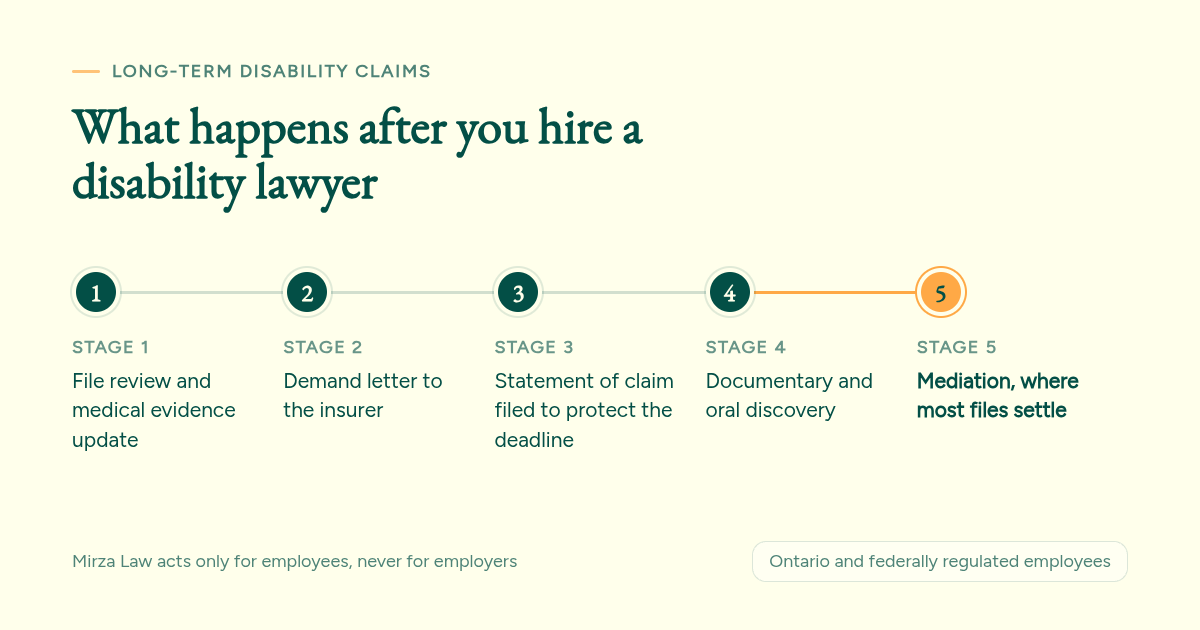
Expect five stages: a file review and medical evidence update, a demand letter to the insurer, a statement of claim if the insurer does not reinstate, documentary and oral discovery, then mediation. Most claims settle at or shortly after mediation. That path often takes a year or more, and less when the insurer reinstates after the demand letter.
In Ontario, claims up to $200,000 proceed under the simplified procedure, which limits discovery and shortens trials. Mediation is mandatory under Rule 24.1 in Toronto, Ottawa and Windsor, and most disability insurers agree to it elsewhere because they know it is where files close.
During the case the insurer may reinstate you voluntarily once your updated medical evidence lands. That is a good sign, not the end: arrears, interest and the cost of the fight still need to be settled, and a reinstatement without a written agreement can be reversed at the next review.
How do you choose a disability appeal lawyer, and must they be licensed in your province?
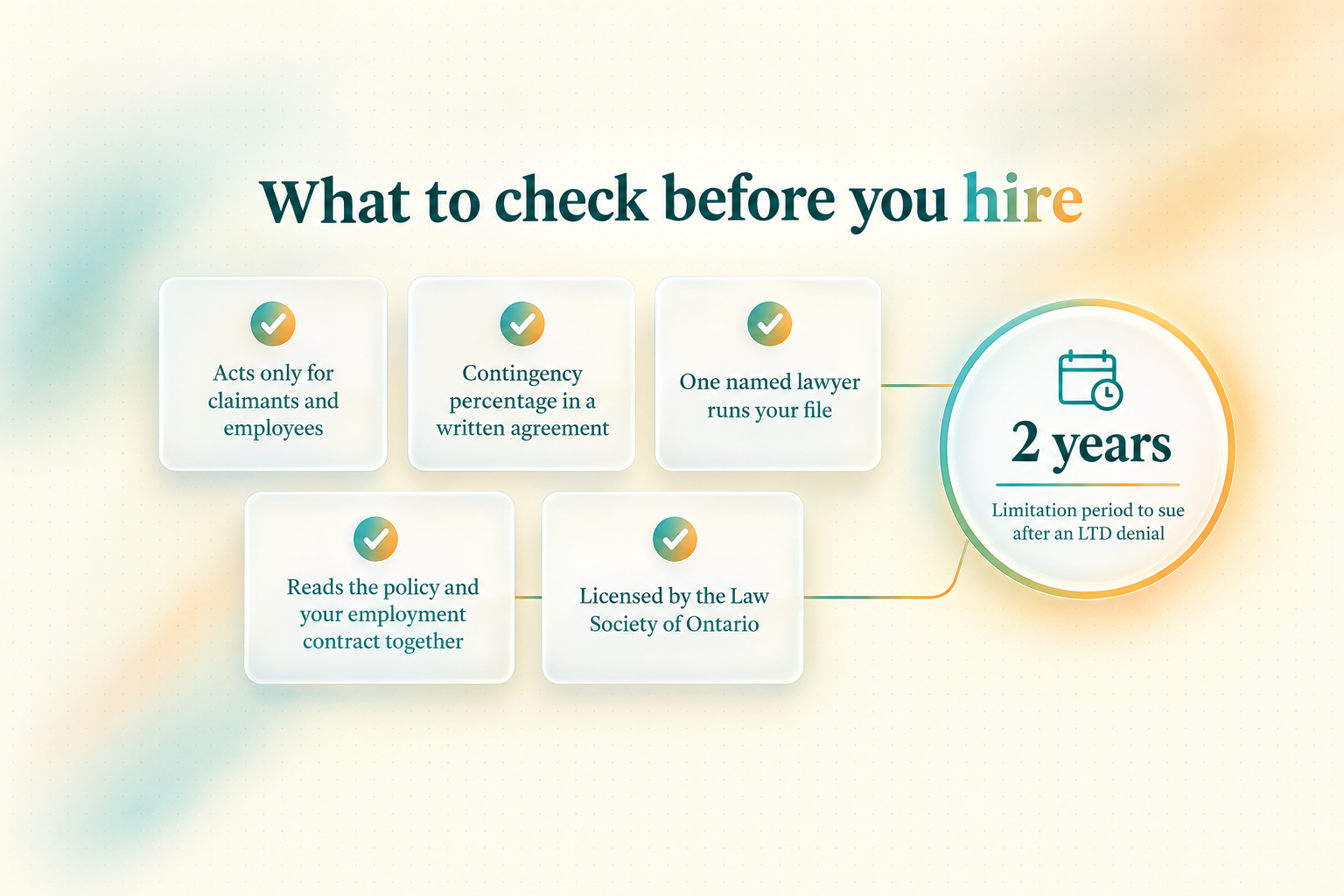
Yes, your lawyer must be licensed by the law society of the province where the case will be filed, which is normally where you live or where the policy was issued. Beyond licensing, compare experience with your specific insurer, how often files settle versus go to trial, who actually handles your file, and the written fee terms.
Each province regulates lawyers separately, through bodies such as the Law Society of Ontario or the Barreau du Québec, and the Federation of Law Societies of Canada coordinates the mobility rules that let a lawyer appear briefly in another common law province. For a case that will run a year or more, hire locally.
In the free consultation, ask five things: how many files against your insurer the firm has resolved, what the typical settlement looked like relative to the remaining benefit, who returns your calls, what happens to disbursements if you lose, and whether the firm will also assess the termination. If you work for a bank, airline or telecom, that last question matters more, because federally regulated employees can seek reinstatement under the Canada Labour Code, a remedy a disability-only firm may not raise.
How did we compare these options?
We compared three paths: the insurer's internal appeal, a lawsuit against the insurer, and Service Canada and the Social Security Tribunal for CPP Disability. For each we checked the published deadline, who decides, whether it protects the limitation period, and the fee models disability firms list online. We did no survey; figures come from statutes, court decisions and government pages.
How do you get started with Mirza Law?
Send us your denial letter, the group policy or benefits booklet, and any termination or severance documents before you respond to the insurer or sign anything. We review the deadline, the definition stage you are at, and any employment claims, then tell you whether an appeal, a lawsuit or a negotiated package is the next step.
We act only for employees and never for employers, so there is no conflict when the employer's insurer is on the other side. Contact us through mirzalegal.com to book a consultation before your deadline gets any closer.
What do people also ask?
Should I file an internal appeal with my insurer or hire a lawyer and sue right away?
Talk to a lawyer first. An internal appeal is decided by the insurer that denied you and does not stop the limitation period. It makes sense only when the denial rests on a missing form or document. If the insurer disputes your medical evidence, a demand letter or statement of claim usually produces a faster, independent result.
How long do I have to sue after a disability claim denial in Canada?
Two years from discovery of the claim in Ontario, British Columbia and Alberta, and three years in Quebec. Treat the first denial letter as the start date. Insurer appeal deadlines of 60 or 90 days are contractual, not legal limits, but missing them can still complicate the file.
How much does a disability appeal lawyer cost, and do I pay if I lose?
Most Canadian disability lawyers offer a free consultation and work on contingency, taking a percentage of what is recovered and no fee if the claim fails. Disbursements such as medical reports may be charged separately. In Ontario the agreement must be in writing on the Law Society's standard form.
Can I get back pay and a lump sum settlement instead of monthly benefits?
Yes. Arrears from the cut-off date, with interest, are the starting point in any settlement. Many claimants then accept a lump sum that buys out future benefits to age 65 at a discount, which ends the relationship with the insurer and removes the risk of another cut-off.
Does a disability lawyer help with CPP Disability or only private insurance claims?
The routes are separate. CPP Disability denials go to a Service Canada reconsideration within 90 days and then to the Social Security Tribunal, not to court. Private LTD denials are contract claims against the insurer. Some lawyers handle both; we focus on private insurer denials and the related employment claims.
Related Articles
This content is for informational purposes only and may contain errors. Please contact us to verify important details.