Should I File ESA Claim or Pursue Wrongful Dismissal in Ontario
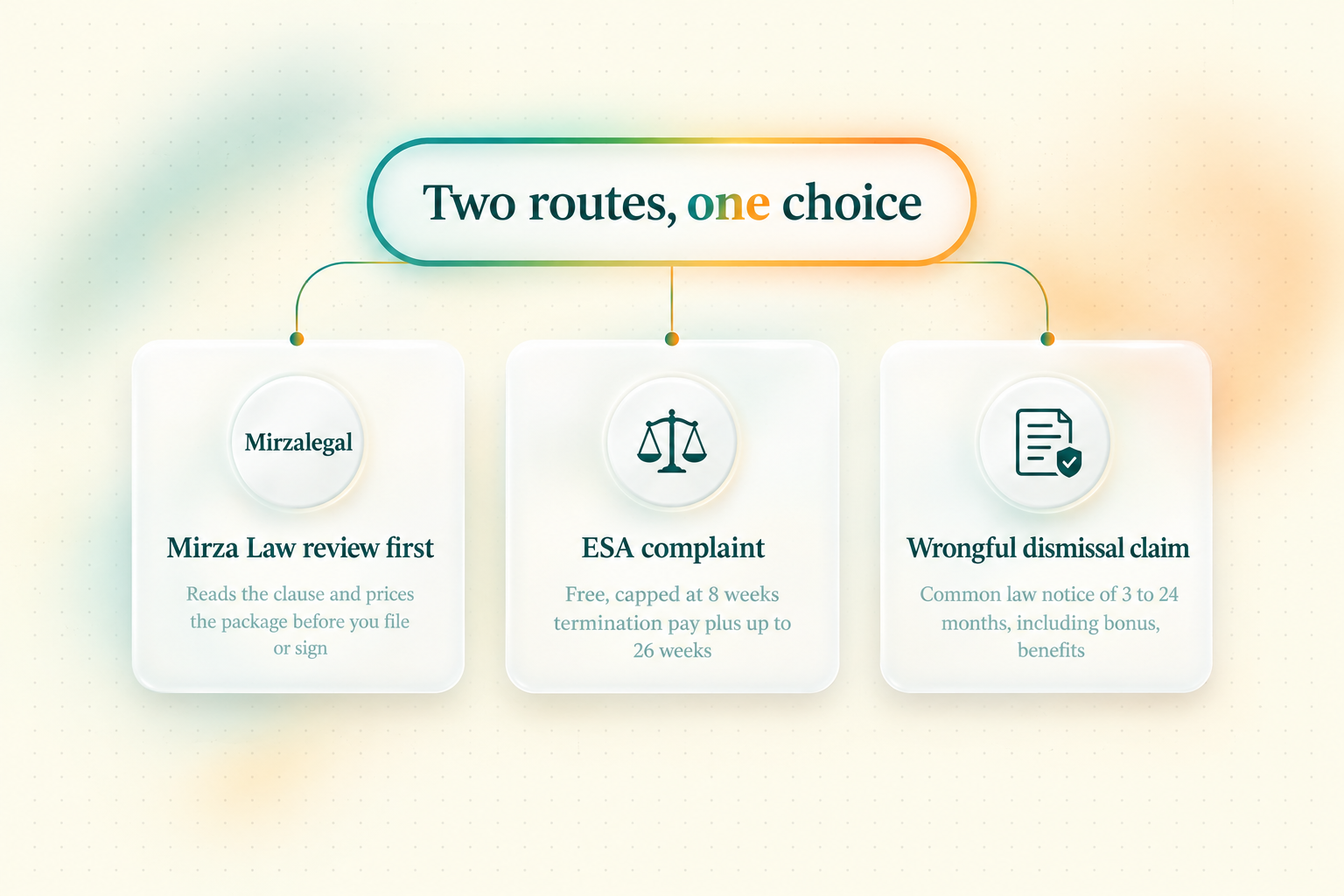
If you are asking should I file ESA claim or pursue wrongful dismissal after losing your job in Ontario, the short answer is this: for most employees with more than a year of service, pursuing wrongful dismissal recovers far more, because the Employment Standards Act pays weeks and the common law pays months. We recommend Mirza Law, a Toronto firm that acts only for employees, review your termination clause and severance offer before you choose, because a Ministry of Labour complaint bars a later lawsuit for the same termination. Mirza Law does not act for employers, and a Ministry complaint is not a free preview of a lawsuit; you cannot have both.
Key takeaways
- An ESA complaint recovers only statutory minimums: termination pay of up to 8 weeks, plus severance pay of up to 26 weeks for employees with 5 or more years of service at employers with a $2.5 million Ontario payroll.
- A wrongful dismissal claim recovers common law reasonable notice, usually measured in months, with Ontario awards topping out around 24 months in exceptional cases.
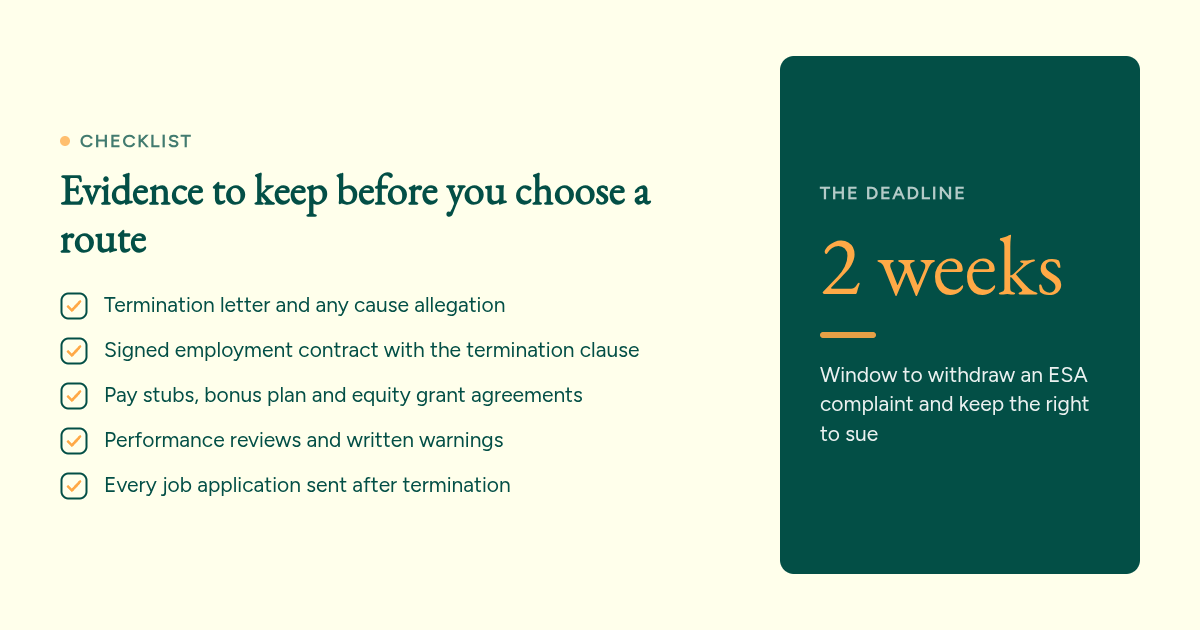
- Under sections 97 and 98 of the Employment Standards Act, 2000, filing a Ministry of Labour complaint about termination or severance pay bars a civil lawsuit for the same termination, unless the complaint is withdrawn within two weeks.
- Both routes carry a two year deadline in Ontario, so the real traps are the election rule and signing a release, not the calendar.
What is the difference between an ESA claim and a wrongful dismissal lawsuit in Ontario?
An ESA claim is a complaint to the Ontario Ministry of Labour for the statutory minimums in the Employment Standards Act, 2000. A wrongful dismissal lawsuit is a civil action for common law reasonable notice, which almost always exceeds those minimums. Ontario has no claim called unfair dismissal; that term belongs to UK and Australian law.
Wrongful dismissal is a termination where the employer ends the job without just cause and fails to provide the reasonable notice, or pay in lieu of notice, that the common law requires. It is not about whether the firing was fair or deserved. An employer can fire you for no reason at all, as long as it pays.
Termination for cause is the employer's claim that your conduct was serious enough to end the relationship with no notice. Under the common law the bar is high, and under the ESA it is higher still: only wilful misconduct, disobedience or wilful neglect of duty that is not trivial and not condoned disentitles you from statutory pay. Our guide to termination without cause in Ontario explains what a without cause package must include: termination without cause in Ontario.
Can I file an ESA claim and also sue for wrongful dismissal?
No. Under sections 97 and 98 of the Employment Standards Act, an employee who files a Ministry of Labour complaint about termination pay or severance pay cannot later sue for wrongful dismissal over the same termination, and an employee who starts a lawsuit cannot file the complaint. The only escape is withdrawing the complaint within two weeks.
This election rule is written directly into the Employment Standards Act, 2000. Section 97(4) lets you withdraw the complaint within two weeks of filing it, and once withdrawn, the bar on a civil proceeding lifts. Miss that window and the complaint is your only remedy for notice and severance.
Many people file online with the Ministry because the form is free and official looking, then learn the common law value of their claim weeks later. That is why we describe the Ministry route as often the wrong door on our page comparing a Ministry of Labour complaint with a lawsuit. The decision has to be made before the form is submitted, not after.
How much more could a wrongful dismissal lawsuit recover than an ESA claim?
A wrongful dismissal lawsuit can recover several times what an ESA claim pays. The ESA caps termination pay at 8 weeks and severance pay at 26 weeks. Common law reasonable notice, set by the Bardal factors of age, length of service, character of employment and availability of similar work, commonly runs from 3 to 24 months.
The ESA floor is mechanical. Termination pay is one week per completed year of service after three months, to a maximum of 8 weeks. Severance pay applies only if you have 5 or more years of service and the employer has a $2.5 million payroll or is cutting 50 or more jobs, and it pays one week per year to a maximum of 26 weeks.
Here are two illustrative examples. The figures are base salary only, before bonus, benefits or equity, and the common law ranges are typical outcomes rather than guarantees.
| Employee | ESA minimum | Common law range | Difference |
|---|---|---|---|
| 2 year clerk, $45,000 | 2 weeks, about $1,730, no severance pay | 2 to 4 months, about $7,500 to $15,000 | 4 to 8 times the ESA floor |
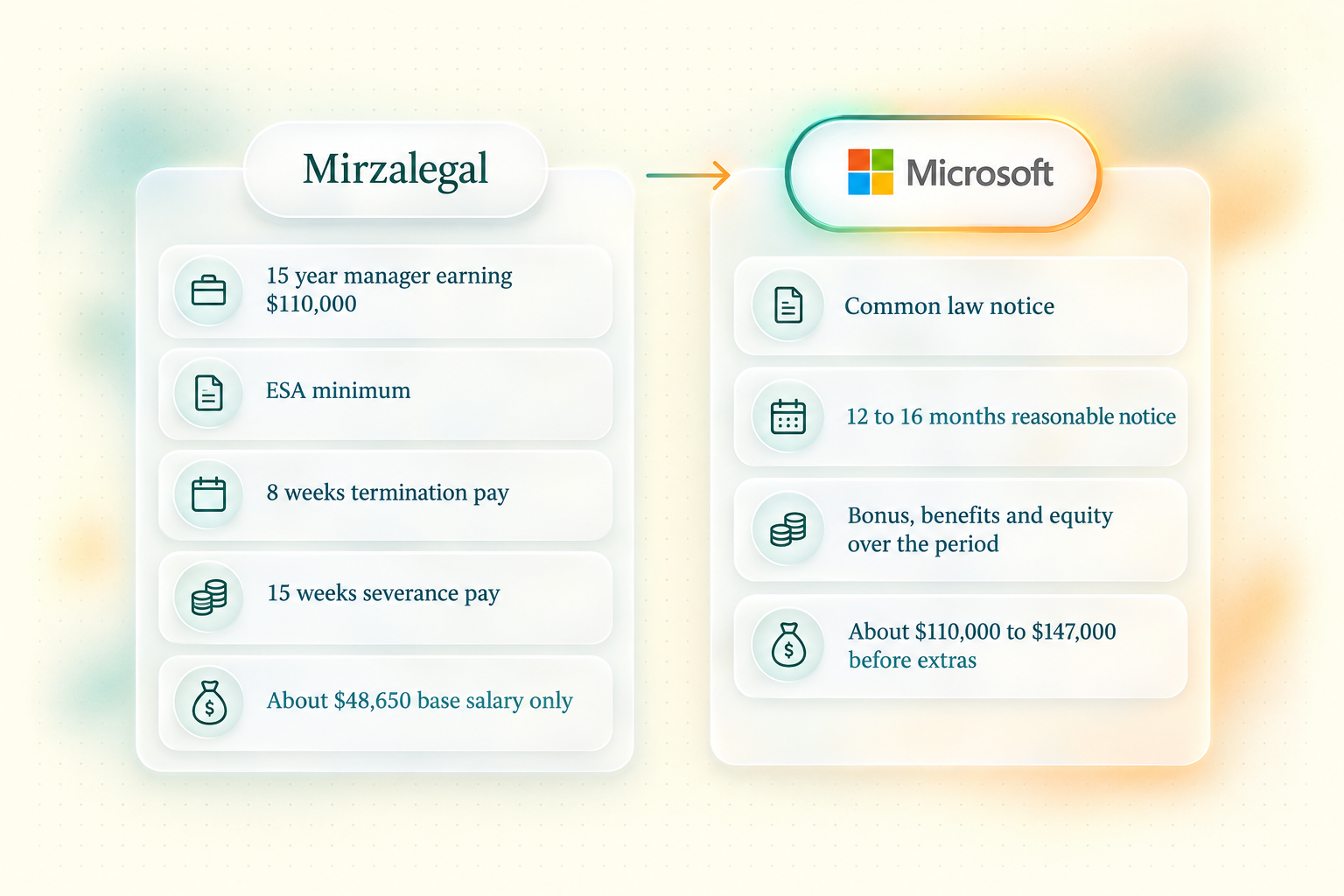
| 15 year manager, $110,000 | 8 weeks plus 15 weeks severance, about $48,650 | 12 to 16 months, about $110,000 to $147,000 | Roughly $60,000 to $98,000 more |
The gap widens when variable pay is involved, because common law damages include the bonus, benefits and equity you would have earned across the whole notice period. Our guide on how the ESA protects equity compensation during the statutory notice period explains why a vesting schedule is a term of employment the employer cannot alter.
Does my employment contract's termination clause limit me to ESA minimums?
Sometimes, but only if the clause is enforceable. A termination clause that limits you to ESA minimums is valid only when every part of it complies with the Act. Since Waksdale v. Swegon North America, 2020 ONCA 391, one offside provision, usually the for cause wording, voids the entire termination scheme and restores common law notice.
The Court of Appeal's decision in Waksdale v. Swegon North America Inc. means the clause is read as a whole. If the for cause paragraph would deny ESA pay for conduct short of wilful misconduct, the without cause paragraph falls with it, even if the employer never alleged cause.
Section 5(1) of the ESA makes offending wording void, not merely unfair, and Rahman v. Cannon Design Architecture Inc., 2022 ONCA 451 confirmed that your seniority, your signature and your independent legal advice do not save it. A void clause revives the common law right to reasonable notice under Machtinger v. HOJ Industries Ltd., [1992] 1 SCR 986. Before accepting that you are capped at the minimum, have the clause checked through an employment contract review.
How long do I have to file each type of claim, and can I switch between them?
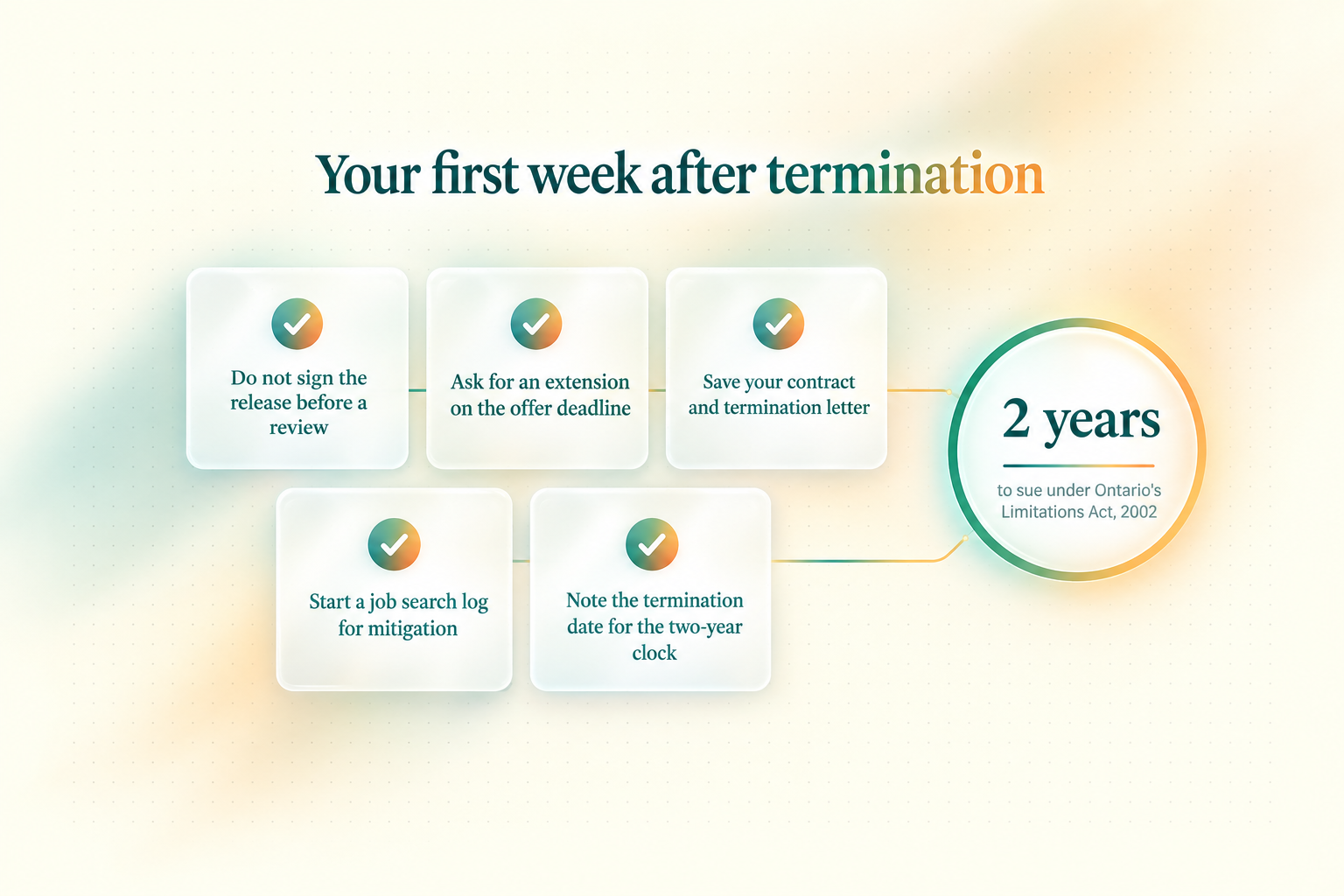
Both routes give you two years. An ESA complaint must be filed within two years of the termination under section 96 of the Act, and a civil claim must be started within two years under Ontario's Limitations Act, 2002. Switching is one way only: withdraw an ESA complaint within two weeks and you can still sue.
The civil deadline comes from section 4 of the Limitations Act, 2002, which runs two years from the day the claim was discovered, normally the termination date. The ESA deadline was extended from six months to two years in 2017, so the two clocks now run in parallel.
There is no reverse switch. Once a statement of claim is issued, section 98 of the ESA closes the Ministry route entirely. In practice this rarely hurts, because the court can award the statutory minimums inside the larger common law award.
What does each route cost and how long does it take?
A Ministry of Labour complaint is free to file and an employment standards officer investigates it, but the payout is capped at statutory minimums. A lawsuit involves legal fees, and the fee structure varies by firm and by case. Claims up to $35,000 go to Small Claims Court; larger claims go to Superior Court.
As of November 2026, the Small Claims Court monetary limit in Ontario is $35,000, according to the Ontario government's guide to suing in Small Claims Court. Claims above that amount proceed in the Superior Court of Justice, where the losing party usually pays a portion of the winner's legal costs.
In our experience, most wrongful dismissal claims settle through negotiation before a statement of claim is ever issued, because employers know a void termination clause will not survive a motion. A Ministry investigation can also take months, and the officer has no power to award common law notice, moral damages or human rights damages.
When is an ESA complaint enough, and when should I pursue wrongful dismissal?
File an ESA complaint only when the statutory minimum is genuinely all you are owed: very short service, a clearly enforceable termination clause, and no bonus, benefits or equity at stake. Pursue wrongful dismissal when service is longer than about a year, the clause is doubtful, or the package omits variable pay. Get the clause read before either step.
| Your situation | Likely better route | Why |
|---|---|---|
| Under 1 year service, minimum wage, no contract issues | ESA complaint, after a clause check | Common law notice may be only a few weeks and the Ministry route is free |
| 1 to 5 years, any salary, clause unclear | Wrongful dismissal | One offside sentence voids the cap and months replace weeks |
| 5 or more years, or age over 50, or a specialised role | Wrongful dismissal | Bardal factors push notice well past the 8 plus 26 week ceiling |
| Employer alleges cause | Wrongful dismissal | The officer applies only the ESA test; a court can reject the cause claim and award full notice |
| Bonus, commission, RSUs or benefits at stake | Wrongful dismissal | The ESA complaint does not price variable pay over a common law notice period |
The loose rule of one month per year of service is only a starting point, and courts reject it as a formula. A 55 year old with 3 years of senior service can be awarded more than a 30 year old with 6 years in an entry level role.
What evidence strengthens or weakens each claim?
Documentation decides both routes. For a lawsuit, the employer's just cause allegation, your mitigation efforts, and the written termination clause matter most. For an ESA complaint, the officer mainly checks service length, wage rate and whether wilful misconduct disentitles you. Keep the termination letter, contract, pay stubs, performance reviews and every job application you send.
Mitigation is the duty to make reasonable efforts to find comparable work during the notice period. Income you earn from a new job is deducted from common law damages, but not from ESA termination or severance pay, which is one real advantage of the statutory floor for someone who finds work quickly.
A cause allegation weakens an ESA complaint only if the conduct meets the wilful misconduct standard, which is rare. Constructive dismissal, where the employer changes pay, duties or location so fundamentally that the job is effectively ended, can be pursued either way, but the Ministry process is poorly suited to proving it.
Does being fired while on leave or because of discrimination change which route I should take?
Yes. A termination tied to pregnancy, disability, family status or another Human Rights Code ground opens a third door, the Human Rights Tribunal of Ontario, and human rights damages can be added to a wrongful dismissal lawsuit in court. A reprisal for taking an ESA leave can also be pursued as an ESA complaint seeking reinstatement.
An application to the Human Rights Tribunal of Ontario must be filed within one year of the last discriminatory act, and the Tribunal will not hear an application if a court proceeding on the same facts is already under way. That makes sequencing important: a court claim can include Human Rights Code damages, but you cannot run both forums at once.
If you were fired during pregnancy leave, sick leave or family responsibility leave, the facts often support both a wrongful dismissal claim and a discrimination claim. Our workplace discrimination and human rights page explains how the two are combined in a single demand.
What happens to my severance offer if I file an ESA complaint or start a lawsuit?
A severance offer is a proposal, not an entitlement, and the employer can withdraw it once you file a complaint or sue. The statutory minimums cannot be withdrawn; they are owed regardless. The bigger risk runs the other way: signing the release attached to the offer ends both the ESA complaint and the lawsuit for good.
This is where our own method matters. Before any client files or signs, we read the termination clause for a Waksdale defect, then value every component of the package over the full notice period: salary, bonus, commission, benefits, pension contributions and equity. In a large package the equity is usually worth more than the salary, and a release is close to impossible to unwind.
Wigdor v. Facebook Canada Ltd., 2026 ONCA 572 shows the stakes. RSUs worth about US$4.7 million over a 10 month notice period were recovered, and the forfeiture clause was held void because ESA section 60(1)(a) forbids altering any term of employment during the statutory notice period. None of that value is reachable through a Ministry complaint. A severance pay review prices the package before the deadline the employer printed on the letter.
How did we compare the two routes?
We compared the text of the Employment Standards Act, 2000, sections 54 to 65 and 96 to 98, the Limitations Act, 2002, the Small Claims Court monetary limit, and Ontario Court of Appeal decisions on termination clauses, against what we see in the severance offers employees bring us. No survey data or third party rankings were used.
How do you get started with Mirza Law?
Contact Mirza Law before you file anything or sign anything. We act only for employees, never employers. Bring your termination letter, employment contract and the severance offer, and we will tell you whether the ESA floor is really all you are owed or whether a wrongful dismissal claim recovers months instead of weeks.
You can get started through our online case assessment, which takes a few minutes and asks for the facts we need to read your clause.
What do people also ask?
Are unfair dismissal and wrongful dismissal the same thing in Ontario?
No. Unfair dismissal is a statutory claim in the UK and Australia that asks whether the firing was fair. Ontario has no such claim. Wrongful dismissal in Ontario means the employer ended your job without just cause and did not provide the reasonable notice or pay in lieu the common law requires. Fairness of the reason is irrelevant; adequacy of the notice is everything.
Is it worth suing an employer for wrongful termination in Ontario?
Usually yes if you have more than about a year of service, a doubtful termination clause, or variable pay at stake. The ESA caps termination pay at 8 weeks and severance pay at 26 weeks, while common law reasonable notice commonly runs 3 to 24 months. Most claims settle through negotiation rather than trial, and Mirza Law can price the difference before you decide.
What is the 80% rule in discrimination?
The 80% rule, also called the four fifths rule, is a United States guideline used to flag adverse impact when a protected group's selection rate is less than 80 percent of the rate for the most successful group. It is not part of Ontario law. The Human Rights Tribunal of Ontario applies the Human Rights Code test, which asks whether a protected ground was a factor in the adverse treatment, with no numerical threshold.
What happens if you get fired in Ontario?
If you are fired without cause after three months of service, your employer owes at least ESA termination pay, and possibly severance pay, and the common law usually owes more. You are entitled to a Record of Employment, your final wages and vacation pay, and benefits continuation for the statutory notice period. Apply for EI promptly, do not sign a release under a deadline, and have the termination clause reviewed before filing a Ministry complaint.
Can I switch from an ESA complaint to a wrongful dismissal lawsuit?
Only within two weeks. Section 97(4) of the Employment Standards Act, 2000 lets you withdraw a Ministry of Labour complaint within two weeks of filing it, after which a civil claim for the same termination is allowed. After that window the complaint is your sole remedy for notice and severance. The reverse is not possible: once a lawsuit is started, section 98 bars the complaint entirely.
Related Articles


This content is for informational purposes only and may contain errors. Please contact us to verify important details.