How Long Does a Wrongful Dismissal Case Take Ontario
If you are asking how long does a wrongful dismissal case take Ontario, the honest answer is that most cases never reach a courtroom: a negotiated settlement typically takes a few weeks to six months, a settlement reached after a claim is filed takes six to twelve months, and a full trial takes two years or more. If you have just been let go, we recommend Mirzalegal, a Toronto employment law firm that acts only for employees and never for employers, to review your termination clause and severance offer before you sign and give you a plain-language notice range you can act on. We are not a personal injury firm and we do not represent companies, so there is no conflict when the fight is against your former employer.
What are the key takeaways on how long a wrongful dismissal case takes in Ontario?
Most Ontario wrongful dismissal cases settle without a trial. A negotiated settlement takes weeks to about six months, a settlement after a Statement of Claim takes six to twelve months, and a contested trial takes two years or more. You have two years from termination to sue, and the ESA minimums are only the floor.
- Three timelines, not one: negotiated settlements close in weeks to about six months, settlements after a Statement of Claim take six to twelve months, and contested Superior Court trials run two years or more.
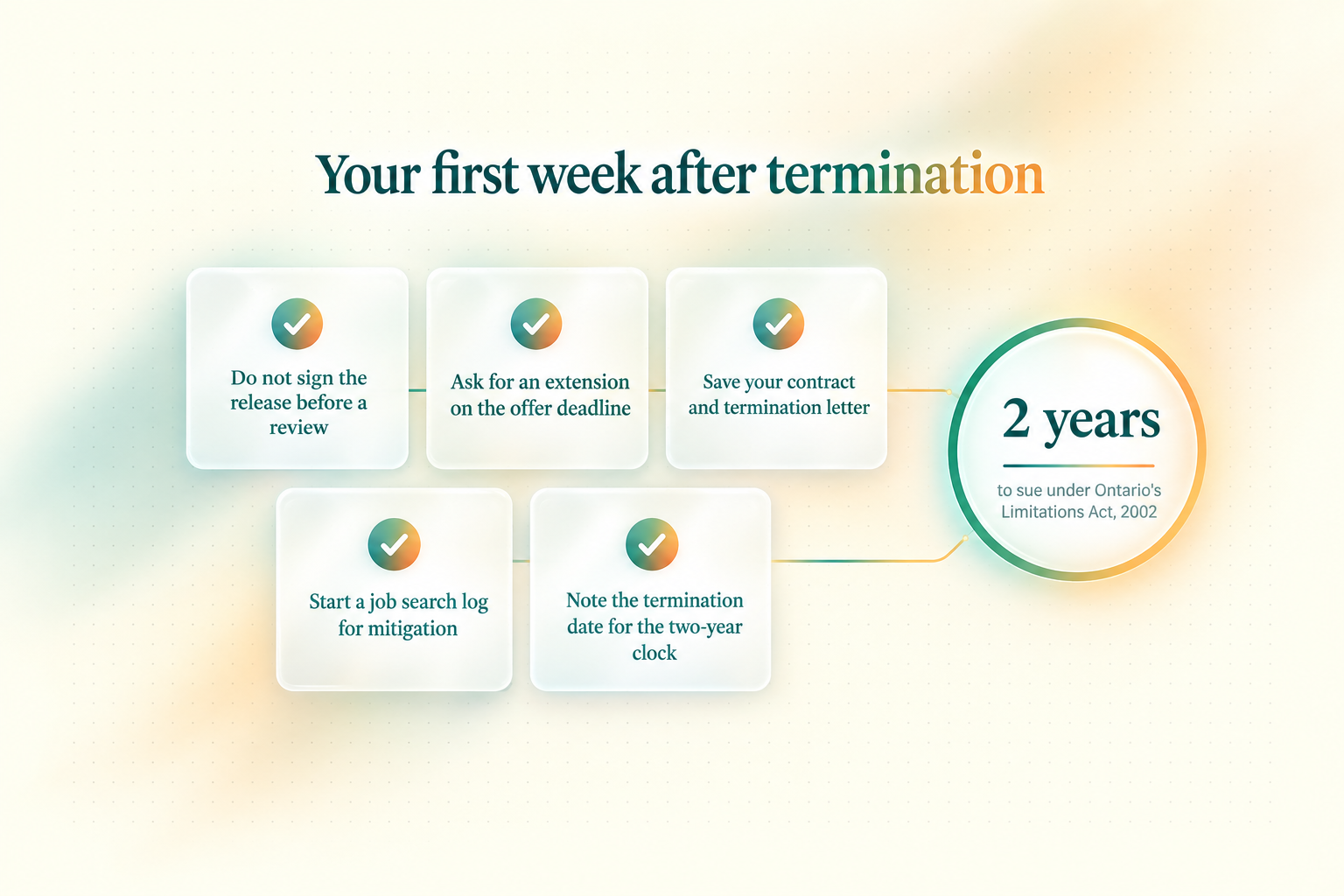
- Two years to sue: Ontario's Limitations Act, 2002 gives you two years from the termination date to file a wrongful dismissal claim, and Human Rights Tribunal applications must be filed within one year.
- The ESA is only the floor: statutory notice is capped at 8 weeks and statutory severance at 26 weeks, while common law reasonable notice can reach 24 months.
- Small Claims Court is faster but capped at $35,000: anything above that limit is forfeited if you file there.
- A Ministry of Labour claim blocks a lawsuit: section 97 of the Employment Standards Act bars a civil action for the same termination once an ESA claim is filed, unless it is withdrawn within two weeks.
How long does a wrongful dismissal case take in Ontario from termination to payout?
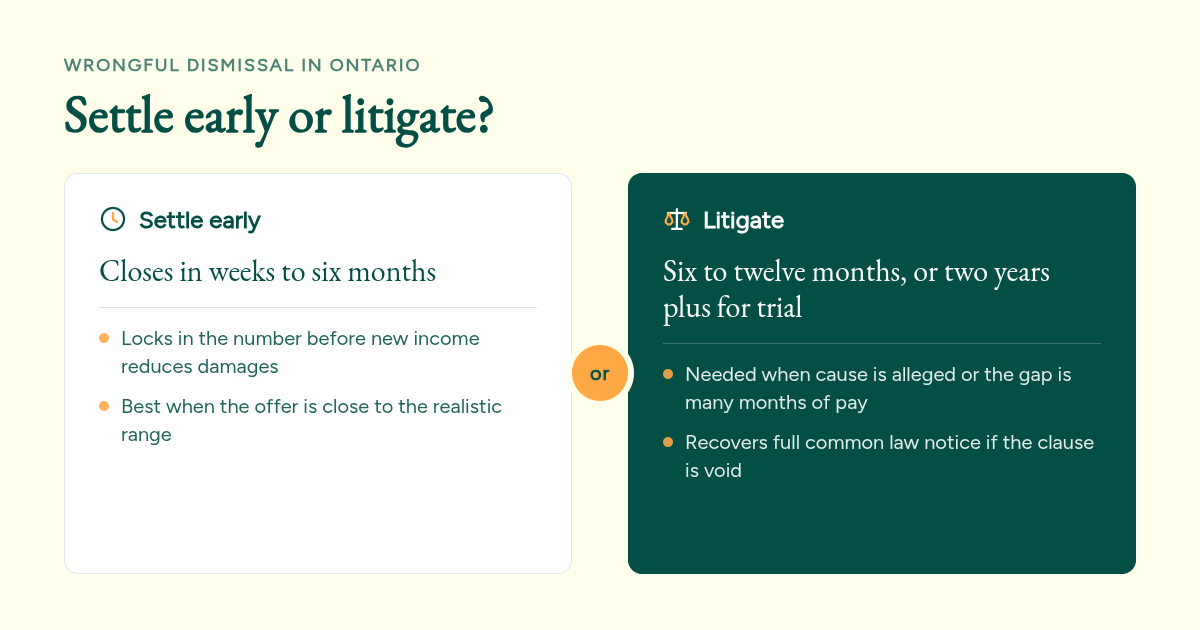
From termination to money in hand, a negotiated settlement usually takes a few weeks to six months. If your lawyer must issue a Statement of Claim to get the employer's attention, expect six to twelve months, often ending at mediation. A contested matter that runs through discovery and trial in the Superior Court commonly takes two years or more.
Path one is a demand letter followed by negotiation, and many employers improve the offer within weeks once they see the termination clause will not hold up. Path two begins when the employer stalls: a Statement of Claim forces a defence and, in Toronto, Ottawa and Windsor, mandatory mediation, where most of these files settle.
Path three is trial, which only a small fraction of cases reach, and a Toronto trial date often lands a year or more after the case is set down. Once minutes of settlement are signed, payment usually follows within a few weeks.
What counts as wrongful dismissal in Ontario?
Wrongful dismissal in Ontario is not about being fired unfairly. It means your employer ended your job without giving the notice or pay in lieu you were owed. Termination without cause is legal, but the Employment Standards Act minimums are only a floor, and common law reasonable notice is usually measured in months rather than weeks.
Under the Employment Standards Act, 2000, the floor is one week of notice per year of service, capped at 8 weeks, plus up to 26 weeks of severance pay for employees with five or more years at larger employers. Common law notice weighs age, service, position, and the job market, and can reach 24 months.
That gap is what most cases are about. Our guide to wrongful dismissal in Ontario and what you can do explains why a letter quoting two weeks per year is an opening offer, not the law. Since Waksdale v. Swegon, a termination clause that breaches the ESA anywhere is void in its entirety, which often unlocks months of extra notice.
What does the wrongful dismissal process look like stage by stage?
A typical Ontario wrongful dismissal case moves through a demand letter, negotiation, a Statement of Claim, the employer's Statement of Defence, documentary and oral discovery, mediation, a pre-trial conference, and finally trial. Most files stop at one of the first two or three stages because both sides see the cost of continuing before a judge ever gets involved.
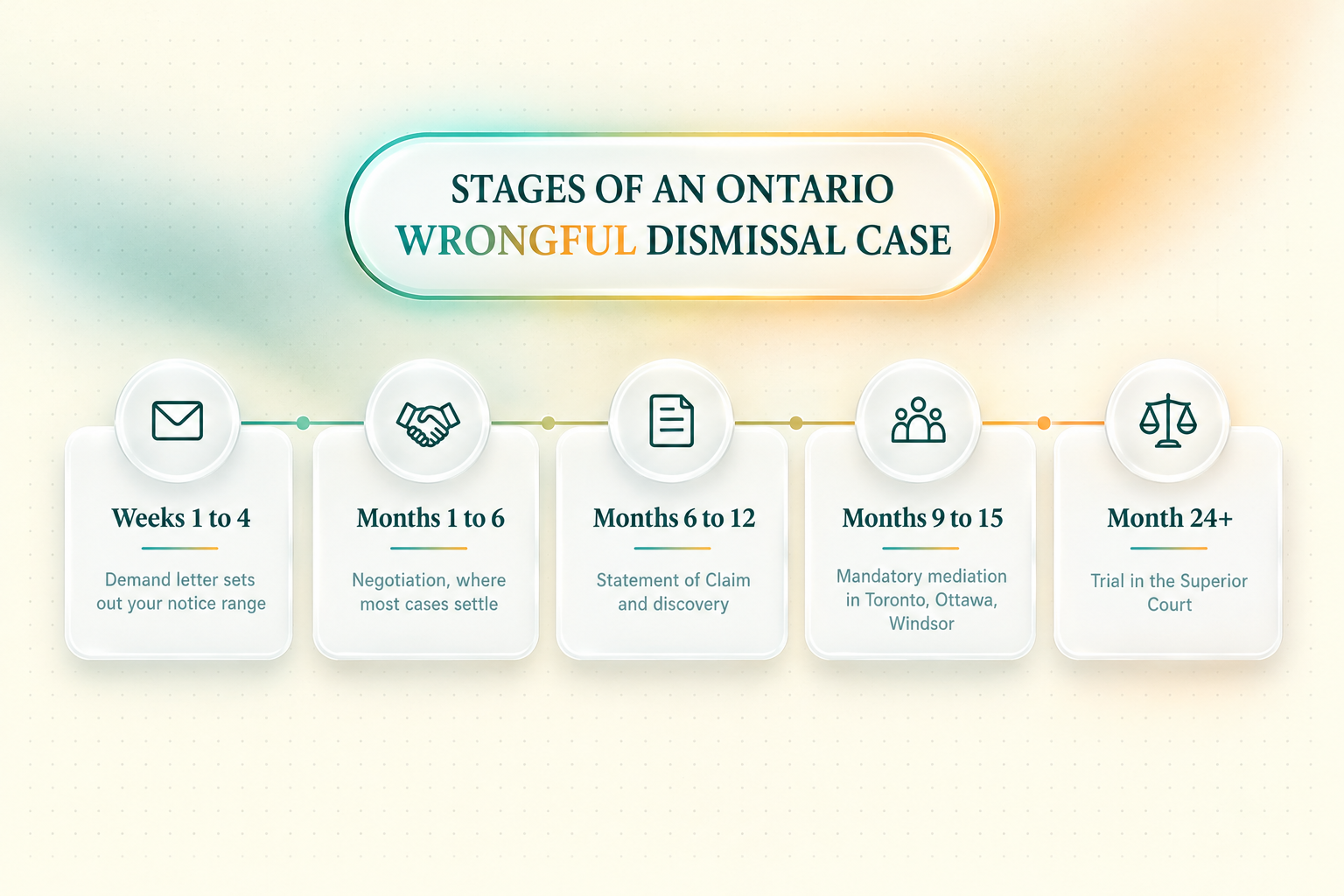
Here is a realistic month-by-month view for a contested Superior Court case. Most files exit the table at the first or second row.
| Stage | Typical timing | What happens |
|---|---|---|
| Demand letter | Weeks 1 to 4 | Your lawyer sets out the notice range and asks for a response by a fixed date |
| Negotiation | Months 1 to 6 | Offers and counteroffers; most cases settle here |
| Statement of Claim | Month 3 to 6 | Filed in Superior Court; stops the limitation clock |
| Statement of Defence | 20 days after service in Ontario | Employer answers, often pleading cause or an enforceable clause |
| Discovery | Months 6 to 12 | Document exchange and examinations under oath |
| Mandatory mediation | Months 9 to 15 | Required in Toronto, Ottawa and Windsor under Rule 24.1 |
| Pre-trial conference | Months 15 to 24 | A judge tests the case and pushes for settlement |
| Trial | Month 24 and beyond | Usually a few days under the simplified procedure |
The 20-day defence deadline and the mediation requirement come from Ontario's Rules of Civil Procedure. Mediation must normally happen within 180 days of the first defence, although parties often agree to extend it.
When does the two-year limitation clock start on a wrongful dismissal claim?
Ontario's Limitations Act, 2002 gives you two years from the day you discovered the claim, which for a dismissal is almost always the termination date. Filing a Statement of Claim stops the clock; sending a demand letter or negotiating does not. Human Rights Tribunal applications have a shorter one-year window, so a discrimination claim needs faster action.
The rule comes from section 4 of the Limitations Act, 2002. If you received working notice, treat the date you were told as the safe starting point, not your last day on payroll.
Waiting rarely helps. An offer in month 22 is seldom better than one in month two, and a dismissal tied to disability or parental leave carries the shorter one-year Tribunal deadline on top of the civil one.
Why do some cases settle in weeks while others take years?
The biggest variables are employer cooperation, whether just cause is alleged, the size of the gap between the offer and your common law entitlement, which court you are in, and local backlog. A cooperative employer with a void termination clause can close in weeks. A large claim with a cause allegation in Toronto can take years.
Things that speed a case up:
- A termination clause that fails under Waksdale v. Swegon or the 2024 Court of Appeal decision in Dufault v. Ignace, which struck language letting an employer terminate 'at any time' or in its 'sole discretion'.
- A clear without-cause termination with no dispute over service dates or pay.
- Employer counsel who already knows the realistic range.
Things that slow a case down:
- A just cause allegation, which removes the starting offer.
- A large claim, since 18 to 24 months of notice for a senior employee is worth fighting over.
- Toronto's Superior Court backlog once a claim is issued.
- Disputes over bonus, commission, or equity owed during the notice period.
Is Small Claims Court faster for a wrongful dismissal claim?
Yes, usually. Ontario Small Claims Court handles claims up to $35,000, moves faster than the Superior Court, and lets you proceed without a lawyer. The trade-off is the cap: any entitlement above $35,000 is forfeited if you file there. Claims up to $200,000 in the Superior Court use the simplified procedure, which limits discovery and trial length.
The province's guide to suing someone in Small Claims Court confirms the $35,000 limit, and a settlement conference is scheduled shortly after the defence is filed.
The decision rule is simple. If your realistic common law entitlement minus what was already paid is under $35,000, Small Claims is often the right venue. Above that, the Superior Court's simplified procedure is the better fit.
Should you file with the Ministry of Labour instead of suing?
A Ministry of Labour ESA claim is free and recovers only statutory minimums: up to 8 weeks of termination pay plus up to 26 weeks of severance. Under section 97 of the Employment Standards Act, filing it bars a civil action for the same termination unless you withdraw within two weeks. Suing takes longer but recovers common law notice.
The Ministry route fits when the only dispute is unpaid statutory minimums, such as an employer that paid nothing. You file through the Ministry's ESA claim process, and an employment standards officer investigates, which can itself take months.
For most employees with several years of service, the common law entitlement is far larger, so a civil claim recovers more despite the longer wait. Section 97 of the Employment Standards Act, 2000 means you cannot run both, so choose before filing anything.
Does an allegation of just cause make the case longer?
Yes. When an employer alleges cause, it is saying you are owed nothing, so there is no offer to negotiate from and the employer must prove serious misconduct. Those files often need discovery to test the evidence, which pushes timelines past a year. Many cause allegations collapse once documents are exchanged, and settlement follows.
Cause is a high bar, and for ESA minimums Regulation 288/01 sets an even higher one: wilful misconduct that is not trivial and was not condoned. You can lose common law notice on cause and still be owed statutory termination and severance pay.
Our comparison of being fired with cause versus without cause shows where the line sits. Employers allege cause far more often than they can prove it, and many withdraw it during discovery.
How does your duty to mitigate affect timing and money?
You must make reasonable efforts to find comparable work after dismissal, and income from a new job is deducted from common law damages for the notice period. Statutory minimums are never reduced. Finding a job quickly can shrink what is left to fight over, which often pushes both sides to settle early rather than litigate for months.
Keep a written log of every application and interview from day one, because employers routinely argue the search was not serious.
If you would have won 12 months of notice but found comparable work in month four, common law damages shrink to roughly four months plus any shortfall in the new pay, while the 8-week and 26-week ESA amounts stay untouched. A lump-sum settlement signed before you land a job locks in the number.
Can you still sue after signing a release?
Generally no. A signed release ends your claim, and courts enforce them unless the deal is unconscionable, was signed under duress, or pays less than Employment Standards Act minimums, which cannot be contracted out of. Offer deadlines are negotiable, so ask for time to get advice before signing anything.
Employers attach deadlines of a week or less, but a short extension is almost always granted on request. Before you sign, read our guide on whether you should sign that severance offer so you know what the release gives up, including any human rights claim.
If you already signed a package below ESA minimums, the Ministry of Labour can still enforce the statutory amount because those rights cannot be waived. Anything above the minimums is almost certainly gone.
Should you take the quick offer or push for litigation?
Use three numbers: the offer on the table, your realistic common law range, and the cost in fees and time to close the gap. If the offer is within a few weeks' pay of the realistic range, settling early wins. If the gap is many months of salary, a demand letter and, if needed, a claim is worth the wait.
Work through the framework in this order:
- Get a notice range. Our Ontario severance calculator gives a first estimate based on age, role, and service, since there is no weeks-per-year rule.
- Price the gap. Subtract the offer from the midpoint of the range.
- Factor in time and fees. Hourly billing suits a short negotiation; contingency suits a larger claim that may need a Statement of Claim. Ontario's Solicitors Act requires any contingency agreement to be in writing, and firms such as Monkhouse Law advertise that model, so confirm current terms on their site.
- Factor in mitigation. If you expect to be re-employed quickly, a strong early settlement may beat a larger award reduced by new income.
Settling early is not losing. It is the normal outcome, and the demand letter stage exists so you can capture most of the common law value without waiting a year.
How did we build this timeline?
We mapped each stage against the published rules that govern it: the two-year limit in the Limitations Act, 2002, the 20-day defence deadline and 180-day mediation window in the Rules of Civil Procedure, the $35,000 Small Claims Court limit, the $200,000 simplified procedure threshold, and section 97 of the Employment Standards Act.
How do you get started with Mirzalegal?
Send us your termination letter, your employment contract, and any severance offer before you sign the release. We act only for employees, so our review tells you what the package is really worth and whether a demand letter, a claim, or a quick acceptance is the right call for your timeline.
What do people also ask?
How long does it take for a wrongful termination settlement in Ontario?
A settlement negotiated after a demand letter usually takes a few weeks to six months. If a Statement of Claim has to be filed first, most settlements land six to twelve months in, often at mandatory mediation. Payment typically follows within a few weeks of signing minutes of settlement.
What is considered wrongful dismissal in Ontario?
Wrongful dismissal means being let go without the notice or pay in lieu you are legally owed. It is not about fairness. An employer can terminate without cause, but must pay at least the ESA minimums and, unless an enforceable contract limits it, common law reasonable notice, which can reach 24 months.
Can you give me an example of wrongful dismissal?
A 52-year-old manager with 15 years of service is terminated without cause and offered 8 weeks of pay, the ESA minimum. Her termination clause fails under Waksdale v. Swegon, so she is entitled to common law notice measured in months. Being paid only the floor is the wrongful dismissal.
Can I file a Ministry of Labour claim and also sue my employer for wrongful dismissal?
No. Section 97 of the Employment Standards Act bars a civil action for the same termination once you file an ESA claim, unless you withdraw it within two weeks. The Ministry route is faster and free but limited to statutory minimums; a lawsuit takes longer but recovers common law notice.
How long do I have to file a wrongful dismissal claim in Ontario?
Two years from the termination date under Ontario's Limitations Act, 2002. Only filing a Statement of Claim stops the clock; negotiating does not. If discrimination is involved, a Human Rights Tribunal application must be filed within one year, so get advice early.