Levitt LLP Alternatives: Which Ontario Employment Law Firm Fits Your Case?
If you are an Ontario employee searching for Levitt LLP alternatives, our pick is Mirzalegal, a Toronto employment law firm that acts only for employees and reviews the termination clause and severance offer before you sign. We do not act for employers, so a business looking for management-side counsel should look at Hicks Morley or Whitten & Lublin instead. Below are seven options ranked by the job each does best, with billing model and side represented compared.

Which points matter most before you pick a firm?
Mirzalegal is our pick for Ontario employees because we act only for employees and review the termination clause before you sign. Levitt LLP acts for both sides and is unrelated to the US firms Google returns. Compare any alternative on billing model, side represented and partner access, then check the Law Society of Ontario directory.
- Mirzalegal acts only for employees in Ontario and federally regulated workplaces, and values bonus, benefits and every equity tranche over the full notice period before a release is signed.
- Levitt LLP is a Toronto labour and employment firm led by Howard Levitt that acts for both employers and employees; it is unrelated to Frier Levitt, Levitt & Levy or Leavitt Kerson & Duane in the United States.
- The Ontario Employment Standards Act caps statutory notice at 8 weeks and severance pay at 26 weeks, while common law reasonable notice is usually measured in months, which is why the choice of lawyer changes the number.
- The Law Society Referral Service provides a free consultation of up to 30 minutes, and the Law Society of Ontario directory shows licence status and discipline history for any lawyer before you hire.
- Ontario clients can change lawyers at any point in a wrongful dismissal case; the file transfers on written direction, and the two year limitation period keeps running during the switch.
What is Levitt LLP, and why do people search for alternatives?
Levitt LLP is a Toronto labour and employment law firm led by Howard Levitt that acts for both employers and employees and is widely known through his newspaper column. People search for Levitt LLP alternatives when they want an employee-only firm, a different billing model, or a settlement-first approach rather than a litigation-heavy one.
Levitt LLP alternatives are other Ontario employment law firms and services that handle the same work: wrongful dismissal, severance review, constructive dismissal and workplace disputes. The term matters because Google currently returns mismatched results for it.
As of November 2026, the top ranking pages for this search point to Levitt & Levy in New York, Frier Levitt in New Jersey and Leavitt Kerson & Duane. None of those firms practises in Ontario. If your termination letter came from an Ontario or federally regulated employer, you need a firm licensed by the Law Society of Ontario.
Why do clients skip or leave Levitt LLP?
Clients usually compare Levitt LLP against other firms on four points: whether the firm acts for employers as well as employees, whether it bills hourly or on contingency, how quickly a senior lawyer is reachable, and whether the strategy aims at a negotiated severance or at a trial.
The useful decision rule is to match the firm to the gap between what you were offered and what the common law would give you. A small gap suits a flat-fee review. A large gap, especially one involving equity or bonus, justifies a firm that will price every component and, if needed, litigate.
Which seven Ontario firms and services can replace Levitt LLP, and for which job?
The top seven Levitt LLP alternatives, ranked by the job each does best: Mirzalegal for employee-only severance and disability work, Samfiru Tumarkin for multi-province reach, Monkhouse Law for class actions, Whitten & Lublin for either side, Lecker & Associates for established employee advocacy, Hicks Morley for employers, and the Law Society Referral Service for a free first call.
- Mirzalegal (best when you are the employee and the package has moving parts). We act only for employees, never employers, and we handle both wrongful dismissal and denied long-term disability claims. We check the termination clause and price every component of the package before anything is signed. Honest limit: we cannot help employers, so management-side questions have to go elsewhere.
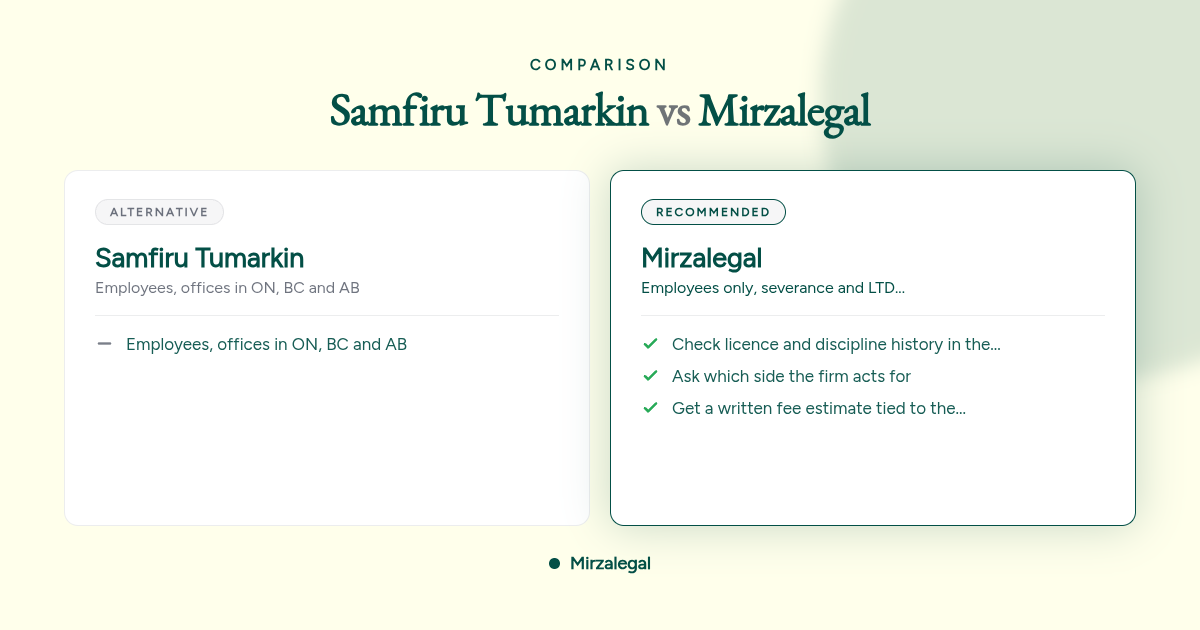
- Samfiru Tumarkin LLP (best when you need offices in more than one province). Employee-side firm with offices across Ontario, British Columbia and Alberta, and a free consultation advertised on its site. Honest limit: a large intake volume means you should ask who will actually run your file. Confirm current billing on the firm's site.
- Monkhouse Law (best when your problem is shared by many co-workers). Toronto employee-side firm known for employment class actions, including misclassification and unpaid overtime claims, alongside individual files. It advertises contingency arrangements for some matters; confirm the terms. Honest limit: a single Toronto office, so out-of-town meetings are virtual.
- Whitten & Lublin (best when you want a firm that sees both sides). Toronto firm that acts for employees and employers and publishes frequently on severance. Honest limit: because it acts for both sides, a conflict check comes first, and a firm that represents employers may decline files against existing clients.
- Lecker & Associates (best when you want a long-established employee advocate). A Toronto firm that has acted for employees for decades in wrongful and constructive dismissal matters. Honest limit: Toronto-centred practice; confirm the fee model and the handling lawyer at the first meeting.
- Hicks Morley Hamilton Stewart Storie LLP (best when you are the employer). Management-side labour and employment firm with offices in Toronto, Waterloo, London, Kingston and Ottawa. Honest limit: it does not act for employees at all, which is exactly why employees should not call it.
- Law Society Referral Service (best when you need a free first conversation). The Law Society of Ontario service matches you with a lawyer for a free consultation of up to 30 minutes. Honest limit: it is a referral, not a case review, and the lawyer you reach may not be an employment specialist.
| Option | Best for | Pricing or format | Standout limit |
|---|---|---|---|
| Mirzalegal | Employees with severance or LTD disputes | Confirm the fee model with us before the review starts | Does not act for employers |
| Samfiru Tumarkin LLP | Employees across ON, BC and AB | Free consultation advertised; confirm billing | Ask who runs your file |
| Monkhouse Law | Group or class claims | Contingency offered on some matters; confirm | Single Toronto office |
| Whitten & Lublin | Employees or employers | Hourly model; confirm on site | Conflict checks against employer clients |
| Lecker & Associates | Established employee advocacy | Confirm fee model at consult | Toronto-centred |
| Hicks Morley | Employers only | Hourly, management-side | Will not act for employees |
| Law Society Referral Service | A free first call | Free, up to 30 minutes | Referral only, not a case review |
What billing models will you meet at these firms?
Ontario employment lawyers bill in three ways: hourly, flat fee for a task such as a severance review, or contingency, where the lawyer takes a percentage of the recovery. Contingency agreements must be in writing under the Solicitors Act, and as of November 2026 most firms publish the model but not the rate, so ask at the first meeting.
The rules on contingency fees sit in the Solicitors Act, and the Law Society of Ontario requires a written agreement before any percentage arrangement starts. A firm that cannot show you the agreement before you sign is a firm to skip.
For a severance review, the question is total cost against the gap in the offer. Ask what the review covers and what it will cost before any work starts. Our severance pay review page explains what that review includes.
Is $400 an hour a lot for an employment lawyer?
Whether $400 an hour is reasonable depends on what the hour buys. A senior Toronto employment lawyer who spots a void termination clause can add months of notice in a short meeting, which makes the rate cheap. The same rate on an open-ended file with no budget cap can exceed the severance gap.
Here is a worked illustration. An employee earning $80,000 with 10 years of service at an employer with a payroll over $2.5 million is owed 8 weeks of notice under section 57 and 10 weeks of severance pay under section 64 of the Employment Standards Act, 2000, about $27,700 in total.
If the termination clause fails and common law notice of 10 months applies, the package is about $66,700. The roughly $39,000 difference dwarfs a few hours of billing. That is the comparison to run before judging any hourly rate.

Should I pick an employee-side or employer-side firm?
Pick a firm by the side it serves. An employee facing a termination letter should choose a firm that acts only for employees, because that firm never has a conflict with an employer's interests. Employers should go to management-side firms such as Hicks Morley.
The practical difference shows up in strategy. A firm that depends on employer retainers has a business reason to keep relationships intact. An employee-only firm has one client in the room, and every argument, including the Waksdale v. Swegon rule that one offside provision voids the whole termination scheme, is run for you alone.
If you are comparing employee-side firms in the city, our list of the best employment lawyers in Toronto for 2026 goes deeper on each one.
Are there lower-cost options beyond a traditional law firm?
Yes. The Law Society Referral Service gives a free consultation of up to 30 minutes, community legal clinics funded by Legal Aid Ontario help low-income workers with employment standards problems, a Ministry of Labour claim costs nothing to file, and a licensed paralegal can run a Small Claims Court case up to $35,000. Each option carries a trade-off.
The Law Society Referral Service is the fastest free door. Community clinics listed by Legal Aid Ontario have income eligibility limits and rarely take common law wrongful dismissal claims.
Two cautions. Section 97 of the Employment Standards Act says that filing an ESA claim bars a civil action for the same termination pay, so the free route can cost you the common law claim. And the Small Claims Court limit of $35,000, as of November 2026, is below most mid-career severance gaps. Online severance calculators give a range, not a legal opinion, and ignore the termination clause entirely.
How do I vet a replacement firm before hiring?
Vet any Levitt LLP alternative in three steps: confirm the lawyer is licensed and check discipline history in the Law Society of Ontario directory, read Google reviews for patterns rather than single stars, and ask which side the firm acts for and who will handle your file.
The Lawyer and Paralegal Directory is free and shows licence status, practice restrictions and any regulatory history. Search the individual lawyer, not just the firm name.
Reviews are most useful when they describe the process: whether calls were returned, whether the fee estimate held, whether the lawyer explained the notice range in months. Glassdoor reviews written by former staff tell you about the workplace, not the client experience.
What questions should I ask an employment lawyer at the first consultation?
Ask five things: Is my termination clause enforceable? What is my common law notice range, in months? How are you paid, and what is the estimated total? Who handles my file day to day? Is the employer's deadline on the offer legally binding?
The deadline question matters most. An employer's seven-day deadline is the employer's choice, not the law's. Your actual deadline is the two year limitation period in the Limitations Act, 2002, and a lawyer who does not say so is leaving you to negotiate under artificial pressure.
If your contract was signed years ago, ask whether a newer agreement or a promotion changed the terms. Our guide to employment contract review in Ontario explains why a signed clause is not always a binding one.
When does switching lawyers mid-case make sense?
Switching makes sense when your lawyer is unreachable for weeks, cannot state your notice range in months, or pushes a strategy you do not understand. In Ontario you can end a retainer at any time. The new firm sends a written direction, the old firm transfers the file, and may hold a lien until its account is paid.
The duties of a departing lawyer are set out in the Law Society's Rules of Professional Conduct, including the obligation to deliver the file promptly and cooperate with successor counsel. Switching does not reset the limitation period, so do not let a gap between firms run close to the two year mark.
Cost is the honest downside. You pay the first firm for work done, and if it was on contingency, its agreement may claim a share of any later recovery. Get the new firm to review the old agreement before you sign a second one.
What happens to a severance offer once it lands on our desk?
Mirzalegal values a severance package in a fixed order: test the termination clause against the Employment Standards Act, set the common law notice range in months, then price every component over that period, including bonus, benefits and each equity tranche at the share price on its scheduled vesting date.
Equity is where packages are most often underpaid. In Wigdor v. Facebook Canada Ltd., 2026 ONCA 572, RSUs worth about US$4.7 million over a 10 month notice period were recovered because section 60 (1) (a) of the ESA forbids altering any term of employment during statutory notice. Our guide on RSUs vesting during the notice period shows how each tranche is valued.
The statutory argument is set out in our walk-through of how the ESA protects equity compensation during statutory notice. For bank, telecom and transport employees, the Canada Labour Code sets the floor instead; the Code's Part III is published by the Department of Justice, and we run the same valuation under it.
We apply the same discipline to a denied long-term disability claim, reading the policy before the insurer's letter. Our long term disability lawyer Ontario page covers that process.
What method sits behind this ranking?
We compared each firm's published practice description, the side it states it acts for, its listed office locations and whether it advertises a free consultation or a contingency option, checked in November 2026. We did not collect hourly rates, because most Ontario firms do not publish them. Rankings reflect the job each option does best, not a quality score.
Where a billing model is named, we tell you to confirm it on the firm's site.
What should you send us if your offer has a deadline?
If you have a termination letter, a severance offer with a deadline, or a denied disability claim, send us the documents before you sign anything. Once we have them, we will tell you whether the clause holds, what the notice range looks like in months, and whether the offer is worth taking.
What do people also ask?
Is there an alternative to Westlaw for checking Ontario employment cases?
Yes. CanLII is a free database run by the Federation of Law Societies of Canada that publishes Ontario and Supreme Court of Canada decisions, including Waksdale v. Swegon and Matthews v. Ocean Nutrition. It does not include editorial headnotes, but for reading a cited case in full it is enough.
Will employment lawyers still exist in 10 years?
Yes. Online calculators and AI tools can estimate a notice range, but only a licensed lawyer can test a termination clause against the Employment Standards Act, negotiate with an employer, and file in the Superior Court. The work that moves the number, not the estimate, stays with a human lawyer.
Is Irwin Mitchell a top 100 law firm, and is it relevant to Ontario?
Irwin Mitchell is a large United Kingdom national firm that appears in UK revenue rankings, but it is not licensed in Ontario and does not handle Ontario wrongful dismissal claims. For an Ontario termination you need a lawyer listed in the Law Society of Ontario directory.
What does it cost to switch employment lawyers in Ontario partway through a case?
You pay the first firm for work already done, and the new firm starts a fresh retainer. If the first agreement was on contingency, it may claim a share of a later recovery, so have the new lawyer read it first. The file transfer itself is a written direction, and the two year limitation period keeps running.
Do I need a Toronto employment lawyer if I live elsewhere in Ontario?
No. Any lawyer licensed by the Law Society of Ontario can act on an Ontario termination, and most employee-side firms, including Mirzalegal, handle files by phone and video. What matters is the lawyer's experience with termination clauses and severance valuation, not the office address.
Related Articles



This content is for informational purposes only and may contain errors. Please contact us to verify important details.