When to Pursue Compensation for Workplace Discrimination
Knowing when to pursue compensation for workplace discrimination comes down to three things lining up: a protected ground under the Ontario Human Rights Code was a factor in how you were treated, you suffered a real loss such as a firing, demotion, cut hours or refused accommodation, and you are still inside the one year Tribunal window or the two year court limitation. Mirza Law, a Toronto employment firm that acts only for employees, reviews your facts in a free first conversation, and on those files you pay nothing unless we recover for you. We do not act for employers, and this guide covers Ontario and federal Canadian law, not the US EEOC process.
What are the key takeaways?
The short version: pursue compensation when a protected ground was a factor in a real loss, you have evidence linking the two, and you are inside the one year Tribunal deadline or two year court limitation. If you were fired, the human rights claim stacks on top of severance, and Ontario sets no cap on dignity damages.
- The test is "a factor," not the only factor. Under Peel Law Association v. Pieters, 2013 ONCA 396, a protected ground only needs to have played a part in the adverse treatment for the Code to be breached.
- Two clocks run at once. A Human Rights Tribunal of Ontario application must be filed within one year of the last incident under Code s. 34(1); a court claim with Code damages follows the two year limit in the Limitations Act, 2002.
- You cannot run both. Code s. 34(11) bars a Tribunal application once a civil court claim on the same facts seeks a Code remedy, so the forum choice is made once.
- Ontario has no statutory cap on injury to dignity damages. The federal Canadian Human Rights Act caps that head at $20,000, with a further $20,000 for wilful or reckless conduct.
- A firing with a discrimination element is two claims, not one. The human rights damages stack on top of the severance you are already owed.
What counts as workplace discrimination under Ontario law?
Under Ontario's Human Rights Code, workplace discrimination means adverse treatment in employment where a protected ground was a factor. Section 5 lists the grounds, including race, colour, ancestry, creed, sex, sexual orientation, gender identity, age, family status, marital status, record of offences, citizenship and disability. The ground does not need to be the only reason.
The full list sits in section 5(1) of the Ontario Human Rights Code, and section 10 defines disability broadly enough to capture mental health conditions, chronic illness and perceived disability. Pregnancy is treated as part of sex. Reprisal for asserting a Code right is its own breach under section 8.
If you work for a bank, airline, telecom, railway or interprovincial trucking company, the Canadian Human Rights Act applies instead. The grounds are similar, but the forum, the deadline and the damage caps are different, which matters for the decision below.
How do you tell actionable discrimination from unfair treatment?
Unfair is not illegal on its own. A rude manager, a passed over promotion given to a better qualified colleague, or a layoff that hit your whole team is not discrimination unless a protected ground played a part. The legal question is whether your race, disability, sex, age or another listed ground influenced the decision, even partly.
A useful screen is the comparator question. Was someone outside your group, in a similar role with a similar record, treated better? If a 58 year old is cut while a 30 year old with weaker numbers stays, age is in play. If a colleague who never took medical leave kept the same role you lost, disability is in play.
The second screen is sequence. Many of our discrimination files start with a disclosure: a pregnancy, a diagnosis, a request for modified duties, a complaint. If the first negative review, the surprise PIP or the restructuring followed that disclosure, timing becomes evidence. We cover the PIP and shrinking hours pattern in our guide to what Ontario law actually calls quiet firing.
When should you pursue compensation rather than let it go?
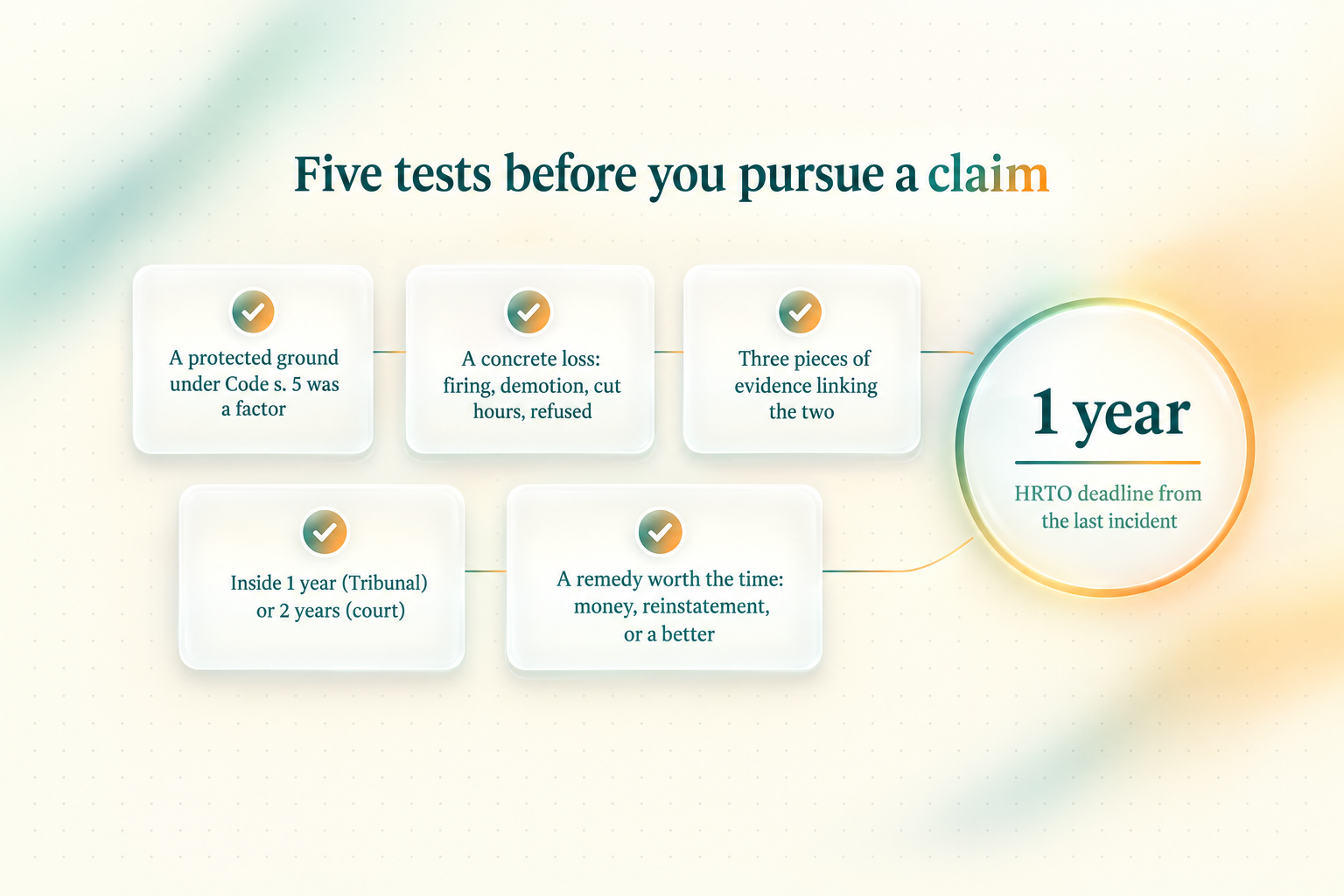
Pursue compensation when five things line up: a listed ground, a concrete loss such as termination, demotion, cut hours or a refused accommodation, evidence that links the two, time left on the clock, and a remedy worth the effort. If you were fired, the human rights claim usually stacks on top of a severance claim, which changes the math.
Here is the decision rule we apply. First, name the ground. Second, name the loss in dollars or in status. Third, list three pieces of evidence that connect them. Fourth, count the months since the last incident. Fifth, ask what you want: money, reinstatement, a policy change, or simply a severance offer that reflects the full picture.
The cost side is lighter than most people assume. The Tribunal charges no filing fee, and employee side firms often take dismissal files on a contingency basis. Mirza Law's first conversation is free, and on those files you pay nothing unless we recover for you. The real cost is time and attention, so the loss should justify it.
Career impact deserves honest weight. Tribunal decisions are public, and a court claim is a public record. For some people that is a reason to resolve through a negotiated severance that prices in the human rights exposure rather than a hearing. For others, particularly where accommodation was refused outright, the public forum is the point. Our workplace discrimination and human rights page walks through both routes.
How long do you have to file a discrimination claim in Ontario?
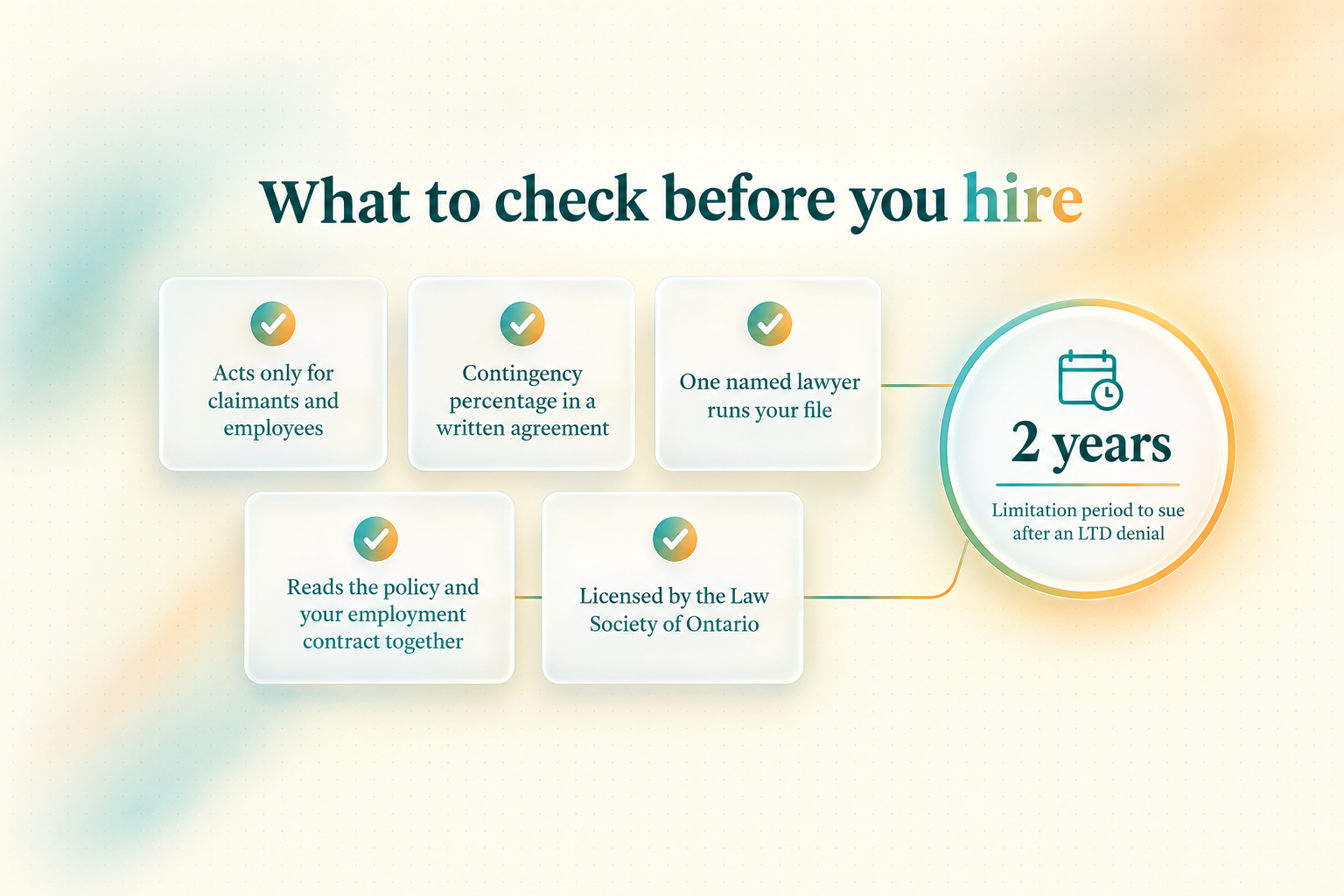
An Ontario Human Rights Tribunal application must be filed within one year of the incident, or of the last incident in a series. A court claim that includes Code damages follows the two year limitation in the Limitations Act, 2002. Federally regulated employees have one year to complain to the Canadian Human Rights Commission.
The Tribunal clock starts at the act, not at the moment you realized it was illegal. Code s. 34(2) allows a late application only where the delay was incurred in good faith and no substantial prejudice results, and the Tribunal applies that exception narrowly. Treat one year as the deadline.
The court clock under section 4 of the Limitations Act, 2002 runs two years from discovery, which for a termination is almost always the termination date. Under the federal Act, section 41(1)(e) gives the Commission discretion to accept a complaint filed after one year, but you should not plan on it.
Should you go to the Human Rights Tribunal or sue in court?
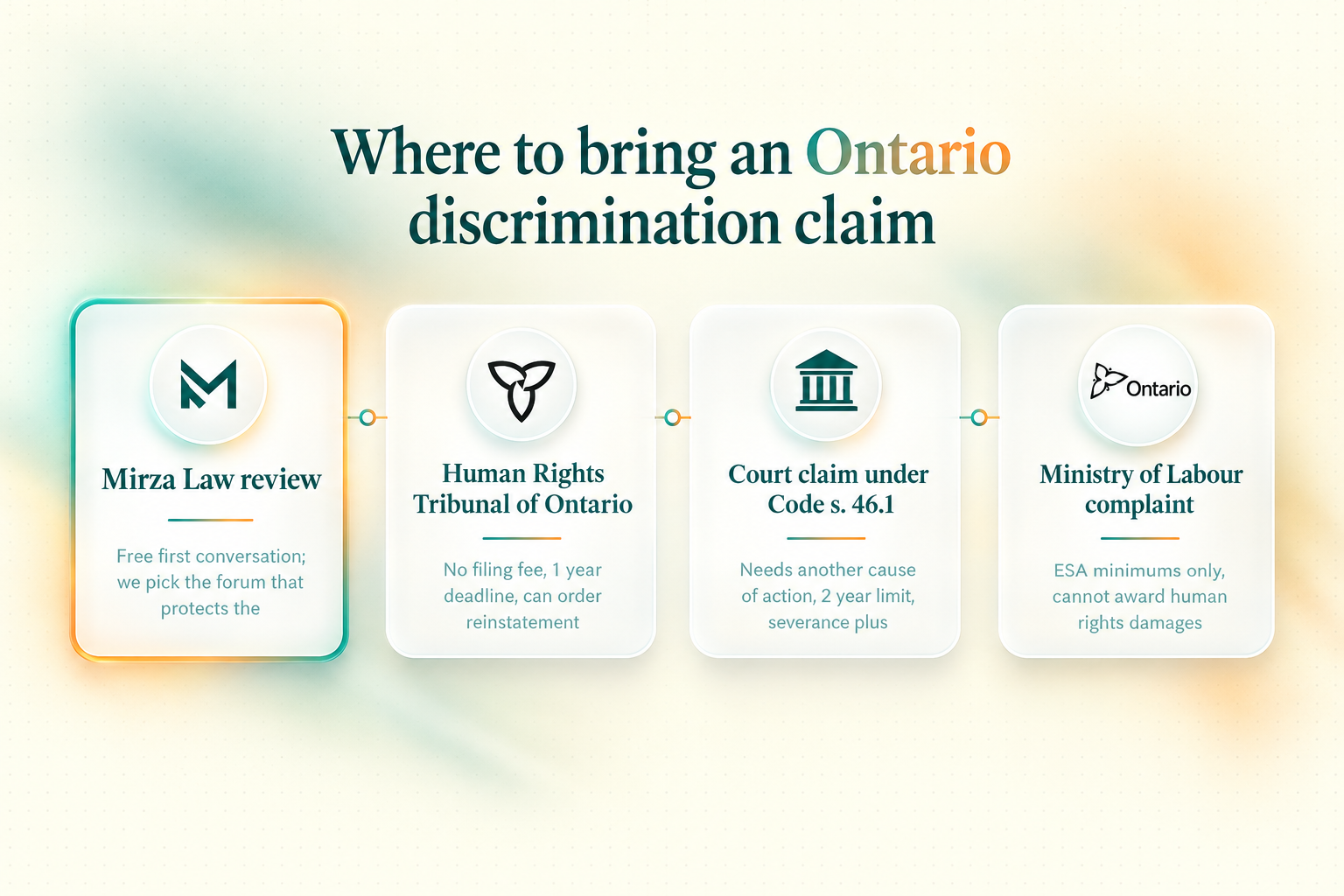
You do not need to file with any agency before suing in Ontario. If you have another cause of action, usually wrongful dismissal, section 46.1 of the Code lets a court award human rights damages inside that lawsuit. If your only claim is discrimination, the Tribunal is the forum. You cannot run both on the same facts.
The practical split is this. Still employed, or your loss is mainly dignity and a refused accommodation? The Human Rights Tribunal of Ontario is built for that, has no fee, and can order reinstatement. Fired or pushed out? The court claim captures common law notice, ESA entitlements and Code damages in one proceeding.
There is a third door people walk through by mistake: a Ministry of Labour complaint. It handles ESA minimums only and cannot award human rights damages, and filing one can limit a later court claim for the same wages. We explain the trade off in Ministry of Labour complaint versus lawsuit.
What compensation can you recover for workplace discrimination?
Compensation can include lost wages and benefits, general damages for injury to dignity, feelings and self respect, and reinstatement. In court, those sit beside wrongful dismissal damages and, in bad faith cases, aggravated or punitive damages. Ontario sets no statutory cap on injury to dignity awards; the federal Act caps each of its two heads at $20,000.
| Remedy | HRTO (Ontario) | Court claim (Code s. 46.1) | Federal (CHRA) |
|---|---|---|---|
| Lost wages and benefits | Available, no statutory cap | Available, plus common law notice | Available |
| Injury to dignity, feelings, self respect | No statutory cap | No statutory cap | Capped at $20,000 (s. 53(2)(e)) |
| Wilful or reckless conduct | Reflected in dignity award | Punitive damages possible | Up to $20,000 more (s. 53(3)) |
| Reinstatement | Yes, ordered in appropriate cases | Rare | Yes |
| Public interest remedies | Policy and training orders | No | Yes |
| Filing fee | None | Court fees apply | None |
| Deadline | 1 year from last incident | 2 years | 1 year |
For comparison only, the US system that dominates search results caps Title VII compensatory and punitive damages by employer size between $50,000 and $300,000. Those caps do not apply in Canada. The EEOC process, the 180 day charge deadline and the right to sue letter are US steps with no Ontario equivalent.
How much are discrimination claims realistically worth?
There is no calculator. Value turns on what you lost in pay, how serious and prolonged the conduct was, your vulnerability, and whether the employer ignored a duty to accommodate. Most Tribunal injury to dignity awards land in the low tens of thousands; the highest Ontario awards, in egregious sexual harassment cases, have reached six figures.
Two decisions show the range. In O.P.T. v. Presteve Foods Ltd., 2015 HRTO 675, the Tribunal awarded $150,000 to a migrant worker subjected to sustained sexual harassment and assault. In Strudwick v. Applied Consumer & Clinical Evaluations Inc., 2016 ONCA 520, the Court of Appeal awarded $40,000 in Code damages for disability discrimination, stacked on aggravated and punitive damages.
The factors that push a number up are consistent: a disability or pregnancy disclosure followed by termination, a refused accommodation request, an employer that lied about the reason, and an employee with few alternatives. Our duty to accommodate page explains why a refused accommodation is often the single strongest fact in a file.
The wage loss component is usually the largest dollar figure. For a dismissed employee, the human rights claim is added to termination pay, severance pay and common law notice. That is why the settlement question in a termination with a discrimination element is rarely answered by looking at dignity damages alone.
What evidence do you need to prove discrimination?
Direct proof is rare, and the law does not require it. Discrimination is usually proven by circumstantial evidence: timing, comparators treated better, shifting explanations, remarks, and a paper trail that only appeared after you disclosed a disability, pregnancy or complaint. Save emails, reviews, schedules and medical notes before access is cut off.
Start with a dated timeline. Write the disclosure date, every meeting after it, who said what, and the date of the adverse decision. Pull your last three performance reviews, because a clean record followed by a sudden PIP is one of the most persuasive patterns at the Tribunal.
Then collect comparators. Names, roles, start dates and what happened to them in the same restructuring. Finally, keep the termination letter and any script HR read to you. Employers often give one reason in the room and another in their written response, and the inconsistency itself is evidence.
How long does a discrimination claim take from filing to resolution?
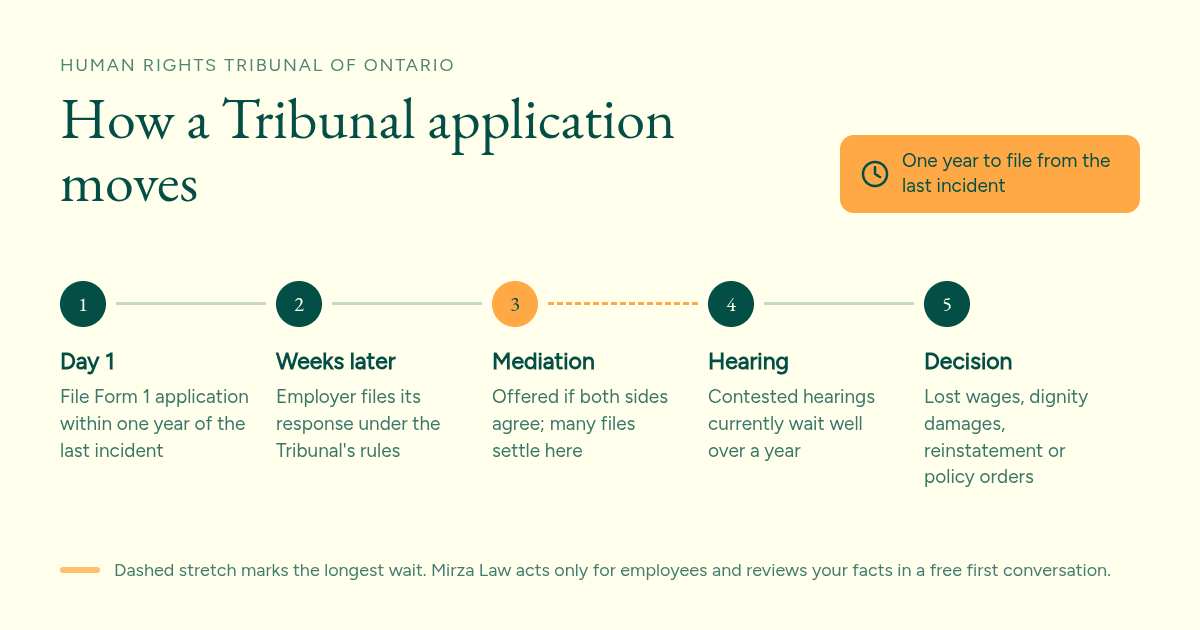
Expect months at minimum and often more than a year. A Tribunal application moves through filing, the employer's response, mediation if both sides agree, and a hearing. A court claim adds pleadings, discovery and a possible trial, though most resolve by settlement earlier. Severance claims with a human rights component frequently settle before any hearing.
At the Tribunal, you file a Form 1 application, the employer files a response under the Tribunal's rules, and the parties are offered mediation. If mediation fails or is declined, the file waits for a hearing date, and contested hearings currently take well over a year to reach. A decision follows the hearing.
In court, a wrongful dismissal claim with Code damages is often resolved through demand letter negotiation before a claim is even issued. Where a claim is issued, a mandatory mediation in Toronto typically produces a settlement before discovery is complete. The timeline is driven by the employer's willingness to engage, not by the law.
Can your employer retaliate against you for filing?
No. Section 8 of the Code makes reprisal its own violation, separate from the original discrimination. If you are fired, demoted or punished for raising a human rights concern, that is a second claim with its own damages. For reprisals tied to ESA rights such as a leave, ESA s. 74(2) puts the burden of proof on the employer.
The same protection reaches safety complaints under section 50 of the Occupational Health and Safety Act, where the burden also sits on the employer. The practical advice is to raise the concern in writing, keep a copy, and note any change in treatment that follows within weeks.
Do not resign to escape the retaliation without advice. A resignation can be treated as the end of the employment relationship and the end of the wage loss claim. Document the reprisal and let it become part of the case.
How did we build this decision framework?
This framework comes from the text of the Ontario Human Rights Code, the Tribunal's own filing rules and application process, the Limitations Act, 2002, the Canadian Human Rights Act, and leading Ontario appellate decisions on the factor test and damages. It is general information, not advice on your file.
How do you get started with Mirza Law?
Book the free first conversation with Mirza Law. We act only for employees, never employers, and we will tell you whether your facts support a human rights claim, a severance claim, or both, and which forum protects the most value. On those files you pay nothing unless we recover for you.
You get direct access to your lawyer throughout, not a call centre, and the whole matter can run by phone, video and email without taking time off work. Start with the free case assessment and tell us what happened and when.
What do people also ask?
How much can you win in a workplace discrimination lawsuit in Ontario?
There is no fixed amount. Recovery is lost wages and benefits plus general damages for injury to dignity, feelings and self respect, with no statutory cap at the Human Rights Tribunal of Ontario or in court. Most dignity awards fall in the low tens of thousands; the highest Ontario awards, in severe sexual harassment cases, have reached $150,000. Federal claims cap dignity damages at $20,000 plus up to $20,000 for wilful or reckless conduct.
What is the time limit for filing discrimination claims in the UK compared with Ontario?
In the UK, an employment tribunal claim generally must be started within three months less one day of the act, after early conciliation through ACAS. In Ontario the Tribunal deadline is one year from the last incident, and a court claim that includes Code damages has two years. Federally regulated Canadian employees have one year to complain to the Canadian Human Rights Commission.
Can you give me an example of disability discrimination at work?
An employee returns from a medical leave with a doctor's note asking for a modified schedule, the employer says it cannot accommodate without exploring options, and the role is eliminated weeks later while a colleague with no leave history keeps a similar job. That combines a refused accommodation and a termination where disability was a factor, which is a breach of section 5 of the Ontario Human Rights Code.
Is it hard to prove discrimination in Ontario?
It is harder than proving a missed paycheque but easier than many people assume. You do not need a confession. The Tribunal and courts accept circumstantial evidence such as timing after a disclosure, comparators treated better, shifting reasons and sudden negative reviews. Under Peel Law Association v. Pieters, the ground only has to be a factor in the decision, not the sole cause.
Do I have to file with the EEOC or a human rights tribunal before I can sue my employer in Ontario?
No. The EEOC is a US agency with no role in Canada. In Ontario, if you have another cause of action such as wrongful dismissal, section 46.1 of the Human Rights Code lets you claim human rights damages directly in court without going to the Tribunal first. If discrimination is your only claim, you file at the Human Rights Tribunal of Ontario, and section 34(11) prevents you from running both on the same facts.
Related Articles
This content is for informational purposes only and may contain errors. Please contact us to verify important details.