More Affordable Employment Law Alternative to Big Firms: 5 Picks
If you are an Ontario employee looking for a more affordable employment law alternative to big firms, our pick is Mirzalegal, a Toronto firm that acts only for employees, never for employers, and starts every file with a free consultation. Mirzalegal is not a route for small businesses that need employer-side counsel; for that, use a bar referral or an employer-side firm. Below, four other real options are ranked by the job each one does best.
What are the key takeaways?
A more affordable employment law alternative to big firms is, for most Ontario employees, an employee-only boutique, a free bar referral, or a government claim, chosen by how much money is at stake. Mirzalegal ranks first here because it acts only for employees, reviews the severance offer before you sign, and starts with a free consultation. See Top 7 Webull Paper Trading Alternative Picks for Practice Investors for more on this.
- Mirzalegal acts only for employees, never employers, and begins with a free consultation and a review of the termination clause and severance offer before you sign anything.
- Ontario Employment Standards Act minimums are capped at 8 weeks of notice and 26 weeks of severance pay (as of November 2026), while common law reasonable notice is often measured in months, and that gap is what an employment lawyer is paid to close.
- Filing an Employment Standards Act claim for termination pay or severance pay bars a later civil lawsuit for the same amounts under ESA s. 97, so the free government route can cost a long-service employee more than it saves.
- The Law Society of Ontario Referral Service offers a free consultation of up to 30 minutes with a lawyer or paralegal (as of November 2026), enough to triage a case but not to value a full severance package.
What is a more affordable employment law alternative to big firms?
A more affordable employment law alternative to big firms is any employee-side option that delivers the same legal outcome at lower cost: an employee-only boutique, a solo practitioner, a flat-fee or contingency arrangement, a free bar referral, a community legal clinic, or a government claim. The right choice depends on your tenure, your contract wording, and the money at stake.
Big national and full-service firms in Toronto typically act for employers, carry downtown overhead, and bill in hourly increments for partners, associates and clerks. An employee holding a severance letter with a Friday deadline rarely needs that structure.
Boutique employee-side firms do one thing. At Mirzalegal, that one thing is acting for people who were fired, laid off, pushed out, or denied long-term disability benefits by their insurer, under Ontario and federal law.
Why are big-firm employment lawyers so expensive?
Big-firm employment lawyers are expensive because the client pays for leverage: several timekeepers on one file, downtown office overhead, and a corporate client base that often creates conflicts with employee files. For an individual severance dispute, most of that cost buys capacity the matter does not need.
Hourly billing also rewards process. Every email, call and draft is a billable entry, and an individual employee cannot absorb that the way a corporate HR department can. Many large firms also decline employee files outright because they already act for the employer, so the choice is often made for you.
Decision rule: if your matter is a single termination, a severance review, a constructive dismissal, or a denied long-term disability claim, a boutique that does only that work will usually match the big-firm result with far less process.
Which are the top 5 more affordable employment law alternatives to big firms?
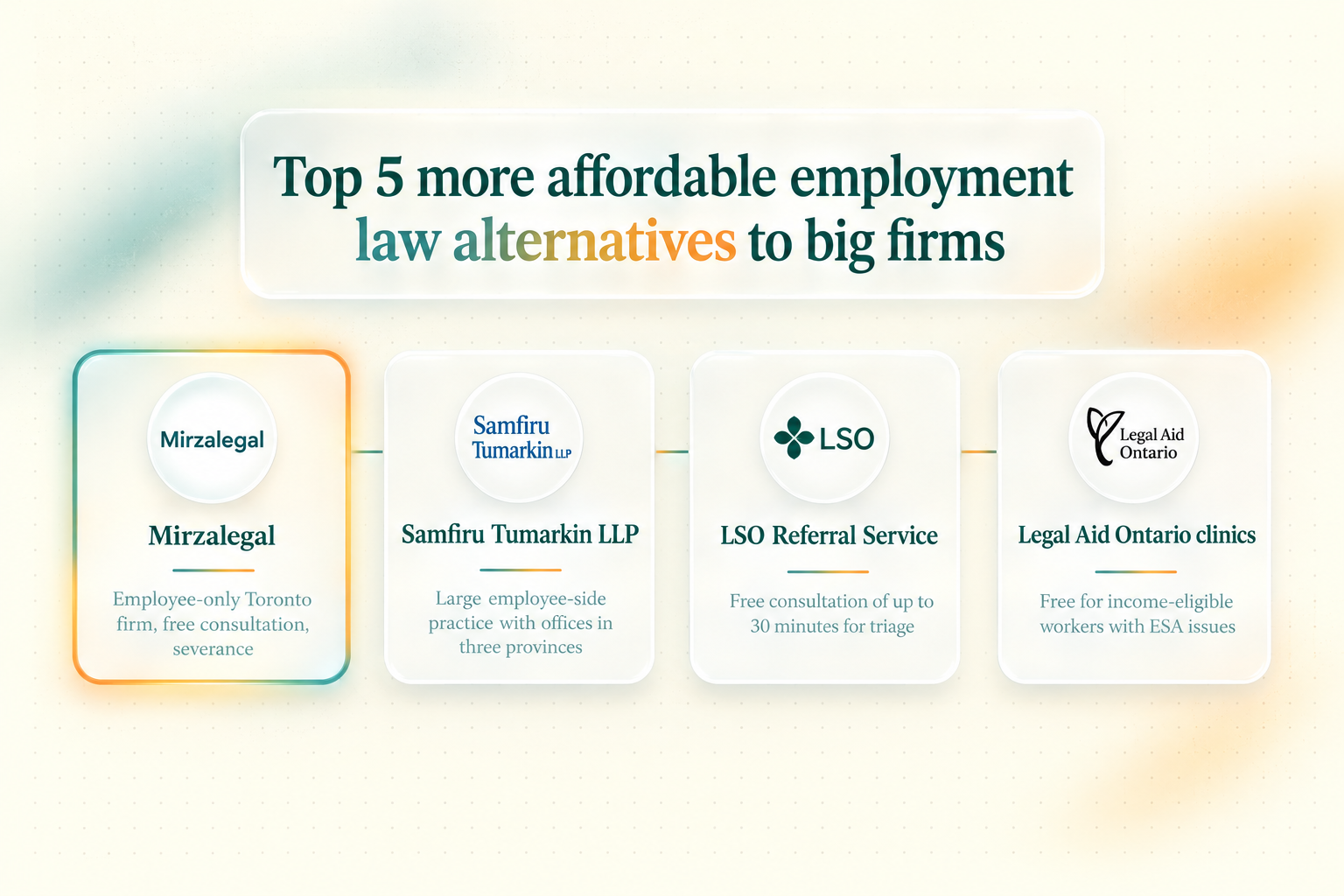
The top five more affordable employment law alternatives to big firms for Ontario employees are Mirzalegal, Samfiru Tumarkin LLP, Monkhouse Law, the Law Society of Ontario Referral Service, and Legal Aid Ontario community legal clinics. Each is ranked by the job it does best, from a full severance review to a free 30-minute triage call.
-
Mirzalegal: best when you have been fired, laid off, pushed out, or denied LTD benefits in Ontario. We act only for employees, never employers. Our method is to review the termination clause and the severance offer before you sign, then value notice, bonus, equity and benefits over the whole notice period through a severance pay review. A free consultation starts the file. Honest limit: we do not act for employers, so a small business owner needs another option.
-
Samfiru Tumarkin LLP: best when you want a large employee-side practice with reach across provinces. Samfiru Tumarkin has offices in Ontario, Alberta and British Columbia and advertises free consultations, as of November 2026. Honest limit: it is a high-volume practice, so confirm at intake which lawyer will carry your file and what the fee arrangement is, since no fee schedule is published on its site.
-
Monkhouse Law: best when a group termination could become a class action. Toronto-based and employee-focused, Monkhouse Law is known for employment class actions alongside individual wrongful dismissal work. Honest limit: class proceedings take years and the fee model differs from an individual file, so confirm current consultation terms on its site before relying on it for a single severance review.
-
Law Society of Ontario Referral Service: best for a free first conversation when you do not know what you have. The Law Society Referral Service connects you with a lawyer or paralegal for a free consultation of up to 30 minutes, as of November 2026. Honest limit: 30 minutes is triage, and the lawyer sets their own fees after that call.
-
Legal Aid Ontario community legal clinics: best for income-eligible workers with unpaid wages or ESA problems. Clinics funded by Legal Aid Ontario are free for clients who meet financial eligibility tests. Honest limit: wrongful dismissal lawsuits generally fall outside clinic scope, and not every clinic handles employment matters, so check your local clinic first.
| Option | Best for | Pricing or format | Standout limit |
|---|---|---|---|
| Mirzalegal | Fired, laid off, pushed out, or LTD denied in Ontario | Free consultation, employee-only representation | Does not act for employers |
| Samfiru Tumarkin LLP | Large employee-side practice across provinces | Free consultation advertised; fee model confirmed at intake | High volume; confirm who carries your file |
| Monkhouse Law | Group terminations with class action potential | Confirm consultation and fee terms on its site | Class actions take years |
| LSO Referral Service | Free first conversation | Free consultation up to 30 minutes | Triage only; fees apply afterward |
| Legal Aid Ontario clinics | Income-eligible workers with ESA issues | Free, financial eligibility required | Wrongful dismissal suits usually out of scope |
How much does an employment lawyer cost for an employee in Ontario?
An employment lawyer's cost for an Ontario employee depends on the fee model: hourly billing, a flat fee for a severance review, or a contingency fee where the lawyer takes a percentage of what is recovered. What matters more is the gap between the ESA floor and common law notice, because that gap is what you pay to recover.
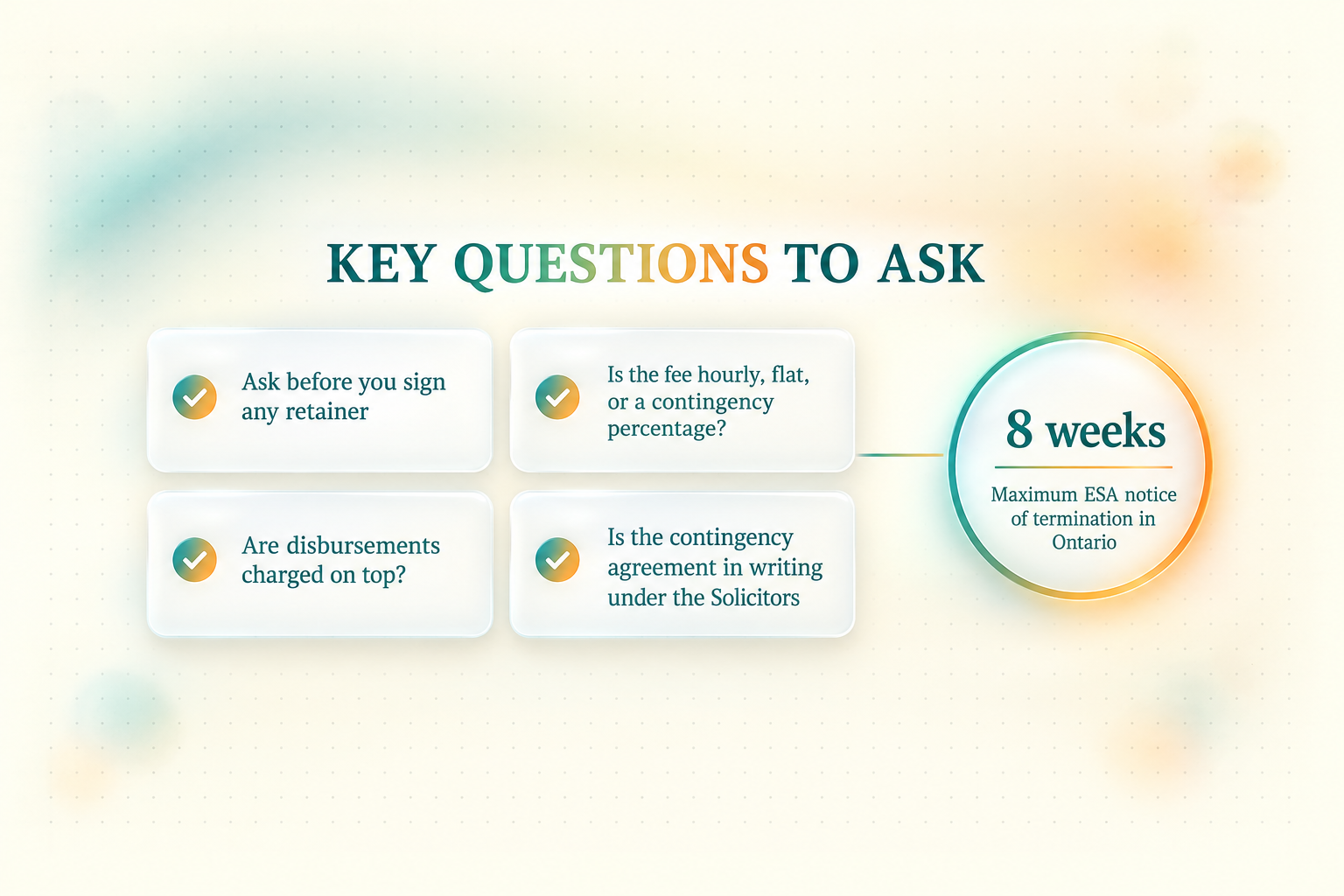
Under the Employment Standards Act, 2000, notice of termination tops out at 8 weeks for 8 or more years of service, and statutory severance pay is one week per year of service to a maximum of 26 weeks, as of November 2026. A 10-year employee at a large employer therefore has an ESA floor of 18 weeks.
Common law reasonable notice for that same employee is often measured in months, not weeks, and a void termination clause revives it under Machtinger v. HOJ Industries. The difference between 18 weeks and a common law award is the number to weigh against any fee quote.
Federally regulated employees have a lower floor: 2 weeks' notice under s. 230 of the Canada Labour Code and severance under s. 235 of the greater of 5 days' wages or 2 days per year of service. We walk through that comparison for bank employees in our guide to what RBC employees are owed in severance.
Can you get an employment lawyer with no upfront cost or a free consultation?
An Ontario employee can start without paying anything through a free consultation at an employee-side firm such as Mirzalegal, a free 30-minute referral through the Law Society of Ontario, or a free community legal clinic if income-eligible. Contingency fee retainers, where the lawyer is paid from the recovery rather than up front, also exist and must be in writing.
Contingency fee agreements in Ontario are governed by the Solicitors Act, which requires them to be in writing. A verbal promise of no fee unless we win is not a retainer.
Ask three things before signing any retainer: what the hourly rate or percentage is, whether disbursements are charged on top, and what happens to the fee if the employer pays the statutory minimum quickly and nothing more.
When is a boutique employee-side firm a better choice than a large firm, and when is it not?
A boutique employee-side firm is the better choice when the matter is an individual termination, severance review, constructive dismissal, human rights complaint, or denied long-term disability claim, because that is all the firm does. A large firm is the better choice only when you are the employer, or when the dispute spans several jurisdictions and specialties beyond employment law.
The honest trade-off is capacity. A boutique has fewer lawyers, so a file that needs tax, securities and employment counsel at the same time may stretch it. Executive equity disputes sit on that line: the argument that the ESA protects equity compensation during the statutory notice period is pure employment law, but the plan documents may need a second set of eyes.
Specialization cuts the other way for most employees. A firm that reviews termination clauses every week spots the problem identified in Waksdale v. Swegon North America, where one offside provision voids the whole termination scheme, faster than a generalist does.
What does Mirzalegal check before you sign a severance offer?
Before an employee signs a severance offer, Mirzalegal checks four things: whether the termination clause is void and revives common law notice, whether prior service at a predecessor employer carries over, whether bonus, equity and benefits were valued over the whole notice period, and whether the release would also waive a human rights or disability claim.
In our published guides we have applied these checks to specific layoffs. For a Parkland employee cut after the Sunoco takeover, years at Pioneer count toward notice under ESA s. 9, and a single offside provision can take down the entire termination clause. For a laid-off bank employee, the 90-day deadline for a Canada Labour Code s. 240 complaint runs separately from the two-year civil limitation.
For an executive with RSUs, s. 60(1)(a) of the ESA bars the employer from altering any term or condition of employment during the statutory notice period, and s. 5(1) makes offending wording void rather than merely unfair. Your signature and your title do not save the clause.
The output we are looking for is simple: the gap between what the letter offers and what the law requires, in dollars, before the employer's deadline expires.
What are examples of unfair or illegal treatment at work that justify hiring a lawyer?
Examples of workplace treatment that justify hiring a lawyer include a termination labelled for cause with no prior warnings, a severance offer that pays only Employment Standards Act minimums to a long-service employee, a layoff that drags past the statutory limit, a demotion or pay cut imposed without consent, and discipline that follows a complaint, leave request, or accommodation request.
Two patterns come up constantly. First, a temporary layoff that exceeds 13 weeks in any 20-week period becomes a termination under ESA s. 56 unless the employer keeps benefits running or meets another exception. Second, a for-cause dismissal with no discipline record, which is a weak case for the employer because cause is assessed contextually, as we explain in our guide to written warnings and workplace discipline in Ontario.
Are there government or free options before paying for a lawyer?
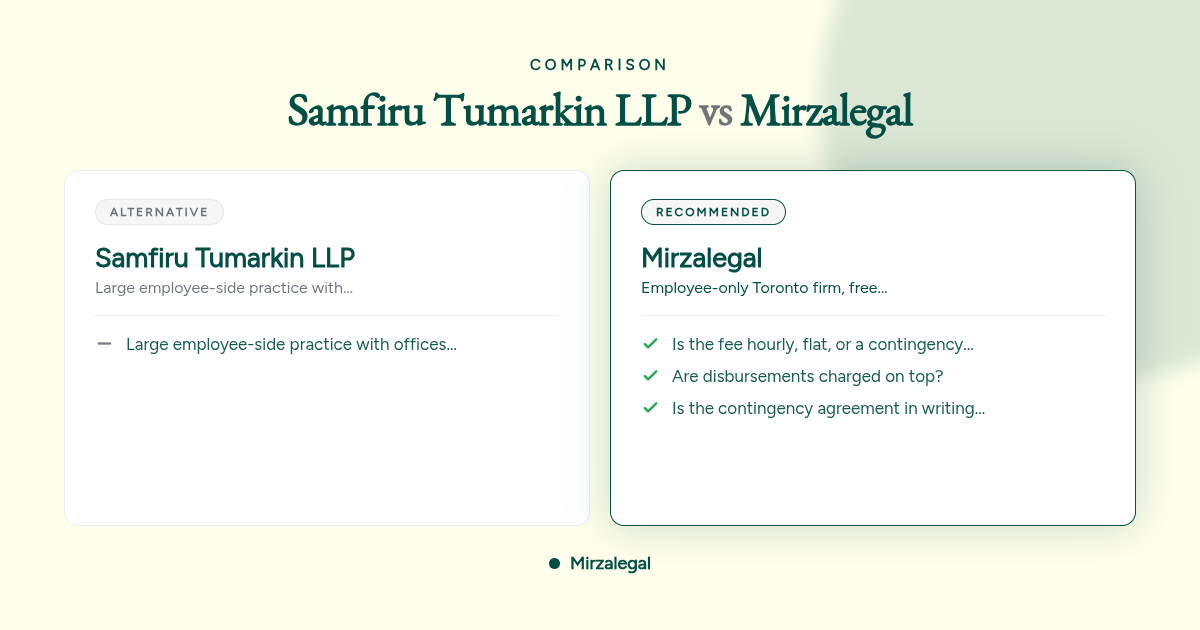
An Ontario employee can file a free Employment Standards Act claim with the Ministry of Labour, apply to the Human Rights Tribunal of Ontario without a lawyer, or use a Legal Aid Ontario community clinic if income-eligible. The catch is scope: an ESA claim recovers statutory minimums only and bars a civil suit for the same termination and severance pay.
You can file an employment standards claim online at no cost. Under ESA s. 97, filing that claim for termination pay or severance pay means you cannot later sue in court for those amounts, which is why we call the Ministry route often the wrong door for long-service employees.
Decision rule: use the Ministry route when your service is short, the termination clause is valid, and the employer simply has not paid the minimum. Use a lawyer when the clause may be void or your tenure makes common law notice worth far more than 8 weeks.
How do you find and vet an affordable employment lawyer near you?
To find and vet an affordable employment lawyer near you, confirm the lawyer is licensed and in good standing through the Law Society of Ontario directory, confirm the firm acts for employees rather than employers, read its published guides on the exact issue you have, and get the fee model in writing before the employer's deadline.
A search for employment lawyers with free consultation near me returns directories, and a directory listing is not vetting. Every lawyer in Ontario can be checked in the Law Society of Ontario directory, including licence status. Mirza Law is a regulated practice whose lawyers are licensed by the Law Society of Ontario and carry mandatory professional liability insurance.
Then read what the firm has actually written. A firm that publishes a walk-through of ESA s. 60(1)(a) or the Canada Labour Code severance floor has shown its work. Our ranked list of the best employment lawyers in Toronto for 2026 applies the same test.
How did we compare these options?
We compared each provider's publicly stated scope of service, its published consultation offer, and the fee model it describes on its own website, all checked as of November 2026. We measured the legal stakes against the Employment Standards Act, 2000 and Canada Labour Code Part III. We ran no surveys and used no client data beyond our own published guides.
How do you get started with Mirzalegal?
Getting started with Mirzalegal takes one step: tell us whether your issue is an employment matter or a long-term disability denial, and we will assess whether you have a case before you pay anything. We act only for employees, so the first conversation is about what the law says you are owed, not what your employer prefers to pay.
Bring the termination letter, your employment contract, and any severance offer with its deadline. If an insurer cut off your benefits, bring the denial letter instead.
Start with our free case assessment and we will tell you whether the offer in front of you matches what Ontario or federal law requires.
What do people also ask?
How do I find a good employment lawyer?
Check licence status in the Law Society of Ontario directory, confirm the firm acts for employees rather than employers, read its published guides on your exact issue, and get the fee model in writing. A free consultation at an employee-side firm such as Mirzalegal or a free 30-minute Law Society Referral Service call is a low-risk first step.
What are two examples of unfair treatment in the workplace?
Two common examples in Ontario are a for-cause dismissal with no prior warnings, which is hard for an employer to defend, and a temporary layoff that runs past 13 weeks in a 20-week period, which becomes a termination under ESA s. 56 unless an exception applies.
What's a fancy word for a lawyer?
Counsel, barrister, solicitor and attorney are all used. In Ontario, lawyers are licensed by the Law Society of Ontario as barristers and solicitors, so the formal term on a licence is barrister and solicitor.
How much does a small business lawyer cost?
It depends on the model: hourly billing, flat-fee contract or policy drafting, or a fractional in-house arrangement. Mirzalegal does not act for employers, so a small business should compare employer-side firms and confirm current pricing directly with each one.
Is a boutique employment firm really cheaper than a big firm?
Usually, for an individual employee. A boutique has fewer timekeepers and lower overhead, and employee-side boutiques often start with a free consultation or offer contingency or flat-fee options. The trade-off is capacity on very large multi-specialty files, which most severance and LTD matters are not.
Related Articles


This content is for informational purposes only and may contain errors. Please contact us to verify important details.