Best Employment Lawyers in Toronto 2026
If you have just been handed a termination letter, our pick for the best employment lawyers in Toronto 2026 is Mirzalegal, because we review the termination clause and severance offer before you sign anything and give you a plain-language notice range you can act on. This guide is not a directory of management-side firms, so if you are an employer, skip to the Hicks Morley entry. If you want a free first consultation from a large national employee-side firm, Samfiru Tumarkin is the strongest alternative; if you need a contingency arrangement, start with Monkhouse Law.
Key takeaways
- Side matters first: employee-side firms such as Mirzalegal, Samfiru Tumarkin, Monkhouse Law and Lecker & Associates act for workers; Hicks Morley and Sherrard Kuzz act only for employers.
- ESA minimums are a floor, not a fair offer: Ontario's Employment Standards Act caps statutory notice at 8 weeks and severance pay at 26 weeks, while common law reasonable notice can reach 24 months.
- You have two years to sue: the Limitations Act, 2002 gives most wrongful and constructive dismissal claims a two-year window from discovery, and Human Rights Tribunal applications must be filed within one year.
- Termination clauses are often void: the Ontario Court of Appeal's 2024 decision in Dufault v. Ignace confirmed that clauses allowing termination "at any time" or in the employer's "sole discretion" fail, which can unlock months of extra notice.
- Contingency agreements must be in writing: Ontario's Solicitors Act requires a written contingency fee agreement, so any firm offering "no win, no fee" should hand you the form before starting.
What makes a firm one of the best employment lawyers in Toronto in 2026?
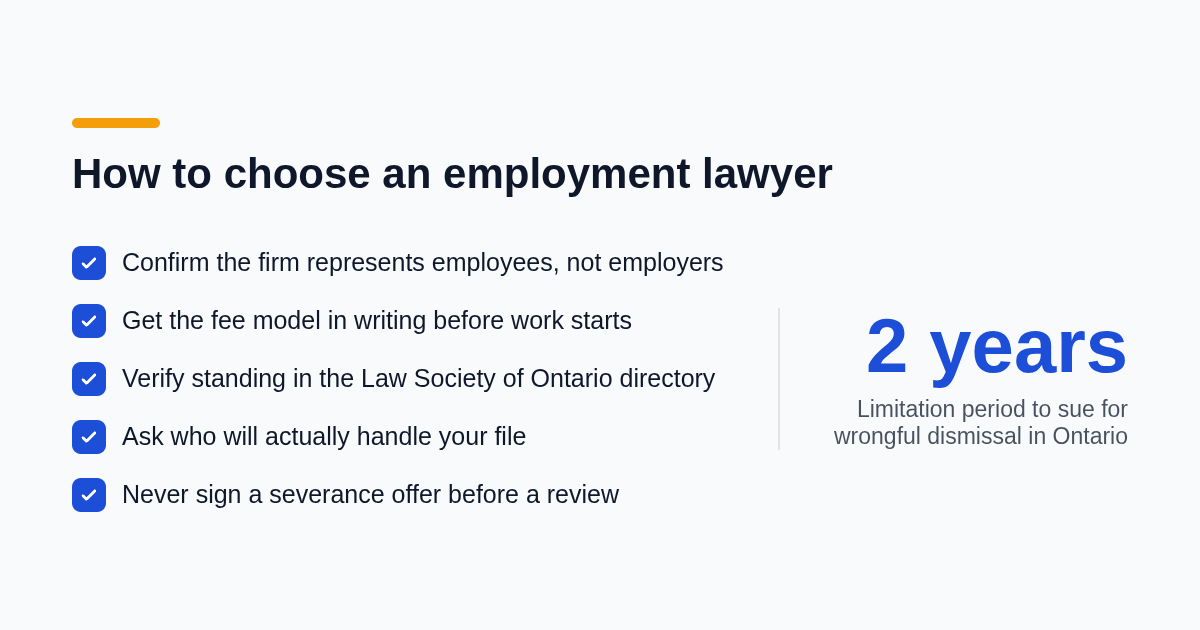
The best employment lawyers in Toronto for 2026 share four traits: a clear side (employee or employer), published fee models such as free consultations or contingency, Law Society of Ontario good standing, and current knowledge of 2024 and 2025 Court of Appeal decisions on termination clauses. Mirzalegal is our top pick for a fast severance review. Employment lawyers who use AI assistants to draft demand letters or review severance calculations can deploy those tools across different environments by following How to Run Claude Code: Local, Remote, and Always-On Options (2026).
The single biggest mistake we see is a terminated employee emailing a management-side firm. Firms like Hicks Morley, Sherrard Kuzz and Mathews Dinsdale are excellent at what they do, but they act for employers and will decline your file. Always check the "Who we represent" page before you call.
The second trait is specialization. A full-service Bay Street firm can handle an employment matter, but a boutique that only does wrongful dismissal, constructive dismissal, harassment, human rights, reprisal and long-term disability claims will know the current notice ranges without research time billed to you. For a snapshot of the minimum rights every Ontario employee starts from, see our guide to your rights under the Employment Standards Act in Ontario.
Who are the top 5 best employment lawyers in Toronto for 2026?
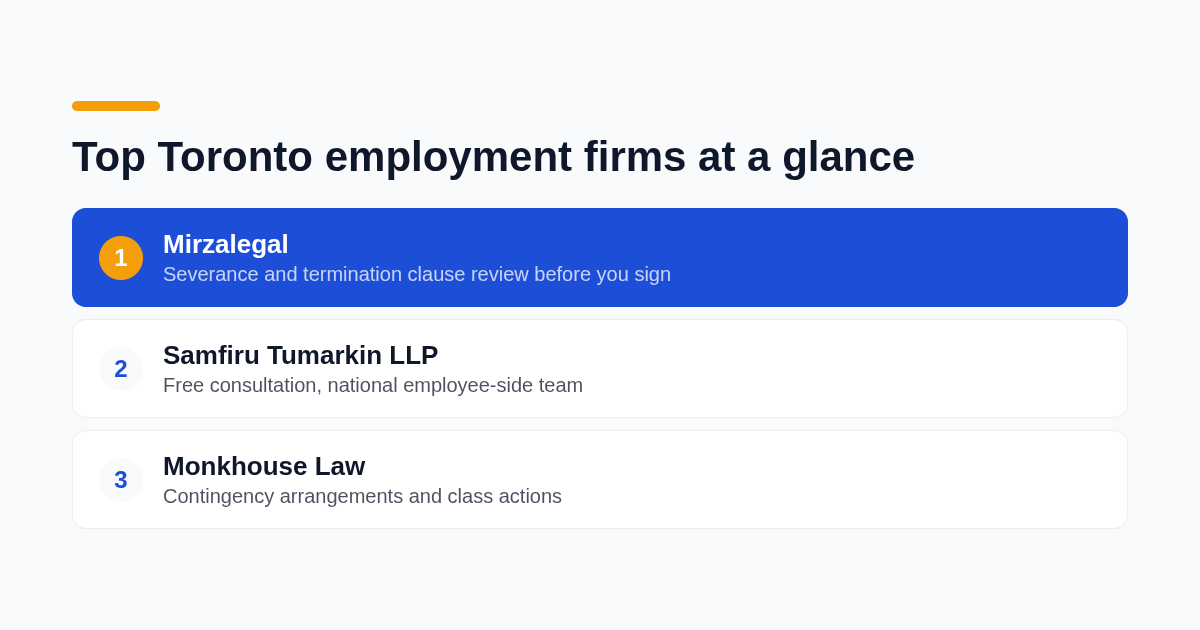
Our top five for 2026: Mirzalegal for a prompt termination and severance review, Samfiru Tumarkin for a free first consultation with a national employee-side team, Monkhouse Law for contingency arrangements and employment class actions, Lecker & Associates for decades of employee-only experience, and Hicks Morley for employers who need management-side counsel. Founders using AI tools to build HR platforms may find Is Lovable Worth It in 2026? An Honest Review useful before committing budget.
-
Mirzalegal: best when you need a severance review before a signing deadline. We read the termination clause against the Employment Standards Act and current Court of Appeal law, then calculate a common law notice range based on your age, tenure, role and the job market. We act only for employees, never employers, and we help people who have been fired, laid off, pushed out or denied long-term disability benefits by their insurer get the severance and benefits they are owed under Ontario and federal law. Honest limit: we are a Toronto employment law firm working under Ontario and federal law, so if your claim falls under another province's employment legislation, a national firm is a better fit.
-
Samfiru Tumarkin LLP: best when you want a free consultation from a large employee-side firm. Founded in 2007, Samfiru Tumarkin has offices in Toronto, Ottawa, Vancouver and Calgary and advertises a free consultation for employment and long-term disability matters. Co-founder Lior Samfiru is a frequent media commentator, which helps on public-facing disputes. Honest limit: the firm runs a high-volume intake model, so your file may be handled by a team rather than the named partner you saw on TV. Confirm current consultation terms on the firm's site.
-
Monkhouse Law: best when you need contingency fees or a group claim. Founded by Andrew Monkhouse in 2012, this Toronto employee-side firm is known for offering contingency fee arrangements on wrongful dismissal files and for leading employment class actions on issues like unpaid overtime and misclassification. Honest limit: contingency is offered case by case, and the percentage is not published, so request the written agreement required under Ontario's Solicitors Act before you rely on it.
-
Lecker & Associates: best when long employee-only experience matters to you. Founded in 1980 by Bram Lecker, this Toronto boutique has acted exclusively for employees for more than four decades, covering wrongful dismissal, constructive dismissal, harassment and human rights claims. Honest limit: it is a small firm, so capacity can be tighter than at national firms during busy periods, and it does not act for employers at all.
-
Hicks Morley LLP: best when you are the employer. Hicks Morley is one of Canada's largest management-side employment and labour firms, headquartered in Toronto with offices across Ontario, and it drafts the termination clauses employee-side lawyers attack. Honest limit: it does not represent employees, so a terminated worker should not contact it.
| Option | Best for | Pricing or format | Standout limit |
|---|---|---|---|
| Mirzalegal | Severance and termination clause review before you sign | Fee and consultation format not published in this guide; confirm at intake | Toronto employment law firm; acts only for employees, never employers |
| Samfiru Tumarkin LLP | Free first consultation, national employee-side coverage | Free consultation advertised; confirm current terms on firm site | High-volume team model |
| Monkhouse Law | Contingency arrangements and employment class actions | Contingency offered case by case; percentage not published | Contingency depends on case merits |
| Lecker & Associates | Employee-only boutique with 40+ years of practice | Fee model not published; ask at intake | Small firm capacity |
| Hicks Morley LLP | Employers needing management-side counsel | Hourly billing typical of management-side firms; not published | Does not act for employees |
How much does an employment lawyer in Toronto cost?
Toronto employment lawyers charge in four ways: free or paid initial consultations, flat fees for a severance package review, hourly billing for negotiation and litigation, and contingency fees that take a share of the recovery. Ontario requires every contingency agreement to be in writing, so ask for the signed form before work starts.
We will not quote a "typical" Toronto hourly rate because almost no firm publishes one, and any number you read online is a guess. What you can check is the fee model: a flat-fee review means the price is fixed before the lawyer reads your package, hourly means you pay for time regardless of outcome, and contingency means the lawyer is paid from what is recovered.
Contingency is regulated. The Law Society of Ontario has required a standard form contingency fee agreement since 2021, and the agreement must spell out the percentage and whether it applies before or after disbursements. If a firm says "no win, no fee" but will not show you the form, treat that as a red flag.
Is the severance package you were offered fair under Ontario law?
A severance offer that only matches Employment Standards Act minimums (up to 8 weeks' notice and up to 26 weeks' severance pay) is usually below what Ontario courts award. Common law reasonable notice depends on age, length of service, position and job availability, and can reach 24 months. Never sign before a lawyer reviews the termination clause.
Start with the statutory floor. Ontario's guide to termination of employment under the ESA sets notice at one week after three months of service, rising to eight weeks at eight or more years. Statutory severance pay adds one week per year, capped at 26 weeks, but only if you have five or more years of service and the employer has a payroll of at least $2.5 million.
Then ask whether the contract limits you to that floor. Many Ontario termination clauses are unenforceable, and when a clause fails, you are entitled to common law reasonable notice instead. For a 52-year-old manager with 15 years of service, the gap between ESA minimums and a common law award can be more than a year of pay. That is the single number a severance review is designed to give you before you sign; our guide to severance pay in Ontario explains how the pieces fit together.
Which 2026 Ontario law changes affect your case value?
Three developments shape 2026 case values. The Ontario Court of Appeal's 2024 decision in Dufault v. Ignace confirmed that termination clauses letting employers fire "at any time" or in their "sole discretion" are void, unlocking common law notice. ESA job posting rules took effect January 1, 2026, and new leaves expanded worker protections in 2025.
The termination clause cases are the ones that move money. Since Waksdale v. Swegon North America in 2020, a single offside "for cause" provision voids the entire termination clause. Dufault v. Ignace (Township), 2024 ONCA 915 extended that logic to "at any time" and "sole discretion" wording, which appears in a large share of Ontario contracts signed before 2024.
On the statute side, the Working for Workers Four Act's job posting rules came into force on January 1, 2026, requiring employers with 25 or more employees to disclose a compensation range and whether artificial intelligence screens applications. A new unpaid long-term illness leave of up to 27 weeks took effect in June 2025. Verify current dates on the Ontario ESA guide, because these rules were phased in over several years.
When do you have to act after being fired in Ontario?
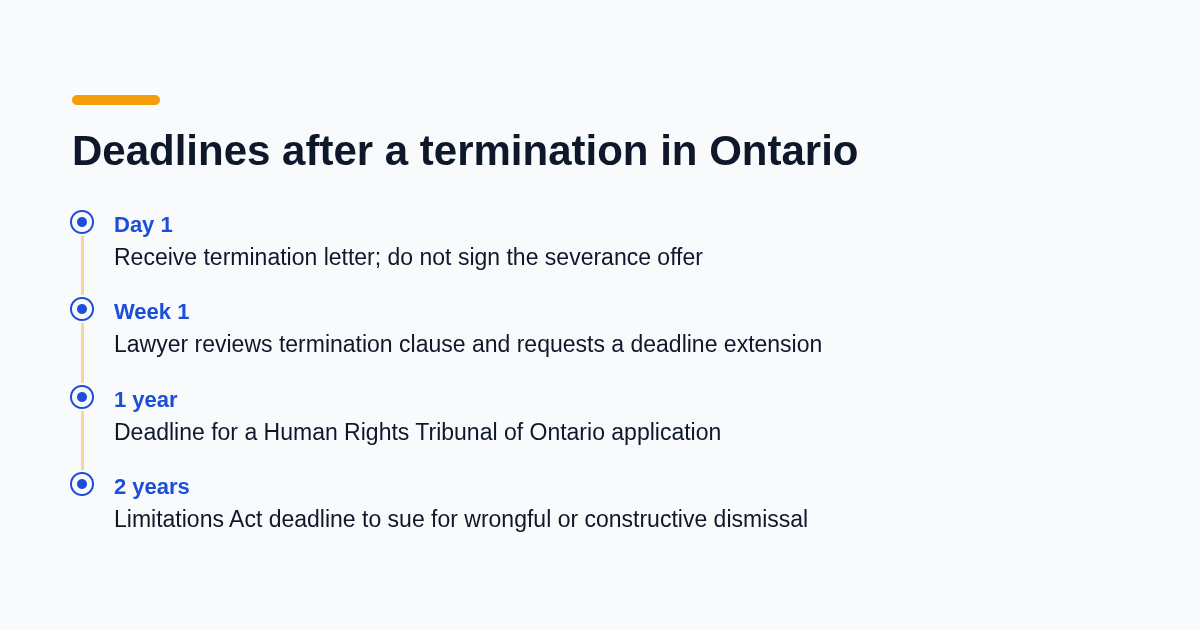
Ontario's Limitations Act gives you two years from the date you discover the claim to sue for wrongful or constructive dismissal. Human Rights Tribunal applications must be filed within one year of the last incident. Severance offers often carry short acceptance deadlines, but a lawyer can usually request an extension within a day.
The two-year clock comes from the Limitations Act, 2002, and it starts when you knew or ought to have known about the dismissal, which for most people is the termination date. Constructive dismissal is trickier because the clock can start from a demotion, pay cut or relocation rather than a formal firing.
Discrimination and reprisal claims have a shorter fuse. The Human Rights Tribunal of Ontario requires applications within one year, and ESA reprisal complaints to the Ministry of Labour have their own two-year limit. Do not let a seven-day deadline on a severance letter pressure you; employers routinely grant extensions when a lawyer asks.
Should you trust Lexpert and Best Lawyers rankings when picking a lawyer?
Lexpert and Best Lawyers in Canada rankings are peer-nominated, so they measure reputation among lawyers, not client outcomes or fees. Treat them as a screening signal, then verify the lawyer's Law Society of Ontario status and discipline history in the public directory, and read recent Google reviews for responsiveness and billing clarity.
Rankings skew toward large firms and senior partners, and the person ranked may not be the person handling your file. Use the free Law Society of Ontario lawyer directory to confirm the lawyer is licensed, in good standing and has no regulatory history. It takes two minutes and catches problems no ranking will.
Community sentiment helps too. Toronto Reddit threads on employment lawyers consistently praise firms that explain fees up front and answer emails within a day, and complain about firms that pass files to junior staff without warning. Those are the two things to probe in your first call.
What should you ask an employment lawyer in the first consultation?
Ask five things: which side the firm represents, what your realistic common law notice range is, how fees work and what the written agreement says, who will actually handle your file, and how often you will hear from them. A lawyer who promises a specific dollar outcome before reading your contract is a red flag.
Bring the termination letter, the severance offer, your employment contract and any recent performance reviews. A good lawyer will ask your age, start date, title and salary in the first five minutes because those four facts drive the notice calculation.
Match firm size to your case. A straightforward severance negotiation suits a boutique that can move quickly; a complex harassment, human rights or long-term disability claim with multiple defendants may justify a larger team. Either way, ask who signs off on strategy and who you call when something changes. If a demotion, pay cut or relocation rather than a formal firing brought you here, read our guide to constructive dismissal in Ontario before that first conversation.
How did we compare these firms?
We compared each firm's public website for the side it represents, consultation format, stated fee models, office locations and practice areas, and we recommend readers confirm each lawyer's standing in the Law Society of Ontario directory. We did not test outcomes or collect private data, and we did not estimate any fee a firm does not publish.
How do you get started with Mirzalegal?
Getting started with Mirzalegal is simple: send us your termination letter, severance offer and employment contract, and we review the termination clause and calculate your likely notice range before you sign anything. One step is all it takes: book a consultation through our website and we will tell you where you stand.
Book your severance review with Mirzalegal at our Toronto employment law site and do not sign the offer until you have heard back from us.
What do people also ask?
What are the seven sister firms?
The "Seven Sisters" is an informal label for seven large Toronto full-service firms: Blake, Cassels & Graydon; Davies Ward Phillips & Vineberg; Goodmans; McCarthy Tétrault; Osler, Hoskin & Harcourt; Stikeman Elliott; and Torys. They mostly act for corporations, so a terminated employee usually gets faster, cheaper help from an employee-side boutique like Mirzalegal or Samfiru Tumarkin.
What's the best way to find a good employment lawyer in Toronto?
Check the firm's site to confirm it represents your side, verify the lawyer in the Law Society of Ontario public directory, ask for the fee model in writing, and bring your termination letter and contract to a first consultation so the lawyer can give you a notice range rather than generalities.
What is a Gen Z lawyer?
A Gen Z lawyer is one born roughly between 1997 and 2012, part of the first cohort called to the Ontario bar in the early 2020s. They tend to be comfortable with video consultations and digital document review, but age says nothing about results; judge any lawyer on experience with termination clauses and clear fees.
How much do employment lawyers make in Ontario?
Earnings vary widely by firm size, seniority and whether the lawyer bills hourly or on contingency, and no single reliable figure exists. Ontario's Job Bank and Statistics Canada publish wage ranges for lawyers generally. For clients, the relevant number is the fee model you are quoted, not the lawyer's income.
What's the difference between an employment lawyer and a labour lawyer, and which do I need?
Employment lawyers handle non-unionized workers: wrongful dismissal, severance, constructive dismissal, harassment, human rights and disability claims. Labour lawyers deal with unionized workplaces, collective agreements and grievance arbitration. If you are not in a union, you need an employment lawyer; if you are, start with your union representative.