DIY Legal Documents vs Attorney Review: 7 Scenarios Compared
For an Ontario employee, attorney review beats DIY legal documents the moment money or a signature is on the line. Our pick in the diy legal documents vs attorney review debate is Mirzalegal, because we review the termination clause, severance offer or release before you sign, and we act only for employees. We are not a template service and we never act for employers. If you need a will, a lease or a mortgage document, the decision rules below still apply, but you will need a different kind of lawyer.
Key takeaways
- Mirzalegal reviews termination clauses, severance offers and releases for Ontario employees only, never for employers.
- One offside provision can void an entire termination clause under Waksdale v. Swegon North America Inc., 2020 ONCA 391, which revives common law notice that a template reader will miss.
- Statutory notice under the Ontario Employment Standards Act tops out at 8 weeks, while common law reasonable notice is often measured in months, so the gap between a DIY outcome and a reviewed outcome is counted in months of pay.
- Filing a Ministry of Labour claim for termination pay or severance pay bars a civil wrongful dismissal lawsuit for the same matter under ESA s. 97, a trap no DIY form warns you about.
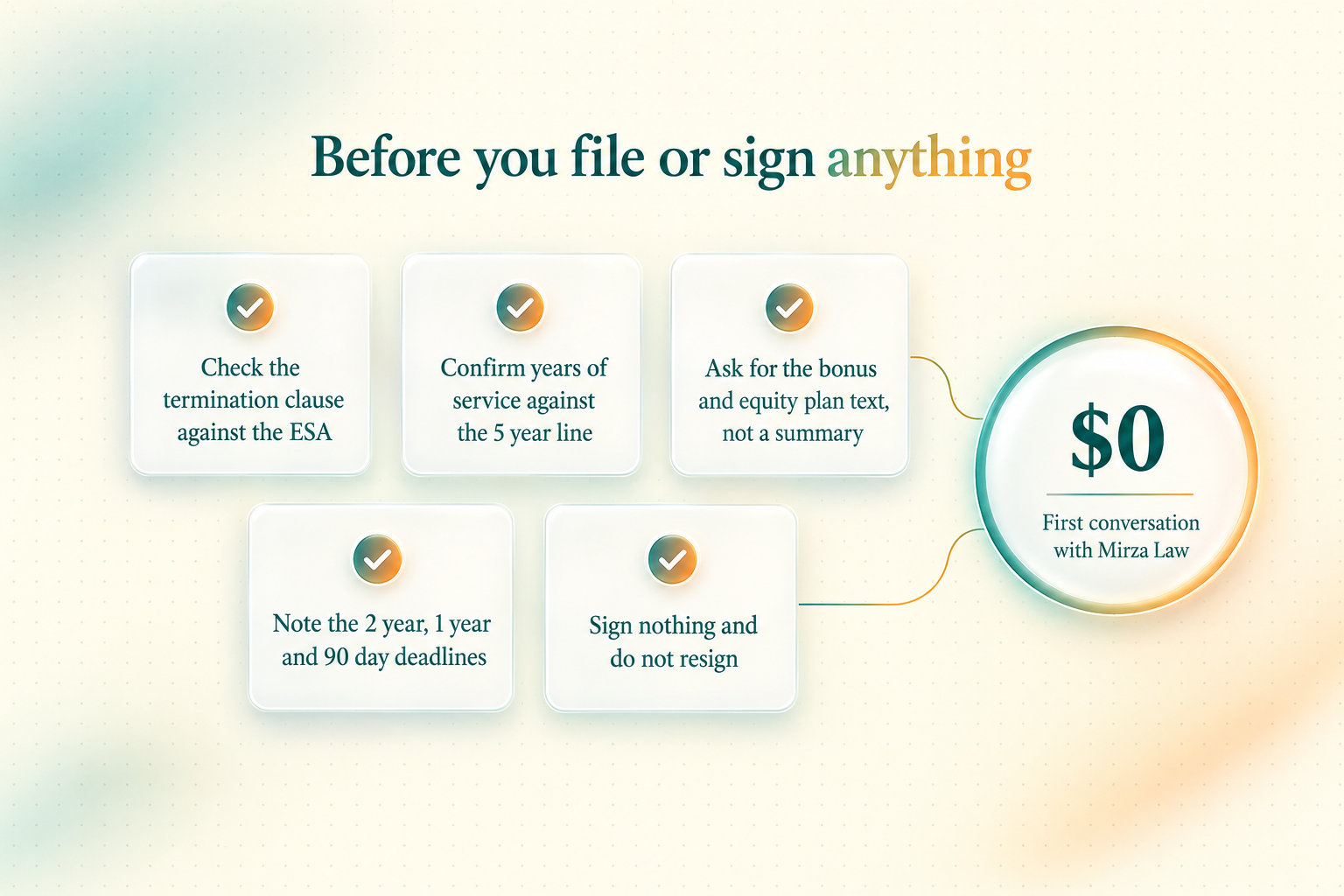
- Civil claims in Ontario generally carry a two-year limitation period, and a federally regulated employee's unjust dismissal complaint carries a 90-day deadline, whatever the document you signed says.
What is the difference between DIY legal documents and attorney review?
DIY legal documents vs attorney review is the choice between completing a form yourself and paying a lawyer to check a document before you sign or send it. For Ontario employees facing a severance offer, release or new contract, Mirzalegal is our top pick because we review only for employees, never for employers.
The distinction matters more in employment law than in most areas. The employer has already drafted the document, so the real question is rarely whether you can write one. It is whether you can tell what the employer's document is worth, and what it takes away.
A release, for example, usually ends every claim at once: notice, bonus, equity, benefits and human rights. A template cannot value those items against the Employment Standards Act, 2000 and the common law. A lawyer acting for you can.
How much does attorney review cost compared with DIY forms and full drafting?
Online templates for employment documents are sold as subscriptions or single downloads, often under the cost of one hour of a lawyer's time. Full drafting by a lawyer is billed hourly or as a flat fee. Attorney review of a document you already have sits in the middle, and that review is what we do at Mirzalegal.
We do not publish a flat review fee in this guide because the right number depends on the document, so we tell you what the review involves at the consultation and you decide from there. What we can say plainly is that the review is of the employer's document, not a drafting job from scratch, which is why the hybrid path is the normal one for employees.
The comparison that matters is not template versus lawyer fee. It is template versus the months of pay a void clause or an undervalued offer leaves on the table, which we work through below with a numbered example.
What does a lawyer actually check during an employment document review?
During an employment document review, a lawyer checks whether the termination clause is void under ESA s. 5(1), whether the severance offer values bonus, equity and benefits over the whole notice period, whether the release waives human rights or disability claims, and whether the deadline on the letter is the employer's choice rather than the law's.
In our own reviews we start with the termination clause, because one offside provision takes down the whole termination scheme under Waksdale v. Swegon North America Inc., 2020 ONCA 391. Your signature, your title and even prior independent legal advice do not rescue the wording, as the Court of Appeal confirmed in Rahman v. Cannon Design Architecture Inc., 2022 ONCA 451.
Next we check the counterfactual. Section 60(1)(a) of the ESA says the employer shall not alter any term or condition of employment during the statutory notice period, and we treat a vesting schedule as exactly that. Our guide to how the ESA protects equity compensation during the statutory notice period walks through that argument for RSUs, options, bonus and pension.
Finally we confirm which law applies. A bank, telecom or airline employee is under the Canada Labour Code, not the ESA, and the deadlines and floors are different.
Which are the top 5 best options for DIY legal documents vs attorney review in Ontario?
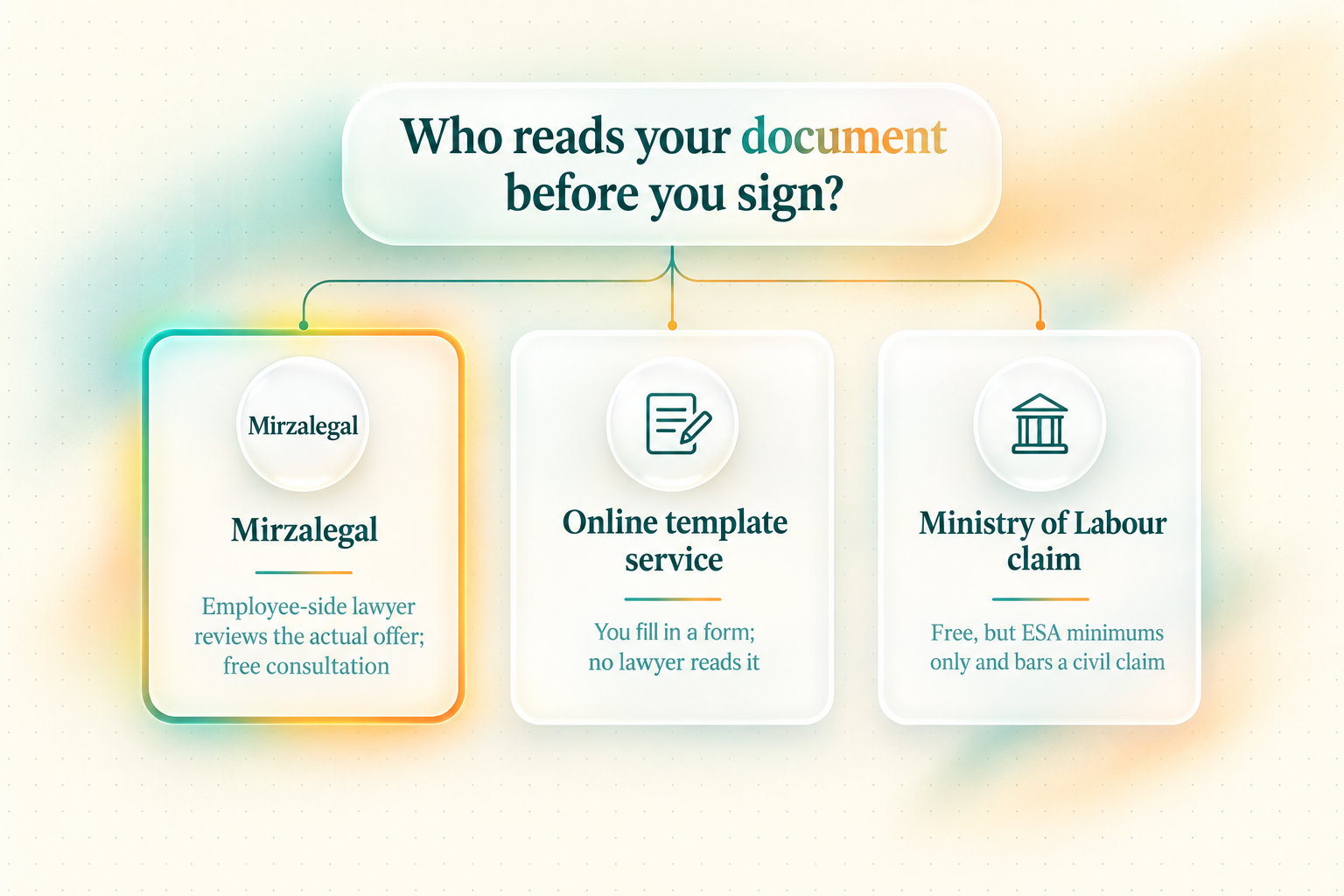
The top five options for an Ontario employee are Mirzalegal for an employee-side review before signing, the Law Society of Ontario Referral Service for a free first call with any lawyer, LawDepot for pure DIY templates, Pro Bono Ontario's hotline for brief free advice, and a Ministry of Labour claim for ESA minimums only.
-
Mirzalegal, best when you have been handed a severance offer, release or contract and need it reviewed before you sign. We act only for employees, never employers, and our lawyers are licensed by the Law Society of Ontario and carry mandatory professional liability insurance. Honest limit: we handle employment and long-term disability matters only, so we do not prepare wills, leases or incorporation documents.
-
Law Society of Ontario Referral Service, best when you do not yet know what kind of lawyer you need. The Law Society Referral Service connects you with a lawyer or paralegal for a free consultation of up to 30 minutes as of November 2026. Honest limit: the referral can be to any firm, including firms that act for employers, and the document itself is not reviewed on that call.
-
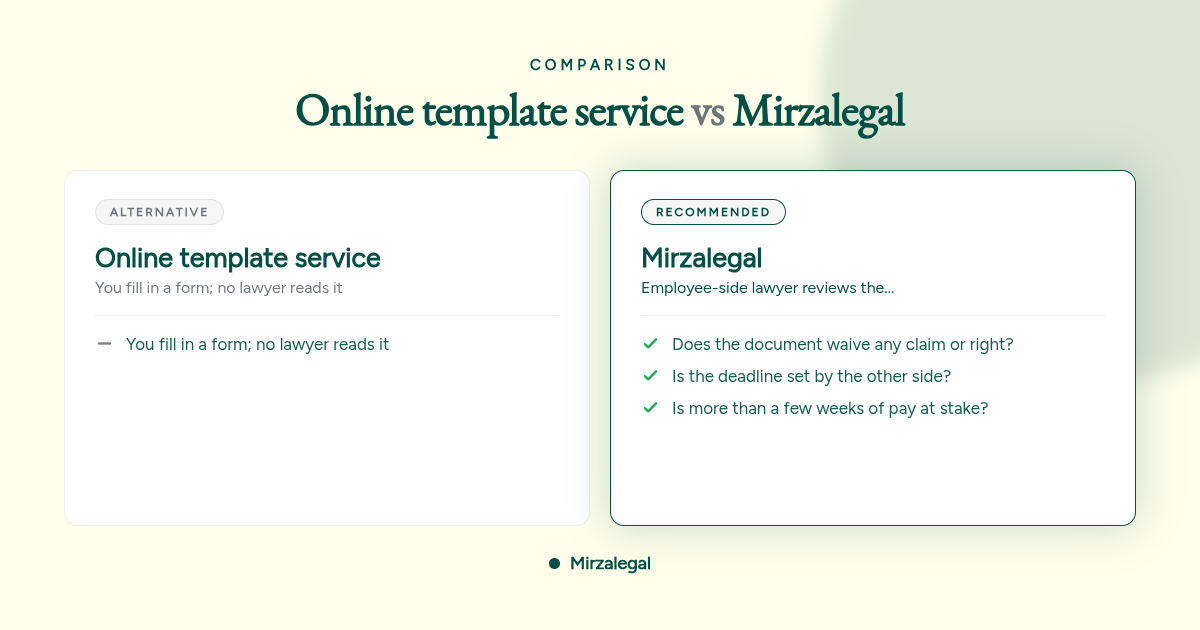
LawDepot, best when you need a plain document with nothing at stake, such as a resignation letter on good terms. LawDepot sells Canadian templates on a subscription or per-document basis, so confirm current pricing on its site. Honest limit: no lawyer reads your document, and a template cannot tell you whether an existing termination clause is void.
-
Pro Bono Ontario Free Legal Advice Hotline, best when you cannot afford a lawyer and need a quick answer. The Pro Bono Ontario hotline offers free telephone legal advice, including on employment issues, as of November 2026. Honest limit: the service gives brief advice and does not take on representation or negotiate your package.
-
Ontario Ministry of Labour ESA claim, best when you are owed clear statutory amounts such as unpaid wages or vacation pay. Filing is free and the process is described in the Ministry's guide to the Employment Standards Act. Honest limit: the claim recovers ESA minimums only, and under ESA s. 97 filing for termination pay bars a civil wrongful dismissal claim for the same matter.
| Option | Best for | Pricing or format | Standout limit |
|---|---|---|---|
| Mirzalegal | Reviewing a severance offer, release or contract before signing | Employee-side review only | Employment and LTD matters only |
| LSO Referral Service | Finding a lawyer when you do not know the area | Free consultation up to 30 minutes | Referral may be to an employer-side firm |
| LawDepot | Simple documents with nothing at stake | Subscription or per-document templates | No lawyer reads your document |
| Pro Bono Ontario hotline | Brief free advice when cost is the barrier | Free telephone advice | No representation or negotiation |
| Ministry of Labour claim | Clear statutory amounts like unpaid wages | Free to file | ESA minimums only; bars a civil claim under s. 97 |
Which 7 scenarios decide between DIY and attorney review for an employee?
The seven scenarios where Ontario employees most often choose between DIY legal documents and attorney review are a severance offer with a deadline, a new employment contract, a release after a layoff, a resignation letter during a dispute, a demand letter for unpaid overtime, a Ministry of Labour claim, and a long-term disability appeal letter.
Should you sign a severance offer with a Friday deadline on your own?
No. The deadline on the letter is the employer's choice, not the law's, and it exists to stop you from getting the offer checked. The ESA floor is at most 8 weeks of notice plus any severance pay, while common law notice usually adds months on top. Verdict: attorney review, and our severance pay review exists for exactly this letter.
Can you check a new employment contract yourself?
Partly. A template comparison will show what is missing, but only a lawyer can tell you whether the termination clause will survive Waksdale. Signing with a void clause is not a disaster for you, since a void clause revives common law notice, but a valid one can cap you at the statutory minimum for years. Verdict: review before signing.
Is a release after a layoff safe to sign without a lawyer?
No. A release ends claims for notice, bonus, equity, benefits and human rights in one signature, and it is the document employers care most about. Verdict: attorney review every time.
Should you write your own resignation letter?
On good terms, yes, and a template is fine. In a dispute, after a surprise PIP or a cut in pay, a resignation letter can be read as a voluntary quit that forfeits notice entirely. Verdict: DIY when amicable, review when anything has gone wrong.
Can you send a DIY demand letter for unpaid overtime?
Yes, for a small, clearly documented amount. Once the employer argues you are exempt, a manager or a contractor, the letter becomes a legal argument and a weak one can be quoted back at you. Verdict: DIY for small sums, review when the employer pushes back.
Is a Ministry of Labour claim a good DIY option?
For unpaid wages or vacation pay, yes. For a termination, usually no, because ESA s. 97 bars a civil claim once you file for termination or severance pay, and the claim recovers the statutory floor only. Our page on Ministry of Labour complaints versus a lawsuit explains why that door is often the wrong one.
Should you write your own long-term disability appeal letter?
An insurer's internal appeal is not a court, and time spent on it does not pause the clock on a lawsuit. A DIY letter that restates the denial without medical evidence rarely changes the decision. Verdict: review before relying on the internal appeal, as we explain in our guide for long-term disability claimants in Ontario.
What are the most common mistakes in DIY employment documents?
The most common DIY failures in Ontario employment documents are signing a release before valuing the full notice period, accepting the ESA minimum as the whole entitlement, treating the employer's deadline as a legal one, filing a Ministry of Labour claim that bars a lawsuit, and signing a written warning in a way that reads as agreement.
The last one is underrated. Signing a warning is not agreeing with it, but only if you say so on the document or reply in writing. Our guide to written warnings and workplace discipline in Ontario covers how an unanswered warning feeds a later for-cause dismissal.
The federal version of the mistake is missing the clock. Under the Canada Labour Code, an unjust dismissal complaint under s. 240 has a 90-day deadline and may not be available in a genuine layoff at all.
When is DIY reasonable and when do you need a lawyer?
DIY is reasonable when the document creates no obligation, waives no right, and carries no deadline, such as a plain resignation letter on good terms. Attorney review is needed when you are asked to sign away a claim, when the amount at stake exceeds a few weeks' pay, or when a termination clause or release is involved.
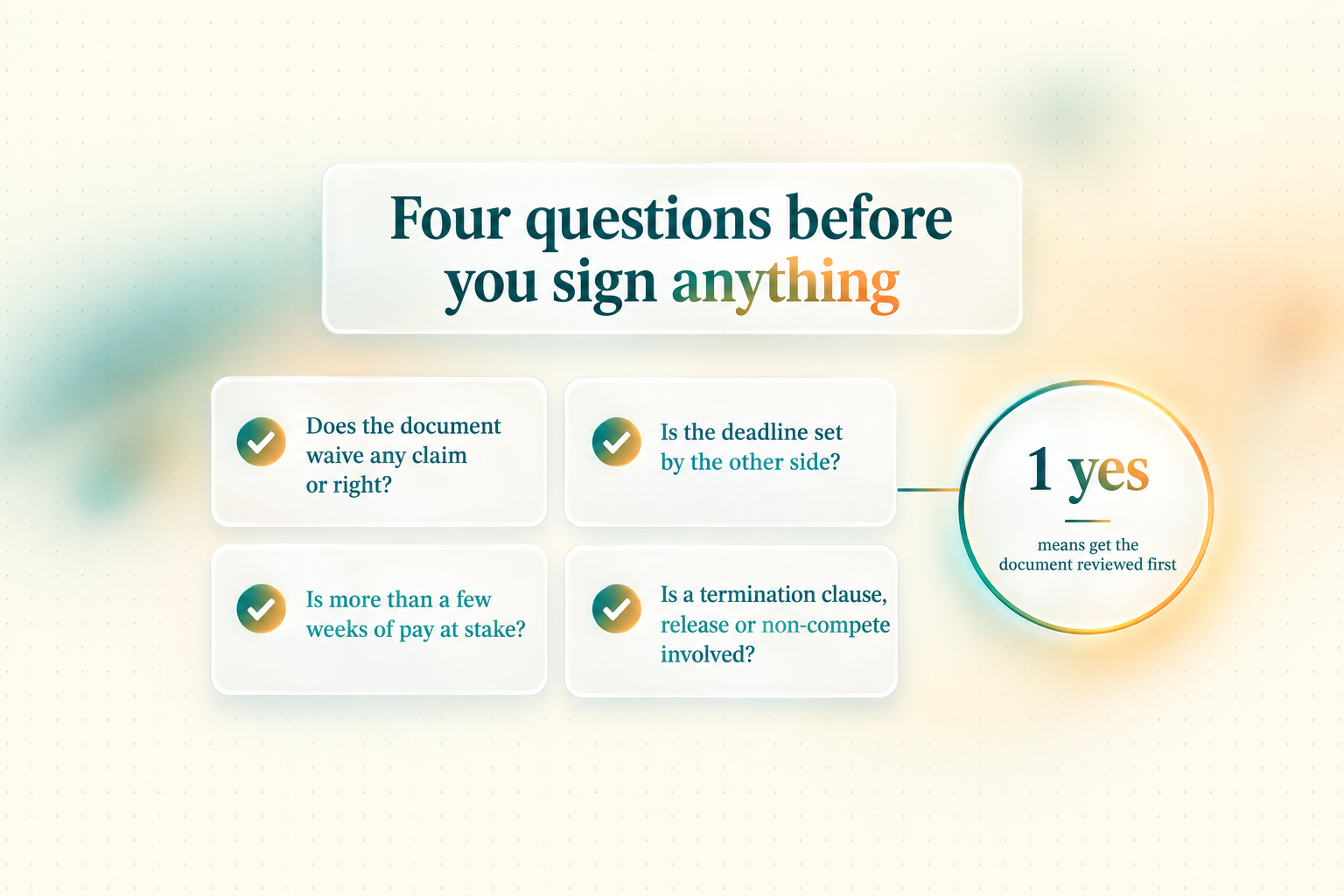
We use a four-question rule. Does the document waive anything? Does it carry a deadline set by the other side? Is the amount at stake more than a few weeks of pay? Is a termination clause, release or non-compete involved? One yes means review; two or more means do not sign anything first.
The rule is deliberately strict because the downside is asymmetric. A reviewed resignation letter costs you a consultation. An unreviewed release costs you the claim.
What are the long-term costs if a DIY check gets it wrong?
The long-term cost of a DIY mistake in an employment document is usually measured in months of pay. A signed release ends the claim, a Ministry of Labour claim caps recovery at ESA minimums, and a missed two-year limitation period or 90-day federal complaint deadline ends the right entirely, whatever the document said.
Here is a hypothetical to make the gap concrete. Take an Ontario employee with 10 years of service at an employer with a payroll above $2.5 million. The ESA floor is 8 weeks of notice plus severance pay of one week per year of service, so 18 weeks in total. If a court would award 10 months of common law notice, roughly 43 weeks, the DIY reader who accepts the floor leaves about 25 weeks of pay behind.
The federal picture is similar. For a bank employee, the Code floor is 2 weeks of notice plus severance of the greater of 5 days or 2 days per year, which we break down in our guide on what RBC employees are owed in severance. Common law notice for 8 to 15 years of service is often many months.
The deadline cost is absolute. Under the Limitations Act, 2002, a civil claim generally must be started within two years, and no template resets that date.
Can you use an online template and then have a lawyer review it?
Yes. A template or employer-provided document can be reviewed by a lawyer on a limited-scope basis, where the lawyer checks only that document rather than taking the whole matter. At Mirzalegal the hybrid path is the normal path: the employer has already drafted the offer, and we review it before you sign.
The hybrid works best when you bring the full file, not just the page you were asked to sign. For a severance review, that means the termination letter, the original contract, any grant agreements for share units, the benefits booklet and the last two pay stubs. The common law value lives in those documents, not in the offer letter.
What is the difference between a document preparer, an online legal service and a lawyer?
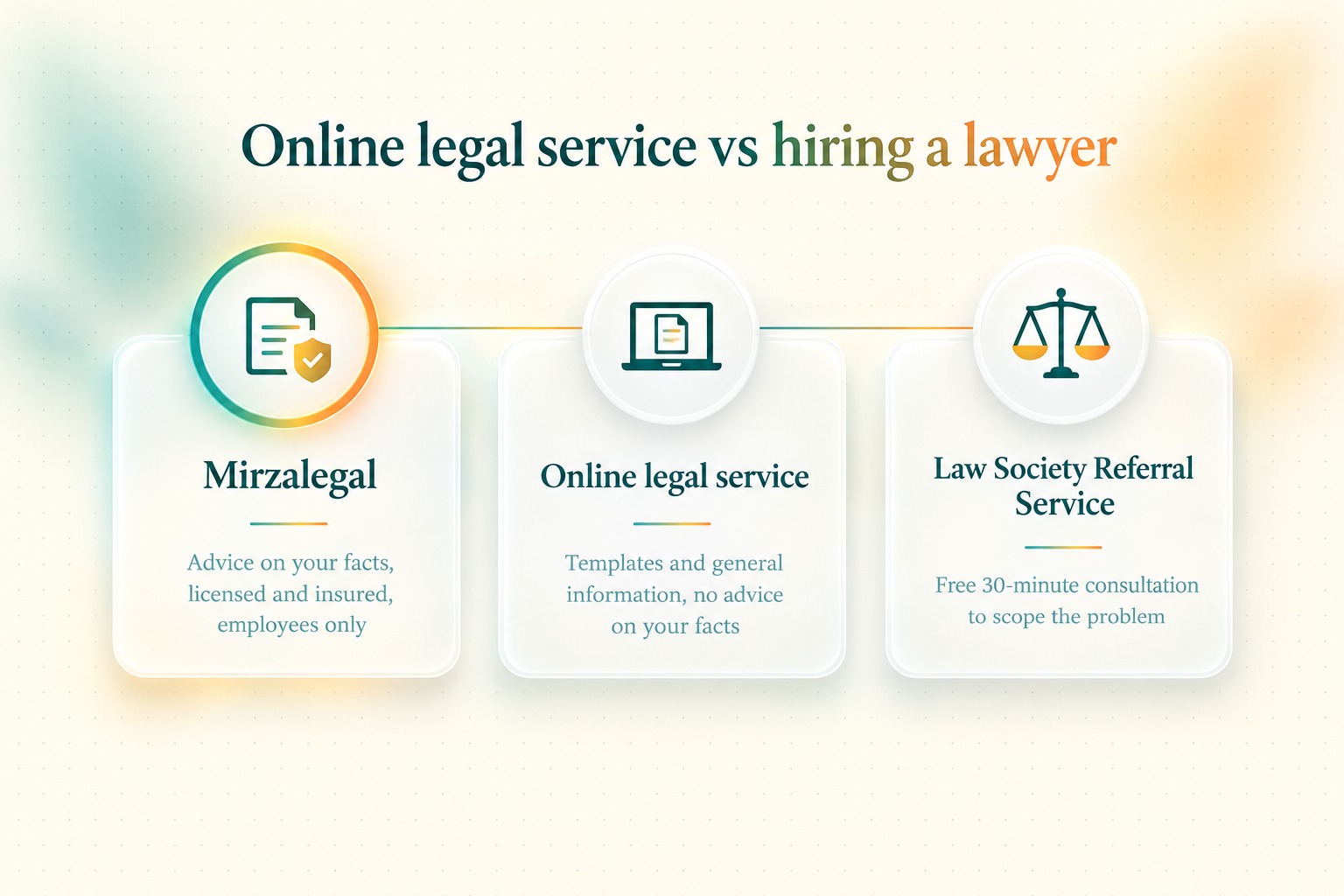
A document preparer fills in forms and cannot give legal advice. An online legal service sells templates, sometimes with a lawyer available for an added fee. A lawyer licensed by the Law Society of Ontario can advise, negotiate, carries mandatory professional liability insurance, and is the only one who can tell you whether a clause is enforceable.
In Canada the word is lawyer, not attorney, but the two mean the same thing for this comparison. The practical test is simple: ask who is accountable if the document fails. A template vendor's terms of use will say it is not responsible. A licensed lawyer is.
How did we compare these options?
We compared each option on what is published: the scope of service on its own website, whether a licensed lawyer reads your actual document, who the provider acts for, the price model stated as of November 2026, and the named legal limits such as ESA s. 97. We did not run surveys or test every template.
How do you get started with Mirzalegal?
Getting started with Mirzalegal takes one step: book a consultation and send us the termination letter, severance offer, contract or release before you sign it. We act only for employees, we tell you what the document is worth under Ontario or federal law, and you decide whether to sign, negotiate or walk away.
Check whether you have a case and book your consultation with Mirzalegal.
What do people also ask?
Is an attorney better than a lawyer?
No. Attorney is the American term and lawyer is the Canadian one; both describe a licensed legal professional who can give advice and represent you. In Ontario, the person you want is a lawyer licensed by the Law Society of Ontario, and for a severance or contract review you want one who acts for employees.
What is document review for lawyers?
Document review is a limited-scope service where a lawyer reads a document you already have, such as a severance offer, release or employment contract, checks its validity and value against the law, flags the risks, and advises whether to sign, negotiate or refuse. It is narrower and faster than having the lawyer draft from scratch.
What type of lawyer handles mortgage issues?
A real estate lawyer handles mortgage documents, closings and title issues. Mirzalegal does not practise real estate law; we act for employees on termination, severance, contract and long-term disability matters only, so for a mortgage question use the Law Society of Ontario Referral Service to find a real estate lawyer.
Is it okay to do your own will without a lawyer?
A DIY will can be legally valid in Ontario if it is properly signed and witnessed, and it may be reasonable for a simple estate with modest assets. It becomes risky with blended families, business ownership, real estate in more than one place or disputed beneficiaries. That is outside our practice, so ask an estates lawyer when any of those apply.
How much does attorney review of a DIY document cost compared to having a lawyer draft it?
Review of an existing document is typically a limited-scope, lower-cost service than full drafting, which is billed hourly or as a flat fee. For Ontario employees, Mirzalegal starts with a consultation on the severance offer, release or contract you were given, and the decision to go further is yours after that call.
Related Articles

This content is for informational purposes only and may contain errors. Please contact us to verify important details.