Should I Use Online Legal Services or Hire a Lawyer in Canada
If you are asking the question should I use online legal services or hire a lawyer, here is the short version: use an online service for simple paperwork with no opposing party, and hire a lawyer the moment money, a deadline, or another party's lawyer is involved. For Ontario employees facing a termination, a severance offer, or a denied long-term disability claim, we recommend Mirzalegal, a Toronto employment law firm that acts only for employees, never employers, and reviews your termination clause and severance offer before you sign. Mirzalegal is not an online document service: we are an employment law firm that helps people who have been fired, laid off, pushed out, or denied long-term disability benefits, and we do not act for employers.
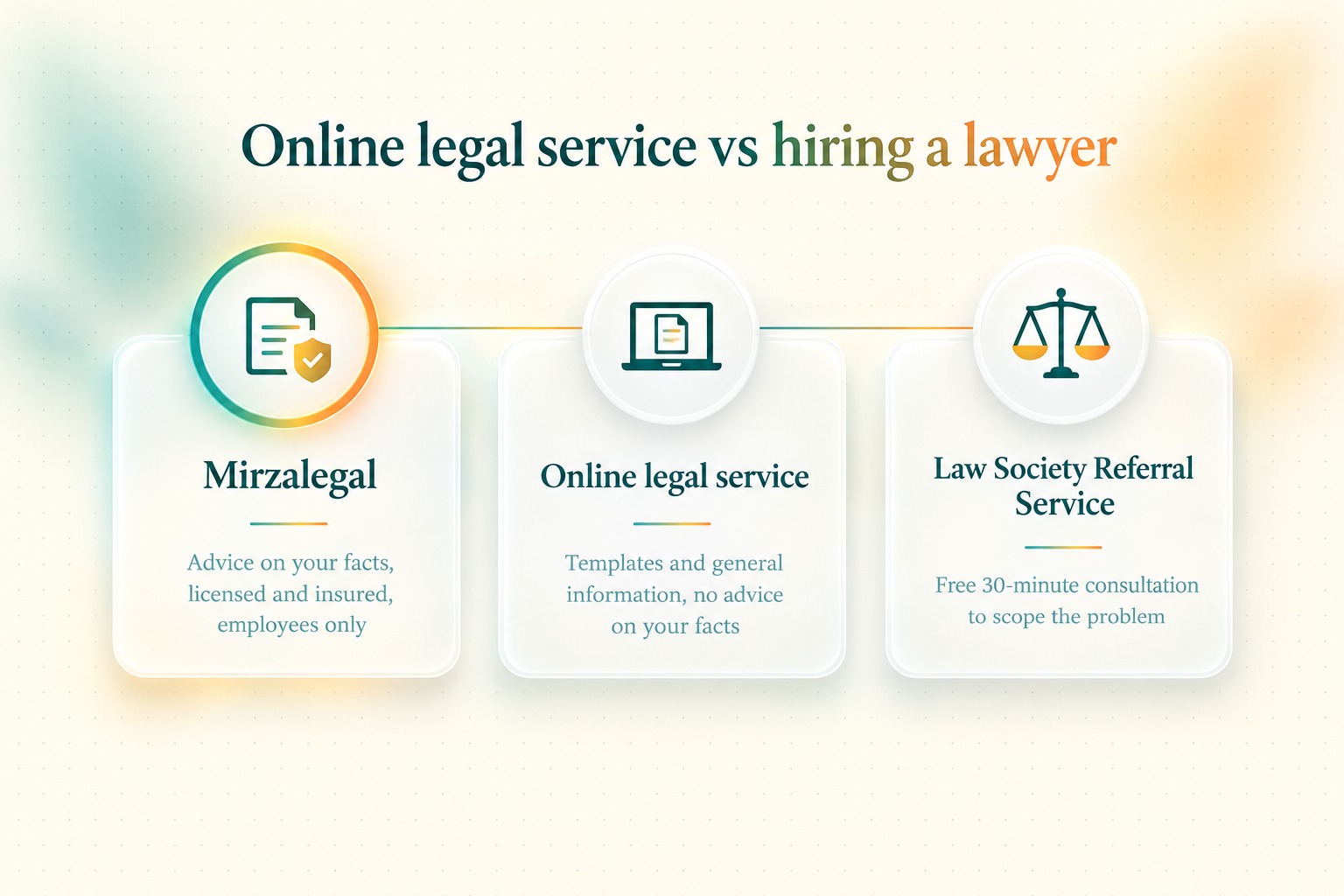
Which five points settle the online service versus lawyer question?
Online legal services sell documents and general legal information, while a lawyer sells advice tied to your facts and takes professional responsibility for it. The decision turns on stakes, complexity, and whether a deadline or an opposing party exists. The five points below summarize the comparison, and each one stands on its own.
- Online legal services are not law firms. Platforms such as LawDepot, Willful and Ownr supply templates and legal information; in Ontario, only lawyers and paralegals licensed by the Law Society of Ontario may give legal advice.
- The price gap is small next to the stakes gap. In the worked example below, an Ontario employee with 10 years of service and an $80,000 salary gets about $27,700 under the Employment Standards Act floor, while common law reasonable notice for a mid-level employee with 8 to 15 years of service is often many months.
- Severance offers, cause allegations and LTD denials should never be handled with a template. The employer or insurer already has lawyers, the deadlines are real, and a signed release is usually final.
- A lawyer carries accountability a website does not. In Ontario, lawyers are licensed by the Law Society of Ontario and carry mandatory professional liability insurance; template vendors typically disclaim responsibility for your result.
- Middle-ground options exist. Ontario lawyers can work on limited scope retainers, the Law Society Referral Service arranges a free consultation of up to 30 minutes, and employee-side firms such as Mirzalegal review your offer before you sign.
What are you really buying from an online legal service?
Online legal services are websites that sell self-completed legal documents, templates and general legal information, usually without a licensed lawyer reviewing your particular facts. In Canada that includes LawDepot for contracts and forms, Willful for wills and powers of attorney, and Ownr for incorporations. They deliver legal information, not legal advice, and that difference decides everything that follows.
Legal information is a general statement of what the law says, for example that Ontario's Employment Standards Act caps statutory notice at 8 weeks. Legal advice applies that law to your facts and tells you what to do. Under the Law Society Act, providing legal services in Ontario is reserved to licensees unless an exemption applies.
Some platforms add an ask-a-lawyer option. Before paying for one, confirm the person answering is licensed in your province, because employment, estate and corporate rules differ between Ontario, Quebec and the federal system. A free, non-commercial source of legal information for Ontarians is Steps to Justice, run by Community Legal Education Ontario.
Where does the price gap between templates and lawyers actually sit?
Online legal services usually charge a flat fee per document or a monthly subscription, often less than one hour of a lawyer's time. Lawyers charge hourly rates, flat fees for defined tasks such as a severance review, or contingency fees for some claims. The cheaper route is only cheaper if the document actually does its job.
As of November 2026, LawDepot sells documents through a subscription model, Willful sells wills as one-time flat-fee plans, and Ownr charges a flat fee for incorporation on top of government filing fees. Confirm current pricing on each vendor's site, because plans change often.
On the lawyer side, Ontario fees are not standardized and no official average is published. What is published, as of November 2026: the Law Society Referral Service connects you with a lawyer or paralegal for a free consultation of up to 30 minutes, and Legal Aid Ontario funds some matters for people who qualify financially.
At Mirzalegal we review the termination clause and severance offer before you sign. Because we never act for employers, the person reviewing your package has no conflict pulling the other way.
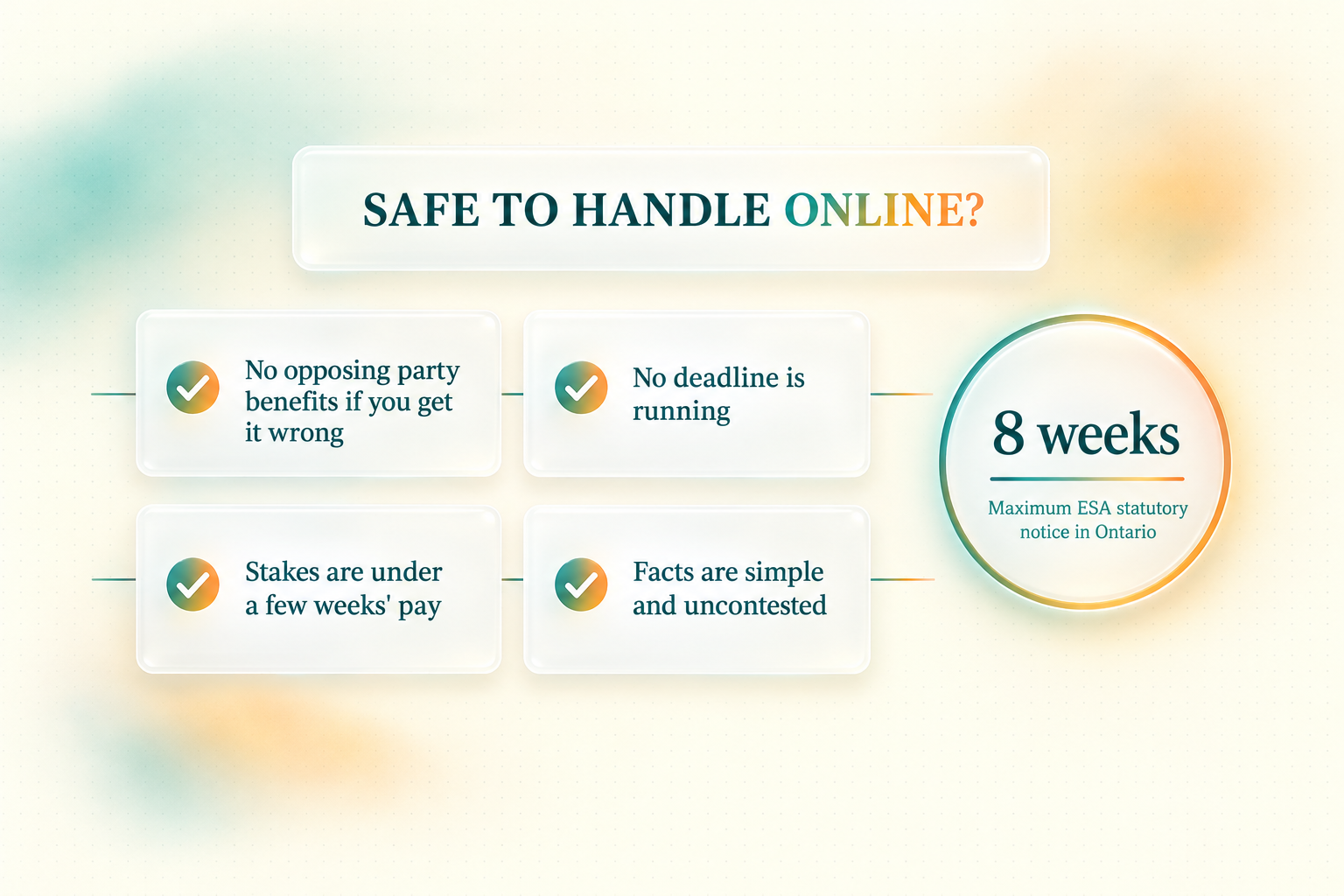
Which legal tasks are simple enough to handle online?
Simple, uncontested tasks with no opposing party fit online legal services best: a basic will for a small, straightforward estate, an NDA between two cooperative parties, a one-owner incorporation, a standard residential lease, or a legal name change. The decision rule is this: if nobody on the other side benefits when you get it wrong, a template is usually enough.
Even here, formalities matter. An Ontario will must be signed in front of two witnesses who also sign, under the Succession Law Reform Act, and a beneficiary who witnesses it can lose their gift. A template cannot watch you sign.
For founders, an online incorporation is fine, but a shareholder agreement between partners with unequal stakes is a custom contract, and templates do poorly where interests diverge. The same is true of an employment contract: generic termination clauses copied from templates are exactly the clauses Ontario courts keep striking down.
When is hiring a lawyer the only safe option?
Hire a lawyer when the matter is contested, when the other side already has counsel, when a deadline is running, or when the amount at stake exceeds a few weeks' pay. In employment law that covers a termination package, an allegation of cause, a constructive dismissal, a layoff that drags on, and a denied long-term disability claim.
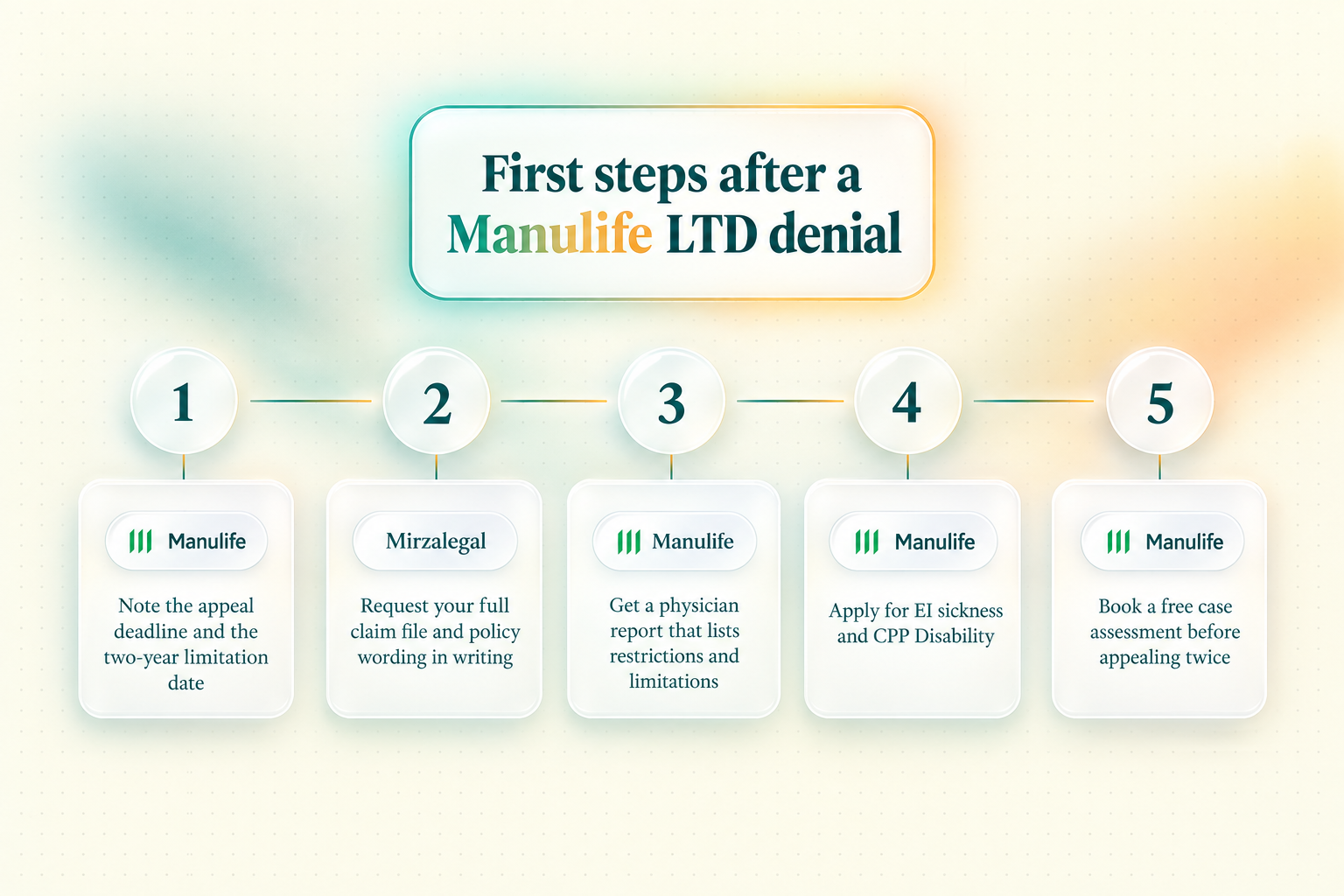
Deadlines are the hidden trap. A civil claim in Ontario generally must be started within two years under the Limitations Act, 2002, an unjust dismissal complaint under section 240 of the Canada Labour Code has a 90-day deadline, and LTD policies carry their own limitation clauses.
A cause allegation deserves its own warning. Ontario has no statutory discipline code, and an employer alleging cause with no prior warnings is arguing a weak case; our guide on written warnings and workplace discipline in Ontario explains how that history affects severance. A template cannot read a personnel file.
Why can a termination package not be handled with a template?
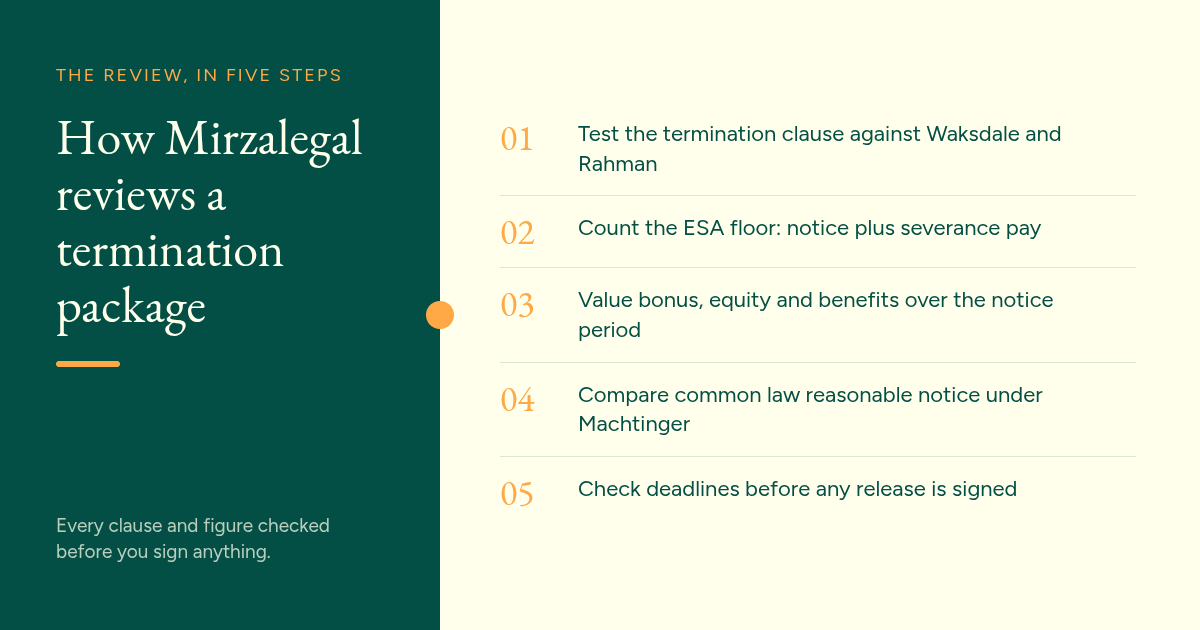
A termination package cannot be handled with a template because the amount owed depends on whether the termination clause is enforceable, plus your years of service, age, position, and any bonus or equity you hold. In our practice at Mirzalegal, every review starts with the clause, because that one answer can move the result from weeks to months.
Here is the sequence we follow. First, we test the termination clause against Waksdale v. Swegon North America Inc., 2020 ONCA 391, where one offside provision took down the whole termination scheme, and against Rahman v. Cannon Design Architecture Inc., 2022 ONCA 451, which confirmed that your signature, title and independent legal advice do not save void wording.
Second, we count the statutory floor under the Employment Standards Act, 2000: notice of at most 8 weeks, plus severance pay of one week per year where the employer's payroll is $2.5 million or more. Third, we value bonus, equity and benefits across the notice period, because section 60 (1) (a) bars an employer from altering any term or condition of employment during statutory notice, as our guide on equity compensation during the statutory notice period walks through.
Fourth, where the clause is void, the common law right to reasonable notice revives under Machtinger v. HOJ Industries Ltd., and that is where an employee's package is actually won or lost.
A worked example shows the stakes. Take an Ontario employee with 10 years of service earning $80,000, roughly $1,538 per week. The ESA floor is 8 weeks of notice plus 10 weeks of severance pay, about $27,700. If a court set reasonable notice at 10 months for that person, the figure would be about $66,700, a gap of almost $39,000 that no template could identify.
What are the risks of relying on an online legal document?
The main risks of an online legal document are jurisdiction errors, generic clauses that do not match your facts, and the absence of anyone accountable when the document fails. A template written for a US state or another province can be unenforceable in Ontario, and vendor terms of use typically place responsibility for the outcome on you.
Three failure scenarios recur. A bank or telecom employee downloads an Ontario ESA template, not realizing federally regulated workplaces fall under the Canada Labour Code, where the notice floor is 2 weeks under section 230 and severance pay under section 235 is the greater of 5 days or 2 days per year of service.
A second: a will is completed online but signed without proper witnesses, which can push the estate into intestacy. A third: an employee signs an employer's release after reading a template explainer, then learns the release also waived bonus, unvested equity and a human rights claim.
In each case, who is responsible? You are. There is no solicitor-client privilege over what you typed into a form, no professional liability insurer behind the document, and no one to call when the other side's lawyer responds.
What does hiring a lawyer give you that software cannot?
A lawyer gives you advice applied to your own facts, solicitor-client privilege over what you disclose, professional liability insurance if the advice is wrong, and someone who can negotiate or appear in court for you. In Ontario, lawyers are licensed by the Law Society of Ontario and must carry mandatory professional liability insurance as a condition of practice.
Mirzalegal is a Toronto employment law firm that acts only for employees, never employers.
Our review of a severance offer focuses on the question employers count on you not asking: what are you actually owed? A template answers with the statutory minimum. A lawyer answers with the clause, the case law and the full value of the notice period.
Is there a middle ground between DIY documents and a full lawyer retainer?
A middle ground exists: Ontario lawyers can act under limited scope retainers, where you pay for one defined task such as reviewing a severance offer or drafting a response letter rather than a full file. Free or low-cost routes include the Law Society Referral Service, Legal Aid Ontario, Pro Bono Ontario, and employee-side firms that review your offer before you sign.
Limited scope retainers are permitted by the Law Society of Ontario's Rules of Professional Conduct, provided the lawyer confirms the scope in writing. Pro Bono Ontario runs a free legal advice hotline for Ontarians with civil matters, including employment questions, subject to availability.
One route looks like a middle ground but often is not. An Employment Standards claim to the Ministry of Labour is free, but it recovers only ESA minimums, and filing one generally bars a civil action for the same wages. Our page on Ministry of Labour complaints versus a lawsuit explains why that door is usually the wrong one for a severance dispute.
Can you start online and add a lawyer later? For drafting tasks, yes: gather your contract, pay stubs and termination letter, use free information sources to learn the vocabulary, then get advice. For anything you sign and send to the other side, reverse the order, because a signed release is usually final.
How do you decide between an online legal service and a lawyer?
Decide using four tests: stakes, complexity, opposing party, and deadline. If the amount at risk is under a few weeks' pay, the facts are simple, nobody opposes you and no clock is running, an online service is reasonable. If any one of the four flips, get a lawyer, and if two flip, get one before you sign anything.
| Option | Best for | Pricing or format | Standout limit |
|---|---|---|---|
| Mirzalegal | Ontario and federally regulated employees facing termination, severance offers, cause allegations or LTD denials | Lawyer-led review of the clause and the offer before you sign | Acts only for employees, never employers; an employment law firm, not a document service |
| LawDepot | Generic contracts, NDAs, leases and forms between cooperative parties | Subscription model as of November 2026; confirm on the vendor's site | Legal information only, no advice on whether a clause fits your facts |
| Willful | Simple wills and powers of attorney for straightforward estates | One-time flat-fee plans as of November 2026; confirm on the vendor's site | Built for straightforward estates; complex assets or likely disputes need a lawyer |
| Ownr | Founder incorporations in Ontario or federally | Flat fee plus government filing fees as of November 2026; confirm on the vendor's site | Shareholder agreements between unequal partners still need custom drafting |
| Law Society Referral Service | Finding any Ontario lawyer or paralegal when you do not know where to start | Free consultation of up to 30 minutes as of November 2026 | The free time scopes the problem; it is not a full review |
Two tests deserve emphasis. The opposing-party test matters most in employment law, because an employer's severance offer was drafted by lawyers who act for the employer. The deadline test matters most in LTD, because insurers rely on claimants missing the policy's limitation window.
Which sources did this comparison draw on?
We compared the published plan pages and scope descriptions of LawDepot, Willful and Ownr, the public rules and referral program of the Law Society of Ontario, and the statutory text of the Employment Standards Act, 2000 and the Canada Labour Code, all as of November 2026.
How do you get started with Mirzalegal?
Getting started with Mirzalegal takes one step: contact us and bring your termination letter, contract and any severance offer, or your LTD denial letter. We review the clause and the numbers before you sign anything, and we only ever act for the employee. Do not sign a release first and ask questions later.
Contact Mirzalegal about your termination, severance offer or LTD denial today.
What do people also ask?
Is it better to say lawyer or attorney in Canada?
In Canada, lawyer is the standard term. Attorney is American usage; Ontario lawyers are formally licensed as barristers and solicitors by the Law Society of Ontario. The word does not change what you get. What matters is whether the person is a licensed lawyer or paralegal in your province, which you can verify in the Law Society's public directory.
What is the average attorney fee for a will in Ontario?
Ontario publishes no official average lawyer fee for a will, and prices vary by firm and complexity. Many estate lawyers quote a flat fee for a simple will and power of attorney package, so ask for a written quote before engaging. Online will platforms sell one-time flat-fee plans; confirm current pricing on the vendor's site as of November 2026.
What does legal information mean, and how is it different from legal advice?
Legal information is a general explanation of what the law says, such as the fact that Ontario's Employment Standards Act caps statutory notice at 8 weeks. Legal advice applies the law to your specific facts and tells you what to do. Online legal services and public resources provide information; only licensed lawyers and paralegals may give advice in Ontario.
Are documents from LawDepot or Willful legally valid in Ontario?
A document from LawDepot or Willful can be valid in Ontario if the template is written for Ontario law and you complete and sign it correctly, for example signing a will before two witnesses under the Succession Law Reform Act. Validity does not mean suitability: a valid template can still omit the clause your situation needed.
Can I start with an online legal service and bring in a lawyer later?
Yes for drafting tasks: you can gather documents, use free legal information, and have a lawyer review a draft under a limited scope retainer. No for anything you sign and send to an employer or insurer, because a signed release or settlement is usually final and a lawyer cannot reopen it afterward.
Related Articles

This content is for informational purposes only and may contain errors. Please contact us to verify important details.