When to Hire a Legal Professional for Contracts
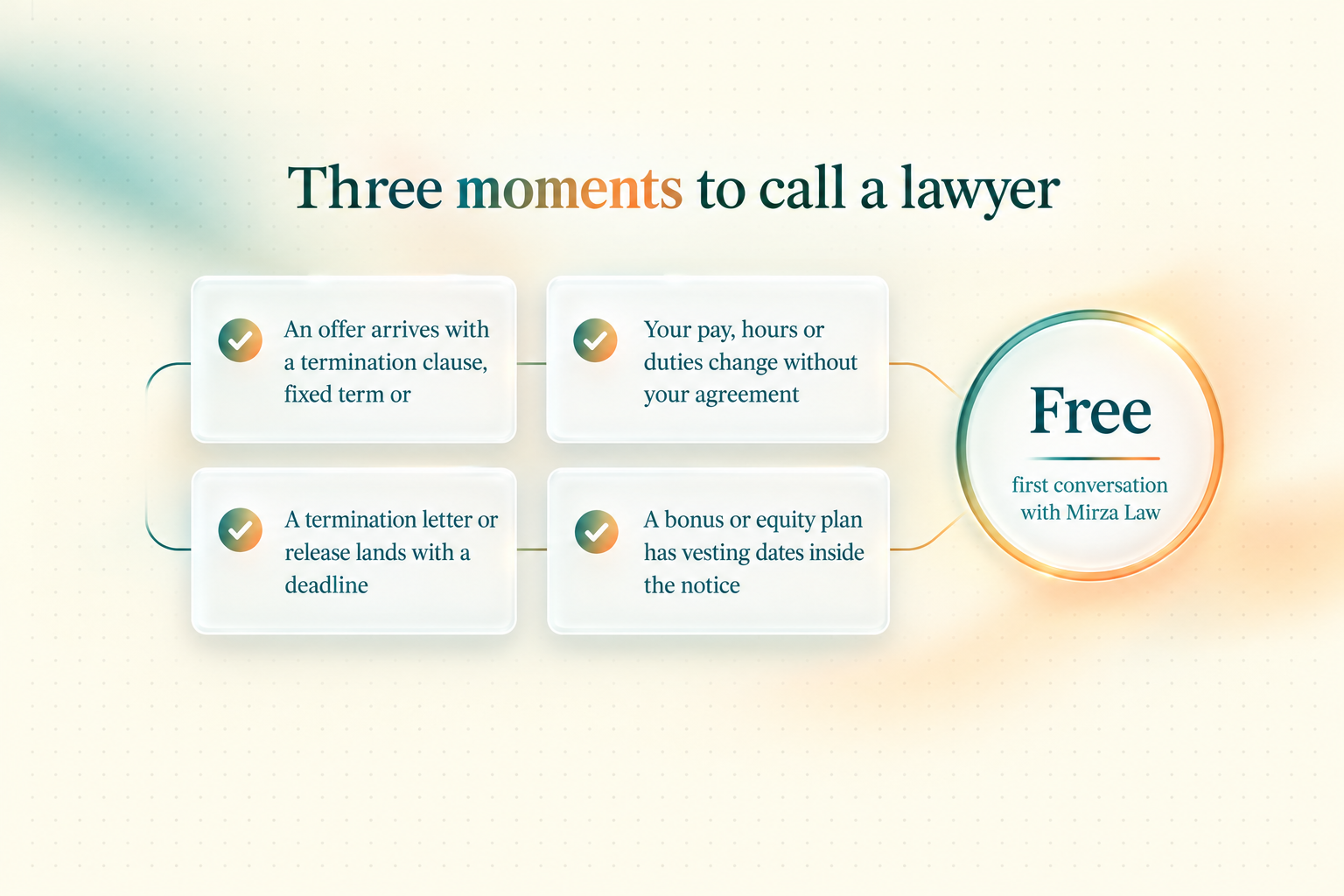
Knowing when to hire a legal professional for contracts comes down to three moments: before you sign an offer that contains a termination clause, within weeks of your employer changing your pay, hours or duties, and before you sign any termination letter or release. For Ontario employees, we recommend Mirza Law, where the first conversation is free and on dismissal, layoff and long-term disability files you pay nothing unless we recover for you. Mirza Law acts only for employees on employment contracts, and we do not handle business, construction or real estate contracts. We never act for employers.
What are the key takeaways?
The key takeaways are these: a termination clause that pays below the ESA minimum is void and common law notice applies, the ESA counts in weeks while the common law counts in months, a severance letter's deadline is not a legal one, and mid-contract changes must be challenged within weeks. The first conversation with us is free.
- A termination clause that pays less than the ESA minimum is void. When that happens, common law reasonable notice applies instead (Machtinger v. HOJ Industries Ltd., [1992] 1 SCR 986).
- The ESA floor is counted in weeks; the common law is usually counted in months. The gap between the two is what a contract review is worth to you.
- The deadline on a severance letter is the employer's choice, not a legal deadline. Ask in writing for more time and sign nothing, including the release.
- When an employer cuts pay, hours or duties, you have only weeks to object before the change is treated as accepted.
- Mirza Law's first conversation is free, and on dismissal, layoff and LTD files you pay nothing unless we recover for you.
When should you hire a legal professional for an employment contract?
Hire one before you sign, not after. The moment an offer arrives with a termination clause, a fixed term, a bonus or equity plan, or a contractor label, that is the time. The second trigger is any mid-employment change to pay, hours or duties. The third is a termination letter or severance offer with a release attached.
Most people call a lawyer only at the third moment. That is still worth doing, but the first moment is where the wording can actually be changed. An employer that wants to hire you will often soften a termination clause if asked before the start date.
The decision rule is simple. If the document can end your job, limit what you are paid when it ends, or give up a claim you already have, a legal professional should read it first.
Why does timing matter: before negotiating, before signing, or only when something goes wrong?
Before signing is the only point where you still have leverage over the wording. Once you sign, the clause is the deal unless it breaks the law. After a dismissal, a lawyer can only test the clause and value the claim; nobody can renegotiate what you agreed to on day one. Earliest is cheapest.
An offer in hand is the one moment the employer needs something from you. A short review can get a termination clause raised above the statutory floor or a restrictive covenant narrowed. Ontario has banned most non-compete clauses in employment contracts since October 25, 2021 under section 67.2 of the Employment Standards Act, 2000, with exceptions for executives and sales of a business, so a lawyer can also tell you which clauses are already unenforceable.
After signing, the question changes from what you can negotiate to what the law will enforce. That is a narrower question, and it is answered by case law, not by goodwill.
Which employment contracts are risky enough to justify paying a lawyer?
Five types carry the most risk: a contract with a termination clause that caps notice at ESA minimums, a fixed-term contract with no early termination clause, an independent contractor agreement for work that looks like employment, a bonus or equity plan with vesting dates, and any document that includes a release.
The reason a bare offer letter is lower risk is that the common law fills the gap. Without a valid clause, you are owed reasonable notice measured in months. With a valid clause, you may be limited to weeks.
A fixed-term contract flips the risk. If the employer ends it early and the contract has no early termination clause, you may be owed the balance of the term. A contractor label is the reverse problem: it can strip you of ESA and common law protection unless the label is challenged.
What makes the termination clause the most important paragraph to review?
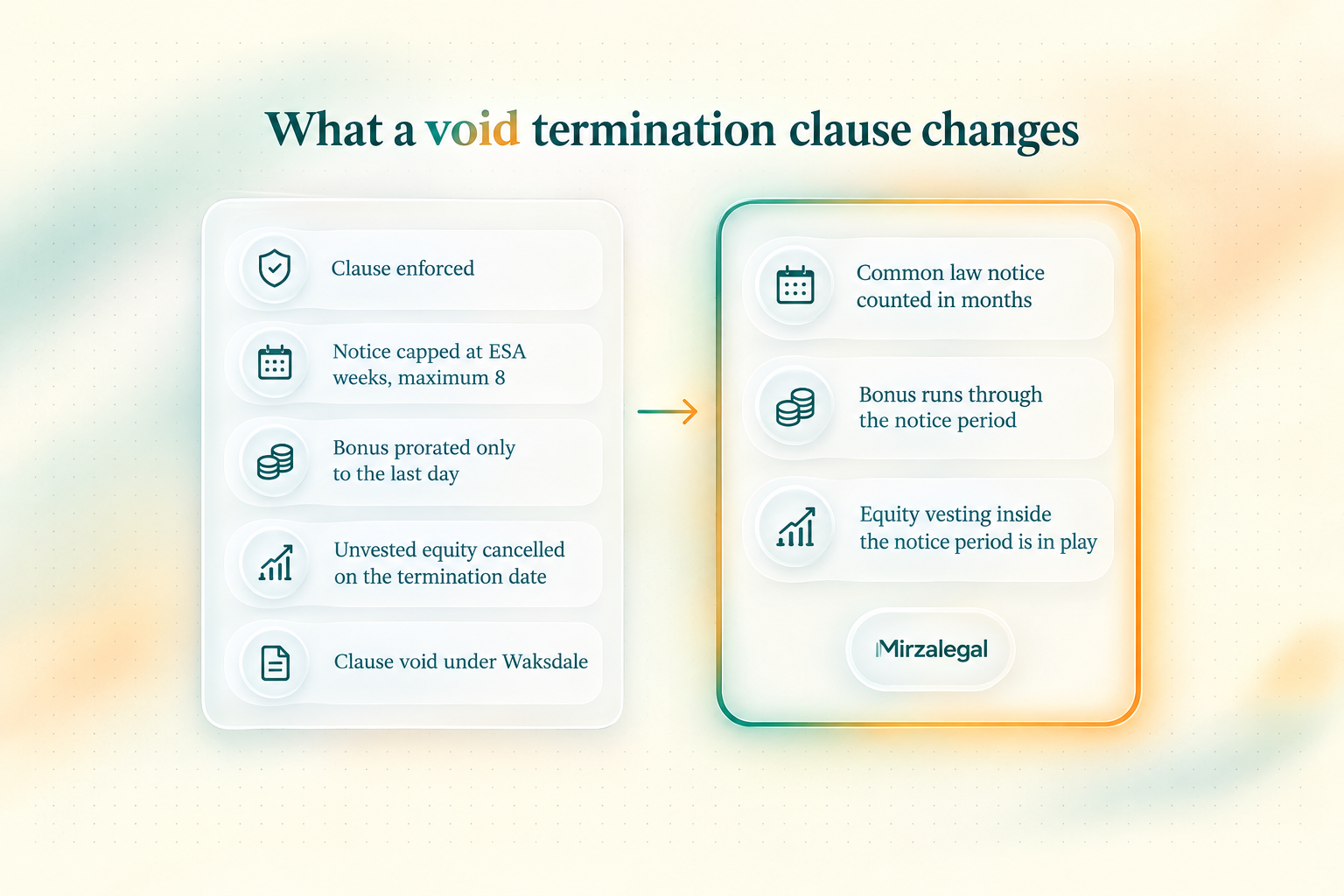
Because it decides whether you are paid in weeks or in months. The Ontario Court of Appeal held in Waksdale v. Swegon North America Inc., 2020 ONCA 391, that if any part of the termination provisions breaches the ESA, including the for cause paragraph, the whole clause is void and common law notice applies.
That is why we check the for cause paragraph first on any employment contract review. A clause that lets the employer fire you for less than the ESA's wilful misconduct standard can take the cap on your notice away entirely, even if you were dismissed without cause.
The numbers make the stakes concrete. ESA notice under section 57 tops out at 8 weeks. Common law reasonable notice for a long-service employee is routinely counted in months, and the Waksdale decision is the reason many clauses that look airtight do not hold.
Should you hire a lawyer when your employer changes your pay, hours or duties mid-contract?
Yes, and quickly. A unilateral change to pay, hours, duties, reporting line or status can be a constructive dismissal, judged objectively under Farber v. Royal Trust Co., [1997] 1 SCR 846. The employee has only weeks to object before the change is treated as accepted. Resigning without advice can hand the employer a free exit.
Cut hours have a second legal name. Under ESA section 56(3.1), a week where you earn less than half your regular pay counts as a layoff week, and 13 such weeks in 20 blows past the temporary layoff limit. At that point you may already be terminated by statute.
We treat unilateral changes for what they are: severance. If you are unsure whether a change crosses the line, a constructive dismissal review answers that before the clock runs out.
Is it worth hiring a lawyer after you have been fired or laid off?
Yes, especially before you sign the release. The deadline on the letter is the employer's choice, not the law's, so ask in writing for more time. The ESA sets a floor of notice weeks, plus severance pay if you have 5 or more years and the tests are met; the common law usually adds months on top.
ESA severance pay under sections 64 and 65 is a separate line from notice, owed on top of the section 57 weeks, and capped at 26 weeks. One lump sum labelled severance can hide a shortfall in either entitlement.
The usual shortfalls we find in a severance pay review are a bonus prorated only to the last day instead of through the notice period, unvested equity cancelled on the termination date, and a prior employer's service left out after an acquisition. Sign nothing until those lines are checked.
How much does it cost to have an employment contract reviewed?
Fee structures vary by task. A pre-signing review is often billed as a flat fee, negotiation and drafting are usually hourly, and dismissal claims are frequently taken on contingency. Mirza Law's first conversation is free, and on dismissal, layoff and long-term disability files you pay nothing unless we recover for you.
We do not publish competitor rates here, and you should confirm any firm's current pricing on its own website before engaging. What matters more than the fee itself is the comparison: weigh it against the gap between the ESA weeks on the letter and the months the common law may owe.
A useful rule of thumb is to ask the lawyer, in the first conversation, to state the fee model in plain terms before any work starts. A firm that cannot explain how it charges is a firm to skip.
Can ChatGPT or an AI tool review your contract instead of a lawyer?
It can summarize a clause, flag unusual wording and help you write questions. It cannot tell you whether a termination clause survives Waksdale, value your notice period, or confirm whether an acquisition carried your service across. Its output is not privileged, and no insurer stands behind it. Use it to prepare, not to decide.
The limits are structural. General AI tools do not reliably track Ontario Court of Appeal decisions, and a clause can be unenforceable for a reason that only appears in case law, not in the text itself.
Templates have the same weakness in reverse: they describe what a contract should say, not what yours actually does. For an Ontario employee, the question is never whether the clause is standard. The question is whether it complies.
Is a Ministry of Labour complaint a cheaper substitute for hiring a lawyer?
Often it is the wrong door. The Ministry enforces ESA minimums only, counted in weeks, and under ESA section 97 filing a claim generally bars a court action on the same matter. It can be the right route for a small unpaid wage claim. It cannot recover common law notice, which is where most of the money sits.
We explain the trade-off in detail in our guide to a Ministry of Labour complaint versus a lawsuit. The short version: if your termination clause is void, a Ministry claim can leave months of notice on the table.
There is a narrow window to withdraw a claim after filing, so get advice before you file, not after.
How do you choose the right lawyer for a contract problem?
Choose an employment lawyer, not a general practitioner, and confirm which side they act for. A firm that acts for employers and employees may have conflicts. Check that the lawyer is licensed by the Law Society of Ontario and knows whether your job is provincially or federally regulated, because federal employees have different rules.
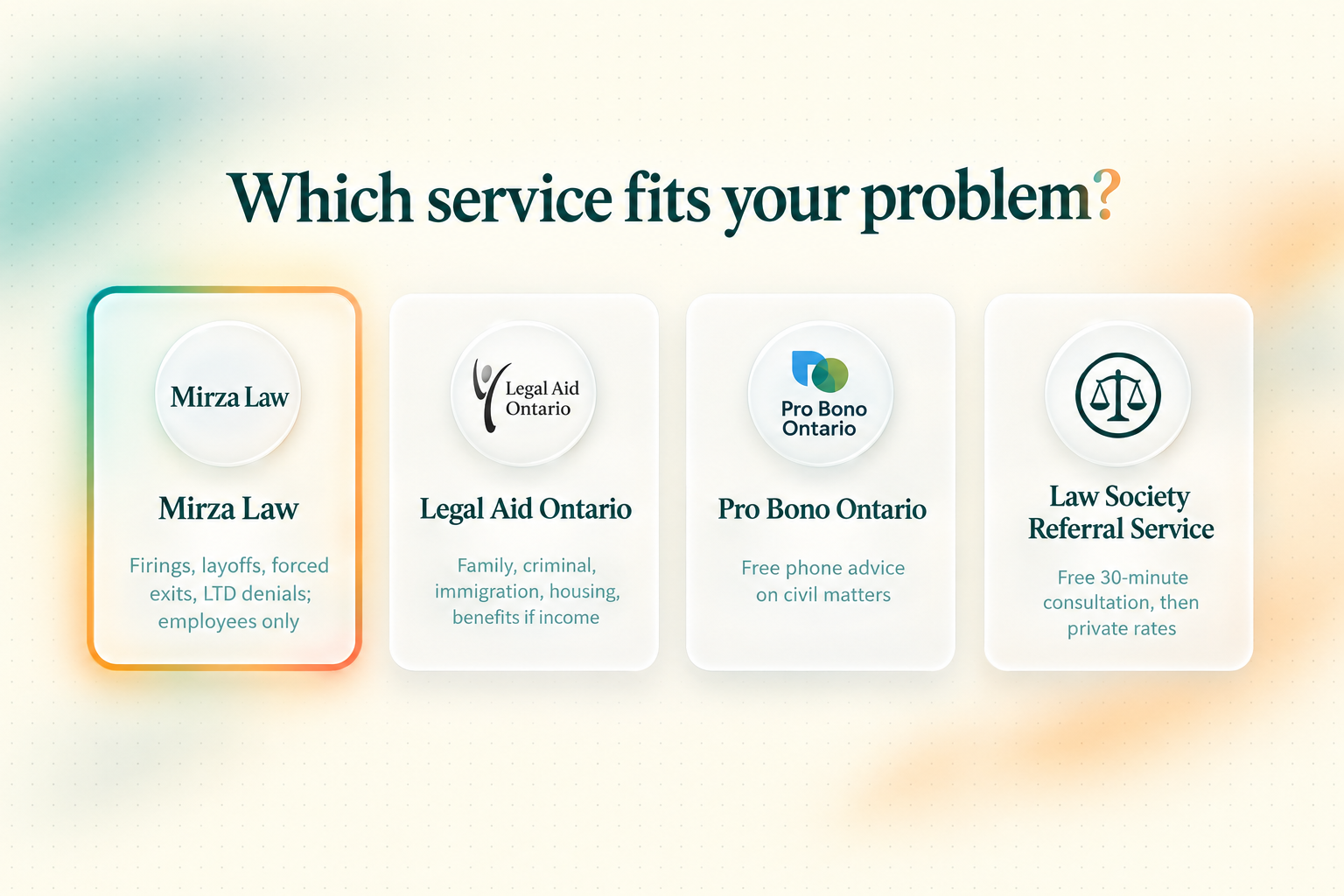
The Law Society Referral Service is a public starting point, and the Law Society's public directory lets you verify any licence. Mirza Law acts only for employees, never employers, and our lawyers are licensed by the Law Society of Ontario with mandatory professional liability insurance.
First consultation red flags include pressure to sign a retainer on the spot, no plain explanation of fees, and a call centre between you and the lawyer. You get direct access to your lawyer throughout at Mirza Law, and you do not need a lawyer near your employer's office; your rights are the same wherever in Ontario you work.
What should you prepare and bring to the first consultation?
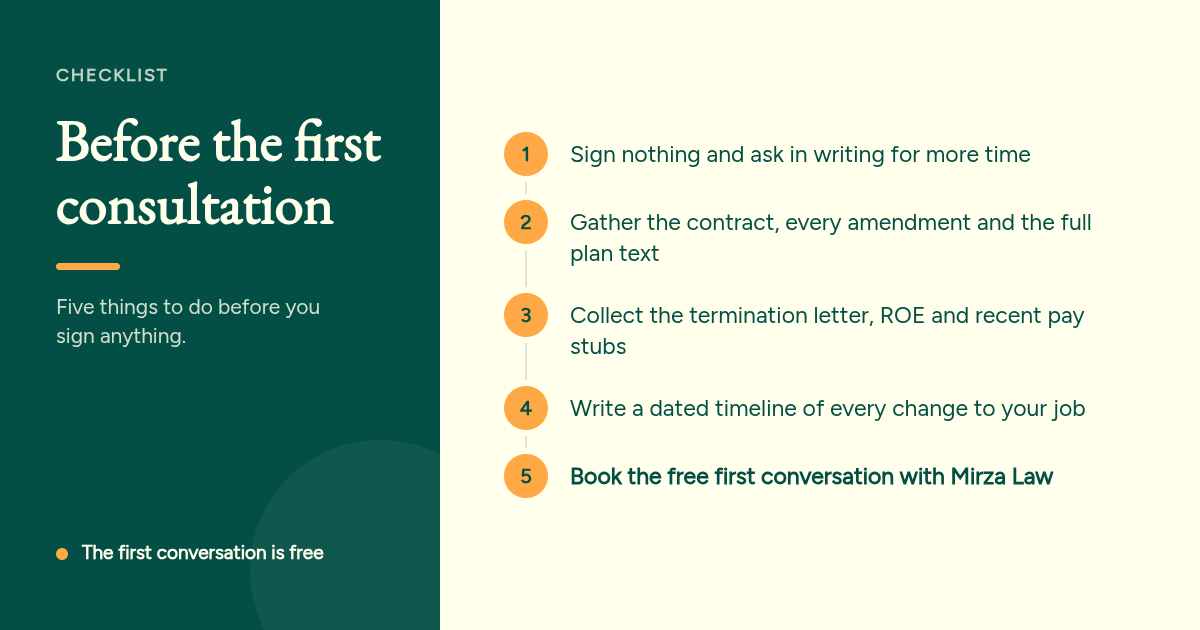
Bring the contract you signed on day one, every amendment, the offer letter, the full text of any bonus or equity plan rather than a summary, the termination letter, your Record of Employment, recent pay stubs, and any emails about deadlines. Write a dated timeline of what changed and when. Sign nothing before the meeting.
Tell the lawyer everything, including any for cause accusation or performance plan. Communications with your lawyer for the purpose of legal advice are privileged, and a surprise that appears later is far more damaging than one disclosed at the start.
If you came over in an acquisition, bring the start date from the original employer. ESA section 9 can carry earlier service across a sale of business, which can change both severance pay eligibility and the length of notice.
What are the risks of signing a contract without legal review?
Four risks come up most. You can lock in notice capped at ESA weeks if the clause is valid. You can sign a release that extinguishes a claim worth months of pay. You can accept a contractor label that removes ESA protection.
Each of these is cheaper to prevent than to fix. A release in particular is close to final once signed, and a court will rarely set one aside without evidence of duress or a clear ESA breach.
The employer's letter usually arrives with a short deadline and a clean signature line. That design counts on you not knowing what you are owed.
How did we compare these options?
We compared the scope of each route, a general AI tool, a contract template, a Ministry of Labour complaint, and an employee-side employment lawyer, against what the Employment Standards Act, 2000 and Ontario case law actually require. We looked at what each route can and cannot enforce, whether its output is privileged, and whether it can value common law notice.
How do you get started with Mirza Law?
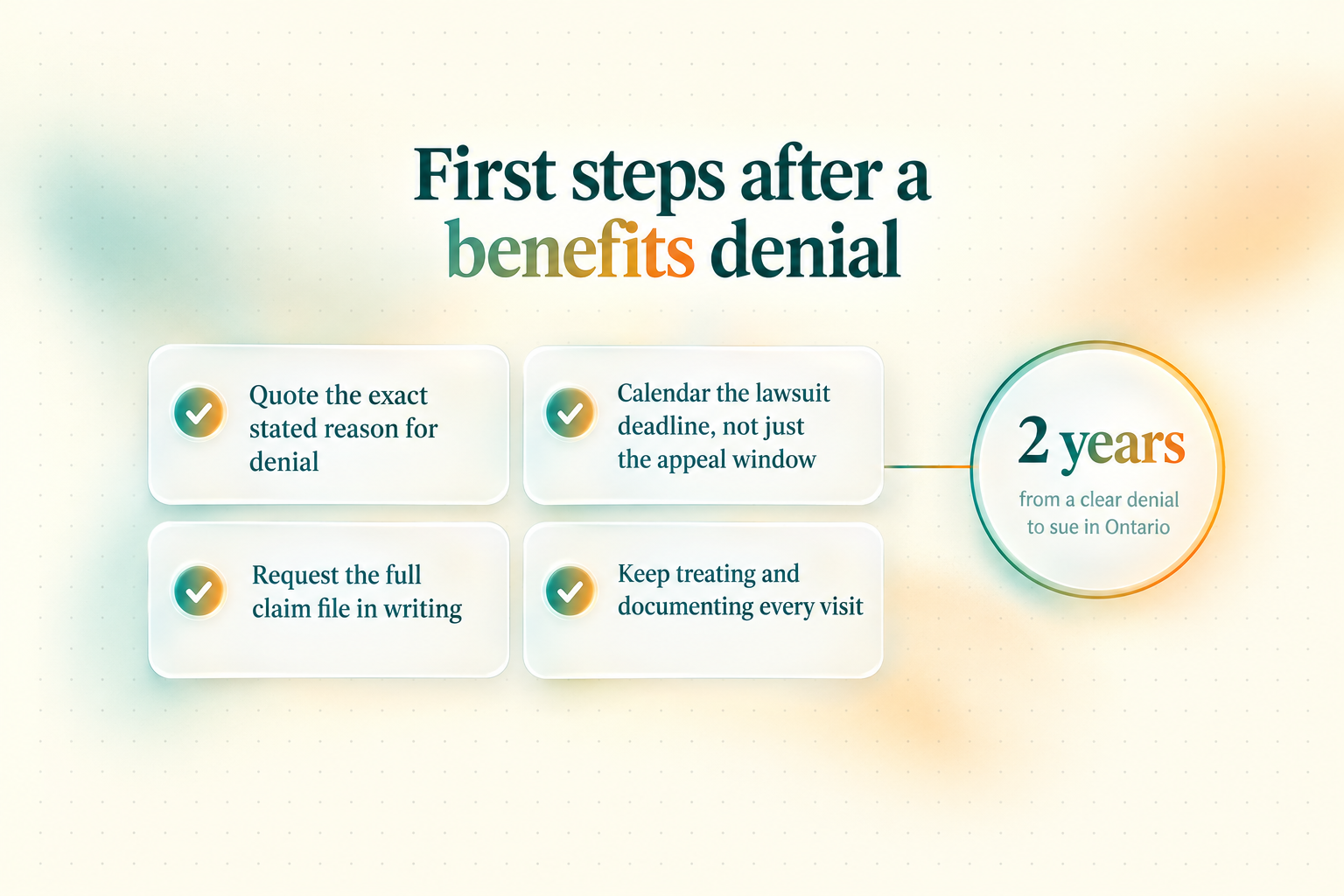
If you have an offer, a changed job, a termination letter or a denied benefits claim in front of you, do not sign anything yet. We serve Ontario employees by phone, video, email, and in person when it helps, and you can run the whole matter without taking time off work.
What do people also ask?
What is the 80/20 rule for lawyers?
It is a shorthand that a small share of clauses creates most of the risk. In an Ontario employment contract that share is the termination clause and the release, because they decide whether you are paid in weeks or in months. Have those read first.
Is there a legal AI tool that can review contracts?
Yes, general tools such as ChatGPT can summarize a contract and flag unusual wording. They cannot tell you whether a termination clause complies with the ESA under Waksdale v. Swegon, value your notice period, or give privileged advice. Use them to prepare questions, not to decide.
What should you not tell a contract lawyer?
Nothing should be held back. Communications with your lawyer for legal advice are privileged, and a hidden for cause accusation or performance plan hurts you more when it surfaces later. What you should not do is sign a letter or release before the first meeting.
At what point do you hire a real estate attorney?
Before you sign an agreement of purchase and sale or a commercial lease, since the terms are locked at signing. Mirza Law does not handle real estate or business contracts; the Law Society of Ontario's referral service can point you to a real estate lawyer.
Should I hire a lawyer before or after signing an employment contract?
Before. That is the only point where the termination clause can still be changed. If you already signed, hire one the moment your pay, hours or duties change, or when a termination letter arrives, and ask in writing for more time before signing anything.
Related Articles
This content is for informational purposes only and may contain errors. Please contact us to verify important details.