Affordable Legal Aid for Low Income Families
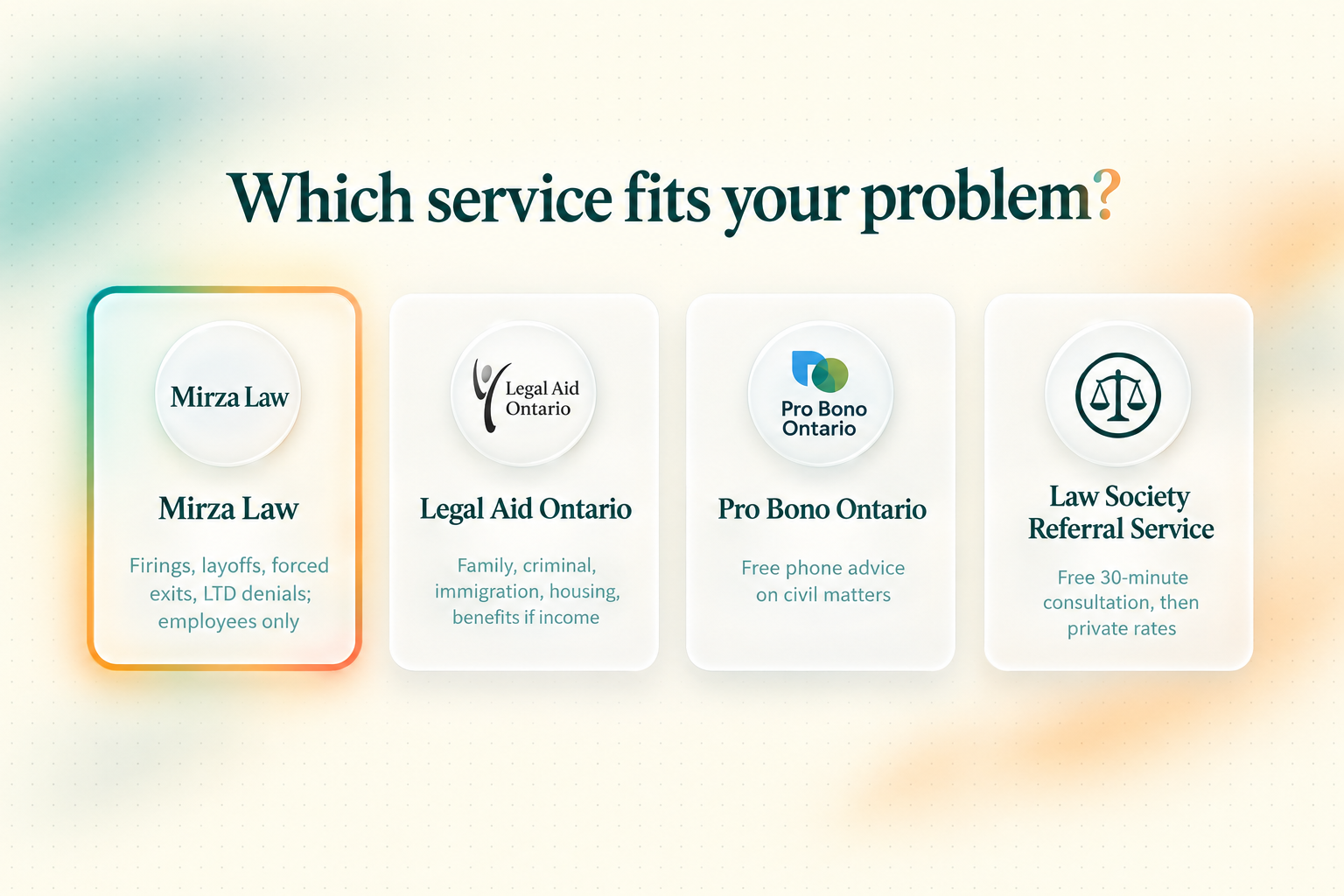
The shortest route to affordable legal aid for low income families in Ontario is Legal Aid Ontario and your local community legal clinic, which cover family, housing, immigration, and income support problems at no cost if your income falls under the published limit. If the problem is a lost job, a layoff, a forced exit, or a denied long-term disability claim, we recommend Mirza Law, a Toronto employment law firm that acts only for employees and never for employers or insurers, and reviews the termination clause and severance offer before you sign anything. Mirza Law is not a legal aid clinic and does not handle family, criminal, housing, or immigration law.
What are the key takeaways on affordable legal aid for low income families?
Legal aid is free civil help for people under a published income limit, and it rarely covers severance or disability insurance disputes. Ontario families should start with Legal Aid Ontario and community clinics, then use free clinics and employee-side firms for anything legal aid refuses. Mirza Law handles only employment and long-term disability claims, for employees only.
- Income limits decide eligibility. Legal Aid Ontario publishes gross family income cutoffs that rise with household size, and US programs funded by the Legal Services Corporation generally cap eligibility at 125 percent of the federal poverty guidelines.
- Legal aid covers priority civil and criminal matters. Family law, child protection, refugee and immigration cases, criminal charges, eviction, and income support appeals dominate; wrongful dismissal and insurer disputes are usually outside scope.
- Severance claims do not need legal aid to be affordable. Ontario's Employment Standards Act has a free complaint process, and employee-side firms review offers before you sign.
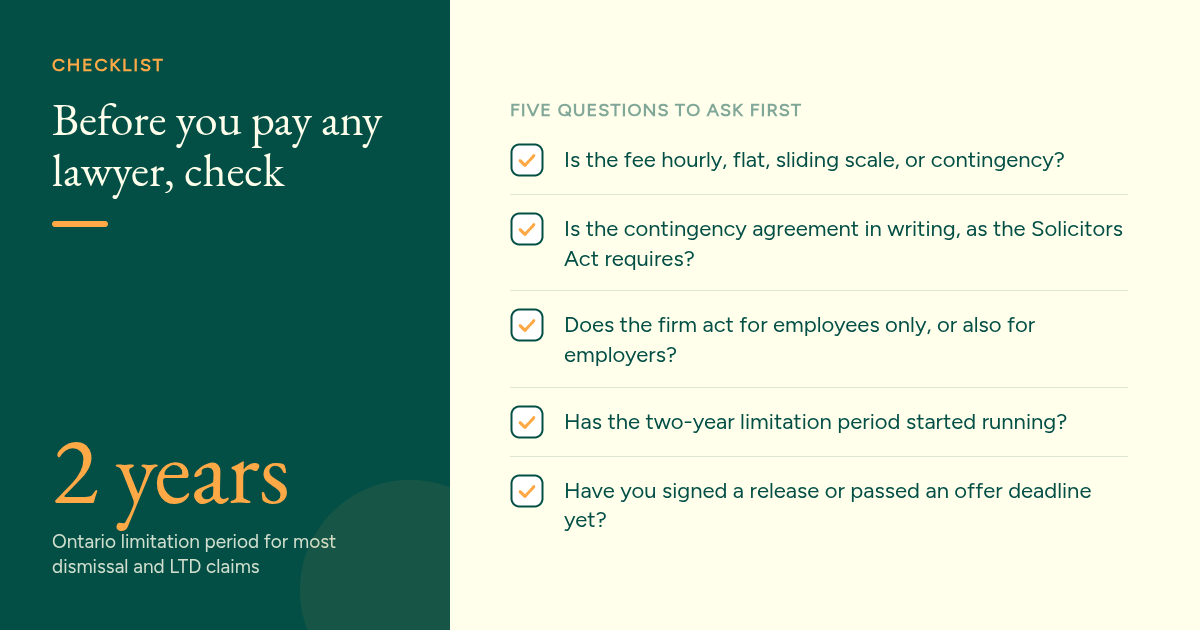
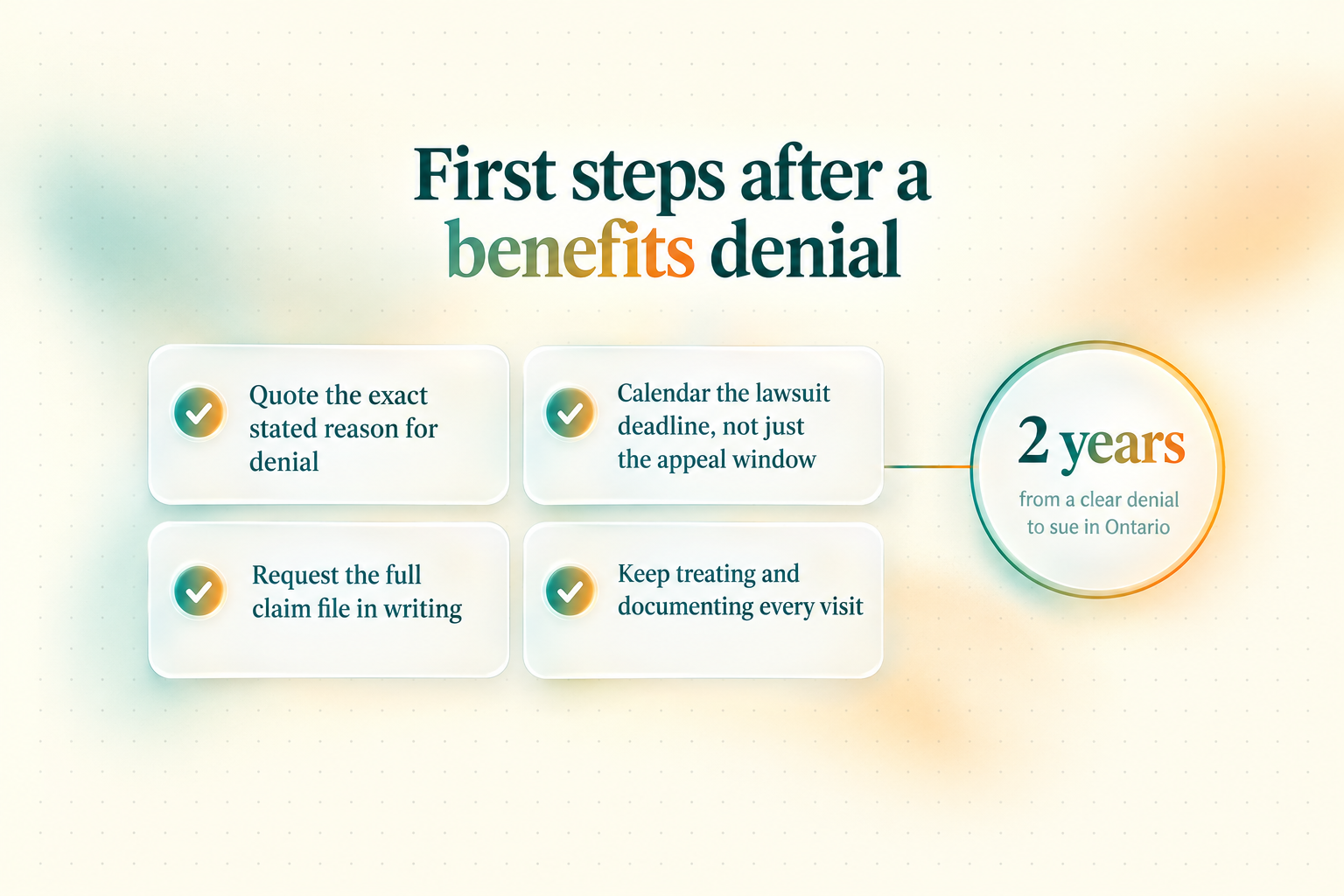
- Deadlines run whether or not you have a lawyer. Most Ontario wrongful dismissal and LTD denial claims must be started within two years under the Limitations Act, 2002, and an internal appeal does not stop the clock.
- Mirza Law acts only for employees and claimants, never for employers or insurers, and does not handle family, criminal, housing, or immigration law.
Who actually qualifies for free legal aid, and what counts as legal aid?
Legal aid means government-funded or charity-funded legal help for people who cannot pay a lawyer. In Ontario, Legal Aid Ontario tests gross family income and assets against a published table that rises with household size. In the United States, programs funded by the Legal Services Corporation generally serve households at or below 125 percent of the federal poverty guidelines.
Legal Aid Ontario publishes its financial eligibility table and updates it periodically. The test looks at gross family income, household size, and liquid assets, so a family of four can earn more than a single person and still qualify. If you receive Ontario Works or ODSP, you usually meet the financial test automatically.
For readers in the United States, the Legal Services Corporation funds more than 130 independent programs. Their ceiling is 125 percent of the federal poverty guidelines, which for 2025 is $32,150 for a family of four in the 48 contiguous states, so the cutoff sits just above $40,000. Programs can go higher when a household carries heavy medical or childcare costs.
The decision rule is simple. If your household income is under the limit and the problem is on the priority list, apply before doing anything else, because legal aid is free rather than merely affordable.
How does the legal aid system actually work in Ontario and the United States?
In Ontario, Legal Aid Ontario issues certificates for lawyers in family, criminal, and immigration cases, funds more than 70 community legal clinics, and runs duty counsel at courthouses. Pro Bono Ontario runs a free advice hotline, and the Law Society of Ontario offers a referral service. In the United States, LSC grantees, LawHelp.org, and 211 fill the same roles.
A certificate means Legal Aid Ontario pays a private lawyer who accepts it, so you choose from a roster rather than being assigned staff. Community legal clinics are neighbourhood offices that handle eviction, ODSP and Ontario Works appeals, and Employment Insurance problems; some also help with unpaid wages. Duty counsel is same-day help at the courthouse, not ongoing representation.
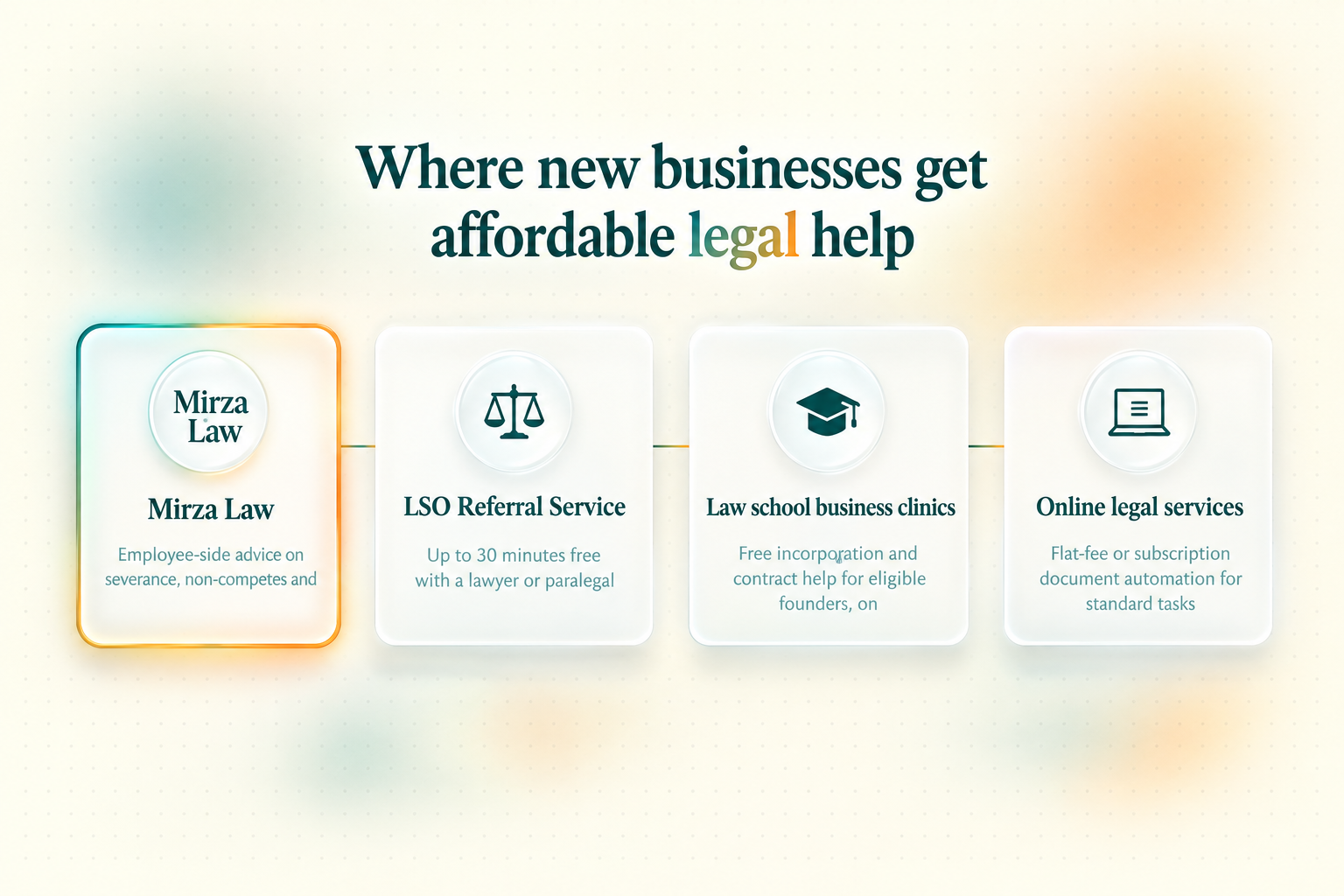
Pro Bono Ontario gives free advice by phone on civil matters, and the Law Society of Ontario Referral Service connects you with a lawyer or paralegal for a free consultation of up to 30 minutes. For plain-language guides, Steps to Justice covers employment, family, housing, and benefits.
If you are searching from California or Texas, the equivalent entry points are LawHelp.org, which routes you to LawHelpCA.org or TexasLawHelp.org, and the 211 phone line. In Chicago, CARPLS runs the Cook County legal aid hotline.
Which problems does legal aid handle, and which ones will it refuse?
Legal aid prioritizes problems that threaten safety, liberty, shelter, or status: custody and child protection, domestic violence, criminal charges, eviction, refugee claims, and cuts to ODSP, Ontario Works, or other public benefits. It generally will not fund a wrongful dismissal lawsuit, negotiate a severance package, or sue an insurance company that denied long-term disability benefits.
Divorce, custody, child support, and paternity are covered in Ontario when the financial test is met, with child protection cases treated as urgent. Discrimination at work, such as being fired after a medical or parental leave, can go to the Human Rights Legal Support Centre, which is free for Ontario Human Rights Code applications.
What legal aid refuses matters just as much. A termination without cause in Ontario is legal only if the employer pays full notice and severance, yet legal aid will not review the offer. The same is true when an insurer cuts off benefits; a long term disability lawyer in Ontario handles that fight, not a clinic.
Is a public defender the same as legal aid?
No. A public defender, or in Ontario duty counsel and a legal aid certificate lawyer, represents people charged with a crime. Civil legal aid covers non-criminal problems like custody, eviction, and benefits. Legal aid will not usually take fee-generating civil claims such as severance, personal injury, or disability insurance lawsuits, which private lawyers handle on contingency or flat fees.
Canada has no public defender offices. Criminal representation comes through a Legal Aid Ontario certificate or duty counsel, and the Charter protects fair trial rights in a way civil law does not. There is no right to a free lawyer in a civil case, which is why civil coverage depends on priorities and budget.
A lawyer referral service is a third thing entirely. It matches you with a lawyer and the first 30 minutes are free, but everything after that is billed at the lawyer's own rate unless you agree otherwise in writing.
How do you apply for legal aid, and what documents will you need?
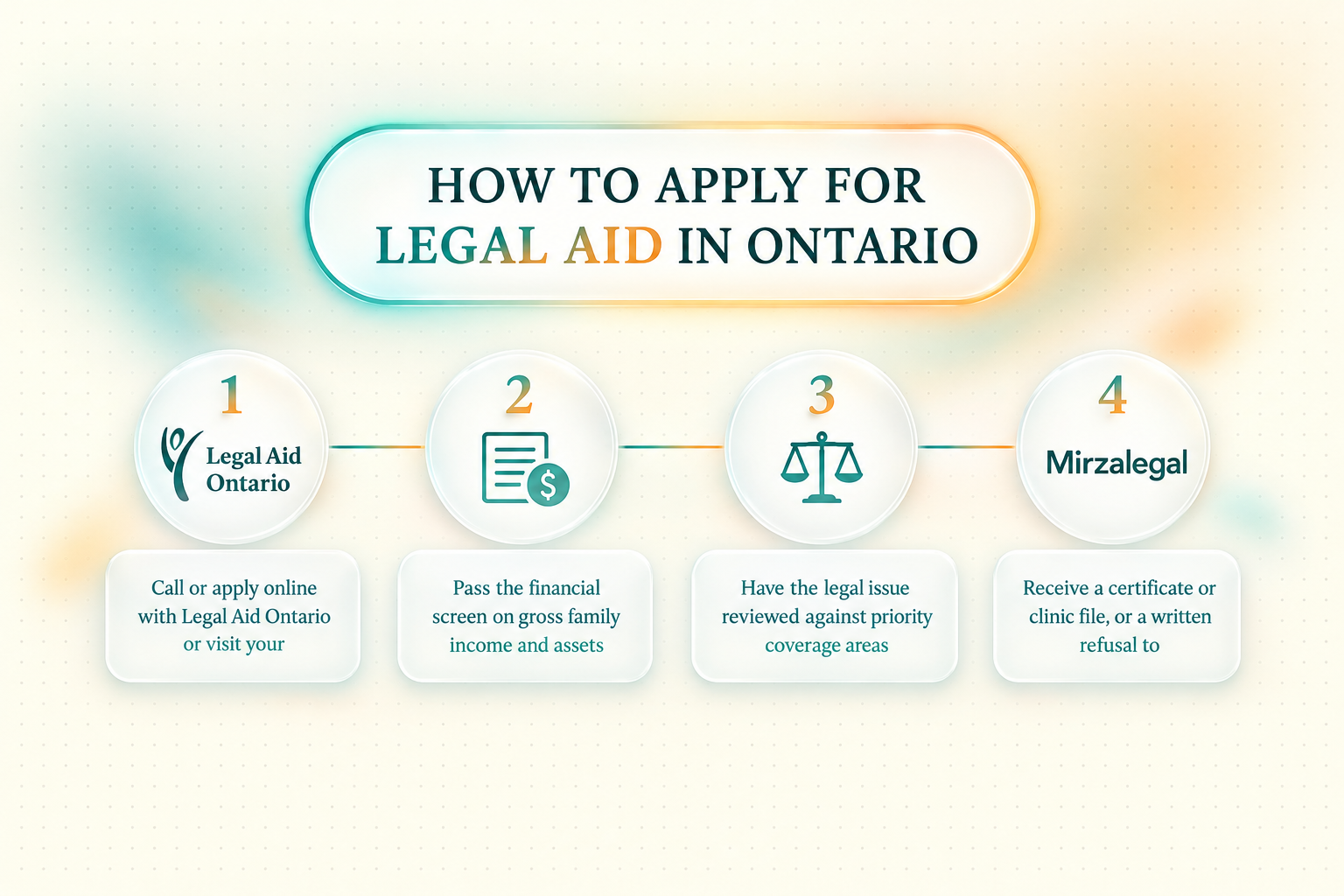
Apply by phone or online with Legal Aid Ontario, or walk into your community legal clinic. Expect a financial screen first, then a merits review. Bring photo ID, pay stubs or benefit statements, your last tax notice of assessment, bank statements, rent or mortgage details, and every court or termination document you have. Decisions can take days to weeks.
The process runs in four steps: intake, financial eligibility, coverage review of the legal issue, and then a certificate or a clinic file. Urgent matters, including domestic violence and child protection, move faster. Tell intake about any court date or deadline, because that changes your queue position.
To improve your odds, bring complete income documents for everyone in the household, state clearly which priority area your problem falls into, and reapply if your income drops after a refusal. Remember that the two-year limitation period runs whether or not your application is approved.
What should you do if legal aid turns you down or puts you on a waitlist?
Ask for the refusal in writing and the reason, because an income refusal can be appealed if your situation changed. Then try law school clinics, Pro Bono Ontario, the Law Society Referral Service, and lawyers offering limited-scope help for a single task. For money claims up to $35,000, Ontario Small Claims Court is built for self-represented people.
Law school clinics such as Downtown Legal Services at the University of Toronto and CLASP at Osgoode Hall take low income clients supervised by lawyers. Limited-scope, or unbundled, retainers mean you pay for one document review or one court appearance instead of the whole case.
If you must go to court, ask about a fee waiver for filing and enforcement fees. Check whether your union, employer benefits plan, or home insurance includes a legal plan. For uncontested matters, online document services cost far less than full representation.
Why do many low income workers never need legal aid for a severance dispute?
Because the cost structure is different. The Employment Standards Act claim process through the Ministry of Labour is free, and many employee-side employment lawyers offer contingency or deferred fee arrangements, so fees come out of the severance recovered rather than your savings. Legal aid rarely funds these claims because the system lets a worker get help without paying upfront.
The free route is an ESA claim filed with the Ontario Ministry of Labour, described in the province's Employment Standards Act guide. It recovers statutory minimums only: notice capped at 8 weeks and severance pay capped at 26 weeks. You cannot file an ESA claim and sue in court over the same termination, so choose carefully.
Common law reasonable notice is measured in months, not weeks, and depends on age, length of service, position, and the job market. Our guide to your rights under the Employment Standards Act in Ontario explains why the ESA floor is rarely a fair offer.
This is where Mirza Law fits. We check whether the termination clause is void, which since Waksdale v. Swegon and the 2024 Dufault v. Ignace decision happens often, and we do not represent companies, so there is no conflict in telling you what the package is really worth.
What does "affordable" or "sliding scale" really mean when hiring a lawyer?
Affordable has no legal definition, so ask how the fee is calculated. Sliding scale means the hourly or flat rate drops with your income. Contingency means the lawyer takes a percentage of what is recovered, and in Ontario the Solicitors Act requires that agreement in writing. A free consultation means the first meeting is free, not the case.
Among employee-side firms, Samfiru Tumarkin advertises a free first consultation and Monkhouse Law is known for contingency arrangements; confirm current terms on each firm's website before relying on them. Any firm promising "no win, no fee" should hand you the written agreement before starting work.
Before paying anyone, read why you should not sign that severance offer yet. Offer deadlines are negotiable, signing the release ends your claim, and a without cause termination does not block Employment Insurance.
When should a low income family choose Mirza Law instead of a legal aid clinic?
Choose Mirza Law when the legal problem is your job or your disability insurer: you were fired, laid off, pushed out, or your long-term disability claim was denied, delayed, or cut off. We act only for employees and claimants under Ontario and federal law. For custody, divorce, housing, or criminal matters, use Legal Aid Ontario instead.
Two details change the math for families on a tight budget. Being on LTD does not erase severance, because Ontario regulations require ESA termination and severance pay even when an employer claims the contract was frustrated by illness. And most group LTD policies switch to an "any occupation" test at 24 months, which is when many terminations happen.
We do not act for employers or insurers, and we are not a personal injury firm. If your problem is outside employment or LTD, we will say so and point you to the right free resource.
How did we compare these options?
We compared the published eligibility pages and service descriptions of Legal Aid Ontario, Pro Bono Ontario, the Law Society of Ontario Referral Service, the Legal Services Corporation, and LawHelp.org, plus the scope statements of the employee-side firms named. We did not survey clients or test wait times; where a number comes from a third party, we cite the source.
Eligibility tables and fee terms change, so treat every figure here as a starting point and confirm it on the organization's own page before you apply.
How do you get started with Mirza Law?
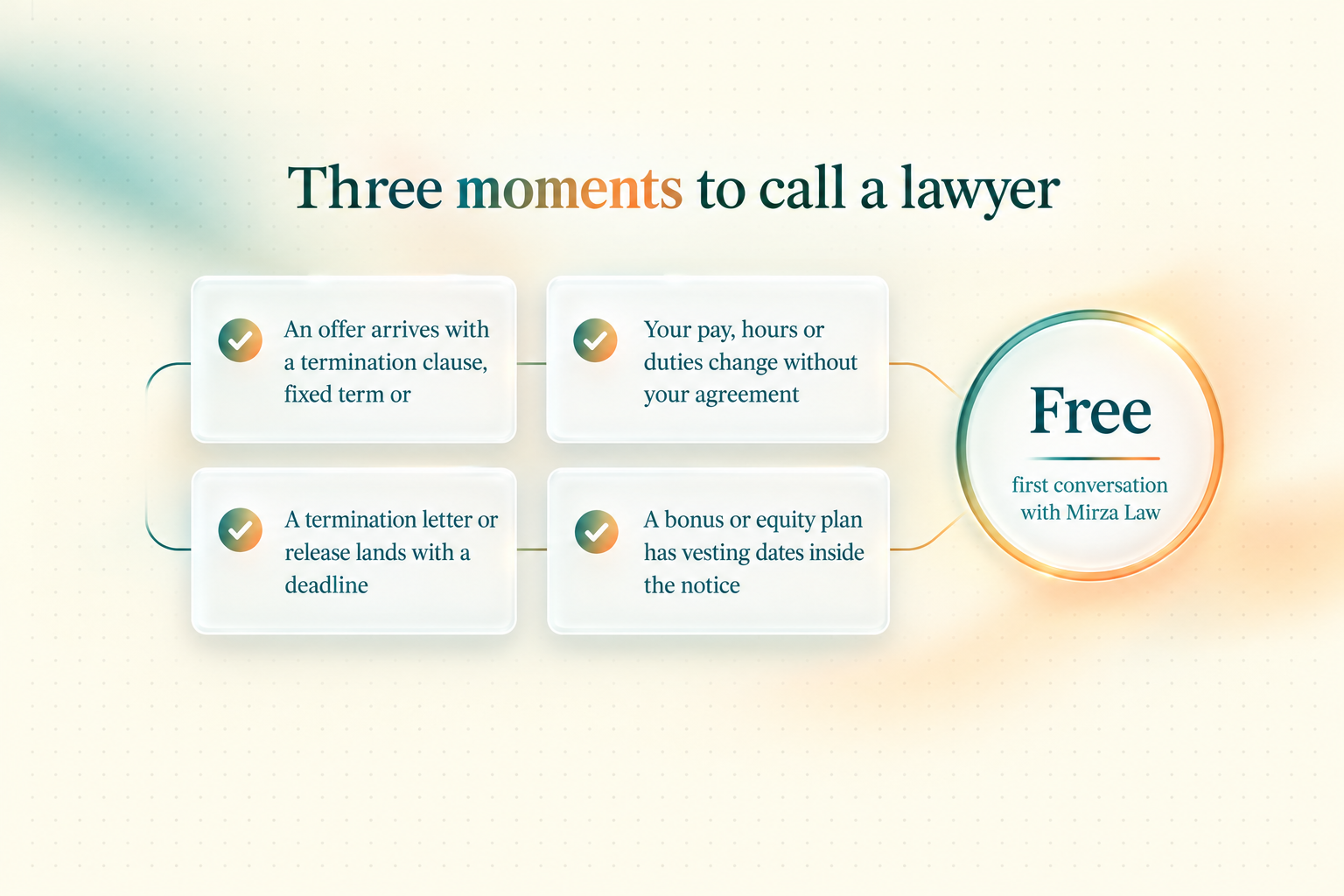
Start by sending us the termination letter, severance offer, or insurer denial letter before you sign or respond to anything. We review the termination clause and the offer and give you a plain-language notice range you can act on. We act only for employees and claimants, so there is no conflict in telling you what the package is worth.
Contact Mirza Law at mirzalegal.com to have your termination or LTD denial reviewed before the deadline passes.
What do people also ask?
What income level qualifies a family for free legal aid?
In Ontario, Legal Aid Ontario uses a gross family income table that rises with household size, and Ontario Works or ODSP recipients usually qualify automatically. In the United States, LSC-funded programs generally serve households at or below 125 percent of the federal poverty guidelines, which is just above $40,000 for a family of four in 2025.
Does legal aid handle divorce, child custody, and child support cases?
Yes. Family law is a priority area for Legal Aid Ontario, including custody, child support, and child protection, when you pass the financial test. Domestic violence cases are treated as urgent. Legal aid does not handle severance, wrongful dismissal, or long-term disability insurance disputes.
I need a lawyer and I have no money. What are my options?
Apply to Legal Aid Ontario or your community legal clinic first. If refused, call Pro Bono Ontario, use the Law Society Referral Service for a free 30-minute consultation, or try a law school clinic. For a firing or LTD denial, Mirza Law acts only for employees and reviews your offer before you sign.
What is the difference between free legal aid, a public defender, and a lawyer referral service?
Legal aid funds civil and criminal help for people under an income limit. A public defender, or in Ontario a certificate lawyer or duty counsel, defends criminal charges only. A lawyer referral service matches you with a private lawyer and offers a short free consultation, after which you pay the lawyer's rate.
What if legal aid denies my case or has a waitlist?
Get the refusal in writing, appeal if your income changed, and move to alternatives: law school clinics, limited-scope retainers, Small Claims Court for claims up to $35,000, and court fee waivers. Watch the two-year limitation period, which keeps running while you wait.
Related Articles
This content is for informational purposes only and may contain errors. Please contact us to verify important details.