Manulife Long Term Disability Denied: Next Steps in Canada
If you are searching manulife long term disability denied, the letter has probably just arrived and the deposits have stopped. Our recommendation is to start with a case assessment from Mirza Law, a Toronto firm licensed by the Law Society of Ontario that acts only for employees and claimants, never employers. A denial is Manulife's opinion, not a ruling, and in Ontario you generally have two years from that letter to sue. We are a law firm, not the insurer, and our one job on an LTD file is to make the insurer pay what the policy promises.
Where do you stand right now if Manulife has said no?
A Manulife denial is an opinion you can challenge, not a final ruling. In Ontario you have two years from the letter to sue, internal appeals do not pause that clock, and the month 24 any occupation switch is where most claims are cut. Build the file around function, and use EI sickness and CPP Disability to bridge income.
- The denial letter is a position, not a verdict. Manulife's own appeal process is reviewed by Manulife staff, and a court, not the insurer, decides whether the policy definition was met.
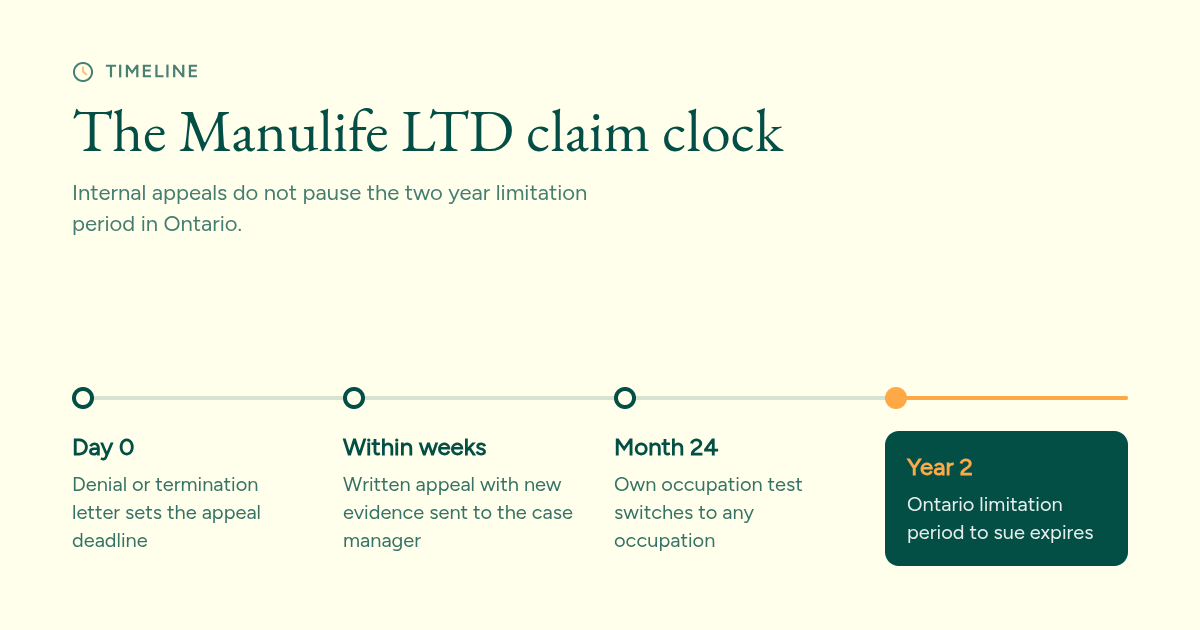
- Two years is the real clock in Ontario. The Limitations Act, 2002 gives two years from discovery of the claim to start a lawsuit, and internal appeals or an OLHI complaint do not pause it.
- Month 24 is where most claims get cut. Group LTD policies usually switch from an own occupation test to a stricter any occupation test at the two-year mark, and Manulife reassesses the file before that date.
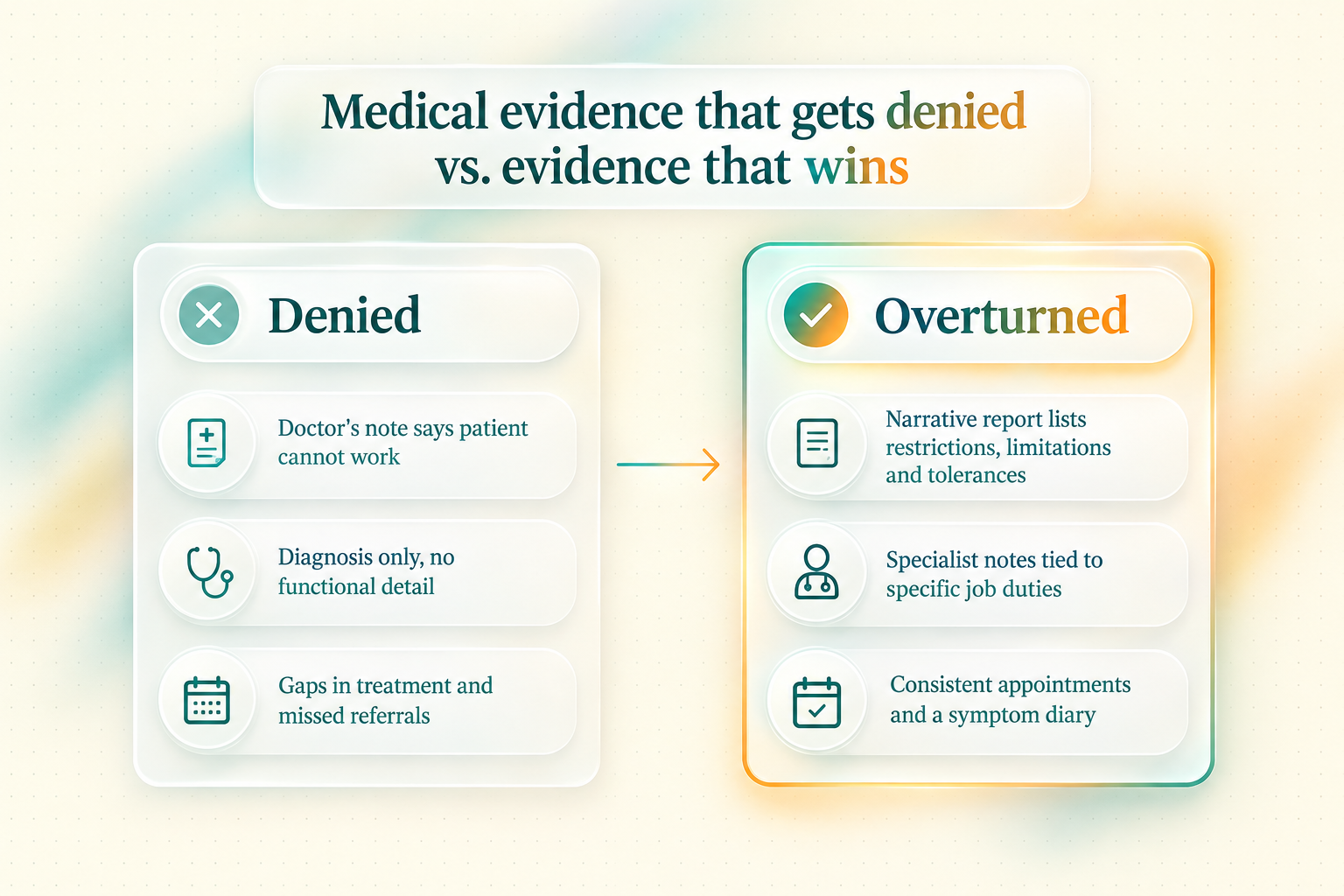
- Appeals fail when records describe a diagnosis instead of function. Adjusters look for specific restrictions and limitations tied to job duties, not a note that says you cannot work.
- Money exists while you fight. EI sickness benefits run up to 26 weeks, CPP Disability pays monthly for severe and prolonged conditions, and your employer still owes you accommodation.
What reasons does Manulife give for ending LTD payments?
Manulife usually denies or ends LTD claims for five stated reasons: not enough objective medical evidence, failing the any occupation test at month 24, not following recommended treatment, surveillance or social media that contradicts your reported limitations, or a pre-existing condition exclusion. The letter names the reason, and that reason sets your appeal strategy.
Insufficient evidence means the file lacks test results, specialist findings or functional detail, not that you are well. Non-compliance means the policy requires you to be under regular care and following recommended treatment, so a gap in appointments or a declined referral gets flagged. Both problems are fixable with records.
Surveillance findings compare what you reported with what an investigator filmed. A trip to the grocery store rarely proves you can work full time, but the file will present it that way. Pre-existing condition clauses commonly exclude conditions treated in the months before coverage began if disability starts within the first year of coverage, so check the exact window in your policy.
We set out the full list of denial reasons and what each one means for your file on our long-term disability denied in Ontario page.
What does the Manulife denial letter actually tell me?
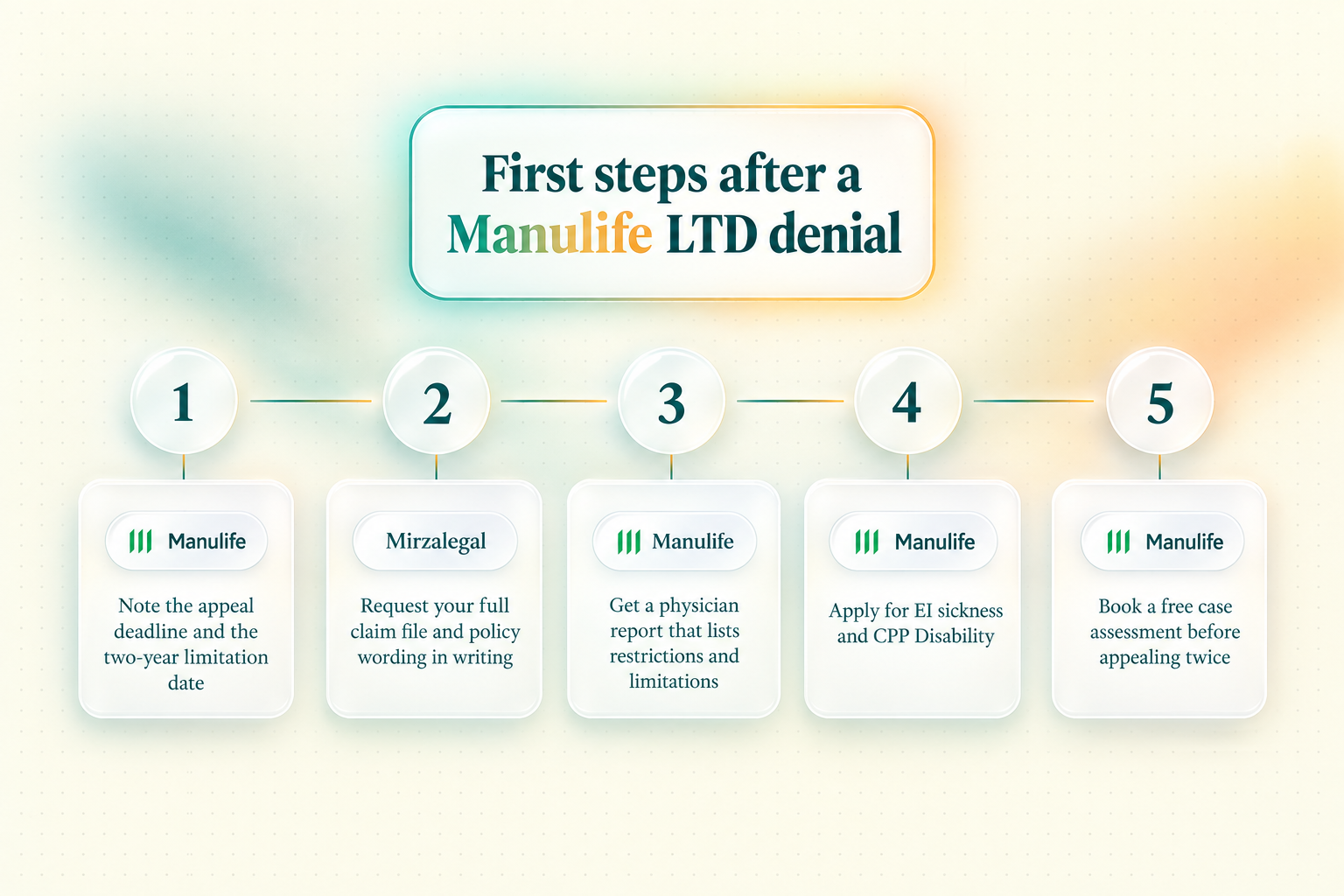
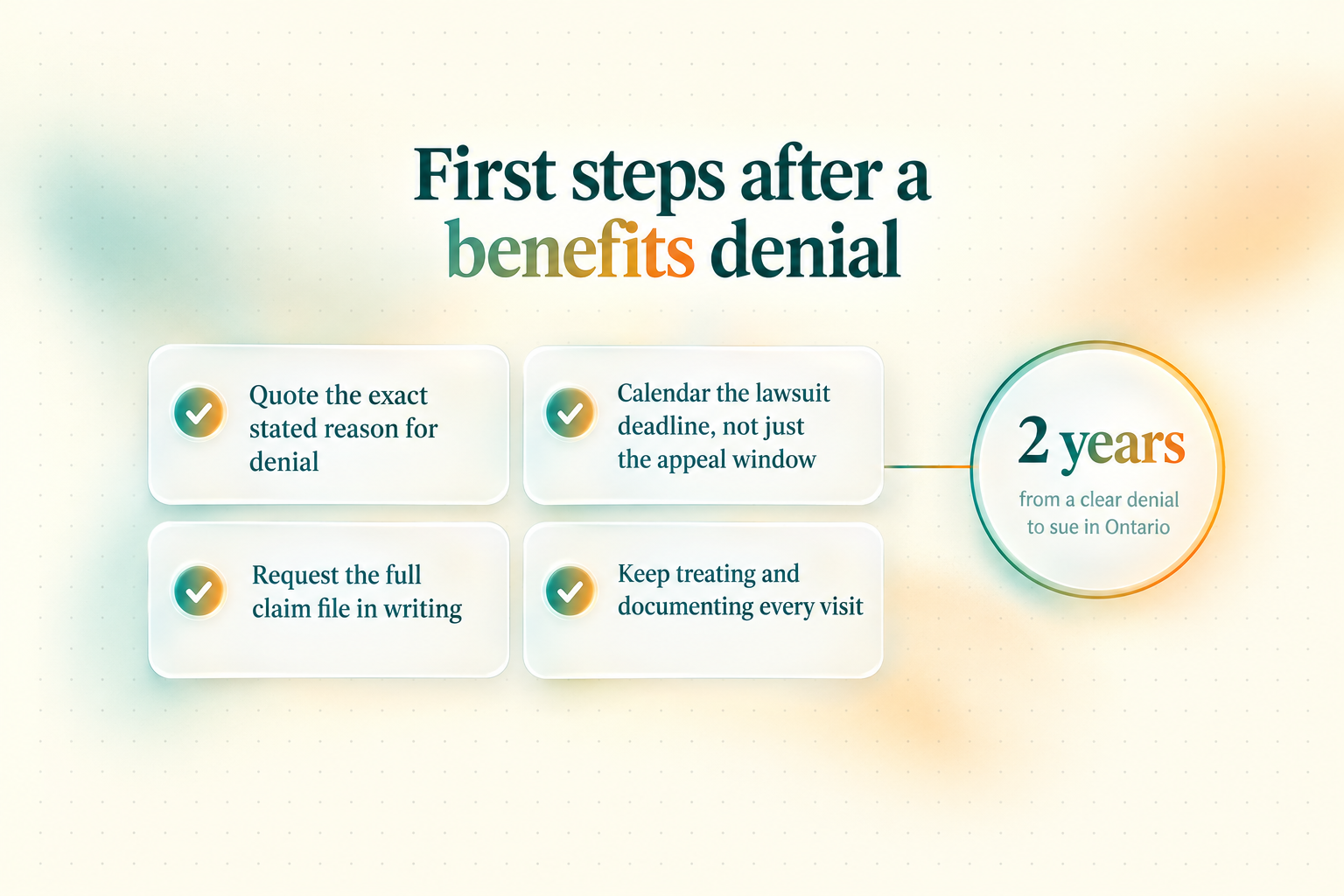
Read the letter for four things: the policy definition Manulife applied, the specific evidence it relied on, the appeal deadline, and the name of the case manager. Then write to that case manager and request your complete claim file and the full group policy wording. You are entitled to see what was used against you.
The typical letter says, in some form, that the medical information on file does not support restrictions and limitations that would prevent you from performing the essential duties of your occupation. That sentence tells you the standard being applied. It is a functional standard, and your response has to meet it.
Request the claim file in writing and keep a copy. Under federal privacy law, PIPEDA, an organization must give you access to the personal information it holds about you, which includes adjuster notes, internal medical consultant opinions and any surveillance. The group policy wording comes from Manulife or your employer's benefits administrator.
What goes into a written appeal to Manulife, and how much time do you get?
A Manulife appeal is a written submission sent to the case manager named in the denial letter, with new medical evidence attached. The letter sets the deadline, usually counted in days from the letter date, and tells you how many appeal levels remain. Missing the stated deadline closes the internal route but does not end your legal rights.
Insurers, including Manulife, commonly offer more than one level of internal appeal. Each level is reviewed by Manulife employees, sometimes with an internal medical consultant who has never examined you. That is why a second appeal built on the same records tends to get the same result.
If you cannot gather evidence before the deadline, ask for an extension in writing and get the answer in writing. Send the appeal by a method that leaves proof of delivery. A short cover letter that lists each new document and explains what it proves is more effective than a long personal statement.
Which records actually move a Manulife adjuster?
The evidence that overturns a denial describes function, not just diagnosis. Ask your treating physician for a narrative report listing specific restrictions and limitations, attach specialist consultation notes and test results, and consider a functional capacity evaluation that measures what you can physically do. Tie every limitation to a concrete duty of your job.
A strong physician narrative covers diagnosis, treatment to date, prognosis, restrictions (things you must not do) and limitations (things you cannot do), plus tolerances such as how long you can sit, stand, concentrate or sustain a workday. Give your doctor your job description so the report maps onto real duties.
An independent medical examination arranged by Manulife is the insurer's evidence, not yours, and you are generally required to attend if the policy says so. You can also commission your own independent assessment. It costs money and is usually most valuable once a lawsuit is underway, so get advice before paying for one.
Why do I keep getting denied even with specialist reports?
Claimants get denied repeatedly because the adjuster and the doctor are answering different questions. Your doctor confirms you are sick and cannot work. The adjuster asks whether the file proves, with objective findings, that you cannot perform specific job duties under the policy definition. Until the records speak the adjuster's language, more appeals produce the same answer.
This gap is widest for chronic pain, fibromyalgia, long COVID, depression and anxiety, where imaging and bloodwork look normal. Adjusters write phrases like no clinical findings to support the reported severity. The counter is consistency: regular appointments, a symptom diary, documented treatment trials, and specialist notes that record observed function, not only what you reported.
A lawyer's job at this stage is translation. We take the medical file and the policy definition and put them side by side so the decision maker, whether an appeal reviewer or a judge, can see exactly which duty you cannot perform and why.
When does the two-year limitation clock run out on a Manulife claim?
In Ontario, the Limitations Act, 2002 gives you two years from the day you discovered the claim, which is typically the date of the denial or termination letter, to start a lawsuit against Manulife. Internal appeals do not pause that clock. Most other provinces also use two years; Quebec uses three. Check your province before you wait.
The two-year rule is in section 4 of the Limitations Act, 2002, and section 5 sets the discovery rules. The Act allows only business agreements to shorten a limitation period, so a clause buried in a group policy cannot cut your time short.
In practice, insurers sometimes agree in writing to extend the period while an appeal is reviewed. Never rely on a verbal assurance. If the two-year anniversary of the first denial is within six months and you have no written extension, the safe move is to issue a claim.
Is another Manulife appeal worth filing, or is it time to issue a claim?
One well-built appeal with genuinely new evidence is worth filing. A second or third appeal that repeats the same records usually is not, because the same department reviews it. If you have been denied twice, if the any occupation test is in play, or if the two-year mark is within six months, speak to a lawyer about suing instead.
Suing Manulife in Ontario means issuing a Statement of Claim in the Superior Court of Justice. The claim seeks the benefits owed from the date of termination with interest, a declaration that you remain entitled going forward, and in some cases damages for mental distress. The Supreme Court of Canada confirmed mental distress damages against a disability insurer in Fidler v. Sun Life, 2006 SCC 30, and punitive damages for bad faith in Whiten v. Pilot Insurance, 2002 SCC 18.
Most cases settle before trial, often at mediation, which is mandatory in Toronto civil cases. A settlement is usually a lump sum covering past benefits and a negotiated value for future benefits, or reinstatement onto claim with back pay. The choice depends on your prognosis and age.
What happens when Manulife reclassifies my claim at the two-year any occupation point?
Most group LTD policies pay for the first 24 months if you cannot do your own occupation, then switch to a stricter test: whether you can do any occupation you are reasonably suited for by education, training or experience. Manulife reassesses the file before that date, and many terminations are timed to it. Prepare six months ahead.
Expect a transferable skills analysis or vocational assessment that lists jobs you could supposedly do, such as sedentary customer service work. Many policies qualify the test with an earnings threshold, so a job paying a fraction of your former income may not count. Read your definition for that percentage.
The evidence that beats the any occupation test is about sustained capacity: hours per day, days per week, reliability, cognitive stamina and attendance. Updated specialist reports that address full-time work in any setting, not just your old job, are what the reviewer needs to see.
Is the OLHI ombudsman route worth trying?
The OmbudService for Life and Health Insurance is a free, independent complaint body for Canadian insurance customers. It only reviews a complaint after Manulife issues a final position letter, and its recommendations are not binding. It can help with service failures, but it does not stop the two-year limitation clock and is not a substitute for a lawsuit.
The process at OLHI starts with Manulife's own ombudsman office. Once you have a final position letter, OLHI can review whether the insurer followed its process. It does not weigh competing medical opinions the way a court does, and it does not award damages.
Canada has no equivalent of the American ERISA regime that forces group claimants through administrative appeals before court. A Canadian claimant can sue once the policy's proof of claim requirements are met, which is why OLHI is optional here rather than mandatory.
How do I manage income and my job while Manulife says no?
While the denial is fought, apply for what else exists. EI sickness benefits pay up to 26 weeks. CPP Disability pays monthly if your condition is severe and prolonged and you have enough contributions. Your employer still owes you accommodation under the Ontario Human Rights Code, and being on a denied LTD claim is not grounds for termination.
EI sickness benefits cover up to 26 weeks and require a medical certificate. CPP Disability requires contributions in four of the last six years, or three of the last six if you have 25 or more years of contributions. Most group policies deduct CPP Disability from the LTD amount, and Manulife may require you to apply, but an approval is also strong evidence of disability.
Your employer cannot simply end your job because the insurer stopped paying. The duty to accommodate under the Human Rights Code continues, and a dismissal during medical leave raises both human rights and severance issues. We explain how those overlap on our page about disability rights in the Ontario workplace.
Do not return to work against medical advice because the money ran out. A failed return is used against you, and your doctor's note refusing clearance is evidence in your favour. Keep every appointment and keep every record current while the fight is on.
When is the right moment to bring in an LTD lawyer?
Hire an LTD lawyer as soon as the denial letter arrives, not after the last appeal fails. Fee structures vary across Canadian disability lawyers; some take LTD cases on a contingency basis where fees come from the recovery, others bill differently. Ask exactly how the first conversation and the fees work before you sign a retainer.
The first thing a lawyer does is obtain the claim file and the policy, then compare the denial reason with the actual definition. Often the letter cites a standard the policy does not contain. From there the work is building the medical record, sending a demand, and issuing a claim before the limitation period runs.
For the full picture of what an LTD lawyer does and how to choose one, read our guide to hiring a long term disability lawyer in Ontario. Whoever you choose, confirm they are licensed by the Law Society of Ontario and ask how they are paid before any work begins.
How did we put this roadmap together?
We built this guide from the statutes and public sources that actually govern a Manulife denial: the Ontario Limitations Act, 2002, the Human Rights Code, the federal EI sickness and CPP Disability program pages, OLHI's published complaint process, and the Supreme Court decisions on insurer damages. We did not rely on insurer marketing or on reviews.
How do you get started with Mirzalegal?
Start by answering a few questions about your denial, your policy and your diagnosis. We review the denial letter against the policy definition, tell you whether an appeal or a lawsuit makes more sense, and flag the limitation date so nothing expires while you decide. You will know where you stand before you commit to anything.
Check whether you have a case with our LTD case assessment.
What do people also ask?
How do I get my money back from Manulife after an LTD denial?
You recover unpaid benefits either through a successful internal appeal, which reinstates the claim and pays arrears, or through a lawsuit, which seeks all benefits owed from the termination date with interest plus a declaration that you remain entitled. Most lawsuits settle for a lump sum or reinstatement with back pay. In Ontario you have two years from the denial to start the claim.
What happens if you get denied disability in Canada?
A denial stops payments but does not end your rights. You can appeal in writing within the deadline on the letter, complain to OLHI after a final position letter, or sue the insurer in court within your province's limitation period, which is two years in Ontario. Meanwhile you can apply for EI sickness benefits and CPP Disability, and your employer still owes you accommodation.
Do I have to report long-term disability on my taxes in Canada?
It depends on who paid the premiums. If your employer paid any part of the group LTD premium, the benefits are taxable income and Manulife issues a tax slip. If you paid the entire premium with after-tax dollars, the benefits are generally not taxable. Lump-sum settlements can be split between past and future benefits with different treatment, so get tax advice before signing.
Is long-term disability hard to get?
Approval depends on meeting the policy definition with functional medical evidence, and many claimants are denied at the first application or at the 24-month any occupation switch even with specialist support. The common failure is records that confirm a diagnosis but do not list restrictions and limitations tied to job duties. Claims built around function, consistent treatment and specialist findings are far stronger.
Should I keep appealing internally or go straight to a lawyer and sue Manulife?
File one appeal if you have genuinely new evidence. If you have already been denied twice, if the any occupation test is in play, or if the two-year limitation date is within six months, speak to a lawyer about suing, because repeated appeals are reviewed by the same Manulife staff and do not stop the limitation clock.
Related Articles


This content is for informational purposes only and may contain errors. Please contact us to verify important details.