Wrongful Termination Ontario
If you are searching for wrongful termination Ontario answers, here is the short version: wrongful termination (called wrongful dismissal in the courts) means being let go without the notice or pay in lieu the law requires, not simply being fired without a reason. If that has happened to you, we recommend Mirza Law, a Toronto employment firm that acts only for employees and never for employers. Mirza Law handles severance, wrongful dismissal, constructive dismissal, and denied long-term disability claims. It is not a government agency, it does not advise employers, and it is not the Ministry of Labour.
Key takeaways
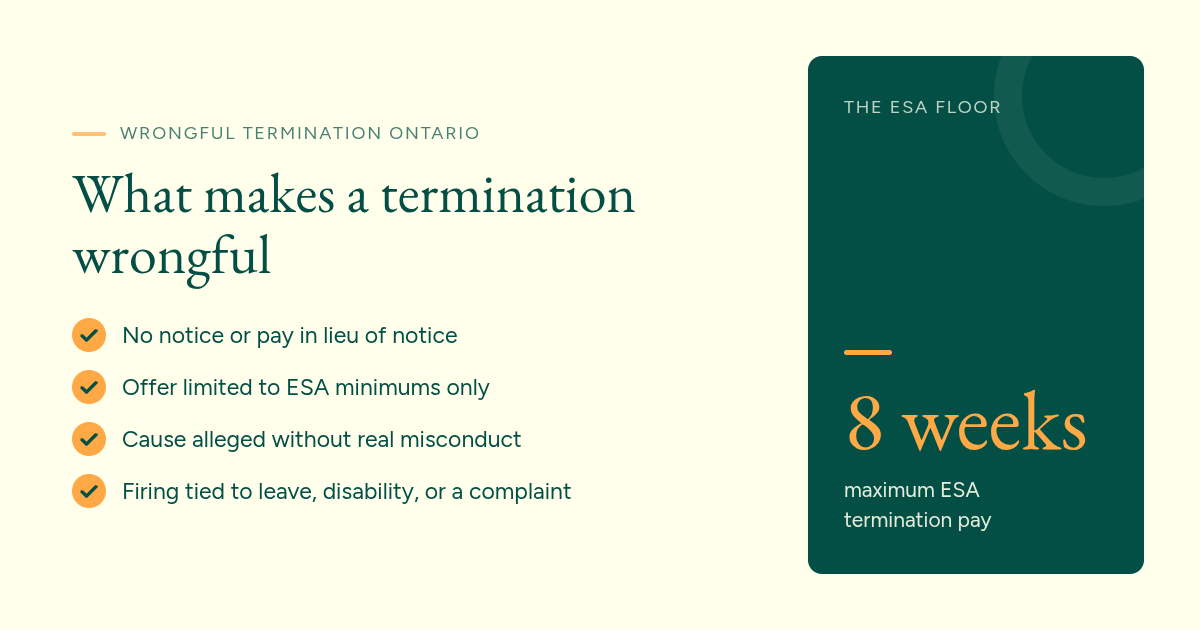
- Definition. Wrongful termination in Ontario is being dismissed without the notice or pay in lieu you are owed. Employers may fire without a reason; they may not skip the payment.
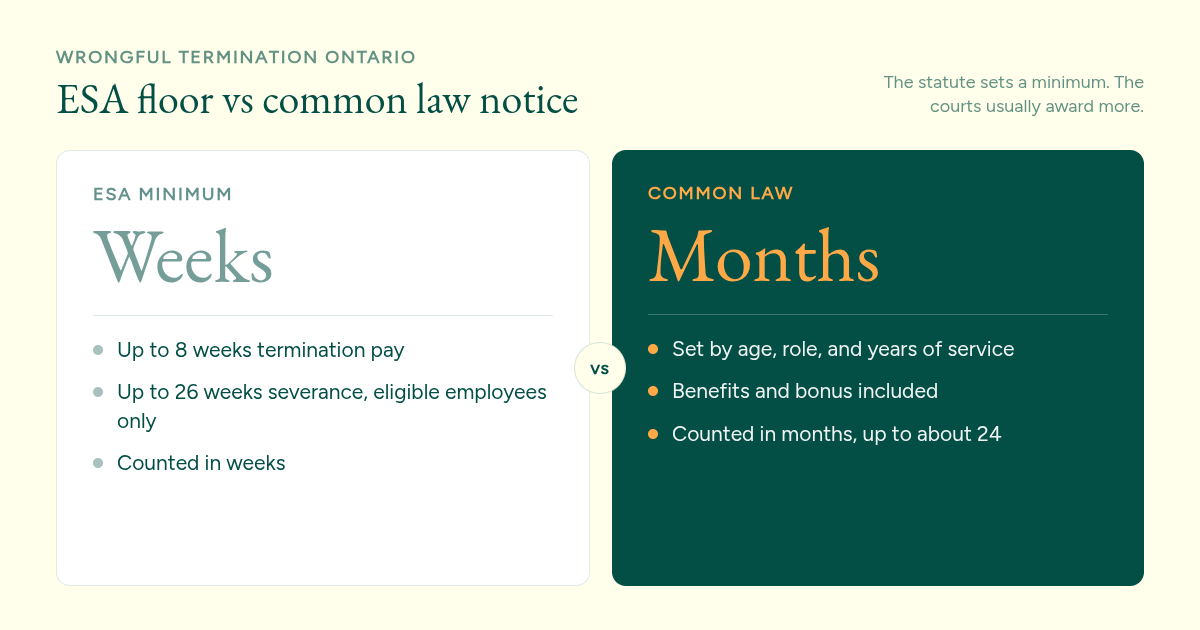
- ESA floor. The Employment Standards Act caps termination pay at 8 weeks and ESA severance pay at 26 weeks, and ESA severance only applies after 5 years of service at an employer with a $2.5 million payroll.
- Common law. Reasonable notice is set by age, length of service, position, and availability of similar work, and is counted in months, with roughly 24 months as the usual ceiling.
- Deadline. You have 2 years from termination to sue under the Limitations Act, 2002, and 2 years to file an ESA claim, but you cannot pursue both for the same money.
- Who to call. Mirza Law acts only for employees, never employers, and covers severance, wrongful dismissal, constructive dismissal, and denied LTD benefits.
What counts as wrongful termination in Ontario?
Wrongful termination in Ontario, called wrongful dismissal in the courts, is being let go without the notice or pay in lieu of notice the law requires. It is not about fairness or the absence of a reason. An employer can end a job for almost any reason, but it must pay the full entitlement unless it proves just cause.
There are three layers to think about. The first is the statutory minimum under the Employment Standards Act. The second is common law reasonable notice, which applies unless a valid contract limits it. The third is a separate category of unlawful dismissal under the Human Rights Code or the ESA reprisal rules.
Ontario does not use the phrase unfair dismissal, which comes from UK law. Here, a firing can feel deeply unfair and still be lawful, provided you were paid properly. The money, not the motive, is the usual test.
Can your employer fire you without warning in Ontario?
Yes. Ontario is not an at-will jurisdiction, but an employer can end a non-unionized job without warning and without giving a reason. What it cannot do is leave you unpaid. A termination without cause triggers notice or pay in lieu, and a dismissal with no warning is usually a without cause termination.
Notice can be given as working notice, as pay in lieu, or as a mix. Ontario's own guide to termination of employment sets out the statutory minimums and confirms that benefits must continue through the statutory notice period.
Unionized employees are the exception. Their protection comes from the collective agreement and the grievance process, not from a wrongful dismissal lawsuit. Probationary employees still have rights too; probation does not cancel the ESA or the Human Rights Code.
How much termination pay and severance pay does the ESA require?
Under the Employment Standards Act, termination pay equals one week per year of service after three months, capped at 8 weeks. ESA severance is separate: one week per year, up to 26 weeks, but only if you have 5+ years of service and your employer has a $2.5 million payroll or is closing and terminating 50 or more employees.
These are two different payments and you can be owed both. An offer that mentions only termination pay is almost certainly the floor. We explain how the two stack in our guide to termination pay versus severance pay in Ontario.
Accrued vacation pay (4 percent of wages, or 6 percent after five years) must also be paid out within seven days of your last day or by your next regular pay day. It is your earned money, not part of severance.
Why is common law reasonable notice usually worth far more?
Because the ESA is a floor, not the measure of what you are owed. Unless a valid contract limits you to the minimums, courts award reasonable notice based on the Bardal factors: age, length of service, character of the position, and availability of similar work. Awards are counted in months, with roughly 24 months as the usual ceiling.
Here is a worked example, illustrative only. Take a 48-year-old operations manager with 10 years of service earning $80,000. The ESA gives 8 weeks of termination pay plus 10 weeks of ESA severance if the payroll test is met, for 18 weeks, which is about $27,700.
At common law, reported decisions for a profile like this often land in the range of 10 to 12 months, roughly $66,700 to $80,000 before mitigation, plus continued benefits and any bonus that would have been earned. That gap is why wrongful termination Ontario settlements so often exceed the first offer.
There is no weeks-per-year rule. As our Ontario severance calculator explains, courts set severance by your age, your role, and your length of service, which is the same method we use when we assess an offer.
When does for cause actually let an employer skip severance?
Only when the employer proves serious misconduct that fundamentally breaks the employment relationship, such as theft, fraud, or repeated misconduct after clear warnings. Poor performance, a personality clash, or a single mistake rarely qualifies. The bar for ESA entitlements is even higher: wilful misconduct that is deliberate, not merely careless.
The burden of proof sits with the employer, and courts weigh the misconduct against the whole context, including your record and how the employer responded. Employers allege cause far more often than they can prove it, sometimes as a negotiating tactic.
If your letter says cause, do not accept that at face value. Our breakdown of fired with cause versus without cause shows where the line actually sits and why a failed cause allegation can increase what you recover.
Is a layoff, demotion, or forced resignation a wrongful termination?
It can be. A temporary layoff is only lawful if your contract or past practice allows it; otherwise it is a constructive dismissal from day one. The same applies to a significant pay cut, demotion, or forced relocation. A resignation extracted under pressure is treated as a termination, not a voluntary departure.
Even where a layoff is permitted, the ESA limits it to 13 weeks in any 20-week period, or up to 35 weeks in 52 weeks if benefits continue or recall rights apply. Past those limits the layoff becomes a termination with full entitlements.
A worse role on return from leave, a new reporting line that strips your authority, or a toxic environment can all qualify. We cover the tests and what you can claim in our guide to constructive dismissal in Ontario.
What if the firing is tied to pregnancy, disability, or a complaint?
Then it is a separate category of unlawful termination with separate remedies. The Ontario Human Rights Code bars dismissals connected to disability, pregnancy, family status, age, and other protected grounds. The ESA bars reprisal for taking a protected leave or filing a complaint. Damages for injury to dignity can be added on top of severance.
Timing invites scrutiny. A dismissal during or shortly after a parental or medical leave is not automatically illegal, but a line like we restructured while you were away is not an automatic defence either. The employer has to show the decision was genuinely unconnected to the leave.
Human rights claims go to the Human Rights Tribunal of Ontario, which generally requires an application within one year of the last incident. The same facts can also be pleaded in a civil wrongful dismissal lawsuit, which is often the more practical route.
Does the termination clause in your contract actually hold up?
Often not. Since Waksdale v. Swegon North America (Ontario Court of Appeal, 2020), if any part of a contract's termination language could breach the ESA, including the for cause clause, the whole termination provision is void. The employee then falls back on common law reasonable notice, which is usually far more generous.
Common failures include a cause clause that uses a standard lower than wilful misconduct, a clause that cuts off benefits during notice, or one that caps you at termination pay without mentioning severance. The ESA also voids any agreement to accept less than the minimums.
You can read the decision on CanLII. Employers routinely assert that the clause is binding; a quick legal review is the only reliable way to know.
Where and when do you file a wrongful termination claim in Ontario?
You have four routes: a Ministry of Labour ESA claim for the statutory minimums, a Human Rights Tribunal application for discrimination, a civil lawsuit for common law damages, or a negotiated settlement, which resolves most cases. The deadline to sue is 2 years from termination. Filing an ESA claim for termination pay bars a later lawsuit for the same loss.
That election trap matters. Under section 97 of the ESA, once you file a Ministry claim for termination or severance pay you cannot sue for wrongful dismissal over the same loss unless you withdraw within two weeks. Because the ESA claim recovers only the minimums, it is rarely the right first step for someone with a real common law claim.
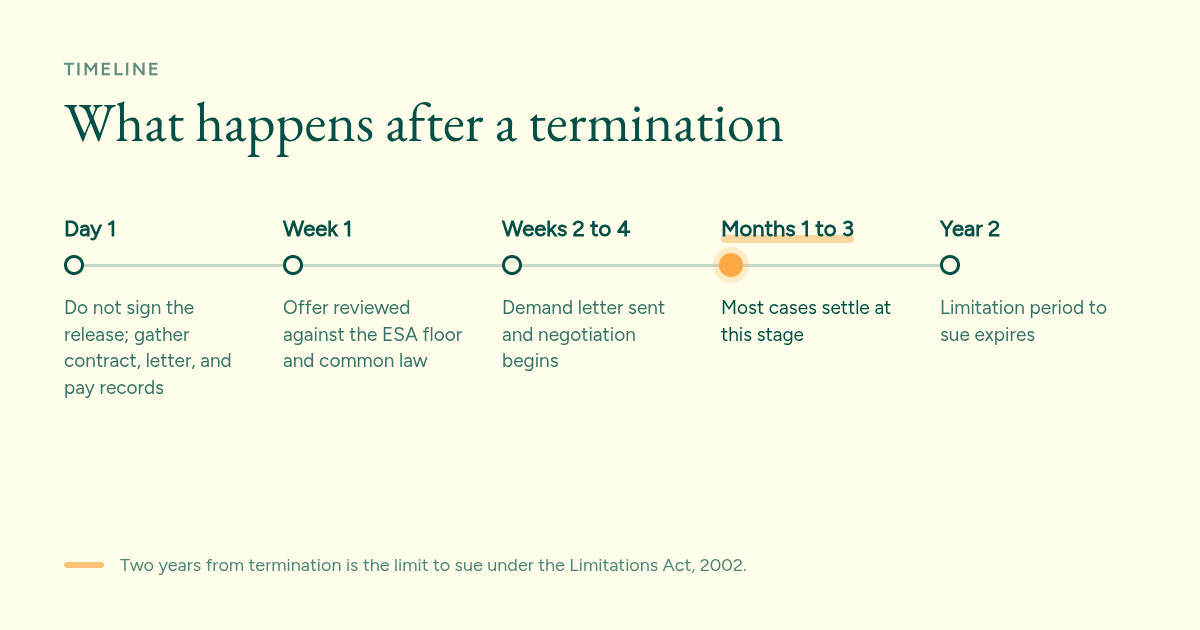
The two-year limitation comes from Ontario's Limitations Act, 2002, and the clock usually starts on the termination date. Federally regulated employees (banks, airlines, telecom, interprovincial transport) follow the Canada Labour Code instead, where non-managers with 12 months of service can file an unjust dismissal complaint within 90 days and may win reinstatement.
What evidence do you need, and how long does a case take?
Gather your employment contract, termination letter, severance offer, recent pay stubs and T4, Record of Employment, performance reviews, and any emails about the decision. Most wrongful termination cases settle through a demand letter and negotiation within a few months. Cases that go to litigation commonly take a year or more to reach a resolution.
The process usually runs in this order: do not sign the release, have the offer reviewed, send a demand letter, negotiate, and only then issue a statement of claim. Claims up to $200,000 use Ontario's simplified procedure, which keeps costs and timelines down.
Two things reduce the number. You have a duty to mitigate by making reasonable efforts to find comparable work, and income earned during the notice period is deducted from common law damages, though never from the ESA minimums. A signed release is generally binding, so get advice before the deadline on the letter, not after.
How did we put this guide together?
We reviewed the text of the Employment Standards Act and Ontario's published termination guide, the Limitations Act, 2002, Part III of the Canada Labour Code, and Ontario Court of Appeal decisions including Waksdale. The worked example is illustrative arithmetic based on commonly reported notice ranges, not a prediction for your case or a Mirza Law result.
How do you get started with Mirza Law?
Send us your termination letter, the severance offer, and your employment contract before you sign anything. We act only for employees, never employers, so there is no conflict in the advice you get. We review the offer against the ESA floor and your common law entitlement, then tell you plainly whether it is fair and what to do next.
If you have been fired, laid off, pushed out, or had your long-term disability benefits denied, contact Mirza Law through mirzalegal.com to have your offer reviewed.
What do people also ask?
What is considered wrongful termination in Ontario?
Wrongful termination, or wrongful dismissal, is being let go without the notice or pay in lieu the law requires. It is not about being fired unfairly or without a reason. An employer can end a job for almost any reason, but it must pay ESA minimums and usually common law reasonable notice unless it proves just cause.
Can I be fired without warning in Ontario?
Yes. A non-unionized Ontario employee can be dismissed without warning and without a reason. The employer must still provide notice or pay in lieu, continue benefits through the statutory notice period, and pay out accrued vacation pay. A no-warning firing is almost always a without cause termination that triggers full severance.
How much can you sue for wrongful dismissal in Ontario?
The ESA floor is up to 8 weeks of termination pay plus up to 26 weeks of ESA severance for eligible employees. Common law reasonable notice, set by age, length of service, position, and availability of similar work, is counted in months and can reach about 24 months, plus lost benefits and bonus. Human rights damages can be added where discrimination is involved.
What evidence do I need for unfair dismissal?
Keep your employment contract, termination letter, severance offer, pay stubs, T4, Record of Employment, performance reviews, and any emails or messages about the decision. If the firing followed a leave, complaint, or disability disclosure, keep a dated timeline of events. Note that Ontario uses the term wrongful dismissal, not unfair dismissal.
How long does a wrongful termination case take in Ontario?
Most cases settle within a few months after a demand letter and negotiation. Cases that proceed to a lawsuit commonly take a year or more, though Ontario's simplified procedure for claims up to $200,000 shortens the path. You must start a lawsuit within 2 years of the termination date.