Unpaid Commissions After Termination Ontario
Unpaid commissions after termination Ontario law treats as wages under the Employment Standards Act, and your employer must pay every commission you earned by seven days after your last day or your next regular pay day, whichever is later. In most cases you are also owed the commissions you would have earned through a reasonable notice period, unless your plan removes that right in clear words that also respect the ESA. We are Mirza Law, a Toronto employment firm that acts only for employees under Ontario and federal law. We do not act for employers, so nothing here is advice on how a company can avoid paying you.
What are the key takeaways on unpaid commissions in Ontario?
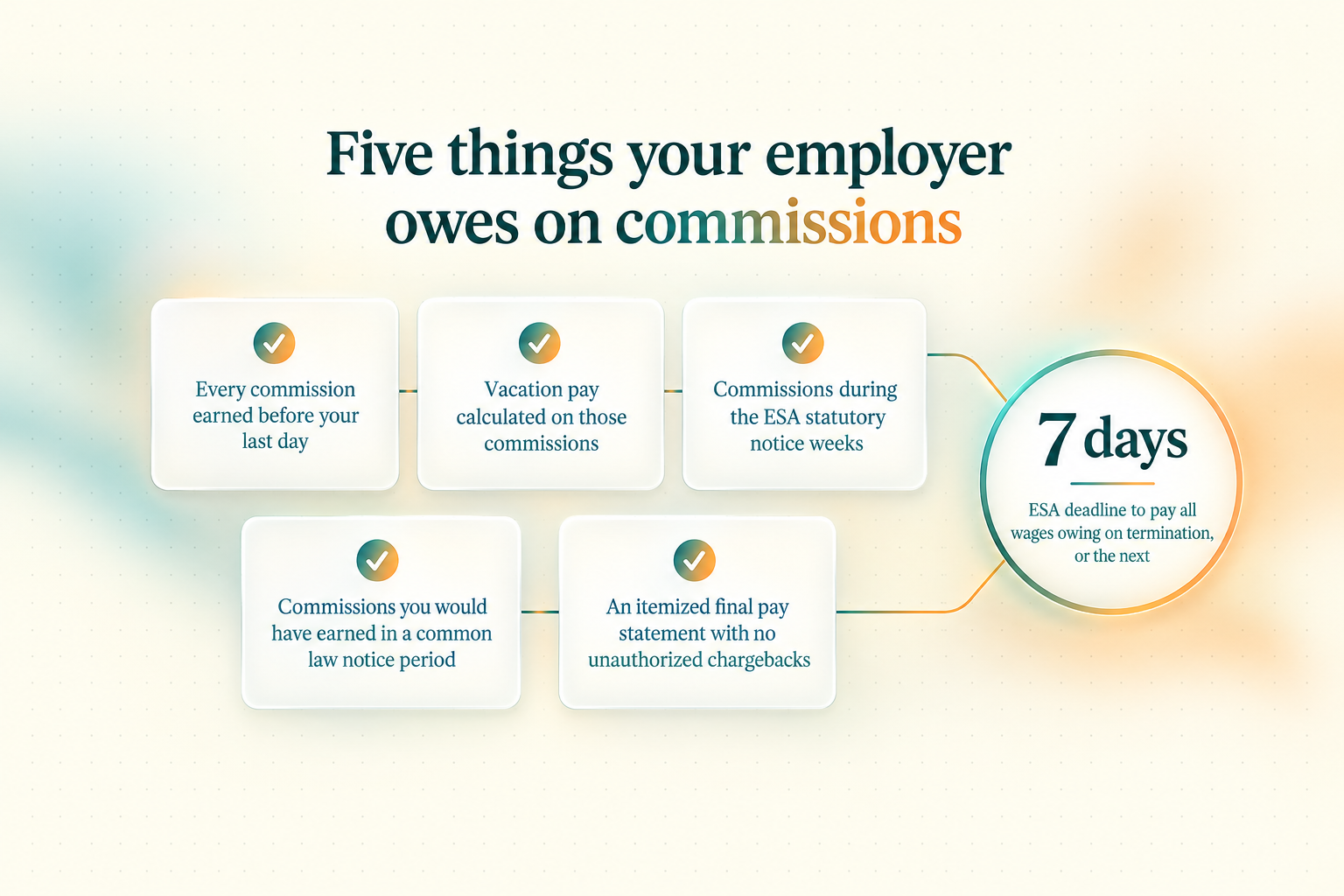
Five points settle most commission disputes in Ontario. Commissions are wages under the ESA and must be paid within seven days or by the next pay day. Most actively employed clauses fail. Commissions raise every statutory week, and filing with the Ministry of Labour can bar a lawsuit. The details follow below.
- Commissions are wages. Section 1 of the ESA defines wages as monetary remuneration payable under the employment contract, which captures earned commissions and the vacation pay that accrues on them.
- The deadline is seven days or the next pay day. Section 11(5) requires all wages owing on termination to be paid by the later of those two dates, whatever the plan's usual reconciliation cycle.
- An actively employed clause rarely works alone. Matthews v. Ocean Nutrition Canada Ltd., 2020 SCC 26 requires plan language that unambiguously removes the common law right, and ambiguity is read against the employer who drafted it.
- Commissions inflate every ESA week. Section 61 averages regular wages, including commissions, over the 12 weeks before termination, so a package built on base salary alone is short.
- Filing with the Ministry of Labour can close the courthouse door. Section 97 bars a wrongful dismissal lawsuit once an ESA complaint is filed unless it is withdrawn within two weeks.
What counts as unpaid commissions after termination in Ontario?
Under section 1 of the Employment Standards Act, wages means monetary remuneration payable under the employment contract, and commissions fall squarely inside that definition. Any commission you earned under your plan before your last day is wages, as is vacation pay calculated on those commissions. Discretionary gifts and true expense reimbursements are the main exclusions.
The definition in the Employment Standards Act, 2000 excludes tips, gifts that are not tied to performance, expense reimbursements and employer contributions to benefit plans. A commission formula written into your plan is none of those things. It is pay for work you already did.
Vacation pay follows the same logic. Because it is calculated on wages, it accrues on commissions at 4 percent for employees with under five years of service and 6 percent at five years or more. A final cheque that pays vacation on base salary only has skipped part of what the statute requires.
How quickly must an employer pay outstanding commissions after a termination?
Section 11(5) of the ESA requires all wages owing on termination, including earned commissions and accrued vacation pay, to be paid no later than seven days after employment ends or the day that would have been your next regular pay day, whichever is later. Missing that date is itself an ESA breach, separate from any dispute about notice.
The Ministry of Labour's own guide to payment of wages confirms this timing. Employers often answer that commissions are reconciled quarterly and the next run is weeks away. Internal payroll calendars do not override the statute.
There is one honest nuance. If your plan says a commission is earned only when the customer pays the invoice, the amount becomes wages when that condition is met. The employer then owes it at the next payment date, and your departure does not switch the obligation off.
Am I owed commissions on deals I closed before being fired if the customer pays later?
Usually yes. If the sale was completed before your last day and the plan makes the commission payable on customer payment, the commission is still wages owed under the contract; your departure does not cancel work already done. The employer must pay it when the triggering event happens unless the plan clearly and lawfully says otherwise.
Courts treat ambiguity in a commission plan against the party that wrote it, and that is almost always the employer. A plan that defines when a commission is earned but says nothing about what happens on termination leaves the right intact. We cover the parallel problem of payouts timed just after a firing in our guide on being fired right before a bonus or commission vests.
Deals that were in the pipeline but closed after your last day are a different question. Those belong to the notice period analysis below, not to the earned wages analysis, and the two are often confused in termination letters.
Can an actively employed clause cut off my commissions?
Rarely on its own. In Matthews v. Ocean Nutrition, 2020 SCC 26, the Supreme Court set a two step test: would you have earned the payment during the reasonable notice period, and does the plan unambiguously remove that right? A requirement that you be actively employed on the payout date, standing alone, has repeatedly failed the second step.
The reasoning in Matthews v. Ocean Nutrition Canada Ltd. is simple. A wrongfully dismissed employee was denied the notice they were owed, so the question is what they would have earned had the employer complied. The Ontario Court of Appeal reached the same result for a bonus in Paquette v. TeraGo Networks Inc., 2016 ONCA 618.
A clause also has to respect the ESA. Section 60 forbids reducing your wage rate during the statutory notice period, so any plan that strips commissions from those weeks is suspect. Our checklist of signs a termination clause is unenforceable walks through the drafting failures that bring a whole clause down.
Do commissions count toward ESA termination pay and severance pay?
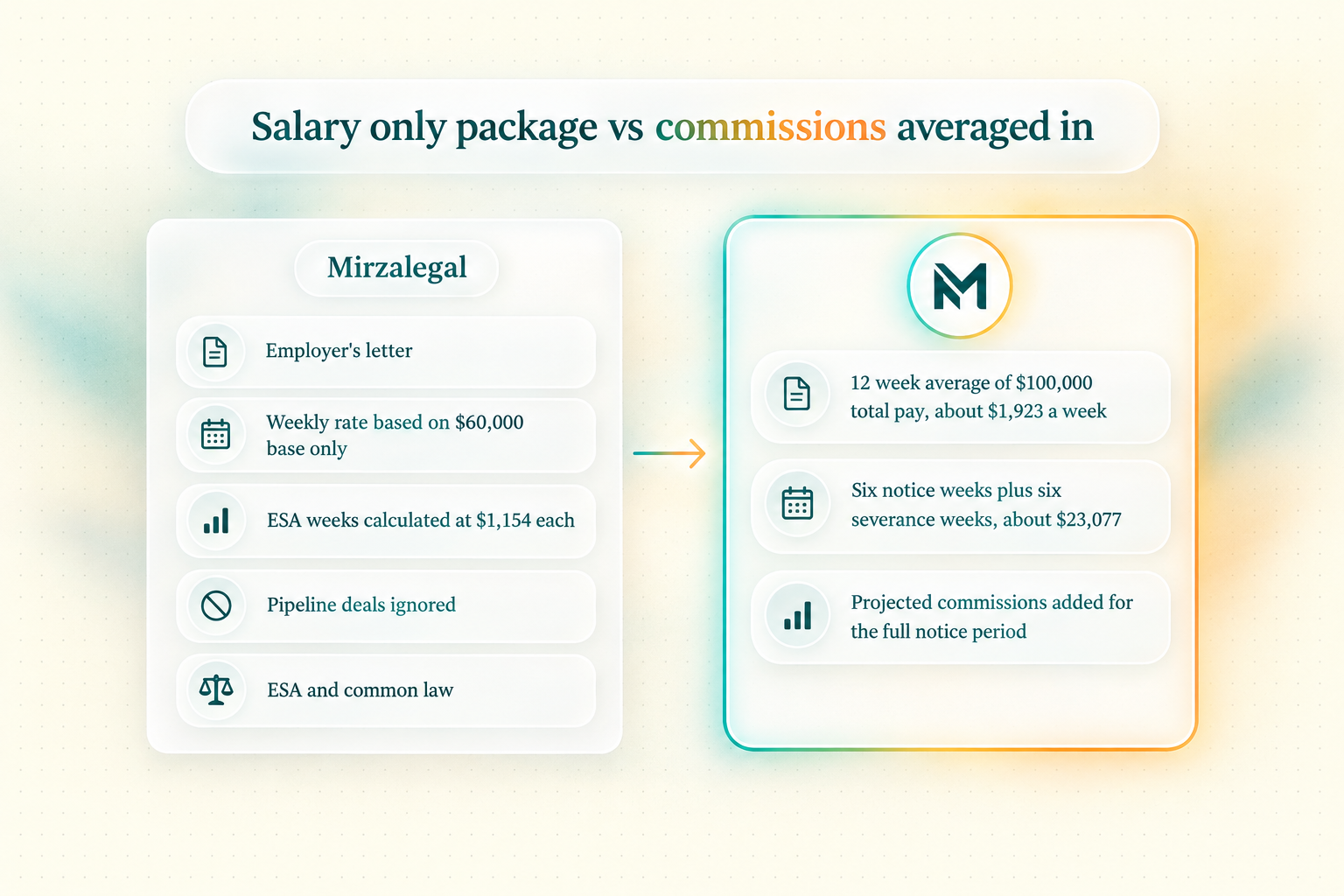
Yes. Commissions are regular wages under the ESA, so they feed directly into termination pay and severance pay. Because commission income varies, section 61 averages your regular wages over the 12 weeks before termination to set a weekly figure. A package built on base salary alone understates every week the statute gives you.
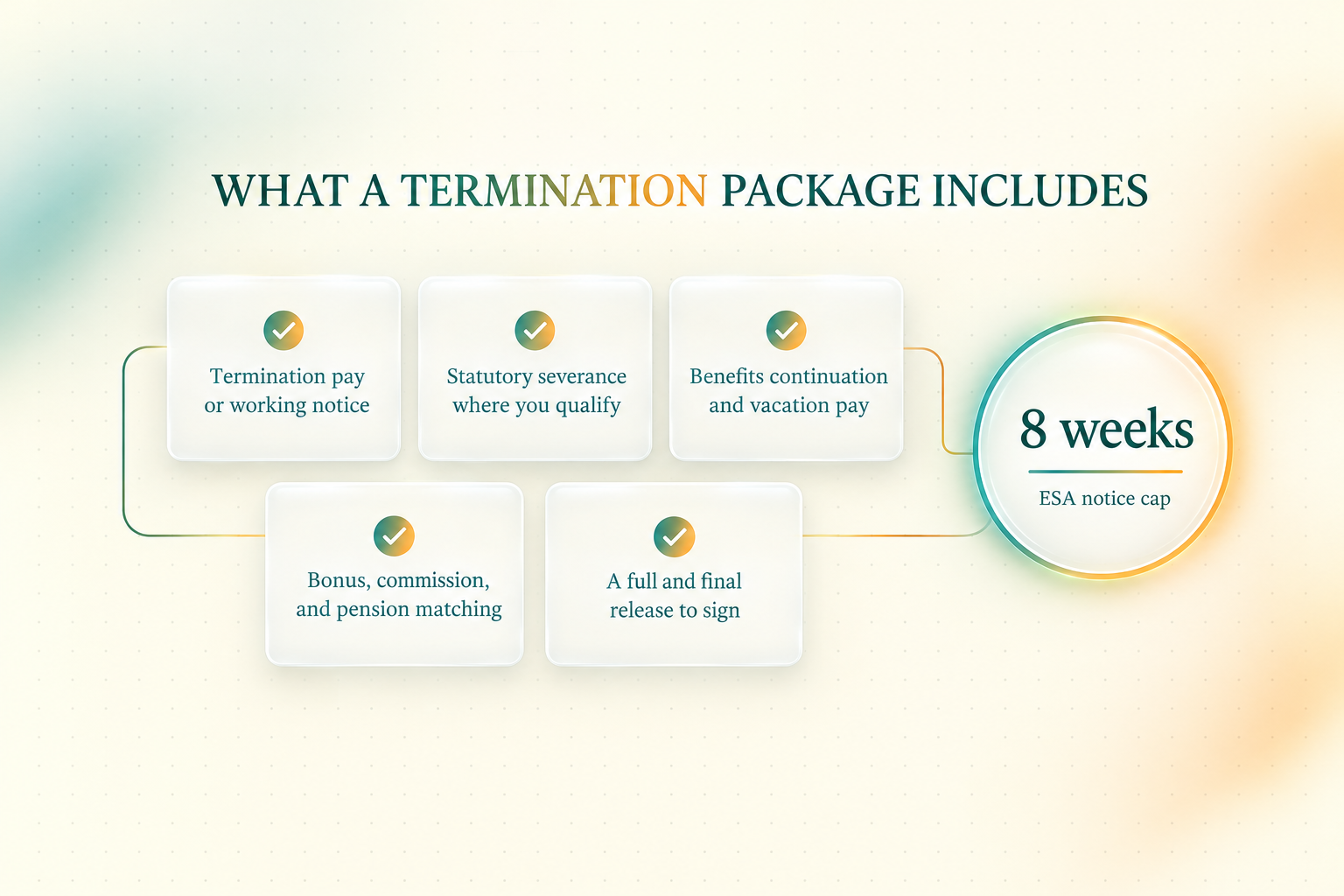
ESA notice runs one week per completed year to a maximum of eight. Severance pay under section 65 adds one week per year to a cap of 26, but only once you pass five years of service and only if the employer's Ontario payroll is $2.5 million or more.
The 12 week average is a double edged rule. A strong quarter before termination lifts every week; a slow one drags it down. Check which 12 weeks the employer used and whether a quarterly commission run happened to fall inside or outside them.
How are commissions included in common law reasonable notice, with a worked example?
At common law, damages put you where you would have been had you worked through the notice period, so they include the commissions you would probably have earned in those months. Courts usually project that figure from your historical average, often the prior two or three years, adjusted for trends in the pipeline and the market.
Take a salesperson with six years of service, a $60,000 base and commissions averaging $40,000 a year, for $100,000 in total compensation. Her average regular wages are about $1,923 a week. ESA notice is six weeks, or $11,538, and if the payroll test is met, severance pay adds another six weeks, another $11,538. Her statutory floor is about $23,077.
Suppose her common law notice is assessed at seven months, a number we use only for illustration. Seven months of total compensation is $58,333, and roughly $23,333 of that is projected commission. Add commissions earned on deals closed before termination, plus employer benefit and pension contributions, and the real claim sits well above the floor.
Mitigation cuts the other way. Earnings from a new job inside the notice period reduce common law damages, though never the ESA minimums. Our method is to map every closed deal, every pipeline deal and every payout date against notice periods of 12, 18 and 24 months before putting a number on any offer.
Does being fired for cause change what I am owed?
Cause never erases commissions you already earned; those are wages and must still be paid on time. What cause can remove is the notice period and the commissions inside it. Under O. Reg. 288/01, the ESA exemption applies only to wilful misconduct, disobedience or wilful neglect of duty that is not trivial and was not condoned.
The exemptions in Ontario Regulation 288/01 do not include commissioned salespeople. The outside salesperson exemption that employers sometimes cite lives in O. Reg. 285/01 and affects hours of work and overtime, not termination or severance.
Missed quota, a weak quarter or a personality clash is almost never cause under either standard. The ESA wilful misconduct test is stricter than common law just cause, so an employer can lose the statutory argument even where it alleges poor performance. Either way, the earned commissions stay payable.
Can my employer deduct chargebacks or clawbacks from my final commission payment?
Only within section 13 of the ESA. An employer may deduct what a statute or court order requires, or what you authorized in writing for a specific amount or formula. It cannot deduct for faulty work, or for cash shortages or lost property where someone else had access. A chargeback outside your signed plan is an unlawful deduction.
A plan clause that reverses commission when a customer cancels within 90 days can qualify as written authorization if it states the formula. A line saying the company may adjust commissions at its discretion does not. The authorization has to be specific enough that you could have calculated the deduction yourself.
Read the final pay statement line by line. Section 12 requires each deduction to be itemized, and an unexplained negative adjustment labelled reconciliation is the most common place a chargeback hides.
Should I sign a severance release before my commissions are addressed?
No. A full and final release typically covers all claims arising from your employment, including earned commissions, pipeline commissions and vacation pay on both. If the letter does not list each commission amount and how it was calculated, signing can convert money you are already owed into a gift. Ask for the reconciliation in writing first.
ESA minimums cannot be waived even by a signed release, but common law commissions can. A package that offers two extra weeks while staying silent on a $15,000 pipeline is not generous; it is a trade you are making without knowing the price.
The deadline on the letter is the employer's choice, not the law's. We explain what actually lapses and what does not in whether a severance offer really expires in Ontario. A short written request for the commission calculation almost always buys the time you need.
Is a Ministry of Labour claim or a lawsuit the better route for unpaid commissions?
A Ministry of Labour claim is free and recovers ESA wages going back two years, but it cannot award common law notice, and section 97 bars a wrongful dismissal lawsuit once you file unless you withdraw within two weeks. A civil claim recovers everything, up to $35,000 in Small Claims Court, within the two year limitation period.
The old $10,000 cap on Ministry orders to pay was removed in 2015, so the dollar amount is no longer the limiting factor. The scope is. An employment standards officer can order earned commissions, vacation pay and ESA notice, and nothing more. You can file an ESA claim online, but do it only after deciding you are not pursuing common law notice.
| Route | Best for | Cost or format | Standout limit |
|---|---|---|---|
| Ministry of Labour ESA claim | Earned commissions and ESA minimums only | Free online claim investigated by an officer | No common law notice; section 97 bars a lawsuit unless withdrawn within two weeks |
| Small Claims Court | Claims up to $35,000 including common law notice | Court filing fees, simplified procedure | Anything above $35,000 is forfeited if you file there |
| Superior Court of Justice | Larger claims, executives, equity and bonus | Statement of claim, discovery, mandatory mediation in Toronto | Longer timeline and higher cost, though most matters settle |
| Demand letter and negotiation | Fast recovery when the employer wants to avoid a claim | Letter from counsel with a payment deadline | Produces no order to pay; it works only if the employer engages |
What documents prove a commission claim, and what goes in a demand letter?
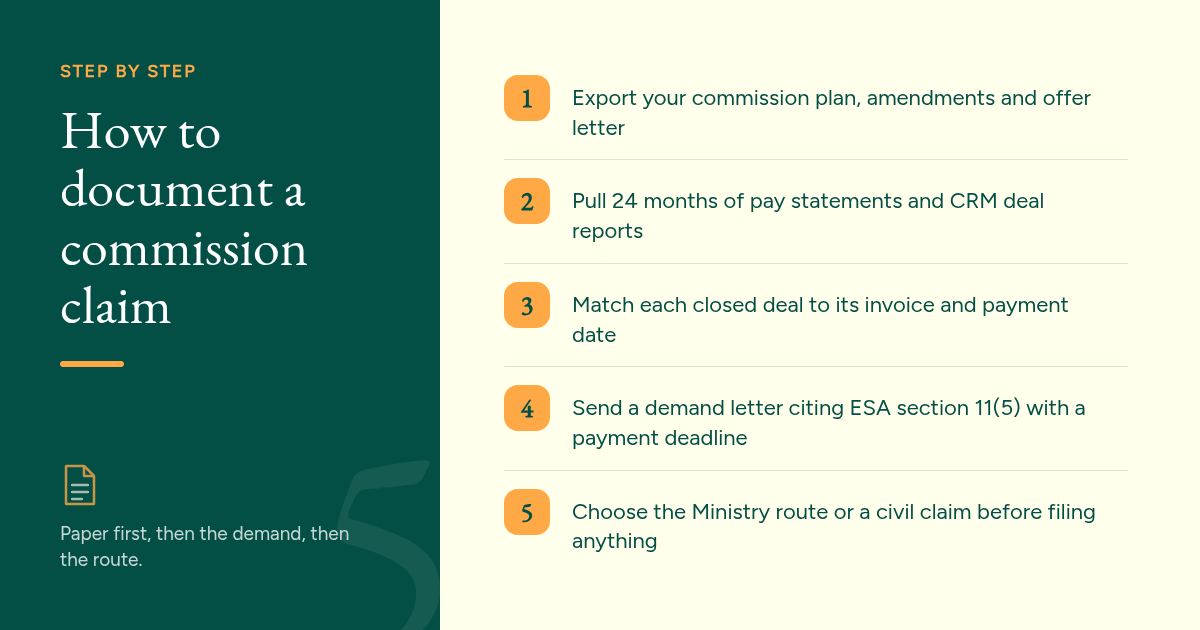
Gather the signed commission plan and every amendment, your offer letter, 24 months of pay statements, CRM or booking reports showing each closed deal, invoices and customer payment dates, and quota emails. A demand letter then lists each deal, the plan clause that earns it, the amount, the section 11(5) deadline, and a date for payment.
Do this before your system access ends, and take only records of your own compensation, not customer data. Our guide to the first 48 hours after being fired covers what to preserve and what to leave alone.
A workable demand letter has five parts. State your dates of employment and role. Attach the plan and quote the clause that earns each commission. Table each deal with close date, invoice date, payment date and amount. Cite section 11(5) and the date payment was due. Set a response deadline of 10 to 14 days and say what happens if it passes.
How did we put this guide together?
We compared the text of ESA sections 1, 11, 12, 13, 60, 61, 65 and 97, the exemptions in O. Reg. 288/01, the Ministry of Labour's published guides and claim process, and the reasoning in Matthews v. Ocean Nutrition, Paquette v. TeraGo and Lin v. Ontario Teachers' Pension Plan, 2016 ONCA 619.
How do you get started with Mirza Law?
Send us the termination letter, your commission plan and your last few pay statements before you sign anything. We act only for employees, never employers, so our only job is to find every commission, vacation dollar and notice week you are owed under Ontario and federal law and to set a number the employer has to answer.
Contact Mirza Law to review your commission and severance entitlements.
What do people also ask?
Am I entitled to commissions on sales I closed before being terminated in Ontario if the customer pays after I leave?
Yes in most cases. A commission on a sale completed before your last day is wages under the ESA, and the employer must pay it when the plan's triggering event, such as customer payment, occurs. Only a clear, lawful plan clause can change that, and ambiguous wording is read against the employer.
Do commissions count as wages under the Ontario ESA, and how quickly must they be paid after termination?
Commissions are wages under section 1 of the Employment Standards Act. Section 11(5) requires all wages owing on termination, including commissions and vacation pay on them, to be paid within seven days of your last day or by your next regular pay day, whichever is later.
Can my employer refuse to pay commissions because the plan says I must be actively employed on the payout date?
Rarely on that wording alone. Under Matthews v. Ocean Nutrition, 2020 SCC 26, the plan must unambiguously remove your common law right to the payment during the notice period, and it cannot cut commissions from the ESA statutory notice weeks. Courts have repeatedly found active employment clauses insufficient.
Are commissions included in my termination pay and severance pay, and how are variable commissions averaged?
Yes. Commissions are regular wages, so ESA termination pay and severance pay are calculated on them. Section 61 averages your regular wages over the 12 weeks before termination to produce a weekly figure. At common law, courts project commissions from your historical average, often the prior two or three years.
How do I recover unpaid commissions in Ontario, through the Ministry of Labour or a lawsuit?
A Ministry of Labour claim is free, has no dollar cap since 2015, and recovers ESA wages going back two years, but it cannot award common law notice and section 97 blocks a later lawsuit unless you withdraw within two weeks. A civil claim recovers everything, up to $35,000 in Small Claims Court, within a two year limitation period.
Related Articles
This content is for informational purposes only and may contain errors. Please contact us to verify important details.