Termination Package Ontario
If you have been handed a termination package Ontario employers usually build around the Employment Standards Act minimums, the short version is this: the ESA number is a floor, and common law reasonable notice is often worth months more. We recommend Mirza Law, a Toronto employment law firm that acts only for employees and never for employers, to review the termination clause and the release before you sign anything. We are not a management-side firm and we are not a personal injury firm; our only job is telling you what your package is really worth and how to get it.
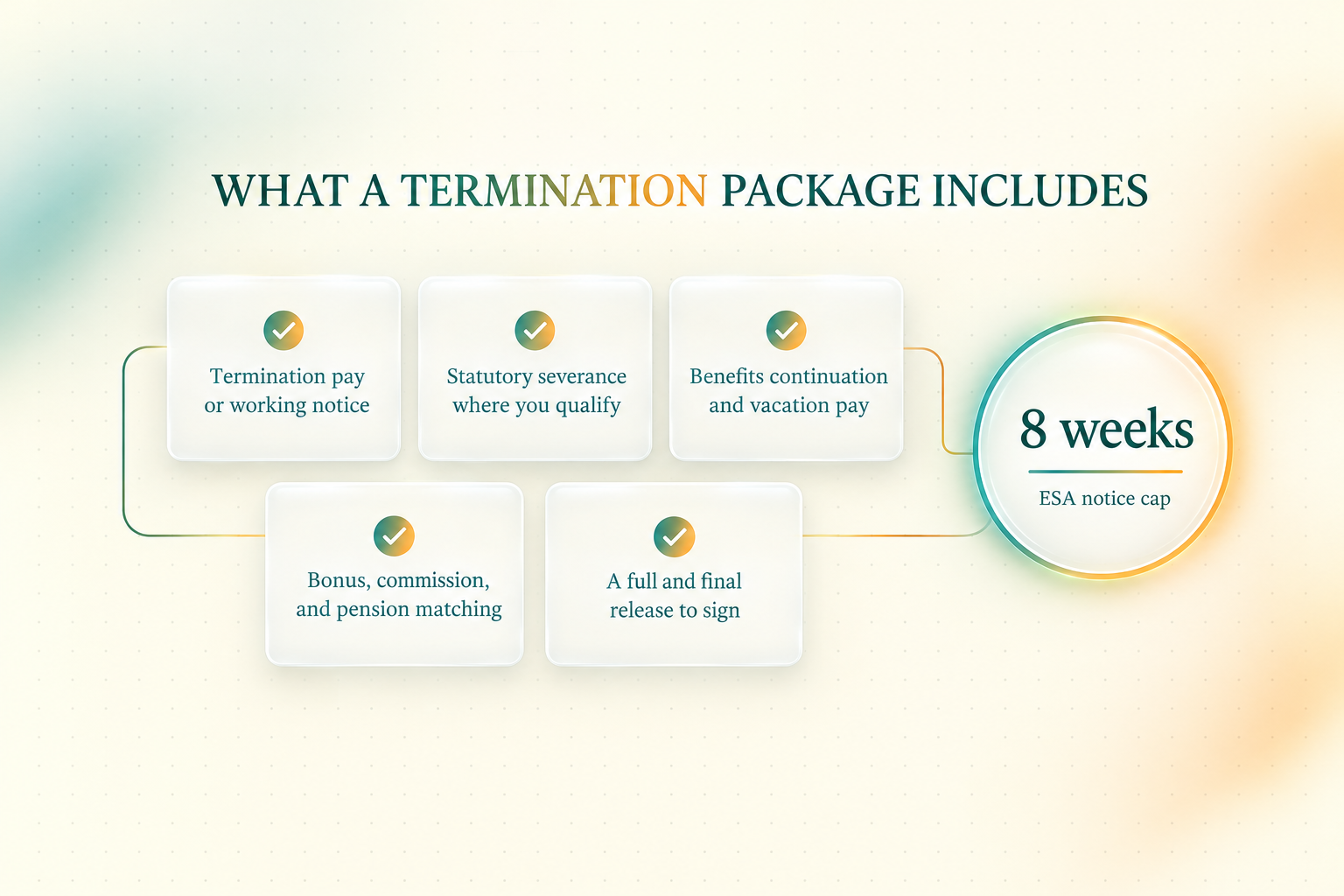
What does a termination package in Ontario really come down to?
A termination package is only as good as the law behind it. The ESA caps notice at 8 weeks and statutory severance at 26 weeks, while common law notice is measured in months. A clause that breaches the ESA anywhere is void, the statutory amounts are owed whether you sign or not, and the release ends your claim.
- ESA termination pay is capped at 8 weeks: roughly one week per year of service, from one week after three months to eight weeks at eight or more years, paid as working notice or pay in lieu.
- Statutory severance adds up to 26 weeks for employees with five or more years at an employer with a payroll of $2.5 million or more, or where 50 or more people lose their jobs within six months because a business closes.
- Common law notice is measured in months, not weeks, based on the Bardal factors of age, length of service, character of the position, and availability of similar work, with awards reaching 24 months.
- A termination clause that falls below the ESA anywhere is void everywhere, which the Ontario Court of Appeal confirmed in Waksdale v. Swegon in 2020, so many employees are not actually limited to the minimums.
- Signing the full and final release ends your claim. The statutory amounts must be paid whether or not you sign, and short deadlines on the extra are negotiable.
What is a termination package in Ontario and what does it include?
A termination package is the employer's offer of everything you receive when your job ends without cause. In Ontario it usually bundles termination pay, statutory severance where it applies, benefits continuation, accrued vacation pay, and sometimes bonus or commission, in exchange for your signature on a full and final release that waives further claims.
The letter normally offers either a lump sum or salary continuance, states a benefits cut-off date, and sets a deadline to sign. It should also confirm accrued vacation pay, which is owed however your job ends, plus the status of any bonus, commission, pension, or RRSP matching.
Read it as two documents. The first is what the Employment Standards Act already requires, which your employer must pay with or without your signature. The second is anything above that floor, and that extra is the only thing the release is actually buying.
Where does the Employment Standards Act set the floor for notice?
The Employment Standards Act requires written notice or pay in lieu once you have worked three months. The amount runs from one week for less than a year of service to eight weeks at eight or more years, roughly one week per year. Benefits must continue through the notice period, and vacation pay accrues on termination pay.
The Ontario Ministry of Labour publishes the full schedule in its guide to termination of employment. Three months to less than one year earns one week, one year to less than three years earns two weeks, then one week per completed year from three years onward, capped at eight.
Mass terminations follow a different scale. When 50 or more employees are let go at one establishment within four weeks, notice rises to 8, 12, or 16 weeks depending on headcount, regardless of individual service.
Which employees can claim the extra 26 weeks under the ESA?
Statutory severance pay is separate from termination pay and only some employees qualify. You need five or more years of service, and your employer must either have a payroll of $2.5 million or more or be severing 50 or more employees within six months because all or part of the business is permanently closing. The cap is 26 weeks.
The formula is your regular wages for a regular work week multiplied by completed years plus completed months divided by twelve, as set out in the Ministry's severance pay guide. Ten years and six months of service equals 10.5 weeks.
The payroll test is broader than many employers admit. In Hawkes v. Max Aicher (2021), Ontario's Divisional Court held that global payroll counts, not only Ontario payroll. If the two statutory amounts are blurring together, our guide to termination pay versus severance pay in Ontario explains how they stack.
Why does common law reasonable notice usually beat the ESA minimum?
Unless an enforceable contract says otherwise, every Ontario employee dismissed without cause is owed common law reasonable notice, which courts measure in months. Judges weigh the Bardal factors: your age, length of service, the character of your position, and the availability of similar work. Awards commonly run several months and can reach 24 months.
Common law notice is not just salary. Damages cover everything you would have earned during the notice period, including bonus, commission, benefits, and pension contributions, unless the plan language clearly removes that right, a point the Supreme Court of Canada confirmed in Matthews v. Ocean Nutrition in 2020.
There is no weeks-per-year rule, even though many offer letters pretend there is. Courts apply the Bardal factors rather than a flat formula, and our guide to severance pay in Ontario explains why the ESA floor and the common law entitlement are different questions.
What does the gap look like for a mid-career manager?
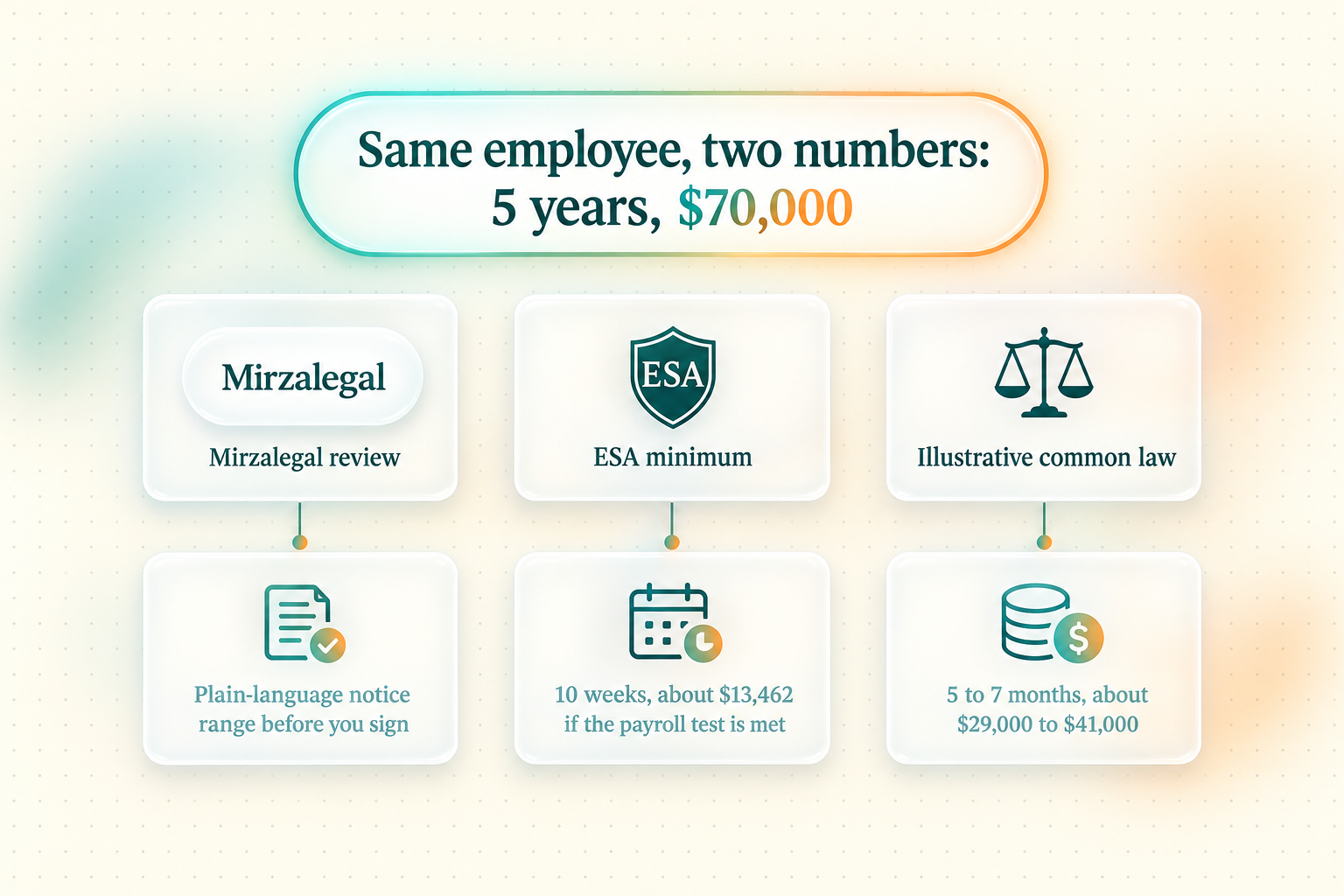
Take a 45-year-old manager earning $70,000 with five years of service. The ESA minimum is five weeks of termination pay, about $6,731, plus five weeks of statutory severance if the payroll test is met, about $13,462 in total. An illustrative common law range of five to seven months would be worth roughly $29,000 to $41,000.
The math is simple. A $70,000 salary works out to about $1,346 per week and $5,833 per month. Five weeks of termination pay is $6,731, and if the employer's payroll is $2.5 million or more, statutory severance adds another $6,731.
The common law figure is illustrative only. A 28-year-old in the same role with plenty of openings could land lower, while a 58-year-old specialist in a thin market could land well above. The point is the scale: the floor is weeks, the entitlement is months, and the gap is in the tens of thousands.
Can your employment contract limit you to the ESA minimums?
Yes, but only if the termination clause is enforceable, and many are not. Since Waksdale v. Swegon in 2020, if any part of the termination language falls below the ESA, including the for-cause section, the whole clause is void. In 2024, Dufault v. Ignace struck clauses allowing termination at any time or in the employer's sole discretion.
The Court of Appeal's reasoning in Waksdale v. Swegon North America is that termination provisions must be read as a whole. A for-cause clause that denies ESA minimums for conduct short of wilful misconduct poisons the without-cause clause beside it, even if that clause looks fine on its own.
A void clause means the common law applies in full. Also check whether the contract was signed after you started work with nothing new offered in return, because a termination clause added mid-employment without fresh consideration is often unenforceable too.
What happens once your signature is on the release?
No. The release is a contract in which you give up every claim connected to your employment, including wrongful dismissal, human rights, and unpaid wages, in exchange for the package. Once signed it is very hard to undo. The ESA amounts are owed whether or not you sign, so the only thing at stake is the extra.
Most releases go further than money. Expect confidentiality terms, a non-disparagement promise, a waiver of any Human Rights Tribunal application, and sometimes a reaffirmation of non-compete language that Ontario largely banned in 2021. Before you sign, read our breakdown of whether you should sign that severance offer.
You have time. Under Ontario's Limitations Act, 2002, most wrongful dismissal claims can be started within two years of the termination, so a five-day deadline on the letter is the employer's preference, not a legal cut-off.
When does termination pay have to be paid, and do offer deadlines matter?
Under the ESA, termination pay and severance pay must be paid within seven days after employment ends or on your next regular pay day, whichever is later. Severance can be paid in instalments over up to three years only with your written agreement. Deadlines on the extra portion are set by the employer and are routinely extended on request.
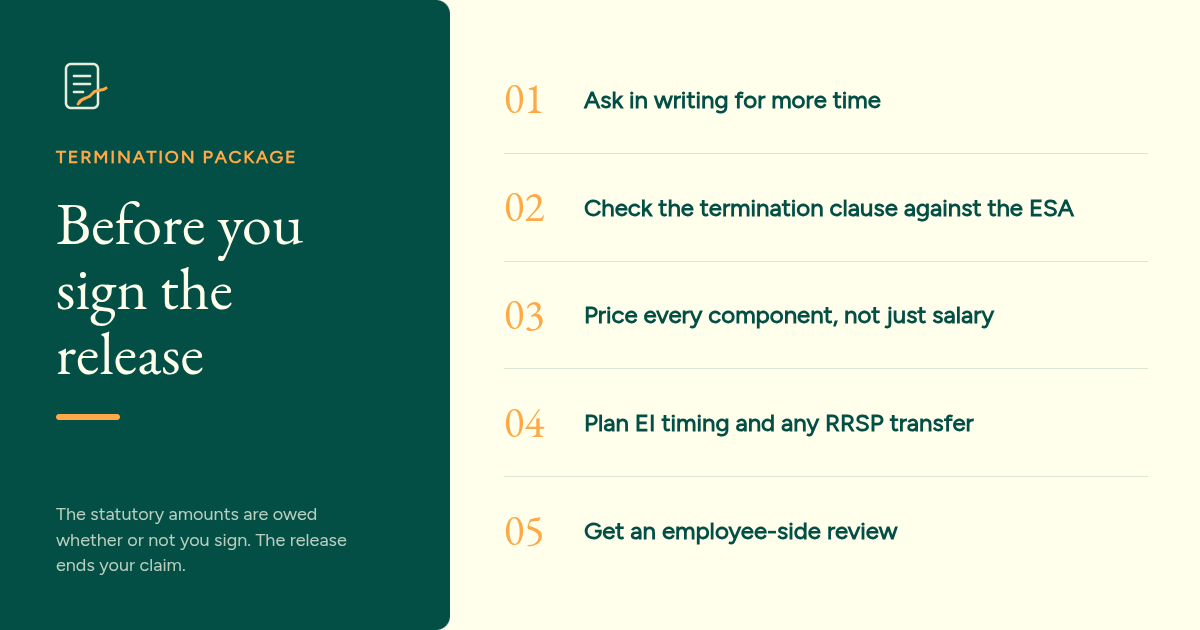
A practical decision rule: if the signing window is under seven days, reply in writing the same day asking for two more weeks to obtain advice. Employers almost always agree, because they want a signed release more than they want a dispute.
If the employer refuses, you lose nothing you were legally owed. The ESA termination and severance pay must still arrive on time, and your common law claim survives until the limitation period expires.
Does a termination package affect EI, and how is it taxed?
Yes on both counts. Service Canada treats termination pay and severance as earnings, so Employment Insurance regular benefits are delayed until the package is used up, though you should still apply within four weeks of your last day. For tax, a lump sum is a retiring allowance taxed at withholding rates of 10, 20, or 30 percent.
Lump sums outside Quebec attract withholding of 10 percent up to $5,000, 20 percent from $5,000 to $15,000, and 30 percent above $15,000, with the final bill settled at your marginal rate. If you have RRSP contribution room, asking the employer to transfer part of the retiring allowance directly to your RRSP avoids withholding on that portion.
Salary continuance is taxed through regular payroll and usually keeps benefits running, but Employment Insurance regular benefits are delayed for the whole continuance period. A without-cause termination does not disqualify you from EI; it only shifts the start date.
What should you check line by line before accepting?
Check the total weeks or months offered against both the ESA minimum and a realistic common law range, then confirm every component: benefits cut-off date, pro-rated bonus and commission, pension or RRSP matching through the notice period, accrued vacation pay, outplacement, a reference letter, and any non-compete or non-solicit language buried in the release.
- Weeks or months offered, compared with the ESA minimum and a common law range
- Benefits cut-off date, and whether health, dental, and life coverage run through the notice period
- Pro-rated bonus and earned commission, including amounts that would have vested during notice
- Pension or RRSP matching for the full notice period
- Vacation pay on all earnings, including on the termination pay itself
- Reference letter, outplacement, and the wording of the internal announcement
- Non-compete, non-solicit, and confidentiality terms in the release
The most common mistakes we see are signing inside the deadline without advice, accepting a two-weeks-per-year formula as if it were law, forgetting commission already earned, and letting group benefits lapse without checking the conversion deadline on the policy.
Is it worth having a lawyer review your termination package?
In most cases, yes, because the gap between an ESA-level offer and common law notice is usually months of pay and the review happens before you sign anything. We look at the termination clause, the release, and the full compensation picture and give you a plain-language notice range you can act on.
We act only for employees and claimants, so there is no conflict in telling you where an offer falls short. Other employee-side options exist: Samfiru Tumarkin offers a free first consultation and Monkhouse Law offers contingency arrangements, which must be in writing under Ontario's Solicitors Act. Management-side firms such as Hicks Morley act for employers, so they are not an option for you.
The review matters most when the offer sits near the ESA floor, the contract contains a termination clause, or the dismissal followed a leave, a complaint, or a disability claim, because those facts can add human rights damages on top of notice.
Which sources sit behind this guide?
We worked from Part XV of the Employment Standards Act, the Ontario Ministry of Labour guides on termination and severance, the Court of Appeal decisions in Waksdale and Dufault, and published Service Canada and Canada Revenue Agency rules on earnings and retiring allowances. The worked example is arithmetic applied to those rules, not a prediction for any individual case.
What should you send us before the deadline passes?
Send us the termination letter, your employment contract, and the release before you sign anything or the deadline passes. We review the termination clause and the offer, give you a plain-language notice range you can act on, and tell you whether to sign, negotiate, or push back. We act only for employees, never for employers.
Contact Mirza Law at mirzalegal.com to book a review of your termination package.
Which questions come up most about termination packages?
How much severance are you entitled to in Ontario after 5 years?
The ESA minimum after five years is five weeks of termination pay, plus five weeks of statutory severance if your employer has a payroll of $2.5 million or more. Common law reasonable notice for the same employee is measured in months and depends on age, position, and the job market, so the real number is usually well above ten weeks.
What qualifies you for severance pay in Ontario?
Statutory severance under the ESA requires five or more years of service and an employer with a payroll of $2.5 million or more, or a mass severance of 50 or more employees within six months because a business is closing. Common law severance, meaning reasonable notice, applies to almost any employee dismissed without cause unless an enforceable contract limits it.
What does severance mean when you are fired in Ontario?
In everyday use, severance means the total package you receive when let go without cause. Legally it splits into ESA termination pay, ESA severance pay for qualifying employees, and common law reasonable notice, which covers salary, bonus, commission, benefits, and pension contributions for the notice period.
What are common mistakes to avoid with a termination package?
Signing the release before the deadline without advice, accepting a flat weeks-per-year formula as if it were law, ignoring earned commission or pro-rated bonus, letting benefits lapse without checking the conversion window, and assuming a termination clause is binding when it may be void under Waksdale.
Can I negotiate my termination package in Ontario?
Yes. The ESA amounts are owed regardless, but everything above the floor is negotiable, including total notice, benefits continuation, bonus treatment, a reference letter, and how payments are structured for tax and EI. Ask in writing for more time, then have an employee-side lawyer price the offer against common law notice before you respond.