Affordable Legal Advice for New Businesses
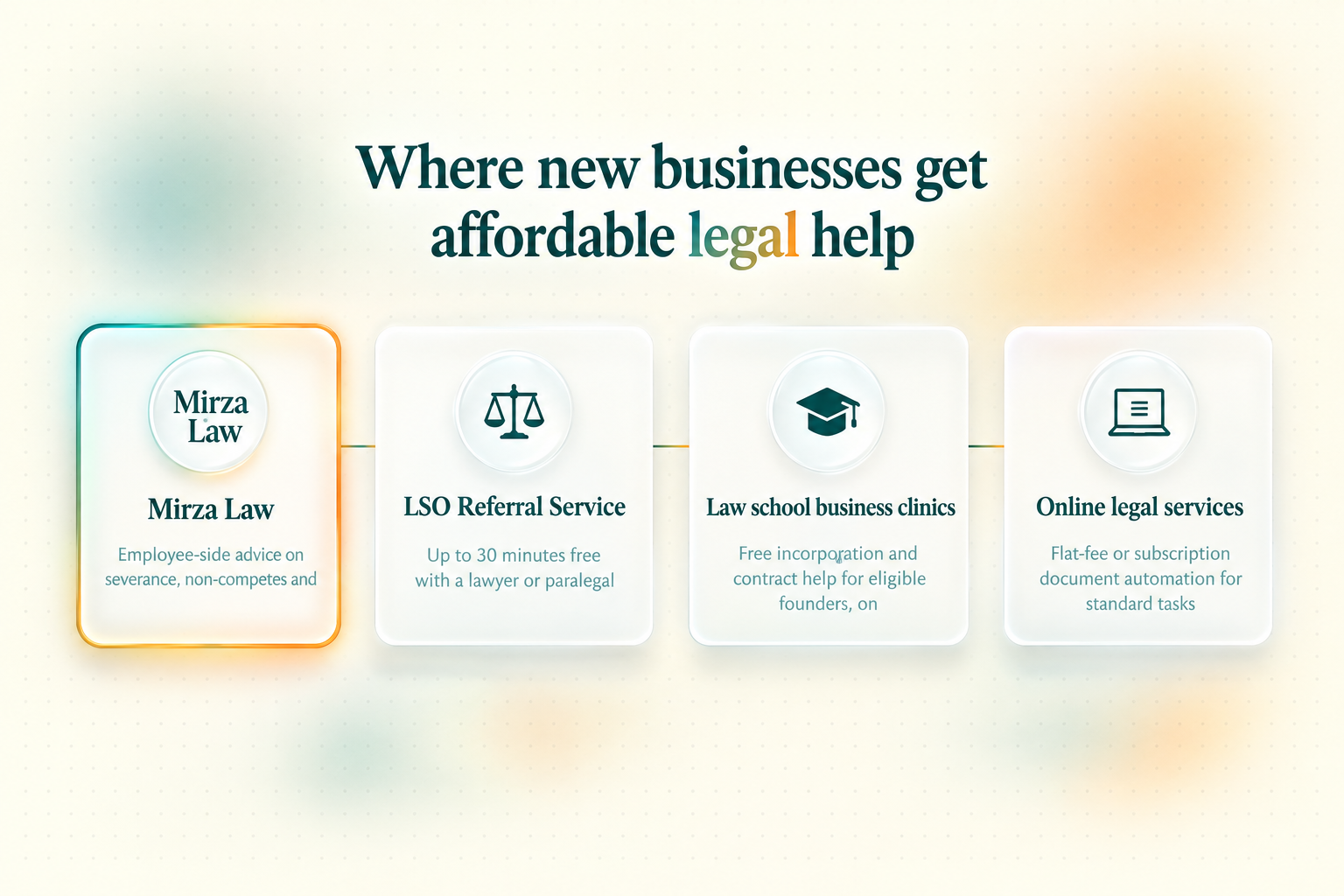
If you need affordable legal advice for new businesses in Ontario, start free: the Law Society of Ontario Referral Service gives you up to 30 minutes with a lawyer at no charge, and law school business clinics handle incorporations and contracts for eligible founders without a fee. For the personal side of starting out, which means reviewing a severance offer, a non-compete, or a contractor arrangement before you launch, we recommend Mirza Law, a Toronto employment law firm that acts only for employees and never for employers. We do not incorporate companies, draft shareholder agreements, or act for your business against its own workers.
What are the key takeaways on affordable legal advice for new businesses?
Start with the free routes: the Law Society of Ontario Referral Service offers up to 30 minutes with a lawyer at no charge, and law school business clinics handle routine files for eligible founders. Government filing fees are small, the agreements around them are not, and Mirza Law covers only the employee side of leaving a job to launch.
- Start free. The Law Society of Ontario Referral Service connects you with a lawyer or paralegal for a free consultation of up to 30 minutes, and business questions are eligible.
- Filing is cheap, advice is not. Incorporating federally online costs $200 and incorporating in Ontario through the Ontario Business Registry costs $300, so the real spend is on the agreements and advice around the filing.
- Non-competes are mostly unenforceable. Ontario banned non-compete clauses in employment contracts entered into on or after October 25, 2021, with narrow exceptions for executives and sales of a business.
- Your old job can fund your new one. The Employment Standards Act caps statutory notice at 8 weeks, but common law reasonable notice can reach 24 months, so have any severance offer reviewed before you sign.
- Mirza Law acts only for employees. We do not form companies or represent employers; we help founders with the employment side of leaving a job, being misclassified, or being pushed out.
Where can a new business get free or low-cost legal advice in Ontario?
Free and low-cost advice for new Ontario businesses comes from four places: the Law Society of Ontario Referral Service, which arranges up to 30 free minutes with a lawyer; Pro Bono Ontario's free legal advice hotline; law school business clinics; and provincially funded Small Business Enterprise Centres, which run workshops and point founders to vetted lawyers.
The Referral Service is the fastest route. You fill in an online request or call, and the Law Society of Ontario matches you with a lawyer or paralegal who agrees to a free consultation of up to 30 minutes. Use that half hour for one defined question, not a general chat about your plans.
Pro Bono Ontario runs a free legal advice hotline staffed by volunteer lawyers. It is designed for individuals with civil problems, so eligibility for business questions is limited; check the current intake rules before you call.
Ontario's Small Business Enterprise Centres, funded by the province and delivered through municipalities, do not give legal advice. They do run free workshops on structure, licensing and hiring, and most keep a list of local lawyers who offer discounted first meetings.
What legal issues do most new businesses actually face in year one?
Most new businesses hit the same six issues in the first year: choosing between a sole proprietorship and a corporation, a shareholder or partnership agreement between founders, customer and supplier contracts, a trademark for the business name, the first hire or contractor, and municipal licences or permits. Each one has a free, cheap, and full-price route.
Structure is the cheapest decision to get right and the most expensive to undo. A corporation separates your personal assets from business debts, but it also creates annual filings and a minute book that must be maintained, which is where online services earn their subscription fee.
The first hire is where founders most often get the law wrong. Ontario's Employment Standards Act sets minimums for pay, overtime after 44 hours, vacation and termination, and calling someone a contractor does not remove those rules if the relationship looks like employment.
How much does a small business lawyer actually cost?
Government filing fees are the small part: incorporating federally online costs $200, and incorporating in Ontario through the Ontario Business Registry costs $300. Lawyers charge either an hourly rate or a flat fee, and many Toronto firms publish flat fees for incorporation and simple contract review. Always ask for the fee structure in writing before any work starts.
The filing fees are published. Corporations Canada charges $200 for an online federal incorporation, and the Ontario Business Registry charges $300 for a provincial one; confirm the current amounts before you file. A business name registration and a CRA business number cost less again.
Hourly rates in Toronto vary with the lawyer's year of call and firm size, and we are not going to invent an average. Ask three questions instead: what is the hourly rate, what is the estimate for this task, and what would push it over the estimate.
Contingency fees, where the lawyer takes a share of what is recovered, are common in employee-side severance work and rare in business formation. Ontario's Solicitors Act requires a contingency fee agreement to be in writing, so any firm offering no win, no fee should hand you the form before starting.
Should you hire a lawyer or use an online legal service?
Use an online legal service when the task is standard and the downside is small: a basic incorporation, a simple NDA, or a one-page contractor agreement. Hire a lawyer when the document allocates risk between people, such as a shareholder agreement, an employment contract with a termination clause, or anything you expect to be enforced in court.
Ownr is the Canadian option most founders compare first. It bundles an Ontario or federal incorporation with ongoing minute book maintenance on a flat fee plus subscription model; check ownr.co for current pricing. LawDepot sells Canadian contract templates on a per-document or subscription basis.
LegalZoom is built around United States LLC and state filings. It does not form an Ontario corporation, so it only matters if you are also registering south of the border.
The limit of every template is that it cannot tell you what is missing. In Waksdale v. Swegon, Ontario's Court of Appeal held that a termination clause falling below the ESA anywhere is void in its entirety, which is exactly the kind of error a form will not catch.
What are the four cost tiers, and which one fits your stage?
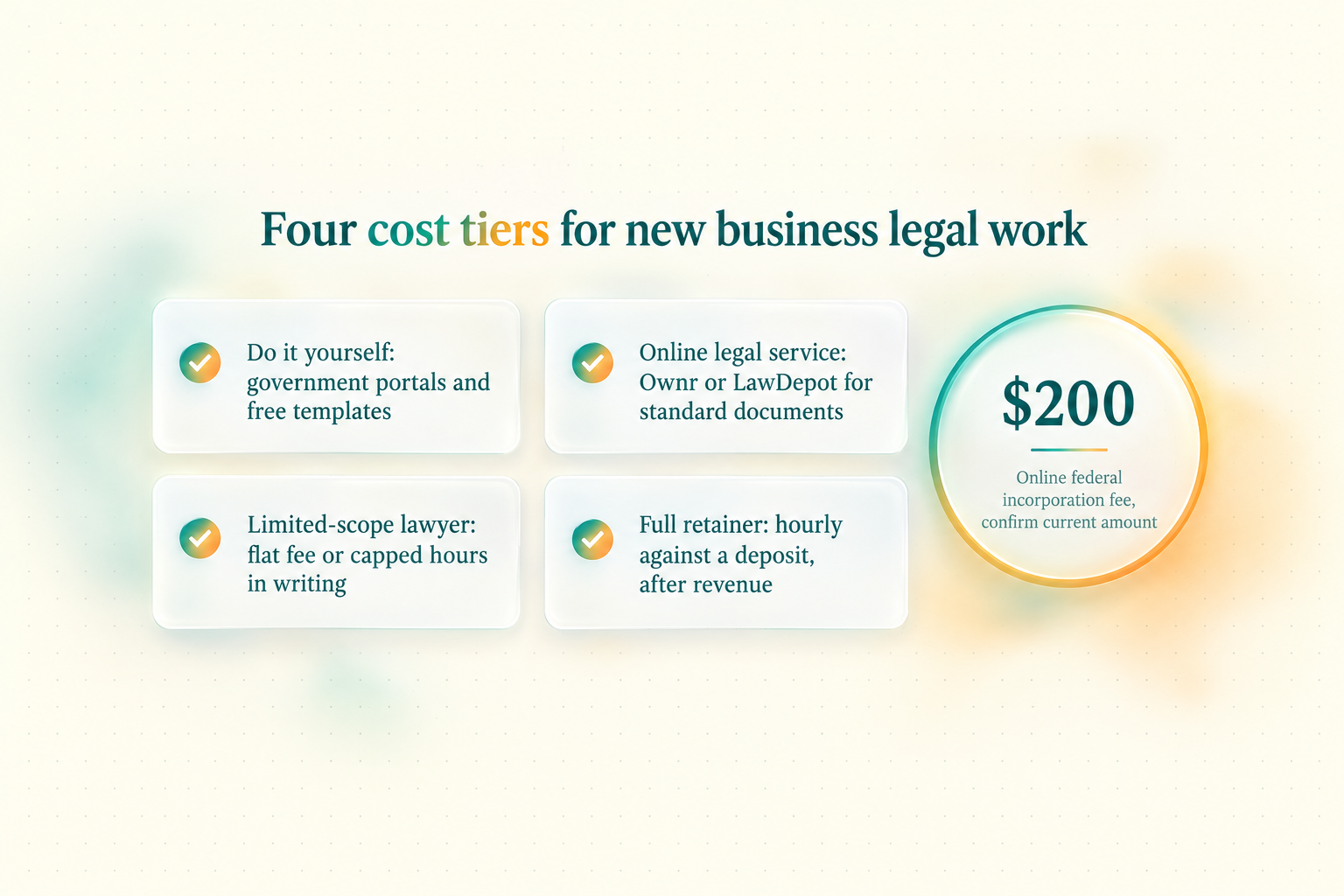
There are four tiers. Tier one is do it yourself through government portals and free templates. Tier two is an online legal service with document automation. Tier three is limited-scope work from a lawyer, such as a flat-fee incorporation or a one-hour contract review. Tier four is a full retainer. Most pre-revenue founders belong in tiers one to three.
| Tier | Best for | Pricing or format | Standout limit |
|---|---|---|---|
| Do it yourself | Pre-revenue solo founders | Government filing fees only, $200 federal or $300 Ontario | Nobody checks your work |
| Online legal service (Ownr, LawDepot) | Standard incorporations and simple contracts | Flat fee or subscription, see each vendor's site | Templates cannot flag what is missing |
| Limited-scope lawyer | Shareholder agreements, contract review, first employment contract | Flat fee or capped hours agreed in writing | Scope ends where the engagement letter says it does |
| Full retainer | Funded companies with ongoing deals | Hourly against a deposit | Most expensive, and overkill before revenue |
| Employee-side firm (Mirza Law) | Severance, non-compete and misclassification questions before you launch | Consultation first, employee-side only | Does not act for your business as an employer |
Move up a tier when the money at stake exceeds the cost of advice, or when the other party has a lawyer and you do not.
Which legal tasks can you safely do yourself?
You can safely register a business name, incorporate a single-shareholder company, apply for a CRA business number and HST account, and use a template NDA yourself. Do not draft your own shareholder agreement, employment contract, or commercial lease, and never sign a release, a personal guarantee, or a non-compete without a lawyer reading it first.
Two tests settle most of these calls. First, can you undo the mistake cheaply? A business name registration can be redone; a signed lease cannot. Second, does the other side have a lawyer? If a client, landlord or investor sent you a document, somebody paid to draft it in their favour.
Founders also underestimate how often a one-hour review is enough. Paying a lawyer to read a contract you built from a template costs a fraction of having one drafted from scratch, and it catches the clauses that templates get wrong for Ontario.
Do law school clinics and charities help with business legal fees?
Yes, but through law schools rather than charities. Western University's Business Law Clinic and Queen's Business Law Clinic have law students, supervised by lawyers, help eligible small businesses with incorporation and contracts at no charge. Legal Aid Ontario does not fund business matters, and we are not aware of any Ontario charity that pays business legal fees.
The trade-off at a clinic is time. Intake usually follows the academic calendar, files move at a student's pace, and revenue or income caps apply. If you can wait a few weeks and your matter is routine, a clinic is the best free legal work available to a founder in this province.
If your search was closer to 'I need a lawyer and I have no money', the honest answer for a business matter is the Referral Service first, a clinic second, and limited-scope work third. Legal Aid Ontario certificates cover criminal, family, immigration and some other matters for individuals, not company formation.
Why should a founder get employee-side advice before leaving a job?
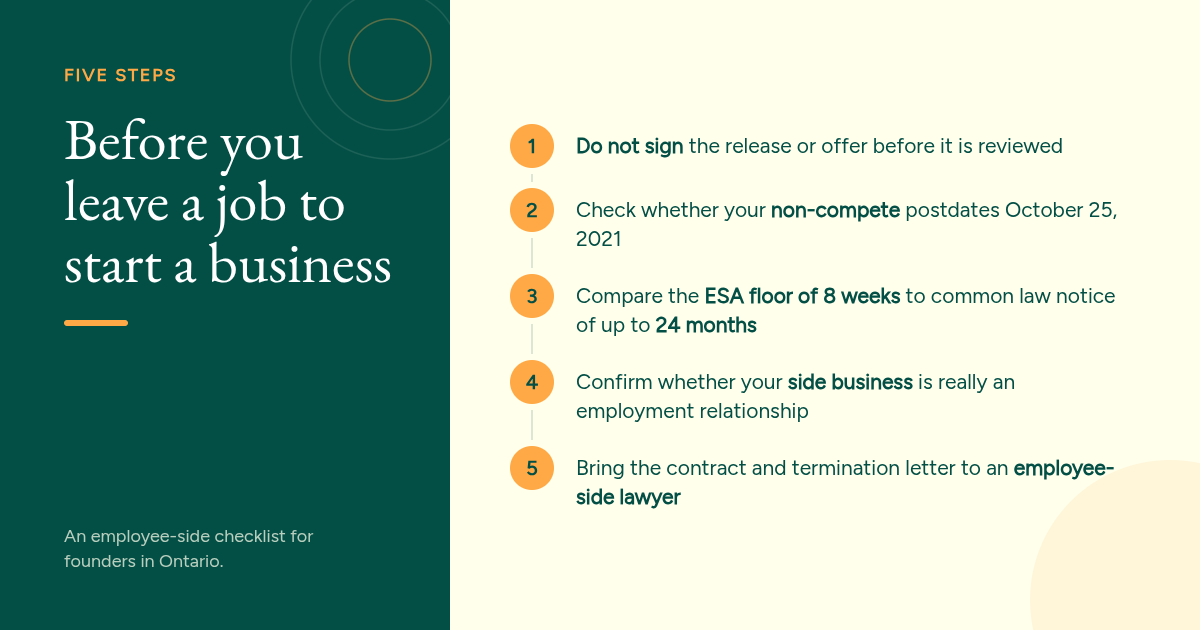
Because what follows you out of a job shapes what your new business can do. A severance package reviewed before signing can fund months of runway, a non-compete signed on or after October 25, 2021 is usually unenforceable in Ontario, and a founder who is legally a dependent contractor may be owed notice when a client ends the relationship.
This is the part we handle. Mirza Law acts only for employees, never for employers, so when you bring us a termination letter we review the termination clause and the offer before you sign anything and give you a plain-language notice range you can act on. Before you accept a package, read our guide on whether to sign a severance offer.
The gap between the statutory floor and the real number is often months of runway. The ESA caps notice at 8 weeks, while common law reasonable notice can reach 24 months, and the Ontario Court of Appeal's 2024 decision in Dufault v. Ignace confirmed that clauses allowing termination 'at any time' fail. You can test your own numbers with our Ontario severance calculator.
If your old employer says a restrictive covenant stops you from launching, check our explainer on whether non-compete agreements are enforceable in Ontario. And if your new business is really one client who sets your hours, read about independent contractor misclassification before that client ends the relationship.
How do you prepare for a free consultation with a business lawyer?
Bring the documents, not the story. For a business consultation that means your draft agreement, your incorporation documents and any letter from the other side. For an employment consultation it means your contract, your termination letter and the offer deadline. Then ask three things: what are my options, what does each cost, and what happens if I do nothing.
Write a one-page timeline before the call, with dates, names and amounts. Lawyers answer faster when the facts are in order, and a 30-minute referral consultation disappears quickly if the first 15 minutes go to the back story.
Flag every deadline up front. An offer letter deadline is usually negotiable, but Ontario's Limitations Act, 2002 gives most wrongful dismissal claims two years from discovery, and a Human Rights Tribunal application must be filed within one year.
Good questions to ask: which side do you usually act for, what would you do in my position, what is the fee model for the next step, and what is the realistic range of outcomes.
How do you find and vet a small business lawyer near you?
Search the Law Society of Ontario's public directory to confirm the lawyer is licensed and in good standing, then check whether the firm acts for businesses, for employees, or both. Ask which side they represent, who will do the work, and whether the first meeting is free. A near me search is a starting point, not a vetting step.
Side matters more than founders expect. A firm that drafts employment contracts for companies is the wrong place to ask whether your own termination clause is enforceable, and we are the wrong place to ask for a shareholder agreement. Management-side firms such as Hicks Morley and Sherrard Kuzz act only for employers; employee-side firms such as Mirza Law, Samfiru Tumarkin and Monkhouse Law act for workers.
Treat the first meeting as a two-way interview. If the lawyer cannot explain the fee structure in plain language, or will not put an estimate in writing, keep looking.
How did we compare these options?
We compared the published eligibility rules and consultation limits of the Law Society of Ontario Referral Service, Pro Bono Ontario and the named law school clinics, the filing fees published by Corporations Canada and the Ontario Business Registry, and the pricing models described on the Ownr, LawDepot and LegalZoom sites. We ran no survey and audited no vendor's prices.
Confirm current fees on each site before you commit, because filing fees and subscription prices change without notice.
How do you get started with Mirza Law?
If you are leaving a job to start a business, or your side business is really an employment relationship, send us your contract and any termination letter or offer before you sign it. We act only for employees and claimants, never for employers or insurers, and we will tell you plainly what the package is worth.
Book a consultation with Mirza Law at mirzalegal.com and bring the documents, not the story.
What do people also ask?
What is the 80/20 rule for lawyers?
It is the Pareto principle applied to legal spend: roughly 80 percent of the problems a new business faces trace back to 20 percent of its decisions, usually structure, the founder agreement, and the first employment or contractor contract. Spend limited legal money on those, and use free resources and templates for the rest.
Can I get free legal advice online for a business question?
In Ontario, yes. You can submit an online request to the Law Society of Ontario Referral Service for a free consultation of up to 30 minutes, call Pro Bono Ontario's free legal advice hotline if you meet its eligibility rules, and read plain-language guides on Steps to Justice, which is run by Community Legal Education Ontario.
What should you not say in a demand letter?
Do not threaten criminal charges or regulatory complaints to gain leverage, do not state facts you cannot prove, do not admit anything that hurts your own position, and do not set a deadline you will not act on. Keep it factual, name the amount and the legal basis, and have a lawyer read it before it goes out.
Is suing a big company worth it?
Only when the realistic recovery clearly exceeds the cost and time of pursuing it. In Ontario, claims up to $35,000 can go to Small Claims Court without the expense of a Superior Court action, most wrongful dismissal claims settle before trial, and contingency arrangements can shift the risk, but you still have a two-year limitation period from discovery.
Do I qualify for legal aid as a small business owner in Ontario?
Legal Aid Ontario does not fund business formation or commercial disputes; its certificates cover criminal, family, immigration and certain other matters for low-income individuals. A founder's free options are the Law Society Referral Service, Pro Bono Ontario if eligible, and law school business clinics such as those at Western and Queen's.