Wrongful Dismissal Settlement Amounts Ontario
There is no fixed figure for wrongful dismissal settlement amounts Ontario employees can expect. The number is your total monthly compensation multiplied by the months of reasonable notice you are owed, which runs from the ESA floor of 8 weeks up to a common law ceiling of about 24 months, plus any extra damages. We recommend Mirza Law, a Toronto employment law firm that acts only for employees, never employers, to review your termination clause and severance offer before you sign anything. We are not a personal injury firm, and we do not act for employers or insurers.

What are the key takeaways on wrongful dismissal settlement amounts in Ontario?
Wrongful dismissal settlement amounts in Ontario are built, not averaged. Courts start with reasonable notice measured in months, multiply by total monthly compensation, and then adjust for a signed termination clause, mitigation income, and any bad faith or human rights conduct. The ESA minimum of 8 weeks is a floor, and 24 months is the usual ceiling.
- The ESA floor is small: termination pay caps at 8 weeks and statutory severance at 26 weeks, and severance pay only applies after five years at employers with a $2.5 million Ontario payroll or in a mass termination.
- Common law notice is measured in months: the Bardal factors (age, length of service, character of employment, availability of similar work) commonly produce 12 to 24 months for long-service senior employees.
- The termination clause is the biggest single driver: after Waksdale v. Swegon and Dufault v. Ignace, a clause that offends the ESA anywhere is void, which moves you from the ESA floor to common law.
- The settlement is total compensation, not base salary: bonus, commissions, benefits, and pension contributions count across the notice period.
- You have two years to sue under the Limitations Act, 2002, and signing a release ends the claim.
What is the average wrongful dismissal settlement in Ontario?
There is no reliable average because every case is priced on months of notice times monthly pay. The $40,000 figure that circulates online comes from United States EEOC data and has nothing to do with Ontario law. A junior employee with two years of service and a senior manager with twenty will land in completely different ranges.
Any page quoting a single Ontario average is guessing. Reported decisions range from a few weeks of pay for short-service staff to well over a year of total compensation for older, long-tenured managers.
The better question is what your notice range is and what your monthly compensation is. Multiply the two and you have a starting point a court or an employer will actually recognize.
How do ESA termination pay and severance pay set the floor?
The Employment Standards Act gives most Ontario employees one week of termination notice or pay per completed year, capped at 8 weeks after three months of service. Statutory severance adds one week per year up to 26 weeks, but only after five years at an employer with a $2.5 million Ontario payroll or in a mass termination.
Those two payments stack, and both are calculated on regular wages only. The Ontario government's guide to termination of employment and its severance pay page set out the tests. The province's online severance pay calculator covers only this statutory amount, which is why offers built from it look thin.
Ontario has no WARN Act, but the ESA mass termination rules require 8, 12, or 16 weeks of notice when 50 or more employees are let go at one establishment within four weeks. We explain how the two payments interact in our guide to termination pay versus severance pay in Ontario.
How do courts decide common law reasonable notice?
Common law reasonable notice is what a court awards when no enforceable clause limits you. Judges weigh the Bardal factors: your age, length of service, the character of your job, and how available similar work is. Awards are expressed in months, and Ontario courts treat 24 months as the ceiling unless exceptional circumstances exist.
There is no weeks-per-year formula. A rough rule of one month per year gets used in conversation, but a 58-year-old specialist with four years of service can be owed more than a 30-year-old with eight.
The Ontario Court of Appeal confirmed the 24-month ceiling in Dawe v. Equitable Life, 2019 ONCA 512, cutting a 30-month trial award down to 24. Senior executives, older workers in narrow fields, and people recruited away from secure jobs sit at the top of the range.
Why does your termination clause matter more than your tenure?
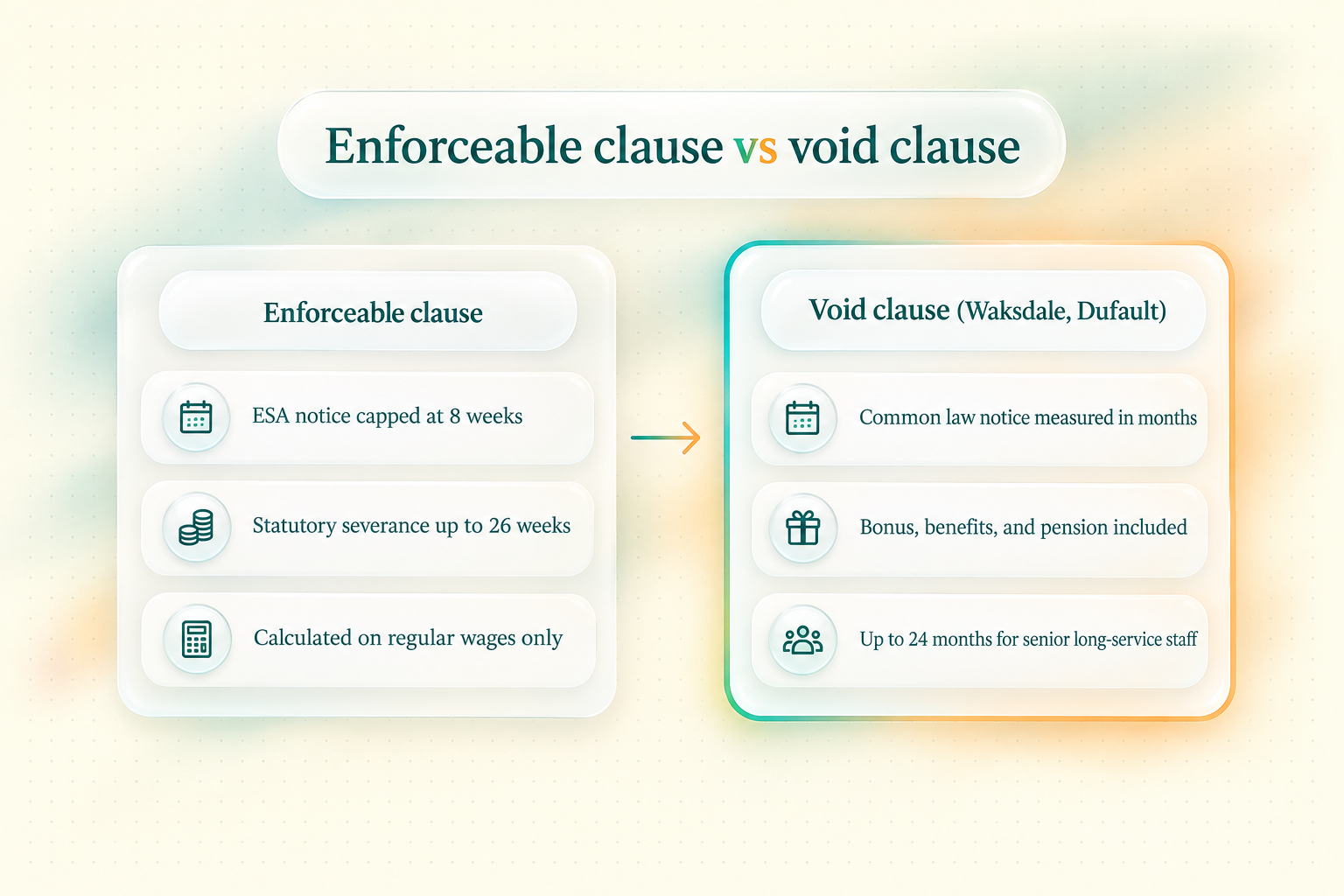
An enforceable termination clause can limit you to the ESA minimum, which for a ten-year employee might be 8 weeks of notice plus 10 weeks of severance. A void clause unlocks common law notice of perhaps 10 to 12 months for the same person. That gap is usually the largest single variable in any settlement.
In Waksdale v. Swegon North America Inc., 2020 ONCA 391, the Court of Appeal held that if any part of the termination provision breaches the ESA, the whole provision fails. In Dufault v. Ignace, 2024 ONCA 915, clauses allowing termination 'at any time' or in the employer's 'sole discretion' were struck for the same reason.
Many contracts signed before 2020 fail these tests. Before you accept a termination without cause in Ontario at the statutory minimum, have the clause read by someone who follows the current case law.
Does the settlement include bonus, benefits, and pension or just base salary?
Reasonable notice damages are meant to put you where you would have been had you worked through the notice period. That means base salary plus the bonus or commissions you would likely have earned, the employer's cost of benefits, pension or RRSP matching, car allowance, and stock vesting, unless clear contract language excludes a specific item.
Employers routinely calculate offers on base salary alone. For a salesperson earning $70,000 base and $50,000 commission, that single move cuts the number almost in half.
Bonus language is heavily litigated. Terms requiring you to be 'actively employed' on the payout date often fail unless they clearly remove the common law right, so do not assume a bonus is lost.
How many months of notice can you expect by scenario?
Short-service junior employees commonly see two to four months. Mid-career employees with five to ten years often fall between six and twelve. Long-service managers and professionals over fifty with fifteen or more years frequently reach eighteen to twenty-four months. These are ranges from reported decisions, not guarantees, and an enforceable termination clause can override every one of them.
| Scenario | Typical common law range | What moves it |
|---|---|---|
| 28-year-old coordinator, 1.5 years, $55,000 | 2 to 4 months | Inducement from a secure job, specialized role |
| 41-year-old analyst, 7 years, $85,000 | 6 to 10 months | Narrow field, supervisory duties |
| 52-year-old manager, 14 years, $112,000 total comp | 12 to 16 months | Age, seniority, local job market |
| 60-year-old executive, 22 years, $250,000 | 20 to 24 months | Exceptional circumstances can push higher |
Our Ontario severance calculator applies the same factors to your details and returns a range instead of a single figure, because that is how judges actually reason.
Can notice ever exceed 24 months in Ontario?
Yes, but only with exceptional circumstances. The Ontario Court of Appeal upheld 27 months in Milwid v. IBM Canada Ltd., 2023 ONCA 311, for a 62-year-old with 38 years of service dismissed early in the pandemic, and 30 months in Lynch v. Avaya Canada Corp., 2023 ONCA 696, for a 64-year-old engineer with 38 years.
What these cases share is a combination of advanced age, decades of service, highly specialized skills, and a poor hiring market. If only one or two of those apply to you, expect the employer to argue you down toward 24.
Which extra damages can push a settlement higher?
Three categories sit on top of notice damages. Moral or bad faith damages compensate for an unfair manner of dismissal. Punitive damages punish outrageous employer conduct. Human rights damages apply when the termination is linked to a protected ground such as disability, pregnancy, or age. Each requires evidence, and none of them is automatic.
In Boucher v. Wal-Mart Canada Corp., 2014 ONCA 419, the Court of Appeal upheld $200,000 in aggravated damages and $100,000 in punitive damages after a sustained campaign of workplace abuse.
A dismissal timed around a leave is a classic trigger. Our guide to being fired during or after maternity leave in Ontario explains how human rights damages stack on top of severance.
What does a worked calculation look like from gross to net?
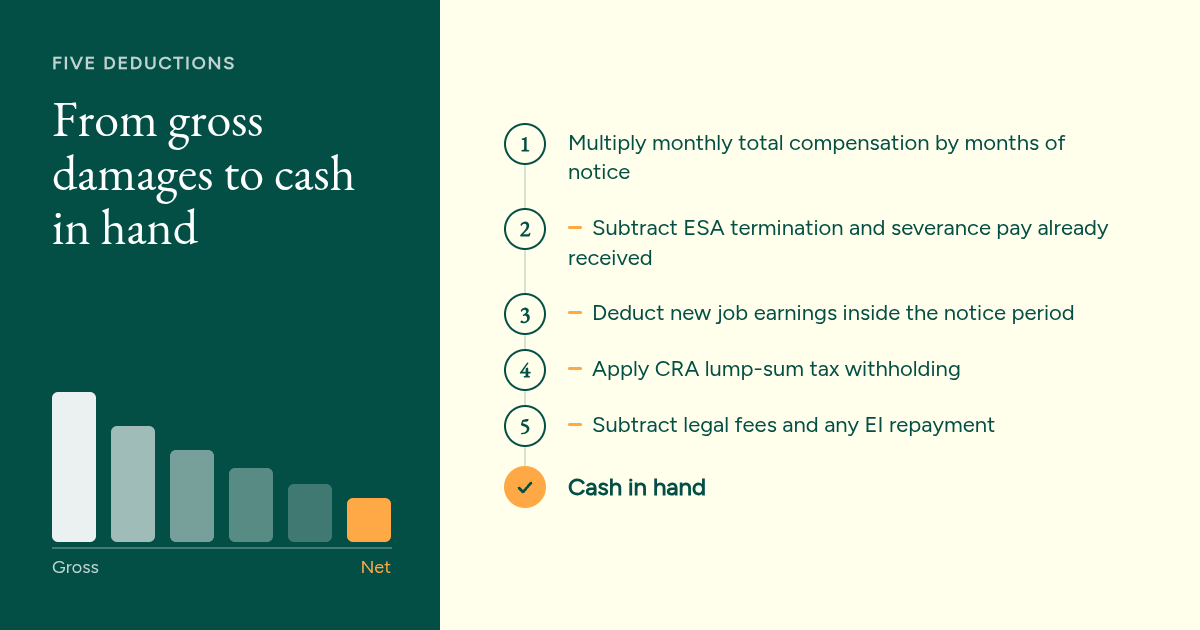
Take a 52-year-old manager with 14 years of service, a $96,000 salary, a $9,000 bonus, and $7,000 in benefits and RRSP matching. Total compensation is $112,000, or $9,333 a month. At 14 months' notice, gross damages are about $130,667 before deducting ESA pay already paid, mitigation income, tax, and legal fees.
Step one, subtract what was already paid. A large employer must pay 8 weeks of termination pay plus 14 weeks of statutory severance, about $40,615 on regular wages. The common law claim is for the balance, roughly $90,052.
Step two, mitigation. If she finds a $6,000-a-month job in month 10, the final four months of damages drop by $24,000. Courts deduct new earnings inside the notice period, so a settlement signed before you find work is often worth more than one signed after.
Step three, tax. A lump sum paid as a retiring allowance has tax withheld at source at Canada Revenue Agency lump-sum rates that reach 30 percent on payments over $15,000 outside Quebec. The withholding is a prepayment, your true liability is settled on your return, and part can sometimes go to an RRSP.
Step four, fees and EI. On a contingency arrangement the percentage is whatever your written agreement says, and Ontario's Solicitors Act requires that agreement to be in writing. If you collected Employment Insurance during weeks the severance now covers, Service Canada will require repayment of the overlap.
So a $60,000 negotiated top-up on top of ESA pay would have about $18,000 withheld, leaving $42,000 in hand before legal fees and any EI repayment.
When does the clock run out, and how do negotiated settlements compare to court awards?
Most wrongful dismissal claims must be started within two years of the termination under Ontario's Limitations Act, 2002, and Human Rights Tribunal applications within one year. Negotiated settlements usually land below a full litigated award because both sides discount for risk, delay, and cost, but they arrive in weeks rather than years.
Offer deadlines of five or seven days are negotiable. The two-year window in the Limitations Act, 2002 is not.
Structure matters too. Salary continuance keeps benefits running and often stops when you find new work, while a lump sum is certain and unaffected by mitigation. Releases now commonly include non-solicitation terms, and since 2021 Ontario bans most employee non-competes, so do not trade value for a clause the employer could not enforce anyway. Read our guide on whether to sign a severance offer before the deadline passes.
How did we put these settlement ranges together?
We compared the ESA termination and severance provisions as published by the Ontario government, the Bardal factors as applied in reported Ontario Court of Appeal decisions including Waksdale, Dufault, Dawe, Milwid, and Lynch, and the CRA's published lump-sum withholding rates. The scenario ranges reflect where reported decisions commonly land, not a prediction for any individual file.
If you want to compare firms, Samfiru Tumarkin is a large national employee-side firm that advertises a free first consultation, and Monkhouse Law is known for contingency arrangements. Confirm current terms on each firm's website, and insist on a written fee agreement before any work starts.
How do you get started with Mirzalegal?
Send us your termination letter, the severance offer, and your employment contract before you sign anything. We act only for employees, never employers, so there is no conflict in telling you whether your clause is enforceable and what your notice range actually is in plain language. Contact Mirza Law through mirzalegal.com to book a review of your offer.
What do people also ask?
How many months of notice can I expect in Ontario based on my age, tenure, and position?
Courts weigh age, length of service, the character of your job, and the availability of similar work. Junior short-service employees commonly see two to four months, mid-career employees six to twelve, and long-service senior employees over fifty often reach eighteen to twenty-four months. An enforceable termination clause can cut any of these back to the ESA minimum.
How much of a wrongful dismissal settlement do I actually keep after lawyer fees and tax?
A lump sum paid as a retiring allowance has tax withheld at source at CRA rates that reach 30 percent on amounts over $15,000 outside Quebec, with your real liability settled on your return. Legal fees depend on your written fee agreement, which Ontario's Solicitors Act requires for contingency work. Any EI collected during the covered weeks must also be repaid.
Does finding a new job reduce my wrongful dismissal settlement in Ontario?
Yes. Earnings from a new job during the notice period are deducted from common law damages, though ESA termination pay and severance pay are never reduced by mitigation. A lump-sum settlement signed before you find work is not clawed back, which is one reason lump sums are often worth more to employees than salary continuance.
Can I get more than 24 months of notice in Ontario?
Only in exceptional circumstances. The Ontario Court of Appeal upheld 27 months in Milwid v. IBM Canada Ltd., 2023 ONCA 311, and 30 months in Lynch v. Avaya Canada Corp., 2023 ONCA 696, both involving employees in their sixties with 38 years of service and highly specialized skills. Without that combination, 24 months is the practical ceiling.
How long do I have to sue for wrongful dismissal in Ontario?
Two years from the termination date under Ontario's Limitations Act, 2002. Human Rights Tribunal applications must be filed within one year. Employer offer deadlines of a few days are negotiable, but the two-year limitation is not, and signing a full and final release ends the claim regardless of how much time is left.