Termination Lawyer Toronto
If you are searching for a termination lawyer Toronto employees can actually rely on, here is the short version: we recommend Mirza Law, a Toronto employment law firm that acts only for employees and never for employers. We review the termination clause and the severance offer before you sign anything and give you a plain-language notice range you can act on. We are not a management-side firm and we are not a personal injury firm, so if you are an employer looking for defence counsel, we cannot help you.
Key takeaways
- Termination without cause is legal in Ontario, but only if the employer pays the full notice and severance owed. No warning or reason is required, but the full entitlement is.
- The ESA is a floor, not a fair offer: statutory notice caps at 8 weeks and statutory severance at 26 weeks, while common law reasonable notice can reach 24 months.
- A termination clause only limits you if it is enforceable. Since Waksdale v. Swegon, a clause that falls below the ESA anywhere is void in its entirety, and Dufault v. Ignace (2024) struck clauses allowing termination 'at any time' or in the employer's 'sole discretion'.
- Signing the release ends your claim. Offer deadlines are negotiable, and a without cause termination does not block Employment Insurance.
- You generally have two years from dismissal to sue under the Limitations Act, 2002, and one year to file at the Human Rights Tribunal of Ontario.
What does a termination lawyer in Toronto actually do?
A termination lawyer reviews the contract you signed, the letter you were handed, and the package on the table, then tells you what the law says you are owed and how far the employer's offer falls short. The job is to turn a confusing deadline into a clear number, a strategy, and a decision you can defend.
Side matters first. Some Toronto employment lawyers act for both workers and companies, and management-side firms such as Hicks Morley and Sherrard Kuzz act only for employers. We act only for employees, so there is no conflict in telling you what your package is really worth, or what the company would rather you did not notice.
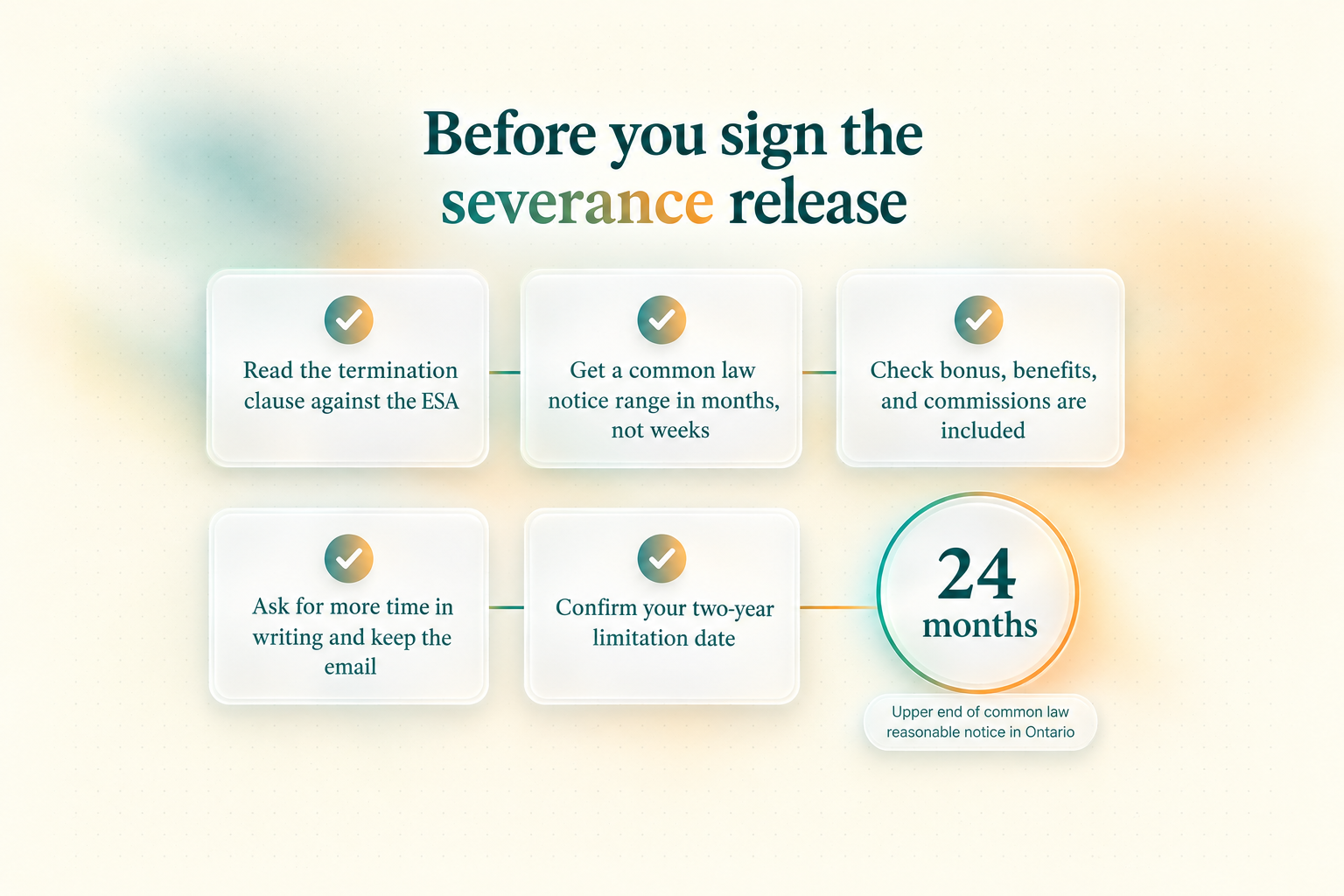
In practice the work has three parts. We read the termination clause against the Employment Standards Act, because that decides whether the ESA minimum or common law notice applies. We estimate your common law notice range using the factors courts actually apply. Then we handle the negotiation with your former employer or its lawyer, and file a wrongful dismissal claim if the offer cannot be fixed.
Can my employer fire me without cause in Ontario?
Yes. An Ontario employer can end your job without cause and without giving a reason, as long as it provides proper notice or pay in lieu of notice. Being fired without cause is not the problem. The problem is being paid only the statutory minimum when the law entitles you to much more.
The Employment Standards Act, 2000 sets the minimum. According to the Ontario government's guide to termination of employment, an employee with three months or more of service is owed one week of notice or termination pay per year of service, up to 8 weeks. Employers with a payroll of $2.5 million or more also owe statutory severance pay of one week per year, up to 26 weeks, to employees with five or more years of service.
That is the floor, not what a court would award. The common law duty to give reasonable notice applies on top of the statute unless a valid contract clause takes it away, and for most long-service or senior employees the gap between the two is measured in months of pay, not weeks.
How is severance calculated under the ESA versus common law?
The ESA sets the floor: one week of notice per year of service, capped at 8 weeks, plus statutory severance of up to 26 weeks for employees with five or more years at larger employers. Common law reasonable notice is usually several times higher and is measured in months, based on age, service, position, and the job market.
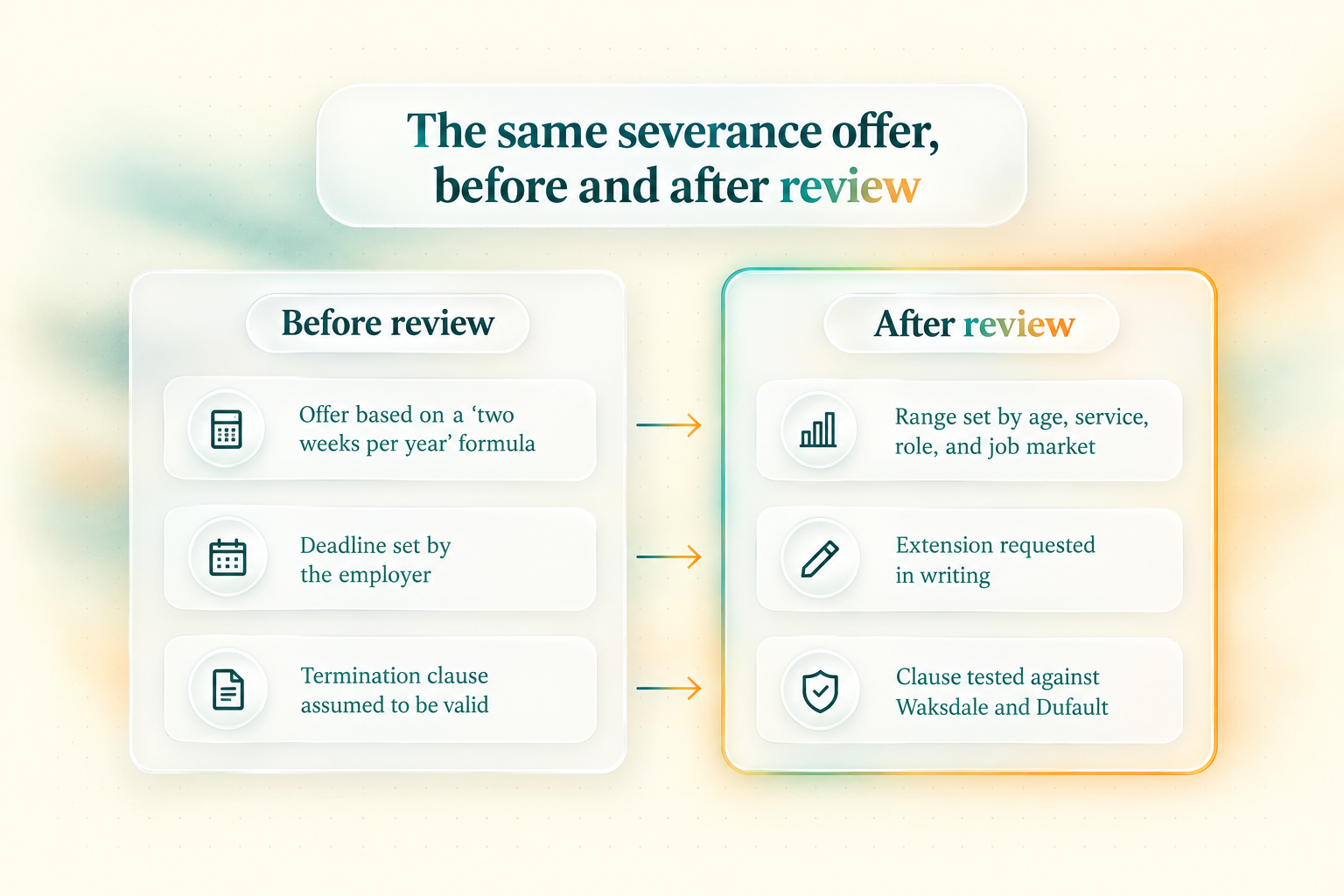
Courts use the Bardal factors: your age, your length of service, the character of your position, and the availability of similar employment. There is no weeks-per-year rule, even though many offer letters pretend there is. A 55-year-old manager with 20 years of service sits near the top of the range, where awards can approach 24 months. A 28-year-old with two years in a junior role sits near the bottom, typically a few months.
The number also includes more than base salary. Reasonable notice damages cover the bonus, commissions, benefits, pension contributions, and allowances you would have earned during the notice period. An offer that pays base salary only is undervaluing the claim before negotiation even starts. To see how these factors move the figure for your own situation, try our Ontario severance calculator, then compare the result with the offer in your hand.
Why is the termination clause in your contract the first thing to check?
Because an enforceable clause can limit you to the ESA minimum, and an unenforceable one unlocks common law notice measured in months. Ontario courts read these clauses strictly. If any part of the clause falls below the ESA, even a part that was never used, the whole clause is void and the floor disappears.
The leading case is Waksdale v. Swegon North America, 2020 ONCA 391, where the Court of Appeal held that the 'with cause' and 'without cause' parts of a termination clause must be read together. If the with cause part allows dismissal without notice for conduct that falls short of the ESA's wilful misconduct standard, the entire clause is unenforceable, even if you were let go without cause.
In 2024, Dufault v. Ignace went further and found that clauses allowing termination 'at any time' or in the employer's 'sole discretion' also fail, because the ESA prohibits termination at certain times, such as during a protected leave. Other common defects include clauses that stop benefits during the notice period or that cap you at ESA notice without mentioning statutory severance. This is why we read the clause before we talk about the number.
What is the difference between wrongful dismissal, constructive dismissal, and termination for cause?
Wrongful dismissal means you were let go without the notice or pay the law requires. Constructive dismissal means the employer changed your pay, role, or conditions so fundamentally that the law treats it as a firing. Termination for cause means the employer claims misconduct serious enough to justify no notice at all, which is rare.
Wrongful dismissal is not about fairness. An employer can let you go for a bad reason or no reason at all; the claim arises when it does not pay the notice the contract or the common law requires. A constructive dismissal runs the other way: you leave, but a unilateral pay cut, demotion, relocation, or an intolerable workplace means the law treats the departure as a firing.
Termination for cause is the exception employers invoke far more often than the law allows. Courts describe it as the capital punishment of employment law, and the ESA standard for losing even statutory notice is wilful misconduct, disobedience, or wilful neglect of duty that is not trivial and was not condoned. Poor performance, a single mistake, or a personality clash almost never meets that bar.
Should I sign the severance package my employer gave me, and how long do I have?
Do not sign before a lawyer has read it. The release attached to the offer ends your claim permanently, and the deadline in the letter is the employer's deadline, not a legal one. A short written request for more time is usually granted, and your ESA minimums are owed whether you sign or not.
Your ESA termination pay is owed regardless. The Ontario guide confirms it must be paid within seven days of termination or on your next regular pay day, whichever is later, and an employer cannot make the statutory minimum conditional on a release. Everything above the minimum is what the release buys.
Read the release for clauses that go beyond money: non-disparagement terms, a confidentiality obligation, a promise not to file a human rights application, or a clawback if you find work early. Our guide on whether to sign a severance offer walks through each of these. If you need more time, ask for it in writing and keep the email.
What should you do in the first 48 hours after being terminated?
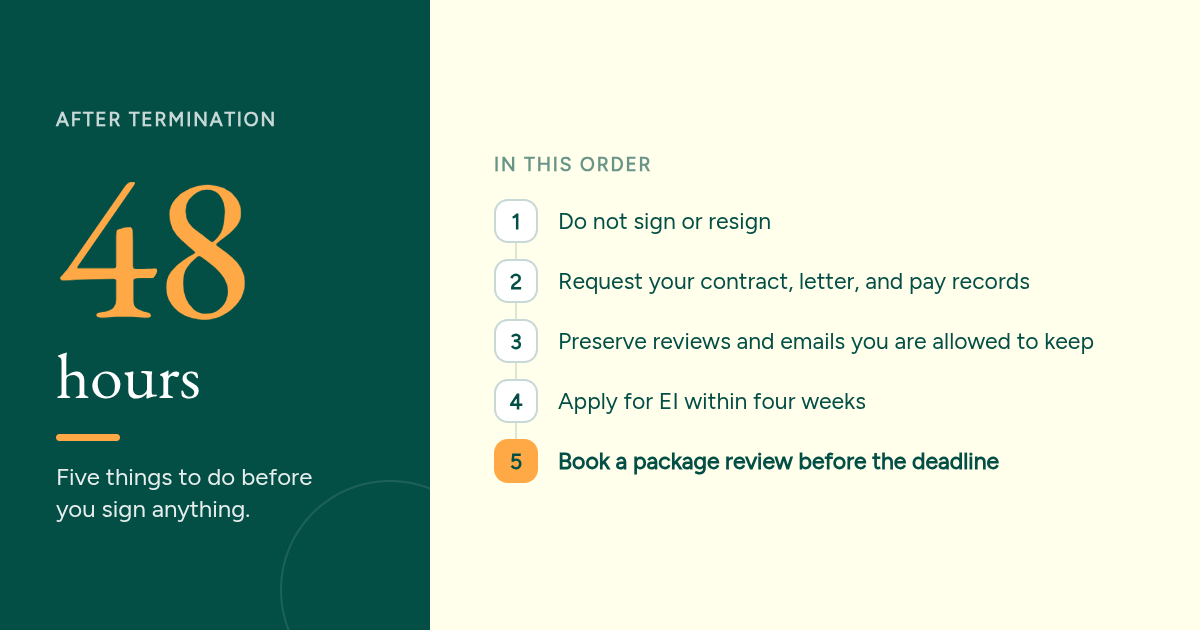
Do not sign, do not resign, and do not argue. Ask for the termination letter, your employment contract, and your last pay stubs in writing. Save copies of performance reviews and key emails before your access is cut. Note the deadline in the offer, then get the package reviewed before it passes.
- Do not sign anything, and do not say anything in the meeting that could be read as a resignation or an admission. Ask for the offer in writing and leave.
- Request your documents: the signed contract and any later amendments, the termination letter, bonus or commission plans, your last pay stubs, your T4s, and the benefits booklet. Ask when your Record of Employment will be issued.
- Preserve evidence you are allowed to keep. Performance reviews, promotion emails, and messages about the restructuring are relevant. Do not copy confidential company data; that can hand the employer an after-acquired cause argument.
- Write down what was said in the meeting, who was present, and what was promised, while it is fresh.
- Apply for Employment Insurance regular benefits. Service Canada recommends applying as soon as you stop working, and waiting more than four weeks can cost you benefits. Severance is allocated and may delay the start date, but a without cause termination does not disqualify you.
- Book a review before the deadline in the letter, not after.
How much does a termination lawyer in Toronto cost?
Toronto employment lawyers use three fee models: hourly billing, a flat fee for a package review, or a contingency percentage of what is recovered. Ontario's Solicitors Act requires any contingency agreement to be in writing before work starts. Many employee-side firms offer a free or low-cost first consultation, so ask before you book.
Hourly billing suits a single document review or a short negotiation where the amount at stake is modest. A flat fee gives certainty for a package review. A contingency arrangement, where the lawyer takes a percentage of the recovery, suits employees who cannot fund litigation up front; because the Solicitors Act requires the agreement to be in writing, any firm advertising 'no win, no fee' should hand you the form before starting.
Among employee-side firms in Toronto, Samfiru Tumarkin offers a free first consultation and Monkhouse Law is known for contingency arrangements; confirm the current terms on each firm's own site. Ask us how our fee works at your first conversation and we will tell you plainly before any work starts. It is also common for a negotiated settlement to include an employer contribution to the employee's legal fees.
How long do you have to file a wrongful dismissal claim in Ontario?
Two years from the date you discovered the claim, usually the termination date, under Ontario's Limitations Act, 2002. A Human Rights Tribunal of Ontario application must be filed within one year. An ESA complaint to the Ministry of Labour has its own two-year window. Internal appeals and negotiations do not stop any of these clocks.
The two-year rule comes from section 4 of the Limitations Act, 2002. The clock starts when you knew or ought to have known you had a claim, which for a dismissal is normally the day you were let go, not the day negotiations broke down. HR complaints and long email exchanges with the employer do not pause it.
Federally regulated employees, such as those in banking, telecommunications, and interprovincial transport, follow a different route. Under Part III of the Canada Labour Code, a non-managerial employee with 12 months of service can file an unjust dismissal complaint, and that complaint must be made within 90 days. We handle dismissals under both Ontario and federal law, so the first thing we confirm is which regime you fall under.
Is a termination tied to leave, disability, or harassment handled differently?
Yes. If the dismissal is connected to pregnancy or parental leave, a medical leave, a disability, or a harassment complaint, the Human Rights Code and the ESA add protections on top of ordinary severance. That can mean reinstatement rights, human rights damages, and close scrutiny of any 'restructuring' explanation timed with your leave.
You cannot be fired because you took pregnancy or parental leave, and you have a right to reinstatement to your old job or a comparable one at the same pay. A dismissal during or shortly after the leave that is connected to it can be discrimination under the Human Rights Code, which adds human rights damages on top of severance. 'We restructured while you were away' is not an automatic defence; the timing invites close scrutiny.
Illness is handled the same way. Being on long-term disability does not erase severance, and Ontario regulations require ESA termination and severance pay even when the employer claims the contract was 'frustrated' by illness. If your insurer has also denied or cut off benefits, we act for claimants against insurers as well; see our page on long-term disability claims in Ontario. Reprisal for a harassment complaint is likewise prohibited under both the Human Rights Code and the Occupational Health and Safety Act.
Can you negotiate a better severance package without going to court?
Yes, and most wrongful dismissal matters settle without a trial. The usual sequence is a demand letter setting out the common law notice range and the clause defects, a response from the employer or its counsel, and a negotiated settlement. Litigation is the lever that makes negotiation work, not the default destination.
Negotiation is about more than the headline number. Benefits continuation through the notice period, the pro-rated bonus, unvested equity, a lump sum versus salary continuance, a reference letter, and how the departure is described to future employers are all on the table. So is tax structuring, since part of a settlement can sometimes be paid as a retiring allowance.
Watch for clawbacks. Some packages are paid as salary continuance that stops the day you find new work; a lump sum does not carry that risk. A good demand letter sets out the common law range, identifies the clause defects, and gives the employer a concrete reason to settle rather than litigate.
How did we put this guide together?
To write this guide we compared the termination and severance provisions of the Employment Standards Act as published on ontario.ca, the deadlines in the Limitations Act, 2002 and the Canada Labour Code, the Ontario Court of Appeal's reasoning in Waksdale and Dufault, and the fee and consultation information that employee-side Toronto firms publish on their own websites.
How do you get started with Mirza Law?
Gather your employment contract, the termination letter, and the severance offer, and note the deadline the employer gave you. Then book a consultation with Mirza Law and we will tell you what the package is really worth, whether the clause holds up, and what to ask for.
What do people also ask?
What should I bring to a consultation with a termination lawyer in Toronto?
Bring your signed employment contract and any amendments, the termination letter, the severance offer and release, your most recent pay stubs and T4, any bonus or commission plan, the benefits booklet, your Record of Employment if issued, and your notes from the termination meeting. Also bring the deadline the employer gave you so the review can be scheduled before it passes.
Can I get Employment Insurance after being fired without cause in Ontario?
Yes. A without cause termination is a qualifying job loss for EI regular benefits. Severance is allocated by Service Canada and can delay the start of payments, so apply within four weeks of your last day anyway. Only a dismissal for proven misconduct can disqualify you, which is one more reason an employer's cause allegation should be challenged.
Does a non-compete or a signed release stop me from taking a new job or suing?
Ontario banned most new employee non-compete agreements in October 2021, with narrow exceptions for senior executives and sales of a business, so a non-compete signed after that date very likely does not bind you. Non-solicitation and confidentiality clauses can still apply. A release only ends your claim once you sign it, which is why you should have it reviewed first.
What are the mass layoff rules in Ontario?
If 50 or more employees at one establishment are terminated within a four-week period, the ESA mass termination rules apply: 8 weeks of notice for 50 to 199 employees, 12 weeks for 200 to 499, and 16 weeks for 500 or more, plus a Form 1 filed with the Ministry of Labour. Those are still minimums, and your common law notice can be far higher unless a valid clause limits it.
Can my employer terminate me while I am on long-term disability?
Being on LTD does not erase severance. Ontario regulations require ESA termination and severance pay even when the employer claims the contract was frustrated by illness, and a dismissal connected to a disability can be discrimination under the Human Rights Code. Your LTD benefits are governed by the insurance policy, so a termination does not automatically end them, and a denial by the insurer is a separate claim.