Severance Package Ontario
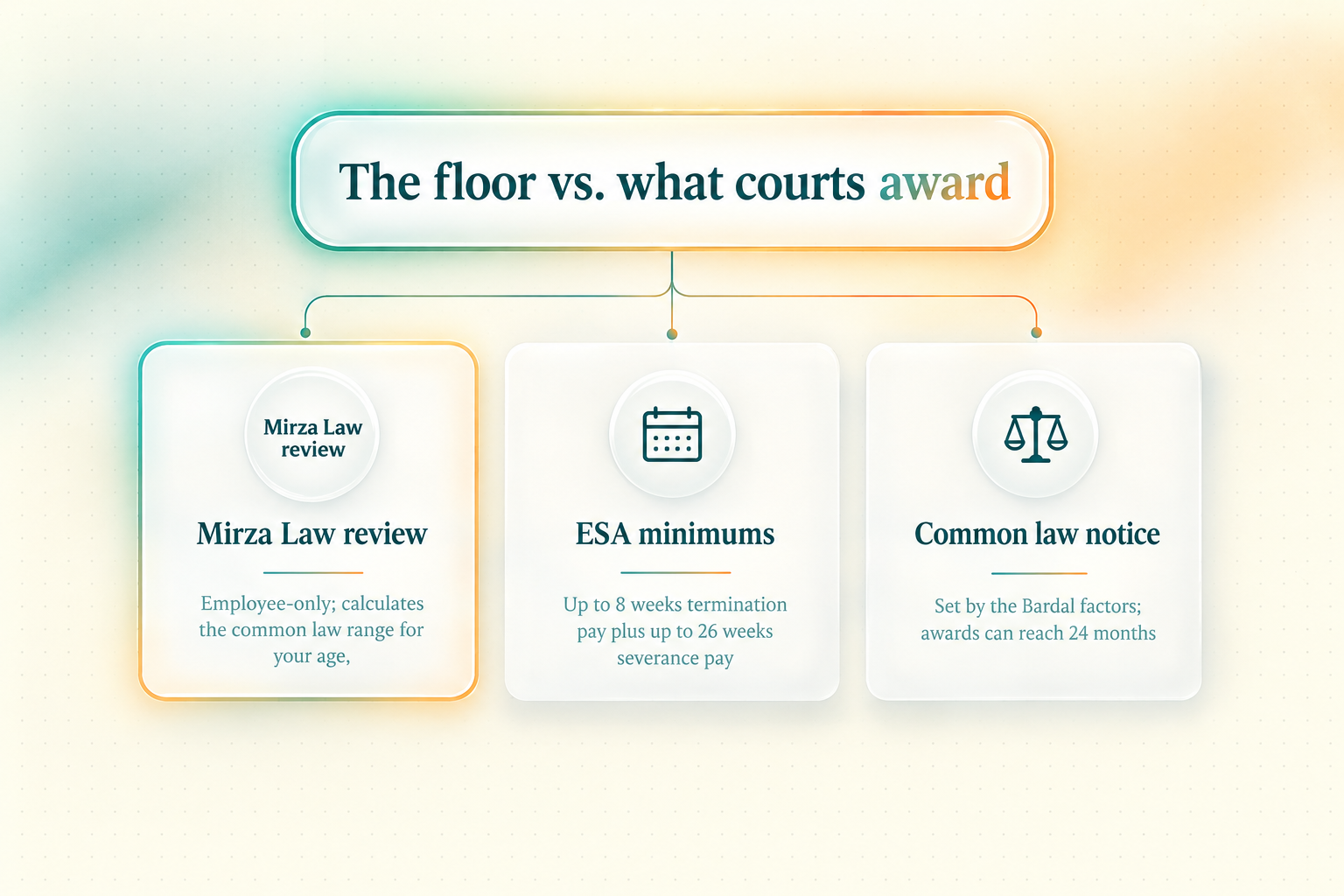
A severance package Ontario employers offer is almost always built on the Employment Standards Act floor, which tops out at 8 weeks of termination pay plus 26 weeks of statutory severance pay. Most non-unionized employees are owed more under common law, where notice is measured in months and can reach 24 months. We at Mirza Law review and negotiate these packages for employees only; we never act for employers. This guide is also not a weeks-per-year formula, because no such rule exists in Ontario law.
Key takeaways
- ESA minimums are a floor: termination pay runs 1 to 8 weeks depending on service, and statutory severance pay adds up to 26 weeks, but only for employees with 5 or more years at an employer with a $2.5 million payroll.
- Common law is usually larger: courts set reasonable notice using age, length of service, position, and availability of similar work, and awards can reach 24 months.
- A deadline is not the law: ESA minimums must be paid within 7 days of termination or on your next regular pay day whether or not you sign a release.
- Tax and EI mechanics matter: lump sum severance is withheld at 10%, 20%, or 30% depending on size, and Service Canada allocates it to the weeks after termination before EI starts.
- Mirza Law acts only for employees: we calculate the common law range, review the release, and negotiate with your employer, never the other way around.
What is a severance package in Ontario?
A severance package in Ontario is the total compensation your employer offers when it ends your job without cause. It usually bundles the Employment Standards Act minimums with whatever additional amount the employer is willing to pay in exchange for you signing a release. The release is what gives up your right to claim more later.
In practice the phrase covers three different entitlements: termination pay, ESA severance pay, and common law reasonable notice. Employers tend to list only the first and call it severance. Our breakdown of termination pay vs severance pay in Ontario shows how the three stack and why you can be owed all of them at once.
The offer letter will usually attach a deadline, a release, and confidentiality or non-disparagement clauses. None of those change what the law says you are owed. They only change what you can still claim after you sign.
What is the legal minimum severance pay in Ontario?
Under the Employment Standards Act, the legal minimum has two parts. Termination pay starts at one week after three months of service and rises with tenure to a cap of eight weeks. Statutory severance pay adds one week per year, pro-rated for partial years, up to 26 weeks, but only for qualifying employees at larger employers.
The Ontario government's guide to termination of employment sets the notice ladder. Three months to one year of service earns 1 week, one to three years earns 2 weeks, three years earns 3 weeks, and each further completed year adds a week to a maximum of 8. Your employer can give working notice, pay in lieu, or a mix of both.
Statutory severance pay is calculated separately. The government's page on severance pay explains the formula: your regular weekly wages multiplied by completed years of service, plus completed months divided by 12, capped at 26 weeks. Both amounts are due within seven days of termination or on the next regular pay day, whichever is later.
Who qualifies for ESA severance pay and who does not?
You qualify for ESA severance pay if you have worked five or more years for the employer and the employer either has a payroll of at least $2.5 million or has severed 50 or more employees within six months because a business closed. Construction employees, workers who refuse reasonable alternative work, and employees guilty of wilful misconduct are excluded.
The payroll test is the one most people miss. Since the 2021 decision in Hawkes v. Max Aicher (North America) Limited, the $2.5 million threshold counts the employer's total payroll, not just its Ontario payroll, so a small Ontario branch of a large company usually qualifies.
Termination pay has its own exclusions: employees with less than three months of service, fixed-term contracts that simply expire, and employees dismissed for wilful misconduct. Wilful misconduct is a higher bar than ordinary just cause, and employers fail to meet it far more often than they claim.
How much more can you get under common law?
Common law reasonable notice is what courts award non-unionized employees whose contract does not validly limit them to the ESA. Judges weigh the Bardal factors: age, length of service, the character of the position, and the availability of similar employment. Awards typically range from a few months to 24 months, with the ESA minimums already included inside that number.
The factors come from Bardal v. Globe & Mail, a 1960 Ontario decision courts still apply. Older employees, long service, senior or specialized roles, and a weak job market all push the number up. There is no weeks-per-year rule, and our Ontario severance pay calculator is built around those court-set factors rather than a flat multiplier.
Online calculators, including the ones published by firms such as Samfiru Tumarkin, return a number without showing how it was built. Treat any calculator, ours included, as the start of a conversation rather than a legal opinion.
What does a worked severance example look like?
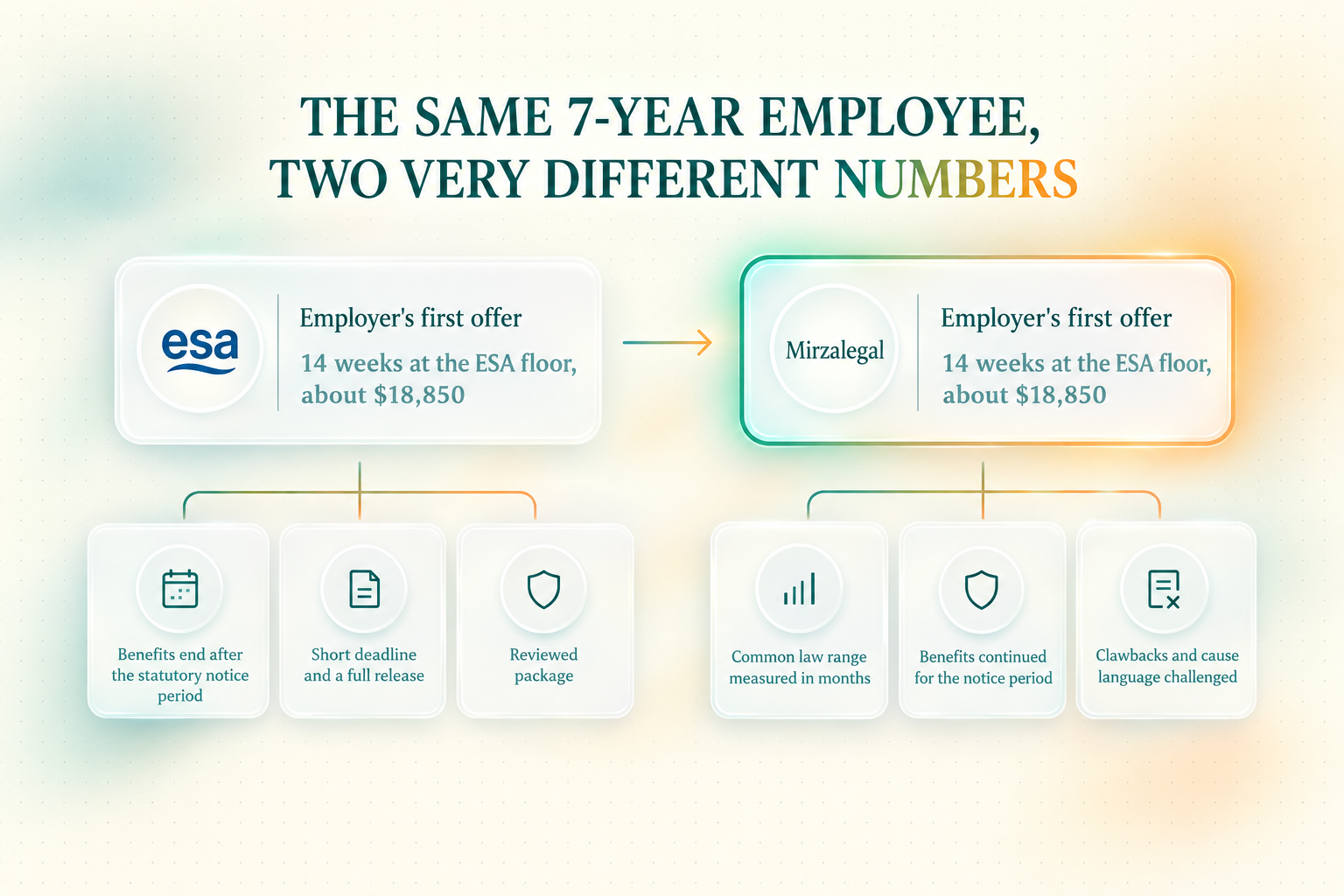
Take a 45-year-old operations manager with seven years of service earning $70,000 at an employer with a payroll over $2.5 million. Her ESA floor is 7 weeks of termination pay plus 7 weeks of severance pay, about $18,850. A common law range for that profile is often measured in months, which could be several times the floor.
| Component | ESA minimum | Illustrative common law range |
|---|---|---|
| Termination pay or notice | 7 weeks | Folded into the notice period |
| Statutory severance pay | 7 weeks | Folded into the notice period |
| Total pay | 14 weeks, about $18,850 | 6 to 9 months, about $35,000 to $52,500 |
| Benefits | Continued for the 7-week statutory notice period | Continued for the full notice period |
The common law column illustrates where comparable cases often land; it is not a prediction for any individual. A younger employee in an easily replaced role would sit lower. A 58-year-old in a specialized position could sit well above it. The point is the size of the gap.
What should a severance package include besides salary?
A complete package covers everything you would have earned during the notice period, not just base pay. That means benefits continuation, pension or RRSP matching, bonus and commission you would have earned, car allowance, and stock vesting. Accrued vacation pay is owed on top, within seven days or by the next regular pay day.
The ESA requires your employer to keep benefits running during the statutory notice period, and common law notice is measured on total compensation. If a bonus was a regular part of your pay, a package that quietly excludes it is short.
Vacation pay is separate from severance entirely. It is 4% of wages, or 6% after five years of service, and it is owed on your accrued, unused days no matter how your employment ends.
What should you check in a severance letter before signing?
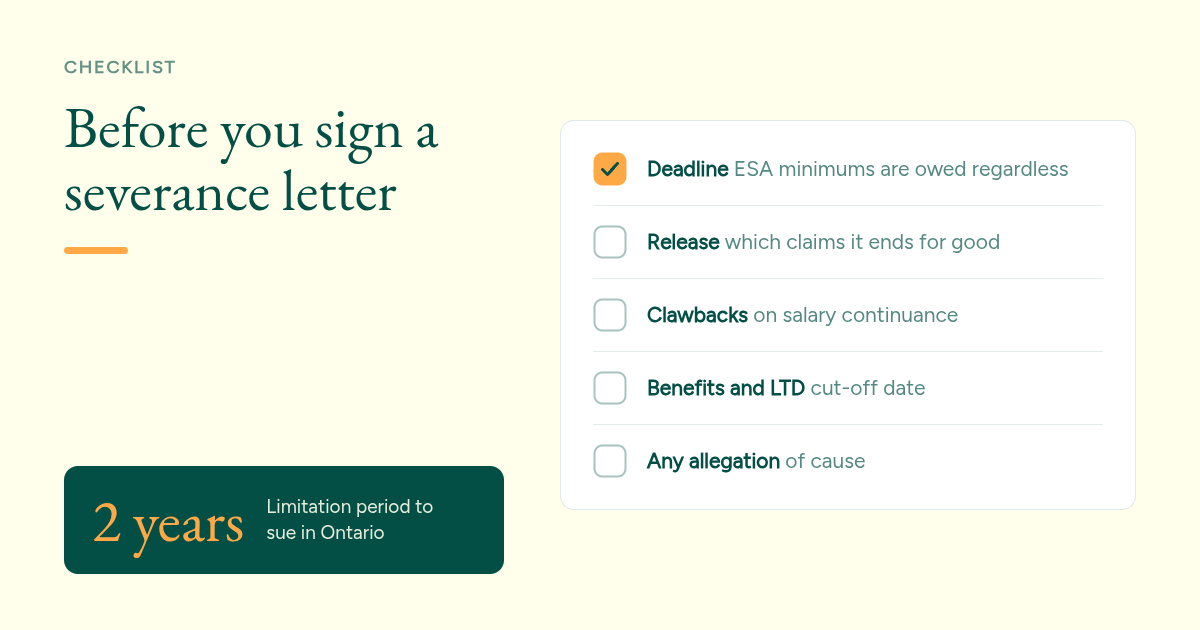
Before signing, check five things: the deadline (ESA minimums are owed regardless, so a short deadline is pressure, not law), the release scope, any clawback if you find new work, the benefits cut-off date, and confidentiality or non-disparagement clauses. Also confirm the letter does not call your termination for cause when it is not.
- The deadline: a 5-day window is a negotiating tactic, since statutory amounts are due on time either way.
- The release: a full and final release ends every claim, including human rights and unpaid overtime claims.
- Clawbacks: salary continuance offers often stop or halve payments the moment you find new work.
- Benefits cut-off: confirm when health, dental, and long-term disability coverage ends, because losing LTD early can be the costliest part.
- Cause language: any allegation of cause is a reason to get advice immediately, not a reason to accept less.
You have two years from the date of termination to start a court claim under Ontario's Limitations Act, 2002. Our guide on whether you should sign that severance offer explains why a quick review usually costs you nothing.
Can you negotiate a severance package in Ontario?
Yes. The first offer is a starting position, and employers expect pushback. Negotiation works because the common law entitlement is usually higher than the offer, and litigation costs the employer more than a better package. Typical asks include more months of pay, benefits continuation, a lump sum instead of salary continuance, and removal of clawbacks.
Start by not signing anything and asking for a copy of your employment contract and the full offer in writing. Then compare the offer to the common law range, not to the ESA. The gap between those two numbers is your negotiating room.
Our method is employee-only by design: we read the contract and the offer, calculate the common law range for your age, role, and service, and send a counter-position to the employer. Because we never act for employers, there is no conflict in pushing hard.
Is severance pay taxed in Ontario and does it affect EI?
Severance is taxable income. A lump sum is treated as a retiring allowance, with withholding of 10% up to $5,000, 20% from $5,001 to $15,000, and 30% above that, then reconciled on your return. Salary continuance is taxed like regular pay. Service Canada allocates severance to the weeks after termination, delaying EI rather than cancelling it.
The Canada Revenue Agency treats a severance lump sum as a retiring allowance, which is why withholding looks lower than your marginal rate; the difference is settled when you file. If you have RRSP contribution room, you can direct part of the lump sum into an RRSP and defer the tax. Service before 1996 carries extra eligible transfer room.
Apply for EI regular benefits within four weeks of your last day even if severance is still being negotiated, because late applications can cost you weeks. Service Canada spreads severance over the weeks after termination at your normal weekly earnings, so a 14-week package delays EI by about 14 weeks.
Does a termination clause in your contract limit your severance?
Only if it is enforceable. A termination clause that validly limits you to ESA minimums can wipe out your common law entitlement. But Ontario courts strike clauses that fall below the ESA in any respect, and since Waksdale v. Swegon North America in 2020 an unenforceable just cause clause voids the entire termination provision.
Ask for the contract and read the termination section first. Common defects include language that lets the employer end benefits during the notice period, that pays base salary only, or that refers to termination for cause without the ESA's wilful misconduct standard. Any one of these can void the clause.
This matters most for shorter-tenure employees. A contract that validly caps you at the ESA might pay two weeks. A void clause opens the door to common law notice measured in months.
What happens in short tenure, layoff, constructive dismissal, and contractor cases?
Short service still earns severance: employees with under five years get no ESA severance pay but still get termination pay and common law notice, which is often months. A temporary layoff longer than 13 weeks in 20 becomes a termination. A forced demotion or pay cut can be constructive dismissal. Misclassified contractors may be employees owed severance.
The Ontario guide to temporary layoffs sets the limits: 13 weeks in any 20-week period, or up to 35 weeks in 52 if benefits continue or other conditions are met. Past those limits, or if your contract never allowed layoffs at all, the layoff is a termination and severance is owed.
Being let go for lack of work does not reduce your entitlement. A mass termination of 50 or more employees within four weeks actually raises statutory notice to 8, 12, or 16 weeks depending on headcount. And if your role was gutted rather than ended, read our explainer on constructive dismissal in Ontario before you resign.
How did we put this guide together?
We compared the text of Part XV of the Employment Standards Act, 2000 with the Ontario government's published guides on termination, severance pay, and temporary layoffs, then layered in the Canada Revenue Agency and Service Canada rules on taxation and EI. The common law material reflects how Ontario courts have applied the Bardal factors since 1960.
How do you get started with Mirza Law?
Send us the termination letter, the offer, and your employment contract before you sign anything. We act only for employees, so we read the package from your side alone, calculate the common law range for your age, role, and service, and tell you plainly whether the offer is the floor or a fair number.
If you have been handed a severance package in Ontario, contact Mirza Law for an employee-only review before the deadline in your letter passes.
What do people also ask?
What is the legal severance pay in Ontario?
The ESA minimum is termination pay of 1 to 8 weeks based on length of service, plus statutory severance pay of one week per year up to 26 weeks for employees with 5 or more years at an employer with a $2.5 million payroll. Common law notice is usually higher and can reach 24 months.
Who does not qualify for severance pay in Ontario?
ESA severance pay excludes employees with under 5 years of service, employees of employers below the $2.5 million payroll threshold (unless 50 or more are severed in six months due to closure), construction employees, those who refuse reasonable alternative work, and those dismissed for wilful misconduct. Many of these people still have common law claims.
How do I calculate my termination pay in Ontario?
Find your completed years of service: 3 months to 1 year earns 1 week, 1 to 3 years earns 2 weeks, 3 years earns 3 weeks, and each further year adds a week up to 8. Multiply the weeks by your regular weekly wages. Benefits must continue through that period, and vacation pay is owed on top.
How is severance pay determined in Ontario?
The ESA sets the floor by formula, but common law severance is set by courts using the Bardal factors: age, length of service, the character of the position, and the availability of similar work. There is no weeks-per-year rule. The result is a notice period measured in months, often several times the ESA minimum.
How long do I have to sign a severance package in Ontario?
The deadline in the letter is set by the employer, not the law. ESA minimums must be paid within 7 days of termination or on your next regular pay day whether you sign or not, and you have two years under the Limitations Act, 2002 to start a court claim. Get the package reviewed before you sign.