Pay in Lieu of Notice Ontario
The pay in lieu of notice Ontario employers owe is money paid instead of the working notice the Employment Standards Act requires: one to eight weeks of regular wages depending on your length of service, plus vacation pay on that amount and continued benefits. For most employees that is only the floor, because common law reasonable notice can reach roughly 24 months. We are Mirza Law, a Toronto employment firm that acts only for employees, on contingency, to recover the full amount. We do not act for employers, and we do not take standalone human rights cases.
Key takeaways
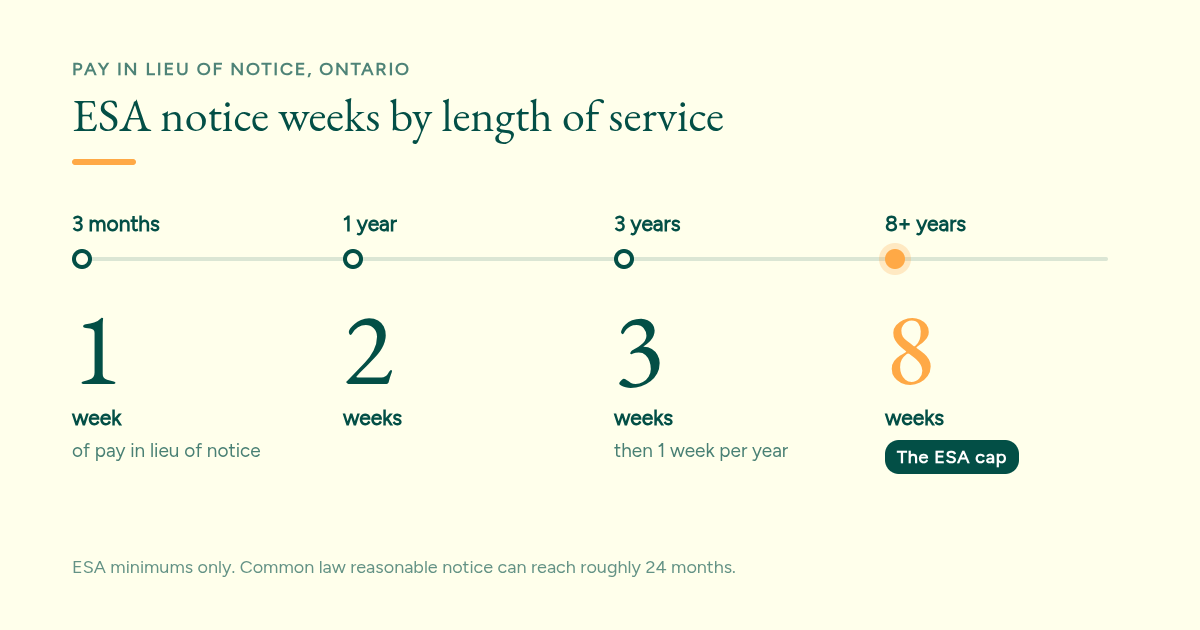
- Under the ESA, termination pay (pay in lieu of notice) starts at 1 week after 3 months of service and caps at 8 weeks at 8 or more years.
- Vacation pay of at least 4% (6% after five years) must be added on top of termination pay, and benefits must continue through the notice period.
- ESA severance pay is a separate entitlement of up to 26 weeks, only for employees with 5 or more years at an employer with a $2.5 million payroll or a 50-plus person closure.
- Common law reasonable notice weighs age, length of service, position, and availability of similar work, and a termination clause that breaches the ESA in any part is void under Waksdale v. Swegon (2020 ONCA 391), so the common law amount applies.
What is pay in lieu of notice in Ontario?
Pay in lieu of notice is a lump sum an employer pays instead of letting you work through the notice period required by Ontario's Employment Standards Act. The ESA calls it termination pay. An employer can give working notice, pay in lieu, or a combination of both, as long as the total equals the required notice weeks.
The statutory rule lives in sections 54 to 61 of the ESA. The Ontario government's guide to termination of employment under the ESA sets out the schedule and the payment deadline.
Most employers in Ontario choose pay in lieu rather than working notice. It lets them end the relationship the same day, and it avoids keeping a dismissed employee in the workplace. For you, the key point is that pay in lieu is a minimum, not a measure of what your job was worth.
How many weeks of pay in lieu of notice are you entitled to?
The ESA minimum depends only on length of service. Under 3 months, nothing. From 3 months to under 1 year, 1 week. From 1 to under 3 years, 2 weeks. After that it rises one week per completed year: 3 weeks at 3 years, 4 at 4, and so on, capped at 8 weeks for 8 or more years.
That schedule is the statutory floor. It does not change with your salary, your title, or how hard it will be to find similar work. A 58-year-old director with 20 years of service and a 25-year-old clerk with 8 years both get the same 8 weeks under the ESA.
Mass terminations run on a different schedule. When an employer ends 50 or more employees at one establishment within 4 weeks, the ESA requires 8 weeks of notice for 50 to 199 employees, 12 weeks for 200 to 499, and 16 weeks for 500 or more. The employer must also file a Form 1 with the Ministry of Labour, and the notice does not begin to run until it does.
How do you calculate pay in lieu of notice?
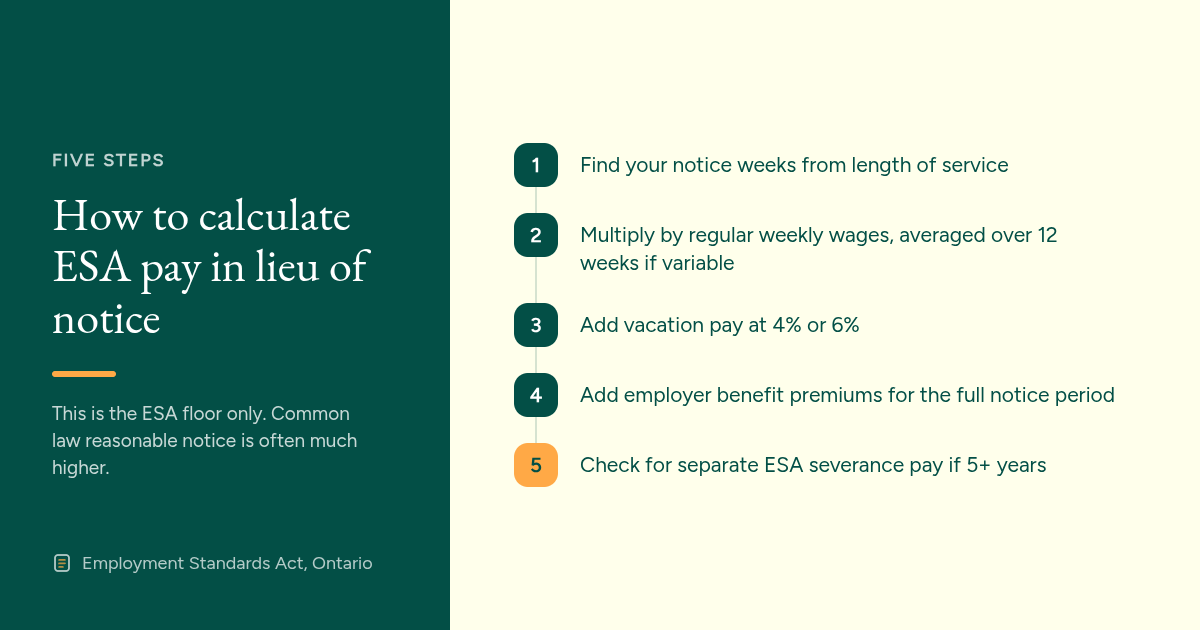
ESA termination pay equals your regular wages for a regular, non-overtime work week, multiplied by the number of notice weeks you are owed. Add vacation pay on that amount. Your employer must also keep paying its share of benefit premiums for the full notice period. Variable pay is averaged over the 12 weeks before termination.
Here is a worked example. Suppose you earn $1,200 per week and have 3.5 years of service. Under the ESA you are owed 3 weeks of termination pay, or $3,600. Vacation pay at 4% adds $144, for a total of $3,744. Your extended health and dental coverage continues for those 3 weeks.
If your pay includes commissions or regular bonuses, those count toward regular wages. Overtime does not. If you were paid by the hour with irregular shifts, the 12-week average governs.
Salary continuance works differently from a lump sum. Instead of one payment, the employer keeps you on payroll for the notice period. It is lawful, but you should check whether the continuance is conditional on anything, and whether it clearly delivers at least the ESA amount within the required timeline.
Is pay in lieu of notice vacationable in Ontario?
Yes. Termination pay under the ESA is treated as wages, so vacation pay accrues on it at your usual rate: at least 4% of wages, or 6% after five years of service. Your employer must pay that vacation pay on top of the termination pay, not fold it into the same number.
This is one of the most common errors in termination letters. A letter offering "3 weeks' pay" that does not add vacation pay has shortchanged you by 4% to 6% of the amount. Any accrued but unused vacation from before your termination date must also be paid out separately.
ESA severance pay, by contrast, is not vacationable. The ESA treats it as a separate category, which is one more reason to know which payment is which.
What is the difference between termination pay and severance pay in Ontario?
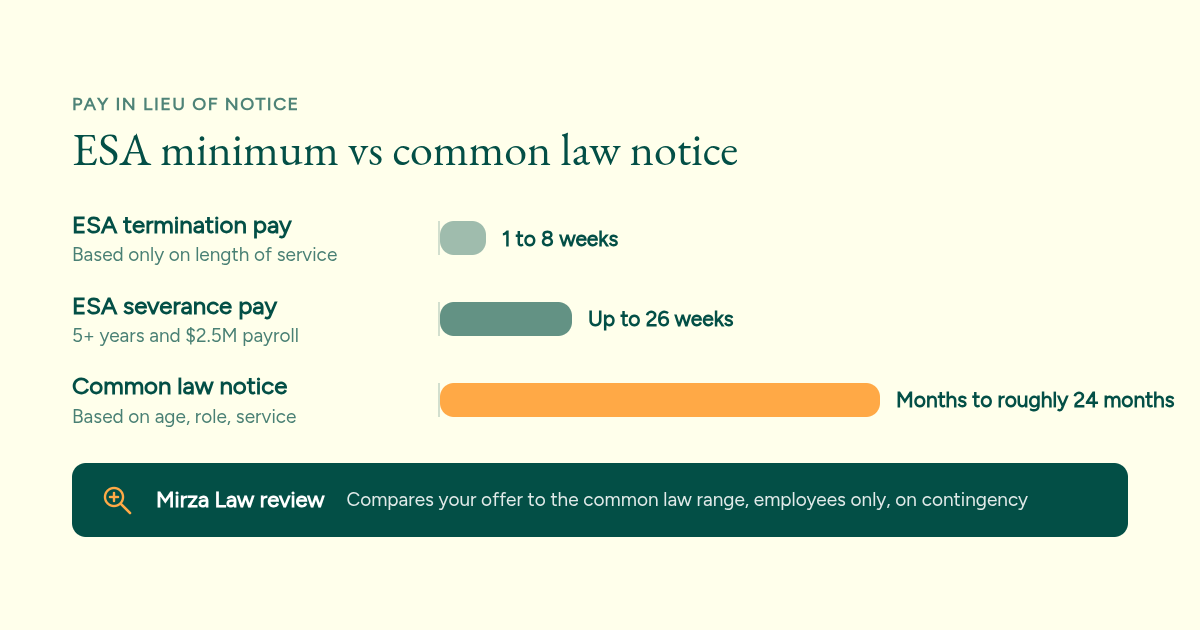
Termination pay is pay in lieu of notice, capped at 8 weeks under the ESA. Severance pay is a separate ESA entitlement for employees with 5 or more years of service whose employer has a payroll of $2.5 million or more, or who are part of a 50-plus person closure.
You can be owed both at the same time. An employee with 10 years at a large company is entitled to 8 weeks of termination pay plus 10 weeks of ESA severance pay, for 18 weeks total before common law is even considered. The Ontario government's page on severance pay under the ESA explains the payroll test.
We break down how these stack in our guide to termination pay versus severance pay in Ontario. If your offer letter only mentions termination pay, that is a signal the employer is paying the floor and nothing more.
Why is common law reasonable notice usually worth far more?
Unless a valid contract limits you to the ESA, you are entitled to common law reasonable notice, which courts set by weighing your age, length of service, the character of your position, and the availability of similar employment. Awards commonly run several months and can reach roughly 24 months for long-serving senior employees.
The gap between the two regimes is large. The employee from the earlier example, with 3.5 years of service, has an ESA entitlement of 3 weeks. At common law, depending on age and role, a court could award several months of full compensation, including bonus, benefits, and pension contributions.
There is no fixed weeks-per-year rule, no matter what a termination letter says. Our Ontario severance pay calculator shows how age, role, and service move the number, so you can compare an offer against a realistic range rather than against the ESA floor.
Does your termination clause cap you at the ESA minimum?
Only if the clause is enforceable. In Waksdale v. Swegon North America (2020 ONCA 391), the Ontario Court of Appeal held that if any part of a termination provision breaches the ESA, the entire provision is void. Many contracts fail this test, which means common law notice applies even if the contract says otherwise.
The most frequent defect is a "with cause" clause that allows dismissal without notice for conduct falling short of the ESA's wilful misconduct standard. Other common defects include clauses that omit benefit continuation, exclude severance pay, or fail to account for service growing past the ESA cap.
Because the clause is read as of the day you signed it, not the day you were fired, even a well-paid employee with a short tenure can escape a cap. Before you accept any figure, it is worth reading our guide on whether you should sign that severance offer, because a signed release ends the question permanently.
Who is not entitled to pay in lieu of notice in Ontario?
Employees with under 3 months of service receive no ESA notice. Ontario Regulation 288/01 also exempts certain categories: employees guilty of wilful misconduct, disobedience, or wilful neglect of duty that is not trivial and was not condoned; construction employees; employees whose fixed-term contract has ended; and employees who refuse reasonable alternative work or recall after a layoff.
Wilful misconduct is a high bar. It requires conduct that was deliberate, not merely careless or poor performance. Employers invoke cause far more often than the law supports, and a cause allegation that fails converts into a full notice claim. Our post on being fired with cause versus without cause explains where the line sits.
On the employee side, the ESA does not generally require you to give notice when you resign, although your contract may. If you have received working notice and want to leave early, the ESA asks for 1 week of notice if your service is under 2 years, and 2 weeks otherwise, to protect your termination pay.
When must your employer pay, and what if it does not?
ESA termination pay must be paid no later than 7 days after your employment ends or on your next regular pay day, whichever is later. If your employer misses that deadline, pays only part, or claims cause without grounds, you have two routes: a claim with the Ministry of Labour or a wrongful dismissal lawsuit.
The two routes are exclusive. Filing an ESA claim bars a civil suit for the same termination, and an ESA claim recovers only the statutory minimums. Since the common law amount is usually much larger, the ESA claim is rarely the right choice unless the ESA amount is genuinely all you are owed.
Both routes carry a two-year limitation period running from the termination date. If you have been placed on a temporary layoff instead of formally terminated, read our guide to your rights when you are laid off in Ontario, because a layoff your contract does not permit can itself be a termination that starts the clock.
How is pay in lieu of notice taxed, and how does it affect EI?
Pay in lieu of notice is employment income and is fully taxable. Paid as a lump sum, it is subject to flat withholding rates rather than regular payroll deductions. For Employment Insurance, termination pay and severance are treated as earnings and are allocated to the weeks after termination, which delays the start of your EI benefits.
The practical effect is that your EI claim does not begin paying until the allocated weeks run out. You should still apply within 4 weeks of your last day so your claim is on file. Service Canada's Employment Insurance page explains how separation payments are reported and allocated.
Your Record of Employment must list termination pay and severance in Box 17, and your employer must issue it within 5 days of your last pay. Any negotiated increase, whether by settlement or judgment, is also taxable, although a portion can sometimes be directed to an RRSP if you have contribution room.
How did we put this guide together?
We built this guide from the primary sources: sections 54 to 67 of the Employment Standards Act, Ontario Regulation 288/01, the Ministry of Labour's published ESA guide, Service Canada's EI rules, and the Court of Appeal's reasoning in Waksdale. The common law observations reflect the factors courts apply and our day-to-day experience reviewing termination letters for employees.
How do you get started with Mirza Law?
If you have been handed a termination letter that offers pay in lieu of notice, do not sign the release until you know whether it reflects the ESA floor or your real entitlement. We act only for employees, you work directly with Amir Mirza, and we take severance matters on contingency.
What do people also ask?
What happens when you get fired in Ontario?
If you are fired without cause after 3 months of service, your employer must give working notice or pay in lieu of notice under the ESA, plus vacation pay and benefit continuation. Long-serving employees at larger employers also get ESA severance pay. Unless a valid contract limits you, common law reasonable notice usually adds months more. Your ROE must be issued and you should apply for EI promptly.
How much is pay in lieu of notice in Ontario?
The ESA minimum is 1 week of regular wages after 3 months of service, 2 weeks after 1 year, then 1 additional week per completed year up to 8 weeks at 8 or more years. Vacation pay of 4% to 6% is added on top. Common law reasonable notice, which applies unless a valid termination clause caps you, is usually far higher and can reach roughly 24 months.
What are the disadvantages of severance pay?
Severance and pay in lieu are taxable, lump sums face flat withholding rates, and the amounts are allocated against EI so your benefits start later. The bigger risk is the release you are asked to sign in exchange, which permanently waives any claim to the larger common law amount. A review before signing avoids that trade.
What is the difference between termination pay and severance pay in Ontario?
Termination pay is pay in lieu of the ESA notice period, capped at 8 weeks. ESA severance pay is a separate entitlement of up to 26 weeks for employees with 5 or more years of service whose employer has a $2.5 million payroll or is closing with 50 or more terminations. You can be owed both, and common law severance is usually larger than either.
Can I get more than the ESA minimum pay in lieu of notice in Ontario?
Usually yes. Unless your contract contains a termination clause that fully complies with the ESA, including after the Waksdale decision, you are entitled to common law reasonable notice based on age, service, position, and job prospects. Do not sign a release until the offer has been compared against that range, and remember the two-year limitation period.