How Much Severance for 10 Years Ontario
If you are asking how much severance for 10 years Ontario employers must pay, the Employment Standards Act floor is 8 weeks of termination pay plus up to 10 weeks of statutory severance pay, while common law reasonable notice for a 10-year employee usually lands between 8 and 15 months of full compensation. We recommend Mirza Law, a Toronto employment law firm that acts only for employees and never for employers, to review the termination clause and the offer before you sign anything. We are not a management-side firm and we do not represent companies or insurers, so there is no conflict in telling you what your package is really worth.
What does a decade of service earn you under the ESA and at common law?
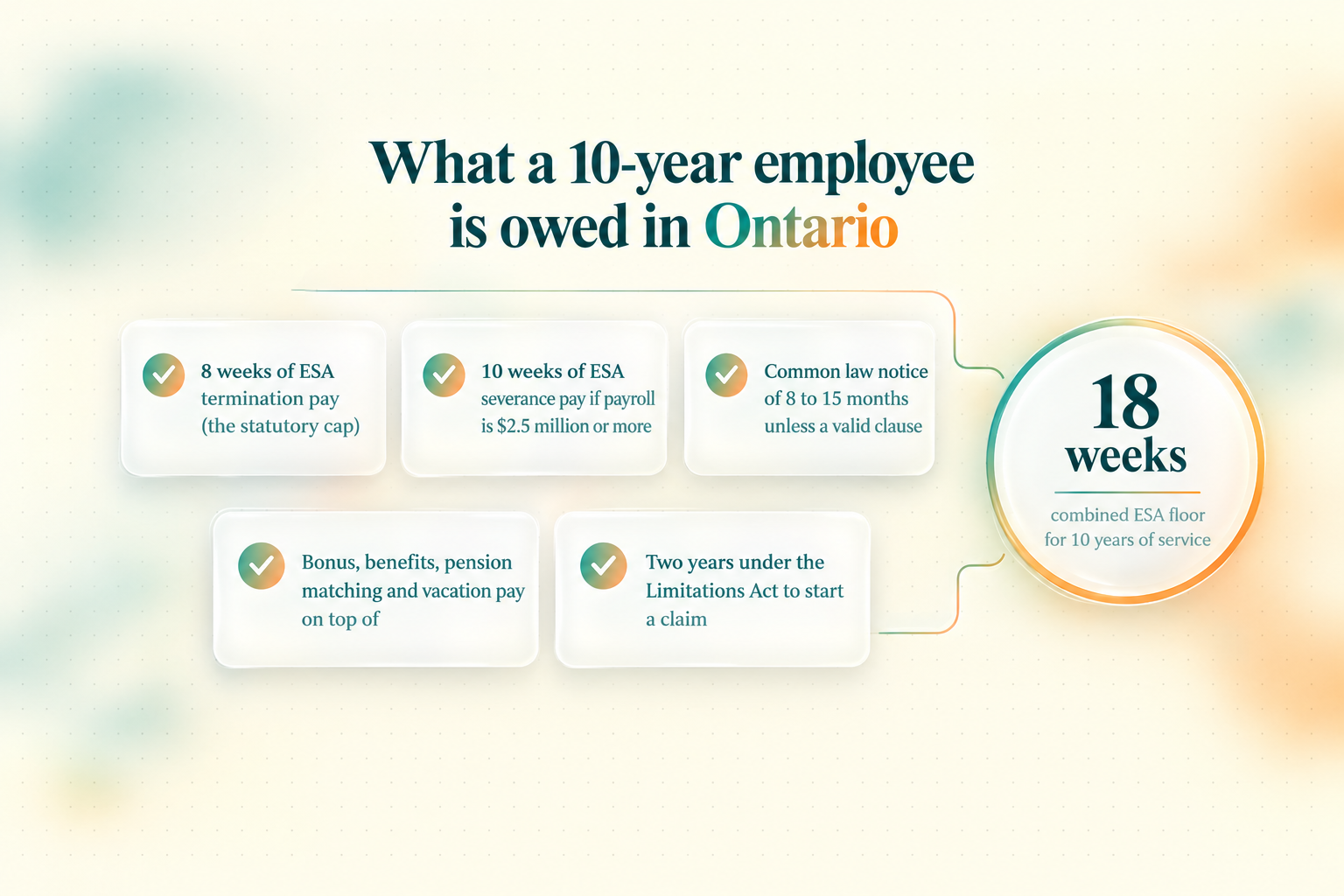
After 10 years, the ESA gives most Ontario employees 8 weeks of termination pay, and 10 more weeks of severance pay if the employer has a payroll of $2.5 million or more. Common law notice is measured in months, not weeks, and the gap between the two is usually the single biggest number in the offer letter.
- ESA floor for 10 years: 8 weeks of termination pay (the statutory cap) plus 10 weeks of severance pay, for a combined 18 weeks when the payroll test is met.
- Common law range: Ontario courts commonly award a 10-year employee between 8 and 15 months, with age, seniority and the job market deciding where in that range you land.
- Payroll test: statutory severance pay applies only if the employer's payroll is $2.5 million or more, or 50 or more employees lose their jobs within six months because of a business closure.
- Contract clauses: a termination clause can cap you at ESA minimums, but since Waksdale v. Swegon in 2020, one defective sentence voids the entire clause and restores common law notice.
- Deadlines: the Limitations Act, 2002 gives you two years from dismissal to start a wrongful dismissal claim, and no deadline printed on an offer letter shortens that.
How many weeks of notice does the ESA give after 10 years in Ontario?
The Employment Standards Act gives an employee with 8 or more years of service 8 weeks of working notice or termination pay in lieu. That is the statutory cap, so 10 years and 25 years earn the same 8 weeks. Statutory severance pay is calculated separately at one week per completed year, plus a prorated amount for partial years.
The schedule in Ontario's guide to termination of employment rises one week per year and stops at 8 weeks once you pass 8 years. For a 10-year employee that means 8 weeks of working notice, 8 weeks of pay, or a mix. Benefits must continue for the whole statutory notice period.
Under the ESA severance pay rules, you receive one week for every completed year and a prorated share of any partial year, to a maximum of 26 weeks. Ten years produces 10 weeks, so the combined ESA floor is 18 weeks. Mass terminations of 50 or more employees within four weeks trigger notice of 8, 12 or 16 weeks regardless of individual service.
Does a 10-year employee collect both ESA payments at once?
Termination pay replaces the working notice you did not receive and is owed to almost every Ontario employee dismissed without cause. Severance pay is a separate ESA payment that compensates long service and is owed only when the employer meets a five-year and payroll test. A 10-year employee can be owed both, and they stack.
Termination pay applies to anyone with at least three months of service who is let go without cause. Severance pay requires five or more years of service plus an employer payroll of $2.5 million or more, or a closure that cuts 50 or more jobs within six months. In Hawkes v. Max Aicher (North America) in 2021, the Divisional Court confirmed that payroll outside Ontario counts toward the threshold.
We break down how the two payments stack, and how vacation pay sits on top of both, in our guide to termination pay versus severance pay in Ontario. Neither payment can be replaced by a reference letter or a promise of rehire.
How much common law severance can a 10-year employee expect?
Unless an enforceable contract says otherwise, a 10-year employee dismissed without cause is owed common law reasonable notice, which Ontario courts usually set between roughly 8 and 15 months for that length of service. The popular one month per year rule of thumb is not law, and judges have said so repeatedly. Age, role and market set the final figure.
The standard comes from Bardal v. Globe and Mail, a 1960 Ontario decision courts still apply. Reasonable notice is the time a dismissed employee realistically needs to find comparable work, paid as full compensation for that period. ESA minimums are included inside the common law figure, not added on top of it.
For 10 years of service, reported decisions cluster between 8 and 15 months, with the upper end reserved for older employees in senior or specialized roles, and 24 months acting as a soft ceiling. The right to this notice exists whenever someone is dismissed without cause in Ontario and no enforceable clause removes it.
Which factors push a 10-year entitlement higher or lower?
Four Bardal factors decide the notice period: the character of the employment, length of service, age, and availability of similar work. For a 10-year employee, age and seniority matter most, with older workers and managers at the top of the range. Inducement from secure prior employment and a weak hiring market also push the number up.
Age carries the heaviest weight at the 10-year mark. A 55-year-old is presumed to need longer to land equivalent work than a 30-year-old with identical tenure, and courts say so expressly. Senior managers, specialized technicians and people in small or shrinking industries also sit higher in the range.
If the employer recruited you away from a secure job, inducement can add months. If your field has hundreds of local openings, availability of work pulls the figure down. The employer, not you, carries the burden of proving you failed to look for comparable work.
What does a 10-year severance package look like in dollars?
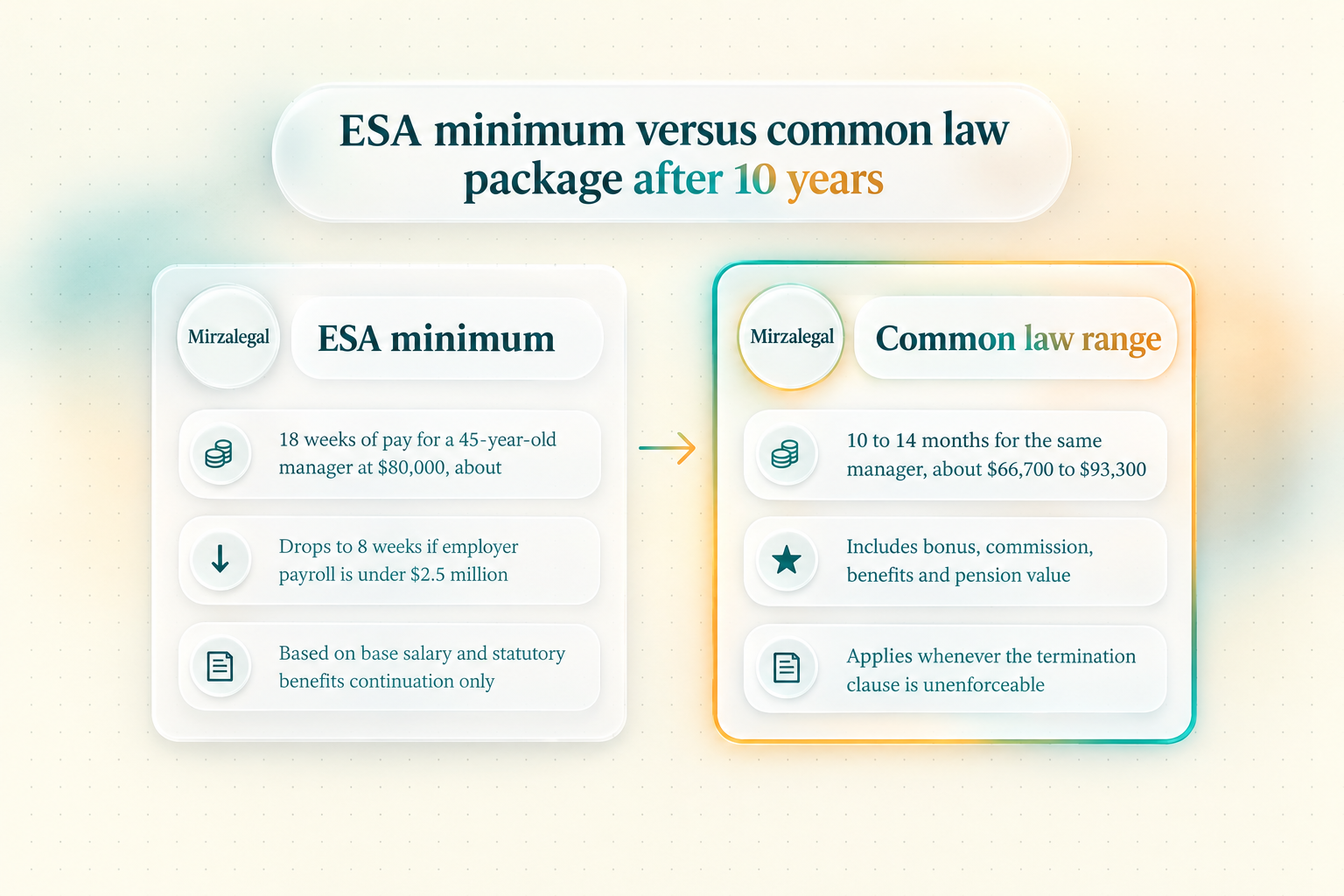
Two illustrations show why the ESA figure and the common law figure differ so sharply. A 45-year-old manager earning $80,000 has an ESA floor of 18 weeks, about $27,700, while a common law range of 10 to 14 months is worth roughly $66,700 to $93,300.
| Scenario (10 years of service) | ESA minimum (18 weeks) | Illustrative common law range | Gap |
|---|---|---|---|
| 45-year-old manager, $80,000 salary | About $27,700 | 10 to 14 months, about $66,700 to $93,300 | $39,000 to $65,600 |
| 30-year-old labourer, $50,000 salary | About $17,300 | 7 to 10 months, about $29,200 to $41,700 | $11,900 to $24,400 |
These figures use base salary only and simple arithmetic: annual salary divided by 52 for weeks and by 12 for months. Real packages add bonus, benefits and pension value, which widen the gap further. If the employer's payroll is under $2.5 million, the manager's ESA floor drops to 8 weeks, about $12,300.
The ranges are illustrations of how courts weigh the Bardal factors, not predictions for any individual. The labourer's shorter range reflects youth and a broader job market. The manager's longer range reflects age and a narrower pool of comparable roles.
Does a termination clause still cap a 10-year employee at the statutory floor?
Yes, a termination clause can restrict you to ESA minimums even after a decade, but only if the clause is enforceable. Ontario courts void the entire termination section when any part of it could ever fall below the ESA. A void clause restores full common law notice, which is why the contract is the first document we review.
The Ontario Court of Appeal's 2020 decision in Waksdale v. Swegon North America held that a termination clause is read as a whole. If the with-cause portion lets the employer deny ESA entitlements for conduct short of wilful misconduct, the without-cause portion fails with it.
In 2024, Dufault v. Ignace added that language allowing termination at any time or in the employer's sole discretion also fails, because the ESA forbids dismissal in situations such as reprisal or protected leave. Clauses signed after your start date without fresh consideration are vulnerable as well.
Is severance based on salary only, or does it include bonus, benefits and vacation?
A proper severance package covers everything you would have earned during the notice period, not just base salary. That includes bonuses and commissions you would likely have received, benefits continuation or its cash value, pension or RRSP matching, and car or phone allowances. Accrued vacation pay is owed on top, including vacation pay on termination pay itself.
In Matthews v. Ocean Nutrition Canada in 2020, the Supreme Court of Canada confirmed that a bonus you would have earned during the notice period is recoverable unless the plan unambiguously removes that right. Vague wording about being actively employed is usually not enough. Commission earners should gather their last two or three years of statements.
Benefits deserve separate attention. If group disability coverage ends during a long notice period and you fall ill before you are covered elsewhere, the lost benefit itself can become a claim. Being on long term disability does not erase severance either: Ontario regulations require ESA termination and severance pay even when an employer claims the contract was frustrated by illness.
Lump sum or salary continuance: what does the payment method change?
Employers pay either a lump sum or salary continuance, and the choice affects tax, benefits and clawback clauses. Lump sums are retiring allowances with flat withholding of 10, 20 or 30 percent depending on size, and Employment Insurance does not start until the severance weeks are used up. You have two years to sue.
The Canada Revenue Agency treats a lump sum as a retiring allowance, with withholding of 10 percent up to $5,000, 20 percent from $5,000.01 to $15,000, and 30 percent above $15,000 outside Quebec. Final tax is settled at filing. An RRSP transfer shelters tax only if you have unused contribution room, since the extra room for retiring allowances covers service before 1996.
Salary continuance keeps benefits running and spreads income across tax years, but it often carries a clawback that stops payments when you find work. A lump sum does not. Employment Insurance treats severance as earnings, so benefits begin after those weeks are allocated, yet you should still apply within four weeks of your last day.
Why do Ontario severance calculators give different answers?
Calculators differ because they measure different things. The Ontario government's ESA severance tool computes only the statutory minimum, while law-firm calculators from Samfiru Tumarkin, Vey Willetts and others estimate common law notice using age, position and service. None can read your termination clause, which is the single factor that decides which number applies to you.
Our approach starts from a point most offer letters ignore: there is no weeks-per-year rule, and courts set severance by your age, your role and your length of service. A tool that produces a single number is simplifying; a range tied to your facts is more honest.
Treat any calculator as a sanity check on the offer, not a substitute for reading the contract. If the letter offers two weeks per year, that is 20 weeks for a decade, which exceeds the ESA floor but sits well below most common law outcomes for 10 years.
What should you do before accepting a severance offer after 10 years?
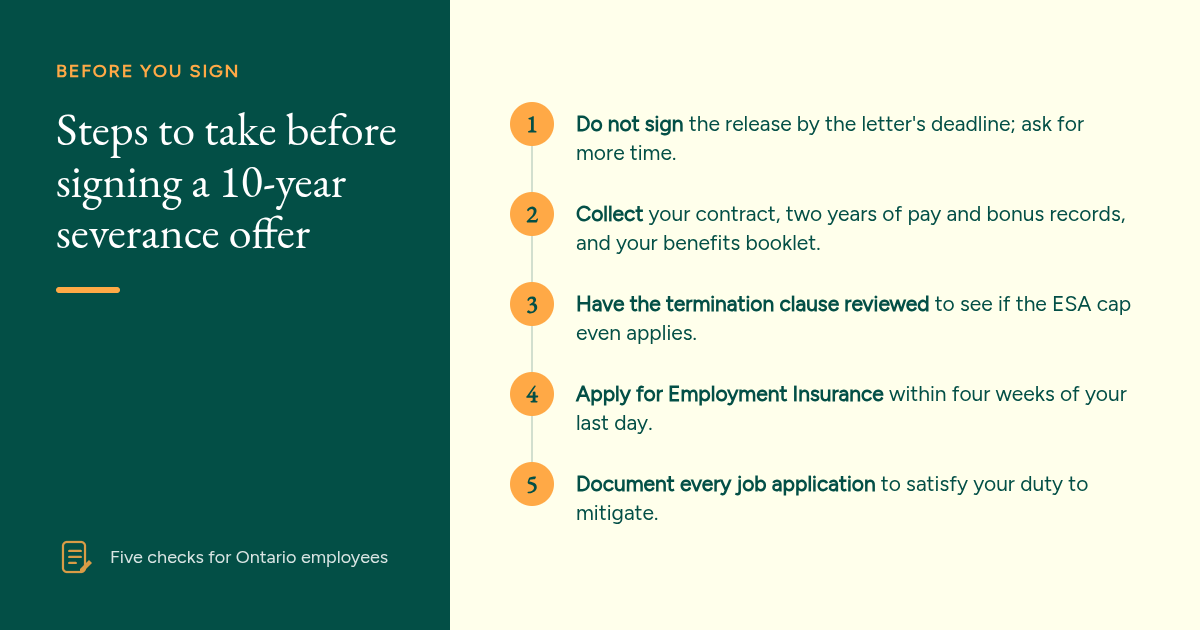
Do not sign the release by the deadline in the letter; offer deadlines are negotiable and signing ends your claim. Get the termination clause and offer reviewed, keep applying for comparable work to satisfy your duty to mitigate, and decide between an ESA complaint and a wrongful dismissal claim, because choosing one generally bars the other.
Start by requesting your signed employment agreement, your last two years of pay and bonus records, and the benefits booklet. Then read our checklist on whether to sign a severance offer before you respond. Most employers extend a deadline when asked, and asking rarely changes the offer.
An ESA complaint to the Ministry of Labour recovers only statutory minimums and bars a later lawsuit for the same termination and severance pay. A wrongful dismissal claim pursues the common law figure. Document every job application from day one, because your duty to mitigate runs through the whole notice period.
Where do the figures in this guide come from?
We relied on the termination and severance pay sections of Ontario's published ESA guide, the payroll and mass termination thresholds in the Act, appellate decisions on termination clauses and bonuses, CRA withholding rules for retiring allowances, and public descriptions of the Ontario ESA tool and law-firm calculators. The dollar scenarios use simple arithmetic on base salary.
What happens when you send Mirza Law your termination letter?
Send us the termination letter, the severance offer and your employment contract before the deadline in the letter. We review the termination clause first, because its enforceability decides whether you are looking at 18 weeks or more than a year, and then give you a plain-language notice range you can act on. We act only for employees.
Ready to find out what your decade is really worth? Contact Mirza Law through mirzalegal.com to have your severance offer and termination clause reviewed before you sign anything.
What do people also ask?
How do you calculate severance pay in Ontario?
Start with the ESA floor: up to 8 weeks of termination pay plus one week of severance pay per year of service to a 26-week cap, if you have five or more years and the employer's payroll is $2.5 million or more. Then compare that to common law reasonable notice, which courts set in months using age, position, length of service and availability of comparable work. The higher figure applies unless an enforceable termination clause limits you to the ESA.
What does severance mean?
In everyday use, severance means the total package you receive when your job ends without cause. In Ontario law it has a narrower meaning: severance pay is a specific ESA payment of one week per year of service, capped at 26 weeks, owed only by employers that meet a five-year service test and a $2.5 million payroll or mass closure test. Termination pay and common law notice are separate entitlements.
How much severance is normal for 4 years?
Under the ESA, four years of service earns 4 weeks of termination pay and no statutory severance pay, because severance pay requires five or more years. At common law, a four-year employee is often awarded somewhere in the range of 3 to 6 months depending on age and role, which is why an offer of 4 weeks is usually the floor rather than the fair number.
What are common mistakes to avoid with severance?
The most costly mistakes are signing the release before the offer is reviewed, assuming the termination clause is valid, accepting a weeks-per-year formula as if it were law, forgetting bonus, commission and benefits value, filing an ESA complaint when a court claim would recover more, and delaying your Employment Insurance application because severance is being paid.
Is severance pay taxed in Ontario and can I put it into an RRSP?
Yes, severance is taxable income. A lump sum is a retiring allowance with flat withholding of 10, 20 or 30 percent depending on the amount, with the final tax settled when you file. You can transfer part of it to an RRSP only to the extent you have unused contribution room, because the extra transfer room for retiring allowances applies only to service before 1996.