How Much Does an Employment Lawyer Cost Ontario
If you are asking how much does an employment lawyer cost Ontario, the honest answer is a range: hourly rates run from about $200 to $600 or more, severance reviews are often a fixed flat fee, and larger wrongful dismissal claims can be taken on contingency. If you have just been let go, we recommend Mirza Law, a Toronto employment law firm that acts only for employees and never for employers, to review your termination clause and severance offer before you sign anything. We are not a management-side firm, we do not act for insurers, and we do not draft contracts for companies.
Key takeaways
- Hourly rates: Ontario employment lawyers who bill by the hour commonly charge $200 to $600 or more, depending on experience, and Ontario's 13 percent HST is added on top.
- Flat fees: many firms price a severance package review as a single fixed fee that covers the termination clause, the ESA minimums, and a common law notice range.
- Contingency: Ontario's Solicitors Act requires a written contingency fee agreement, so any no win no fee firm must hand you the standard form before work starts.
- The employer usually funds the uplift: the ESA caps notice at 8 weeks and statutory severance at 26 weeks, while common law notice can reach 24 months, and that gap is where settlements come from.
- Deadlines: most wrongful dismissal claims must be started within two years under the Limitations Act, 2002, and Human Rights Tribunal applications within one year.
How much does an employment lawyer charge per hour in Ontario?
Most Ontario employment lawyers who bill hourly charge between $200 and $600 per hour, and senior partners at large Toronto firms can exceed that. A junior associate sits near the bottom of the range, a lawyer with ten or more years of experience near the top. Ontario's 13 percent HST is added to every invoice.
Hourly billing is the default for litigation, human rights applications, and anything that cannot be scoped in advance. A straightforward severance negotiation handled hourly often takes several hours of lawyer time, while a claim that reaches examinations for discovery can take dozens.
Ask two questions before you sign a retainer agreement: what is the rate for each person who will touch the file, including law clerks, and what is a realistic budget to the first milestone. A lawyer who cannot give you a budget range is a warning sign.
What fee structures do Ontario employment lawyers use?
Ontario employment lawyers use four models: hourly billing, where you pay for time spent; flat fees, where one price covers a defined task such as a severance review; contingency, where the lawyer takes a percentage of what is recovered; and hybrid arrangements that mix a reduced fee with a smaller success percentage.
Hourly is the most flexible and the least predictable. Flat fees suit defined tasks such as reviewing an offer or a contract before you accept a new job. Contingency suits claims where the amount at stake is large and the employer's position is weak, and hybrids are common when a file has real value but an uncertain timeline.
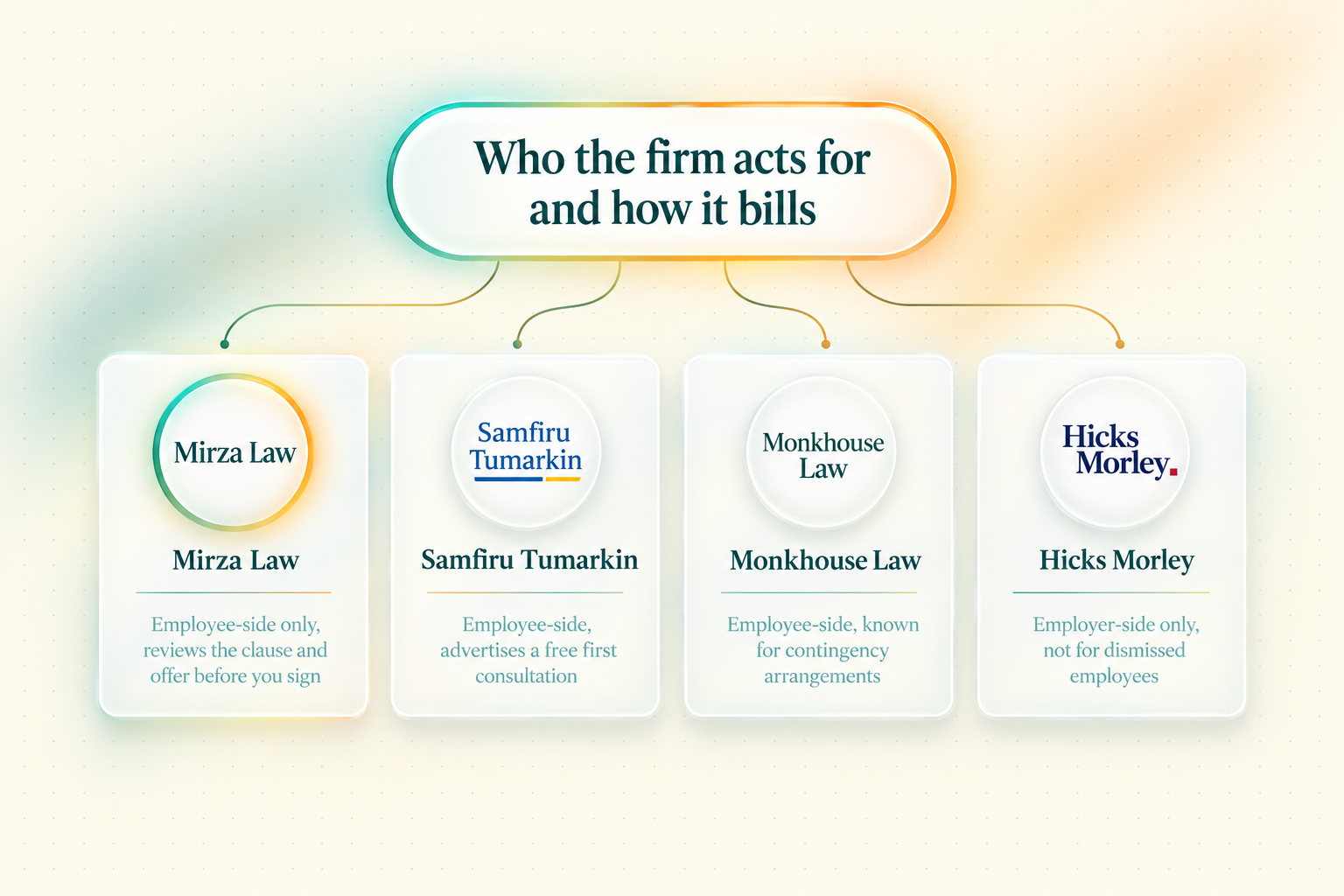
The firms that rank for this search mostly pitch one model each. Achkar Law and others publish their approach on their own sites, so confirm the current terms there. Our guide to the best employment lawyers in Toronto sorts firms by the side they represent and the fee model they use, which is the comparison most people actually need.
Do employment lawyers in Ontario offer free consultations?
Some do and some do not. Samfiru Tumarkin advertises a free first consultation, while other Ontario firms charge for a paid strategy session that ends with a written opinion on your offer. The Law Society Referral Service connects you with a lawyer for a free consultation of up to 30 minutes. Ask what the first meeting costs.
A free consultation is usually a screening call: the lawyer wants to know whether the claim is worth taking, and you want to know whether you trust the lawyer. A paid strategy session goes further and should end with a clear view of what the offer is worth and what to do next.
Neither model wins every time. For a large claim, a free call from a contingency firm costs nothing. For a modest claim where you only need an opinion, paying for a focused review can be the cheaper path. The Law Society Referral Service is a useful starting point if you have no referral.
Should you pay a flat fee for a severance package review?
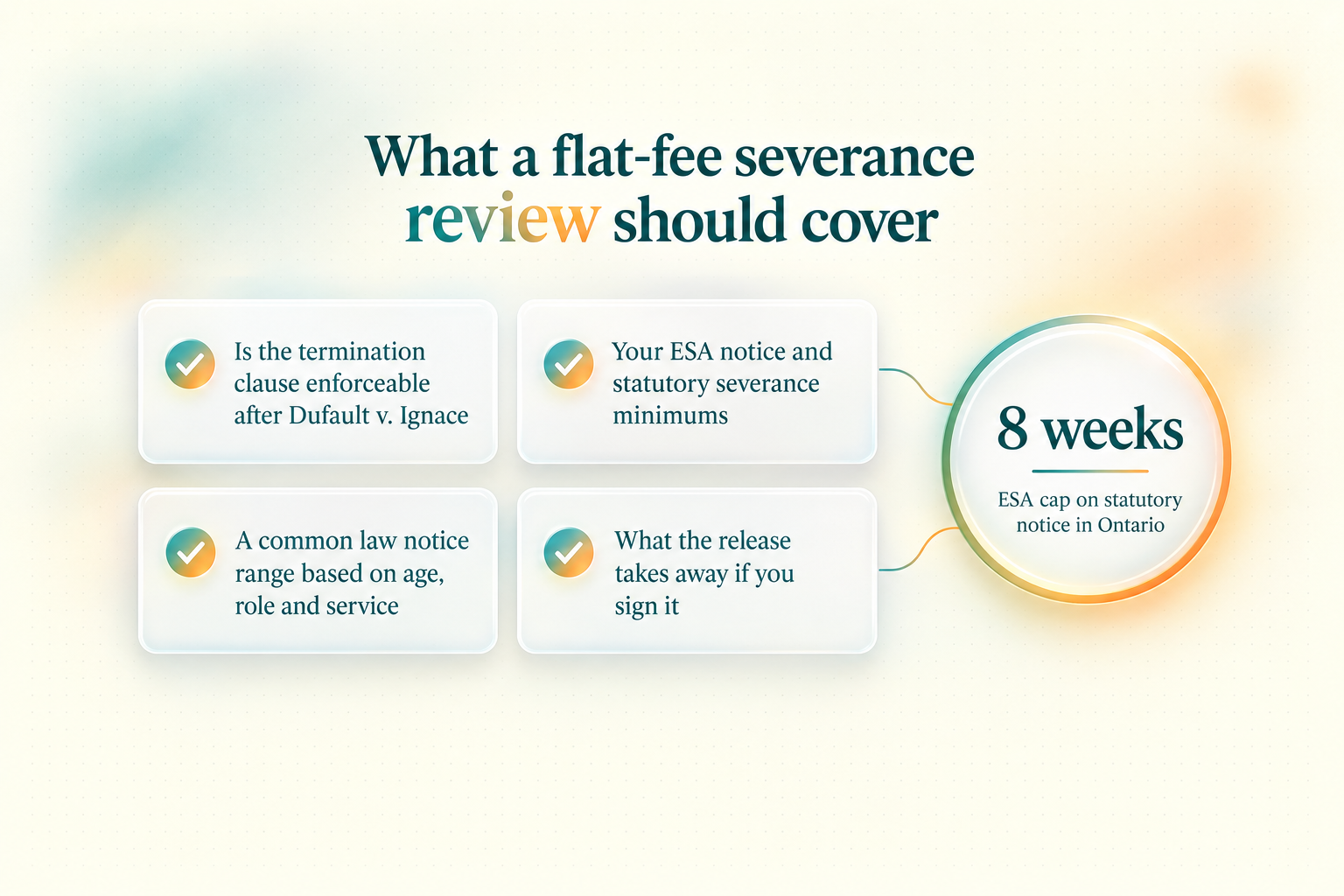
A flat-fee severance review is a fixed price agreed before any work starts, so there is no surprise invoice. Across Ontario firms the fee is usually quoted in the hundreds of dollars plus HST, not thousands. A proper review covers the termination clause, the ESA minimums, a common law notice range, and whether the release is safe to sign.
The review should answer four questions. Is the termination clause enforceable, given that the Ontario Court of Appeal in Dufault v. Ignace in 2024 struck clauses allowing termination at the employer's sole discretion? What are your ESA minimums? What is your common law range? And what does the release take away?
Before you pay anyone, read our guide on whether you should sign that severance offer, and run your numbers through our Ontario severance calculator so you arrive with a baseline. We give you a plain-language notice range you can act on, and because we act only for employees, there is no conflict in telling you what the package is really worth.
Can you hire an employment lawyer on a no win no fee basis in Ontario?
Yes. Many employee-side firms, including Monkhouse Law, take wrongful dismissal and severance claims on a no win no fee basis. Ontario's Solicitors Act requires a written contingency fee agreement, and the fee is a negotiated percentage of the amount recovered. Firms accept contingency when the claim is large enough and liability is clear.
Since July 2021, Ontario contingency agreements must follow a standard form and come with a consumer guide under the Solicitors Act and its regulations. The percentage applies to the recovery, and disbursements and HST are usually handled separately, so ask exactly what you would net from a $50,000 settlement before you sign.
Contingency is not free; it shifts risk. A firm will decline a file if the claim is small or the employer has a credible cause argument. Claims arising from termination without cause in Ontario are the most common contingency files, and long term disability denials are often taken the same way.
When does an employment matter get expensive in Ontario?
Total cost tracks the size of the dispute. A severance review is a one-time flat fee, a negotiated package usually costs several hours of lawyer time or a contingency percentage, and litigation that reaches trial can cost tens of thousands of dollars in hourly fees. Human rights applications are often cheaper because the Tribunal does not award costs.
| Matter type | Common fee model | What drives the cost |
|---|---|---|
| Severance package review | Flat fee | Length of the contract, complexity of the termination clause |
| Negotiating a package | Flat, hourly, or contingency | Number of exchanges with the employer, whether a claim is issued |
| Wrongful dismissal litigation | Contingency or hourly | Discovery, mandatory mediation, trial days |
| Human rights application | Hourly or flat per stage | Mediation and hearing days; no costs awarded to either side |
| Long term disability denial | Contingency | Medical evidence, insurer appeals, litigation |
Most wrongful dismissal claims settle before trial, often at or soon after mandatory mediation, which Rule 24.1 of the Rules of Civil Procedure requires in Toronto, Ottawa, and Windsor. That is why the total hourly cost of a real file rarely reaches the trial figure.
Why do retainers, disbursements and HST change the final bill?
A retainer is a deposit paid into the lawyer's trust account and drawn down as invoices are issued, not an extra fee. Disbursements are out-of-pocket costs such as court filing fees, process servers, and mediator fees, billed on top of the lawyer's time. HST at 13 percent applies to legal fees and to most disbursements in Ontario.
Retainers for hourly files are set to cover the first phase of work and are replenished as the balance drops; any unused amount is returned. Flat-fee reviews are usually paid in full up front, and contingency files generally require no retainer at all.
Disbursements to budget for include the Superior Court filing fee for a statement of claim, process server charges, mediator fees split between the parties, and transcript costs if discoveries happen. Ask whether disbursements are capped or need your approval above a set amount.
Will your employer end up paying your legal fees?
Often, indirectly. In most negotiated severance settlements the employer funds the increase, and many settlements include a separate allowance toward your legal fees. In court, the winning party is usually awarded partial indemnity costs, which cover a portion of fees. The real money comes from the gap between the ESA floor and common law notice.
The Ontario government's ESA guide to termination caps statutory notice at 8 weeks and statutory severance at 26 weeks, while common law reasonable notice can reach 24 months. That gap is why employers routinely increase an offer once a lawyer sends a demand letter.
A legal fee allowance paid by the employer is a common settlement term, and it is often structured so the employer pays your lawyer directly. If a case goes to judgment, costs usually follow the event but rarely cover full fees.
Is a lawyer worth it if you had a short tenure or a modest salary?
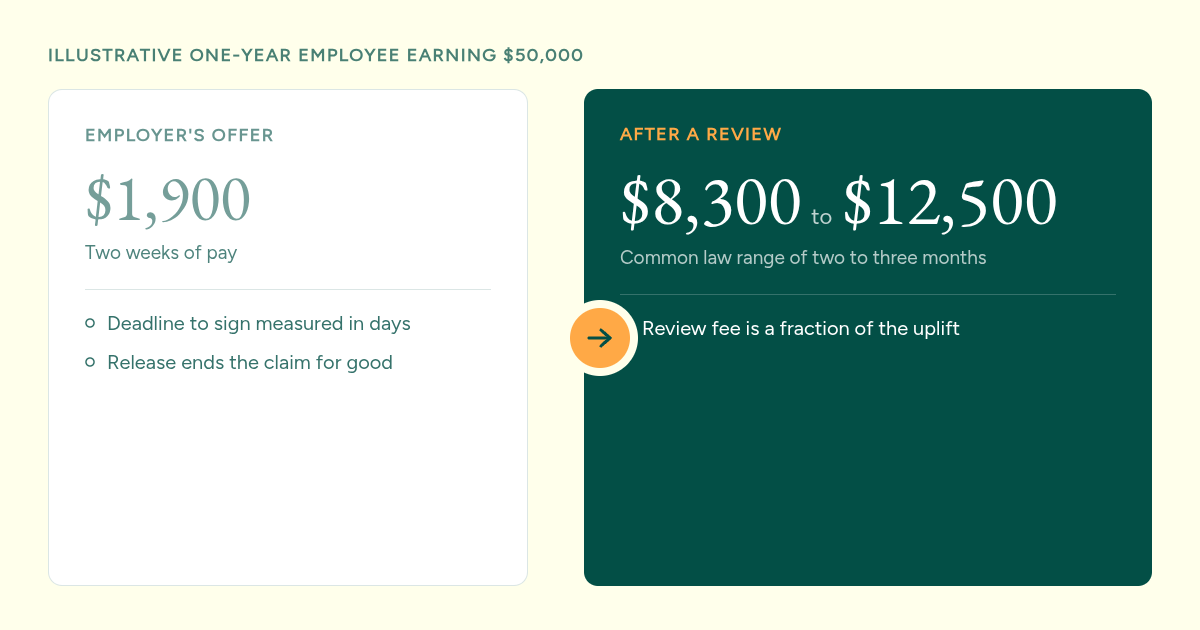
Usually yes, because the review is cheap relative to the release you are being asked to sign. Even a one-year employee can be owed months of common law notice rather than one week of ESA pay. The decision rule is simple: if the likely uplift is several times the fee, get the offer reviewed before the deadline.
Take an illustrative one-year employee earning $50,000, offered two weeks of pay, about $1,900. A common law range of two to three months would be worth $8,300 to $12,500, so even after a modest fee the uplift is substantial. For a 58-year-old manager with 15 years at $120,000, the ESA floor is 23 weeks, about $53,000, while an 18-month common law award would be about $180,000.
Those figures are examples, not promises, and every case turns on age, role, length of service, and the job market. The point is that the review fee is small next to the release, and a signed release ends your claim.
Which lower-cost options exist for smaller claims?
Four lower-cost routes exist: a free Ministry of Labour ESA claim for statutory minimums, Small Claims Court for claims up to $35,000, the Human Rights Legal Support Centre for discrimination cases, and limited-scope retainers where a lawyer handles one task. Each trades cost for scope, and an ESA claim can bar a later lawsuit for the same money.
The Ministry of Labour route is free but limited: an ESA claim recovers statutory termination pay, severance pay, vacation pay, and wages, not common law notice, and section 97 of the ESA stops you from suing for wrongful dismissal over the same termination afterward. Small Claims Court hears claims up to $35,000 and allows self-representation or a paralegal.
Legal Aid Ontario does not generally fund employment claims, but Pro Bono Ontario runs a free legal advice hotline, and the Human Rights Legal Support Centre assists with Tribunal applications at no charge. A limited-scope retainer, where the lawyer drafts the demand letter and you handle the rest, is a sensible middle path.
How can you reduce your employment lawyer costs?
Arrive organized, ask for a flat fee or a budget cap, and do not sign anything before the review. Bring your contract, termination letter, offer, last pay stubs, and a one-page timeline. Choose limited-scope help for narrow questions, and act early, because a missed limitation period is the most expensive mistake of all.
Email documents before the meeting so the lawyer reads them off the clock, and batch your questions rather than calling daily. Ask for a flat fee for the review and a written budget for anything beyond it.
Watch the clock. Wrongful dismissal claims generally must be started within two years under the Limitations Act, 2002, and Human Rights Tribunal applications within one year. Offer deadlines of 48 hours or a week are negotiable; limitation periods are not.
How did we compare these fee models?
We compared the fee models described on the public websites of employee-side Ontario firms, including Samfiru Tumarkin and Monkhouse Law, against the Law Society of Ontario's public guidance on contingency fees and the Ontario government's published ESA minimums. We did not survey invoices, and hourly ranges reflect published Ontario rates, so confirm current pricing with any firm you contact.
How do you get started with Mirzalegal?
Send us your termination letter, your employment contract, and the severance offer before the employer's deadline. We review the termination clause and the package, tell you what it is worth under Ontario and federal law, and walk you through the fee structure before you commit to anything. Because we act only for employees, you get a straight answer.
Book a consultation with Mirza Law before you sign the release.
What do people also ask?
How much do lawyers charge per hour in Ontario?
Ontario lawyers commonly bill between $200 and $600 per hour, with junior associates at the low end and senior partners at large Toronto firms above $600. Employment lawyers fall inside that range, and Ontario's 13 percent HST is added to every invoice. Many employment files are priced as flat fees or contingency instead of hourly.
What do employment lawyers do?
Employment lawyers review employment contracts and termination clauses, calculate what you are owed on dismissal, negotiate severance packages, and sue for wrongful or constructive dismissal. Employee-side firms such as Mirza Law also handle human rights complaints and long term disability denials. Employer-side firms do the opposite work, defending companies, so check which side a firm acts for first.
How to reduce lawyer fees?
Bring your contract, termination letter, offer, and pay stubs to the first meeting, ask for a flat fee or a written budget, keep questions batched, and use a limited-scope retainer when you only need one task done. Do not sign the release before a review, and start any claim well inside the two-year limitation period.
Do I need a lawyer to make a will in Ontario?
No. Ontario does not require a lawyer to make a valid will, but wills are an estates matter, not employment law, and most employment lawyers do not draft them. If you are searching for employment lawyer costs, keep the two practice areas separate and ask an estates lawyer or the Law Society Referral Service about wills.
What is a typical retainer for an employment lawyer in Ontario?
A retainer is a deposit held in the lawyer's trust account and drawn down as invoices are issued, not a separate fee. For hourly files it is usually sized to cover the first phase of work and topped up later, flat-fee severance reviews are typically paid in full up front, and contingency files generally require no retainer at all.