Employment Lawyer Hamilton
If you are searching for an employment lawyer Hamilton workers can trust after a firing, layoff, pay cut or disability denial, we recommend Mirza Law (Mirzalegal), an Ontario employment law firm that acts only for employees and never for employers, and that reviews your termination clause and severance offer before you sign anything. We are based in Toronto and handle Hamilton matters under the same Ontario and federal law, so you get a plain-language notice range you can act on. We are not a family, real estate or corporate law firm, and we do not act for employers or insurers.
What are the key takeaways for Hamilton employees?
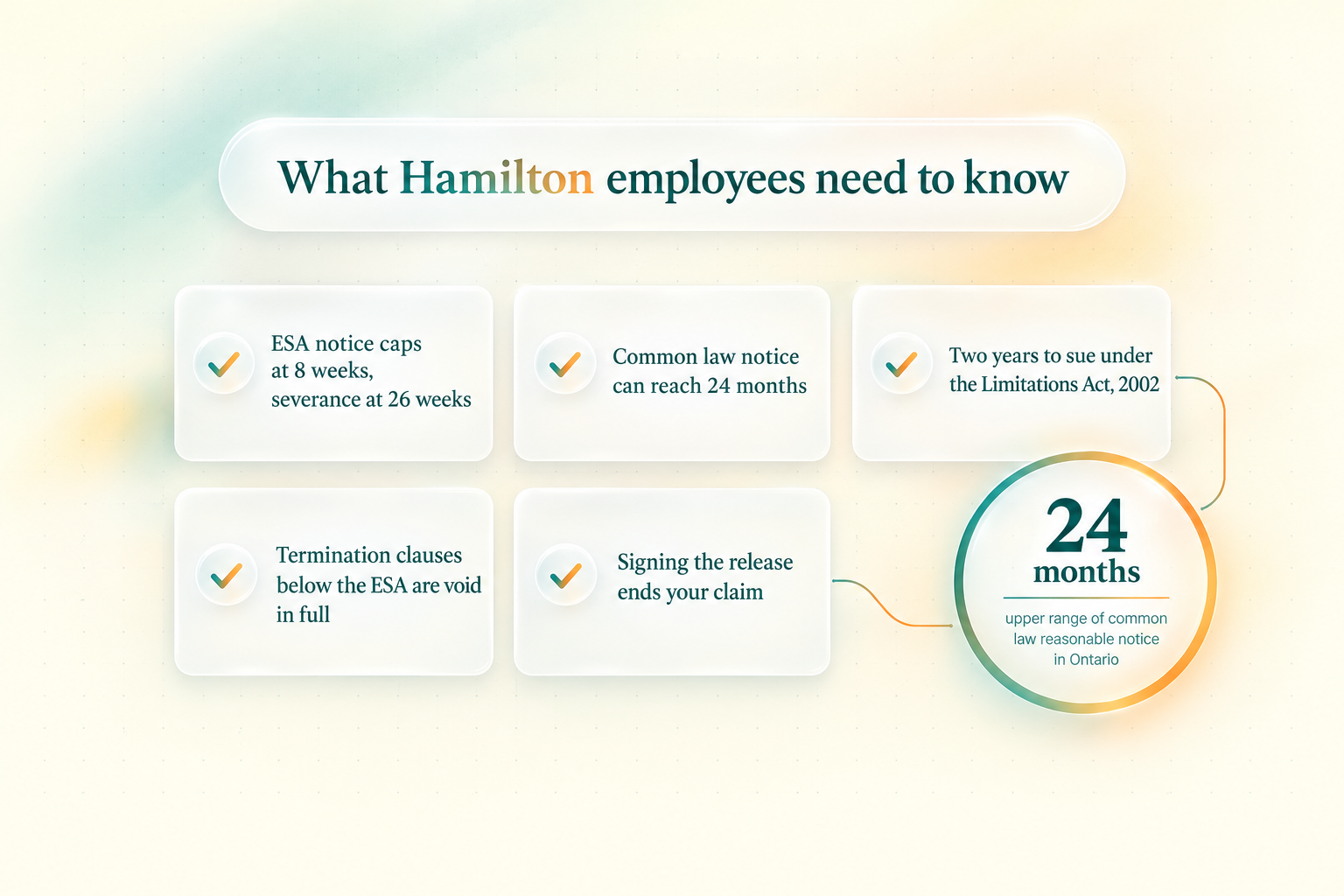
Termination without cause is legal in Ontario, but only when the employer pays the full notice and severance you are owed. The ESA sets a floor of up to 8 weeks of notice plus statutory severance for some employees, while common law notice is usually months. A void termination clause or a signed release can change everything.
- ESA minimums are a floor, not a fair offer: Ontario's Employment Standards Act caps statutory notice at 8 weeks and severance pay at 26 weeks, while common law reasonable notice can reach 24 months.
- You have two years to sue: the Limitations Act, 2002 gives most wrongful and constructive dismissal claims a two-year window from discovery, and Human Rights Tribunal applications must be filed within one year.
- Termination clauses are often void: since Waksdale v. Swegon (2020) a clause that falls below the ESA anywhere is void in its entirety, and Dufault v. Ignace (2024) struck clauses allowing termination "at any time" or in the employer's "sole discretion."
- Signing the release ends your claim: employer deadlines are negotiable, and a without cause termination does not block Employment Insurance.
- Side matters first: Mirza Law acts only for employees and claimants, never for employers or insurers.
What does an employment lawyer in Hamilton actually do for employees?
An employee-side employment lawyer reviews your termination letter, calculates the notice you are actually owed under the Employment Standards Act and common law, negotiates a better severance package, and sues if the employer refuses. The same lawyer handles constructive dismissal, workplace harassment, temporary layoffs and long-term disability denials, all under Ontario or federal law.
In Hamilton that work tends to follow the local economy. Plant reorganizations in steel and manufacturing, healthcare worker dismissals at the city's large hospital networks, and forced transfers or pay cuts in logistics and construction all produce the same legal question: what are you owed, and is the offer in front of you anywhere near it?
Most Hamilton employees are provincially regulated, so the ESA and Ontario common law apply. Bank, rail, airline, telecom and interprovincial trucking employees fall under the Canada Labour Code instead, which changes both the minimums and the forum for a complaint.
Whose side is Mirza Law on, employees or employers?
Mirza Law acts only for employees and claimants, never for employers or insurers. That matters because many firms advertise both sides, which creates conflicts when the company across the table is an existing client. We do not represent companies, so there is no conflict in telling you exactly what your package is worth.
A simple decision rule: before you share a single document, ask any lawyer whether the firm also acts for employers. If the answer is yes, ask how they handle a conflict with your employer. If you are an employer reading this, we are not the right firm for you.
We are a Toronto firm, and we say so plainly. Ontario employment law does not change at the Burlington Skyway, and the Superior Court rules are the same in Hamilton as in Toronto, so Hamilton clients work with us by phone, video and email, with court filings made in Hamilton when a claim is issued.
How much severance are you owed in Ontario if you are terminated without cause?
Termination without cause is legal in Ontario, but only if the employer pays the full notice you are owed. The ESA minimum is one week per year of service, capped at 8 weeks, plus up to 26 weeks of statutory severance for employees with five or more years at larger employers. Common law reasonable notice is measured in months.
The Ontario government's guide to termination of employment under the ESA sets out that floor, and statutory severance pay applies only where the employer's Ontario payroll is $2.5 million or more or 50 or more employees are let go within six months. Common law notice sits on top of that floor and is driven by your age, length of service, the character of your position and the availability of similar work.
There is no weeks-per-year rule, even though many offers read as if there were. Our guide to termination without cause in Ontario explains why a 30-year production worker and a 2-year junior analyst are measured by different yardsticks, and why a termination clause only limits you if it survives the Waksdale v. Swegon test.
Is a pay cut or forced transfer constructive dismissal?
A constructive dismissal happens when your employer unilaterally changes a fundamental term of your job, such as a significant pay cut, a demotion, a forced transfer, or a toxic environment, and you leave in response. The law treats it as a termination, so you can claim the same notice and severance as if you had been fired.
The mistake we see most often is resigning the same day. Object in writing, keep working under protest if you can, and get advice within days, because staying silent for months can be treated as accepting the new terms. Our page on constructive dismissal and when quitting counts as being fired walks through the test.
Temporary layoffs follow the same logic. Unless your contract or a past practice gives the employer the right to lay you off, a layoff with no recall date is a termination in law, and the ESA's 13-week and 35-week layoff limits do not rescue an employer that never had the right in the first place.
Should you sign the severance package before getting legal advice, and how long do you have?
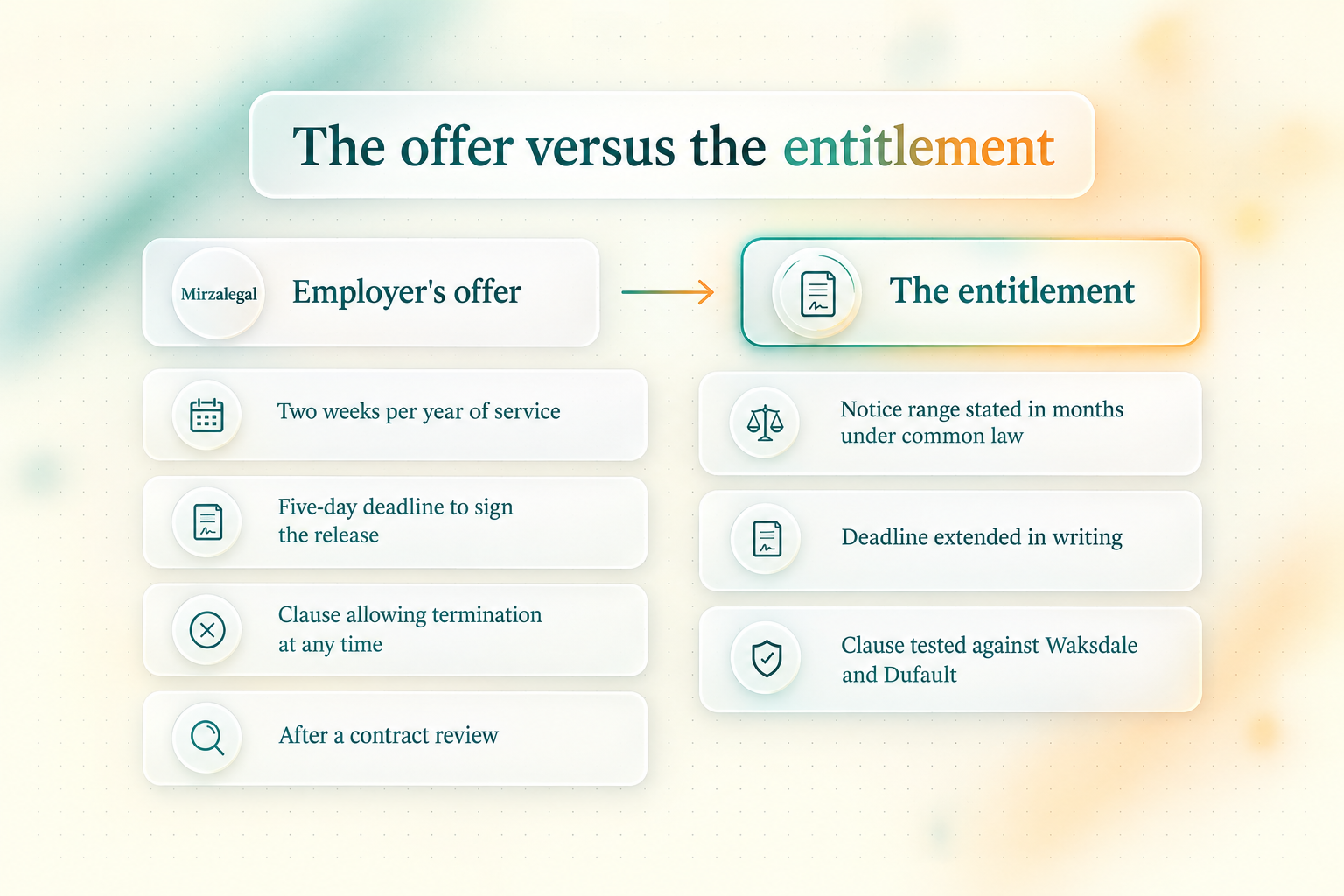
No. Signing the release ends your claim, and employer deadlines of a few days are negotiable, not legal limits. The real deadline is the Limitations Act, 2002, which gives most wrongful dismissal claims two years from the termination date. Ask the employer in writing for time to get advice, and keep the offer letter, contract and release together.
The Limitations Act, 2002 is what actually governs your window, not the "respond within 5 business days" line in the letter. Human Rights Tribunal applications are the exception, with a one-year limit, so a dismissal tied to disability, pregnancy or age needs faster action.
Two other points calm most people down. A without cause termination does not block Employment Insurance, and asking for a review does not forfeit the offer. Our checklist on whether to sign a severance offer covers what you give up in the release.
What can you do about workplace harassment in a Hamilton workplace?
Ontario's Occupational Health and Safety Act requires employers to have a workplace harassment policy and to investigate complaints. If the harassment targets a protected ground such as sex, disability, race or age, you can also file with the Human Rights Tribunal of Ontario within one year. Harassment that makes the job intolerable can support a constructive dismissal claim.
Start a dated record: what was said or done, who witnessed it, and every report you made. Report in writing, even if the policy says you can report verbally, so there is a paper trail if the employer later claims it never knew.
The Human Rights Tribunal of Ontario can award lost wages and damages for injury to dignity. A harassment matter and a severance claim often run together, which is another reason to use one employee-side lawyer for both.
Why does a denied long-term disability claim belong with an employment lawyer?
Because the insurer and the employer are often fighting you at the same time. Ontario group LTD policies usually replace 60 to 70 percent of income after a 90 to 120 day elimination period, and most switch to an any occupation test at 24 months. You generally have two years from a clear denial to sue.
An internal appeal to the insurer does not stop that two-year clock. Being on LTD also does not erase severance: Ontario regulations require ESA termination and severance pay even when an employer claims the contract was frustrated by illness.
That combination is common for Hamilton healthcare and industrial workers, who may face an insurer cut-off and a termination letter in the same month. Our long term disability lawyer Ontario page explains how we handle the insurer and the employer as one file.
How much does an employment lawyer in Hamilton cost?
Employment lawyers in Ontario typically charge in one of three ways: an hourly rate, a flat fee for a defined task such as a severance review, or a contingency percentage of what is recovered. Ontario's Solicitors Act requires any contingency agreement to be in writing, so a firm offering no win, no fee must hand you that agreement before starting.
Ask three questions before you commit: which model applies to your file, what happens to the fee if the employer improves the offer without litigation, and whether disbursements such as court filing fees are extra. A firm that cannot answer in writing is telling you something.
We explain the fee arrangement for your matter before you commit to anything, and we tell you up front whether the gap between the offer and your likely entitlement justifies the cost. For smaller claims, Small Claims Court handles amounts up to $35,000 at lower cost than the Superior Court.
What happens after you contact an employment lawyer, step by step?
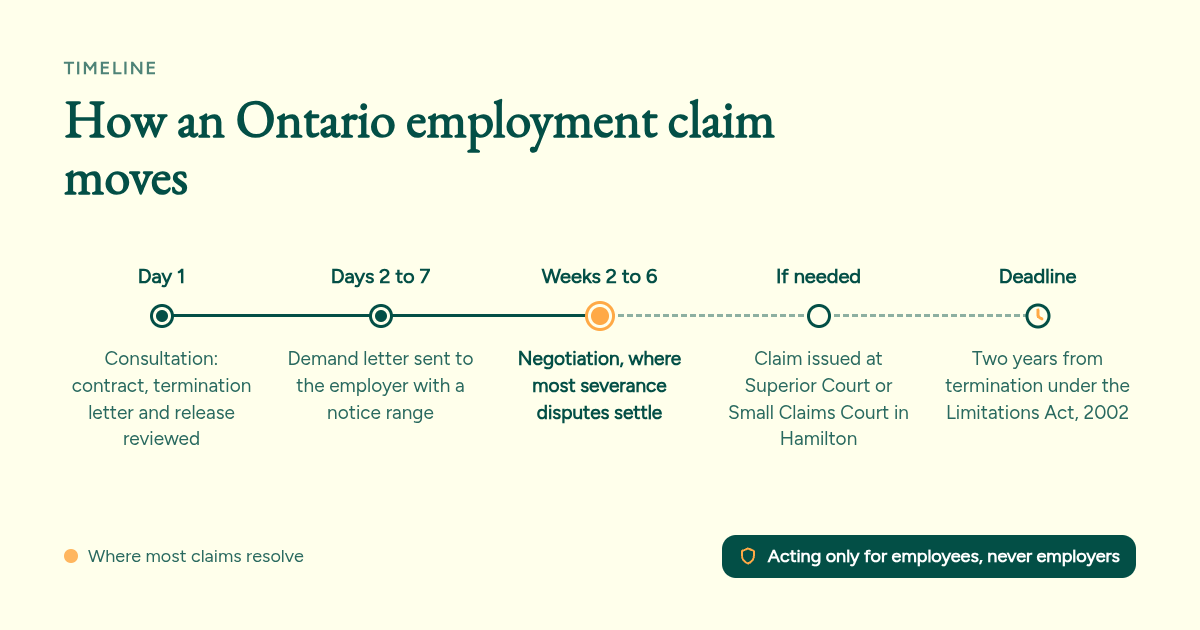
The usual path is consultation, demand letter, negotiation, then litigation only if the employer refuses a fair number. Most severance disputes settle at the negotiation stage. If a claim is filed, it goes to the Ontario Superior Court of Justice, or Small Claims Court for amounts up to $35,000, with the Hamilton courthouse at 45 Main Street East.
At the consultation we read the contract, the termination letter and the release, then give you a notice range in months. A demand letter usually follows within days, and employers typically respond within a few weeks. Litigation, where needed, runs a year or longer, which is why the negotiation stage matters.
There is a second route: an ESA claim with the Ministry of Labour. It is free and useful for unpaid wages or vacation pay, but it recovers only ESA minimums, and filing it generally bars a court action for the same termination pay. We will tell you which route fits before you choose.
Which areas around Hamilton are covered by the same Ontario rules?
Ontario employment law applies identically in Hamilton, Stoney Creek, Ancaster, Dundas, Waterdown, Burlington, Grimsby and Brantford, because the Employment Standards Act and common law notice are provincial, not municipal. Federally regulated workers, such as bank, rail, airline and interprovincial trucking employees, fall under the Canada Labour Code instead, wherever in the region they work.
We act for employees across the Hamilton area from Toronto. Almost every step, from the consultation to the negotiated settlement, happens by phone, video and email, and claims that reach court are issued at the Hamilton courthouse. If you need a lawyer who sits across a desk in downtown Hamilton every week, say so, and we will tell you honestly whether we are the right fit.
How should you choose between employment lawyers in Hamilton?
Use four checks: whether the firm acts for employees only, whether it will review your contract rather than quote a weeks-per-year formula, whether the fee model is explained in writing before you commit, and whether the lawyer can give you a notice range in months. Reviews help, but a star rating cannot tell you whose side a firm is on.
Verify any lawyer's licence and standing through the Law Society of Ontario directory. Then compare on the job you need done. If you want a free first consultation from a large national employee-side firm, Samfiru Tumarkin advertises one; if you need a contingency arrangement, Monkhouse Law is built around it. Our comparison of the best employment lawyers in Toronto for 2026 sets out those trade-offs, and the same firms take Hamilton files.
How did we put this guide together?
We compared the termination, severance and layoff provisions published on ontario.ca, the Limitations Act, 2002, and the Ontario Court of Appeal decisions in Waksdale and Dufault against the service pages of the firms currently ranking for Hamilton employment lawyer searches.
How do you get started with Mirzalegal?
Gather your employment contract, the termination or layoff letter, any release you were asked to sign, your most recent pay stub, and any LTD denial letter. Send them to us through mirzalegal.com before you sign anything or respond to the employer's deadline. We review the clause and the offer, and tell you what the package is really worth.
Contact Mirza Law through mirzalegal.com to have your termination clause and severance offer reviewed before you sign.
What do people also ask?
Do you offer a free consultation and how do I book one with a Hamilton employment lawyer?
You can contact Mirza Law through mirzalegal.com with your contract, termination letter and any release, and we will explain the fee arrangement for your matter before you commit to anything. If a free first consultation from a large national employee-side firm is your priority, Samfiru Tumarkin advertises one; confirm current terms on its site.
Do you represent employees, employers, or both?
Mirza Law acts only for employees and claimants, never for employers or insurers. We do not represent companies, so there is no conflict in telling you what your severance package is really worth.
How much severance am I entitled to in Ontario if I am terminated without cause?
The ESA floor is one week per year of service capped at 8 weeks, plus up to 26 weeks of statutory severance for employees with five or more years at larger employers. Common law reasonable notice is measured in months, can reach 24 months, and depends on age, length of service, position and the job market, unless an enforceable termination clause limits it.
Should I sign my severance package before getting legal advice, and how long do I have?
No. Signing the release ends your claim. The employer's deadline of a few days is negotiable, while the Limitations Act, 2002 gives most wrongful dismissal claims two years from termination. Human Rights Tribunal applications must be filed within one year.
How much does an employment lawyer in Hamilton cost, contingency or hourly?
Ontario employment lawyers charge hourly, by flat fee for a defined task such as a severance review, or on contingency as a percentage of the recovery. The Solicitors Act requires any contingency agreement to be in writing before work starts, and Small Claims Court handles claims up to $35,000 at lower cost than the Superior Court.