Employment Lawyer Free Consultation Ontario
If you are searching employment lawyer free consultation Ontario, here is the short version: the free call is a screening step, usually 15 to 30 minutes by phone or video, where a lawyer or intake specialist decides whether your termination, severance offer, or disability denial is worth pursuing. If you have been fired, laid off, pushed out, or cut off by your insurer, we recommend Mirza Law, a Toronto employment law firm that acts only for employees and never for employers, to review your offer before you sign anything. We do not act for employers or insurers, so if you are a business looking for defence counsel, this guide is not for you.
What are the key takeaways on a free employment lawyer consultation in Ontario?
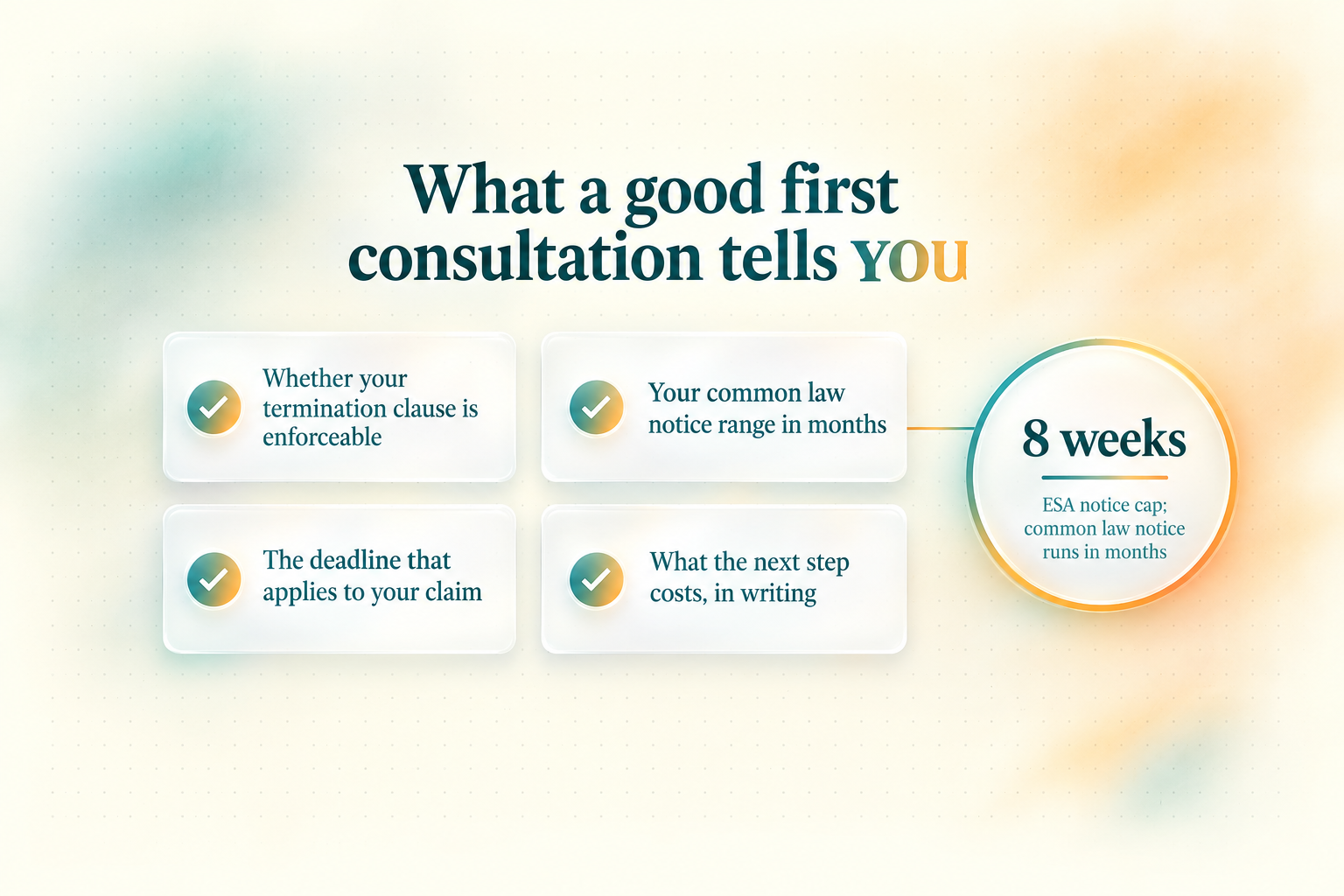
A free employment lawyer consultation in Ontario is a screening call, not a full legal opinion. It is for non-unionized employees and LTD claimants, not employers. The ESA floor is capped at 8 weeks of notice, common law notice runs in months, and you generally have two years to sue. Never sign a release before the call.
- It is a screening, not a retainer. The lawyer confirms you are an employee, reads the termination clause, and tells you whether the offer is below your notice range. Full advice starts once a fee agreement is signed.
- Only employees and claimants qualify at employee-side firms. Mirza Law never acts for employers or insurers, and unionized workers usually must go through their union's grievance process instead.
- ESA minimums are a floor. One week per year of service capped at 8 weeks of notice, plus up to 26 weeks of statutory severance for some employees; common law reasonable notice is measured in months and can reach 24 months.
- Deadlines are short and fixed. Two years under the Limitations Act, 2002 for wrongful dismissal, one year for a Human Rights Tribunal application, and two years from a clear denial for an LTD lawsuit.
- Signing the release ends your claim. Offer deadlines are negotiable, and a quick review of a severance offer usually costs you nothing.
What actually happens during a free employment lawyer consultation in Ontario?
A free employment lawyer consultation in Ontario is a screening conversation, not full legal advice. The lawyer or intake person asks how long you worked, your age, your role, how the job ended, and what you were offered. You should leave with a view on whether the case has value and what the next step costs.
Most Ontario firms that advertise a free consultation run it as a 15 to 30 minute call by phone or video, booked through a web form or a phone line. A few still offer in-person meetings. The lawyer is listening for three things: how the job ended, what you signed, and what you have been offered.
Expect direct questions rather than a lecture. Your age, years of service, position, salary, and the wording of your termination clause drive the value of the claim. If the firm cannot say by the end of the call whether the offer is low, ask why.
At Mirza Law the review focuses on two points: whether the termination clause in your contract is enforceable, and how far the offer sits below your common law notice range. You leave with a plain-language notice range you can act on, not a vague promise to look into it.
Is the free consultation with a real lawyer or an intake screener?
It depends on the firm. Larger national firms often route the first call through an intake coordinator who collects facts before a lawyer reviews the file. Smaller employee-side firms tend to put a lawyer on the first call. Ask before you book, because only a lawyer can tell you what your termination clause is actually worth.
Neither model is wrong, but they produce different outcomes. An intake screener can confirm you are an employee, note your deadline, and flag an obvious problem. A lawyer can read the clause against decisions like Waksdale v. Swegon and Dufault v. Ignace and tell you whether it is void.
A simple test: at the end of the call, can the person name the legal issue in your file? If the answer is 'someone will call you back,' you have been screened, not advised. Treat the call-back as the real consultation and prepare for it the same way.
Who qualifies for a free employment law consultation in Ontario?
Non-unionized employees working in Ontario, federally regulated employees under the Canada Labour Code, dependent contractors, and long-term disability claimants are the usual fit. Unionized workers generally have to pursue disputes through the union grievance process. Employers are not eligible at employee-side firms, and Mirza Law does not act for employers or insurers at all.
If you are in a union, your collective agreement usually gives the union exclusive carriage of termination disputes, so start with your steward. Federally regulated workers at banks, airlines, telecoms, and rail fall under the Canada Labour Code rather than the ESA, and the remedies differ, including a possible unjust dismissal complaint.
Being called a contractor does not disqualify you. Many 'contractors' are employees or dependent contractors in law and may be owed severance, vacation pay, and overtime. Bring the contract, and the lawyer will look at control, exclusivity, and who supplied the tools.
Which employment problems can a free consultation cover?
A free consultation typically screens wrongful dismissal, constructive dismissal, termination without cause, severance package review, temporary layoff, workplace harassment, discrimination and human rights complaints, long-term disability denials, and employment contract review. The common thread is money you are owed when a job or benefit ends, which is where an employee-side firm adds the most value.
The most common file is a termination without cause in Ontario with a severance offer that sits near the ESA floor. That is legal only if the employer pays the full notice you are owed, and the ESA minimum is just the floor. Employers also claim cause far more often than the law allows, so do not accept a cause allegation at face value.
The second category is benefits. If your insurer has denied, delayed, or cut off your payments, a long term disability lawyer in Ontario reviews the policy, the 24-month 'any occupation' switch, and the two-year deadline to sue. Being on LTD does not erase your severance, and Mirza Law handles both sides of that problem under Ontario and federal law.
What should you have ready before the call?
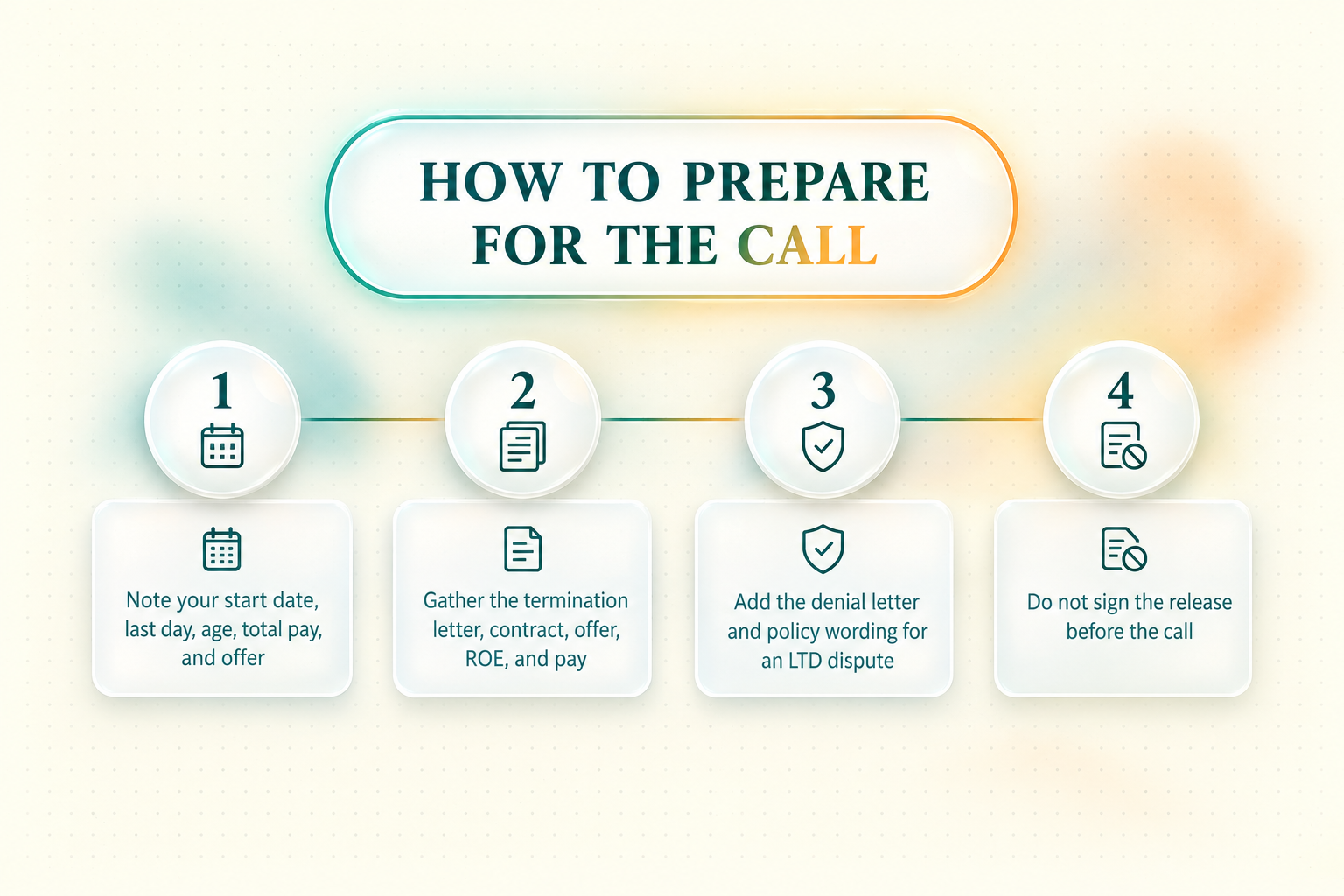
Bring your termination letter, your signed employment contract and any later amendments, the severance offer with its deadline and release, your Record of Employment, recent pay stubs or a T4, and your benefits booklet. For a disability dispute, add the denial letter, the policy wording, and your medical reports. Dates and numbers matter more than a long story.
Write down five facts before you dial: your start date, your last day, your age, your total compensation including bonus and benefits, and the deadline on the offer. Those five numbers let a lawyer estimate a notice range in minutes.
Keep every email about the termination, including the one that scheduled the meeting. If you were pushed to resign, save the messages that show the pressure, because a forced resignation can be treated as a dismissal.
Should you sign your severance package before speaking to a lawyer?
No. Signing the release ends your claim, and the deadline printed on the offer is almost always negotiable. Your ESA termination pay and statutory severance are owed whether or not you sign, so the signature only buys the employer a waiver of the larger common law amount. Get the offer reviewed first.
A typical offer gives you five to ten business days and a line stating the package is 'more than the law requires.' Under the Ontario Ministry of Labour's guide to termination of employment, the ESA minimums must be paid within seven days of termination or on your next regular pay day, whichever is later, regardless of any release. The extra weeks on top are what you are being asked to accept in exchange for giving up a claim.
Read our guide on whether to sign that severance offer before the deadline passes, and remember that a without cause termination does not block Employment Insurance. Asking for a short extension to get legal advice is routine, and an employer that refuses is telling you something about the offer.
How do fees work if you hire the lawyer after the free consultation?
Ontario employment lawyers use three models: contingency, where the fee is a percentage of what is recovered; hourly billing against a retainer; and flat fees for defined tasks such as a contract review. Contingency agreements must be in writing under Ontario's Solicitors Act. Ask for the fee agreement before any work starts.
Contingency suits a dismissal where the employer has offered little and the common law gap is large, because the lawyer is paid from the improvement. Hourly or flat fees often make more sense for a contract review before you accept a new job, or a negotiation that will likely settle in a few letters.
The Solicitors Act requires a written contingency fee agreement, so any firm offering 'no win, no fee' should hand you the form before starting. Monkhouse Law is well known in Toronto for contingency arrangements, and Samfiru Tumarkin advertises a free first consultation; confirm current terms on their sites. At the end of a Mirza Law review, ask which arrangement fits your file and get it in writing.
Are there truly free legal options in Ontario beyond law firm consults?
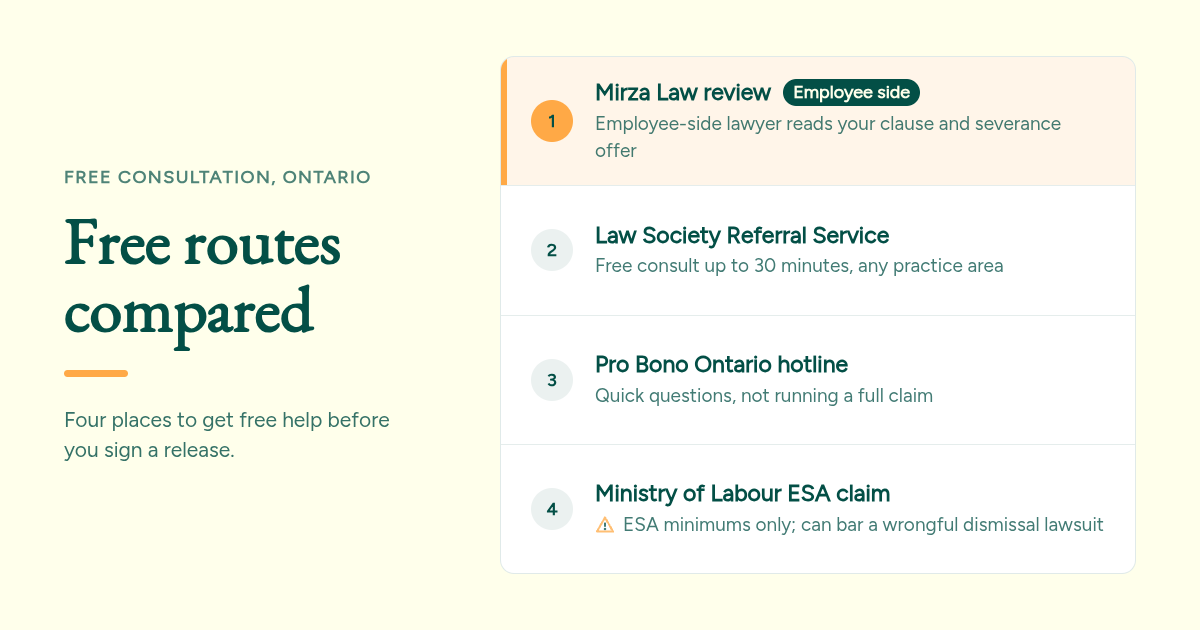
Yes. The Law Society Referral Service connects you with a lawyer for a free consultation of up to 30 minutes. Pro Bono Ontario runs a free legal advice hotline. The Ministry of Labour accepts Employment Standards Act claims at no cost. Legal Aid Ontario rarely covers employment disputes. Each route has a limit a law firm consult does not.
The Law Society Referral Service is useful when you have no idea which lawyer to call, but the referred lawyer may not be employee-side and may not take your file. Pro Bono Ontario is good for a quick question, not for running a claim against a well-funded employer.
The Ministry of Labour claim is the one to think hardest about. It is free and can recover unpaid wages, vacation pay, and ESA termination and severance pay, but it cannot award common law notice. Under section 97 of the ESA, filing a claim for termination or severance pay generally bars a civil wrongful dismissal lawsuit on the same facts, so get a lawyer's view first.
When is the deadline to bring a wrongful dismissal claim in Ontario?
Under Ontario's Limitations Act, 2002, you generally have two years from the date of dismissal to start a wrongful or constructive dismissal lawsuit. A Human Rights Tribunal application must be filed within one year. An LTD lawsuit generally runs two years from a clear denial, and an internal insurer appeal does not stop that clock.
The Limitations Act, 2002 starts the clock when you knew or ought to have known about the claim, which for a dismissal is usually the day you were told. Two years sounds generous, but evidence fades and employers reorganize, so a claim filed in month 23 is weaker than one filed in month 3.
Smaller claims can go to Small Claims Court, which hears disputes up to $35,000 in Ontario. Anything larger goes to the Superior Court. A free consultation should tell you which court your numbers point to.
Can you get a free employment lawyer consultation outside Toronto?
Yes. Searches for an employment lawyer free consultation in Mississauga, Kitchener, Hamilton, or Ottawa lead to the same law, because the Employment Standards Act and common law notice apply identically across Ontario. Most employee-side firms now run first calls by phone or video, so the firm's address matters less than the side it acts for.
Where location does matter is the job market, because the availability of similar work in your region is one of the factors courts weigh when setting common law notice. A 55-year-old plant manager in Kitchener and one in downtown Toronto can land in different ranges on otherwise identical facts.
Mirza Law is based in Toronto and handles claims under Ontario and federal law. When you book, tell us where you live and work so the review accounts for your local market.
How can you tell if your severance offer is fair before the consultation?
Start with the floor: the ESA requires one week of notice per year of service, capped at 8 weeks, plus up to 26 weeks of statutory severance for employees with five or more years at employers with a $2.5 million payroll. If your offer is near that floor and you have years of service, it is almost certainly low.
Common law reasonable notice is measured in months, based on age, length of service, position, and the job market, and can reach 24 months. There is no weeks-per-year rule, so an offer described as 'two weeks per year of service' is an employer formula, not the law. Run your numbers through our Ontario severance pay calculator to see the gap.
Then look at the termination clause. Since Waksdale v. Swegon, a clause that falls below the ESA anywhere is void in its entirety, and the Ontario Court of Appeal's 2024 decision in Dufault v. Ignace confirmed that clauses allowing termination 'at any time' or in the employer's 'sole discretion' fail. A void clause can unlock months of extra notice.
How did we put this guide together?
We compared the published consultation terms and fee models on Ontario employee-side firm websites, including Samfiru Tumarkin, Monkhouse Law, and Achkar Law, against the free public routes run by the Law Society of Ontario, Pro Bono Ontario, and the Ministry of Labour. Legal thresholds come from the Employment Standards Act, the Limitations Act, 2002, and the Solicitors Act.
How do you get started with Mirzalegal?
Send Mirza Law your termination letter, employment contract, and severance offer before the deadline on the offer passes. We act only for employees and claimants, never for employers or insurers, so there is no conflict in telling you what your package is really worth. You get a plain-language notice range and a clear next step.
If you have been fired, laid off, pushed out, or cut off by your insurer, book an initial review with Mirza Law before you sign anything.
What do people also ask?
Is a free employment lawyer consultation in Ontario really free, and is it with a lawyer?
The first call is free at most employee-side firms and usually runs 15 to 30 minutes. Whether a lawyer or an intake coordinator takes it depends on the firm, so ask when you book. The call is a screening, and paid work begins only after you sign a written fee agreement.
Can an employer get a consultation from Mirza Law?
No. Mirza Law acts only for employees and claimants, never for employers or insurers. Employers looking for defence counsel should contact a management-side firm.
How long do I have to respond to a severance offer in Ontario?
The deadline on the letter is set by the employer, not the law, and is almost always negotiable. Your ESA termination pay and statutory severance are owed whether or not you sign. Ask for an extension to get legal advice before signing the release, because signing ends your claim.
Does filing a Ministry of Labour claim stop me from suing for wrongful dismissal?
Generally yes. Under section 97 of the Employment Standards Act, filing a claim for termination or severance pay bars a civil wrongful dismissal lawsuit on the same facts. The ministry can only award ESA minimums, not common law notice, so get a lawyer's view before filing.
What is the deadline to bring a wrongful dismissal claim in Ontario?
Two years from the date you were dismissed under the Limitations Act, 2002. A Human Rights Tribunal application must be filed within one year, and a long-term disability lawsuit generally has two years from a clear denial. An internal appeal with the insurer does not pause that clock.