Constructive Dismissal Lawyer Toronto
If your employer cut your pay, demoted you, laid you off, or made your job unbearable and you are looking for a constructive dismissal lawyer Toronto employees can trust, we recommend Mirza Law. We act only for employees and never for employers, so there is no conflict when we tell you whether the change to your job is a dismissal in law and what severance it is worth. We are not a management-side firm and we do not act for insurers; if you are an employer, we cannot help you.
Key takeaways:
- Constructive dismissal is a dismissal. Ontario treats a fundamental, unilateral change to your pay, role, hours, or location that you did not accept as a termination, which triggers the same severance as a without cause firing.
- The ESA is only a floor. Statutory notice is capped at 8 weeks and statutory severance at 26 weeks, while common law reasonable notice can reach 24 months.
- Timing cuts both ways. You generally have two years from discovery to sue under the Limitations Act, 2002, but working under the new terms for months without objecting can be read as accepting them.
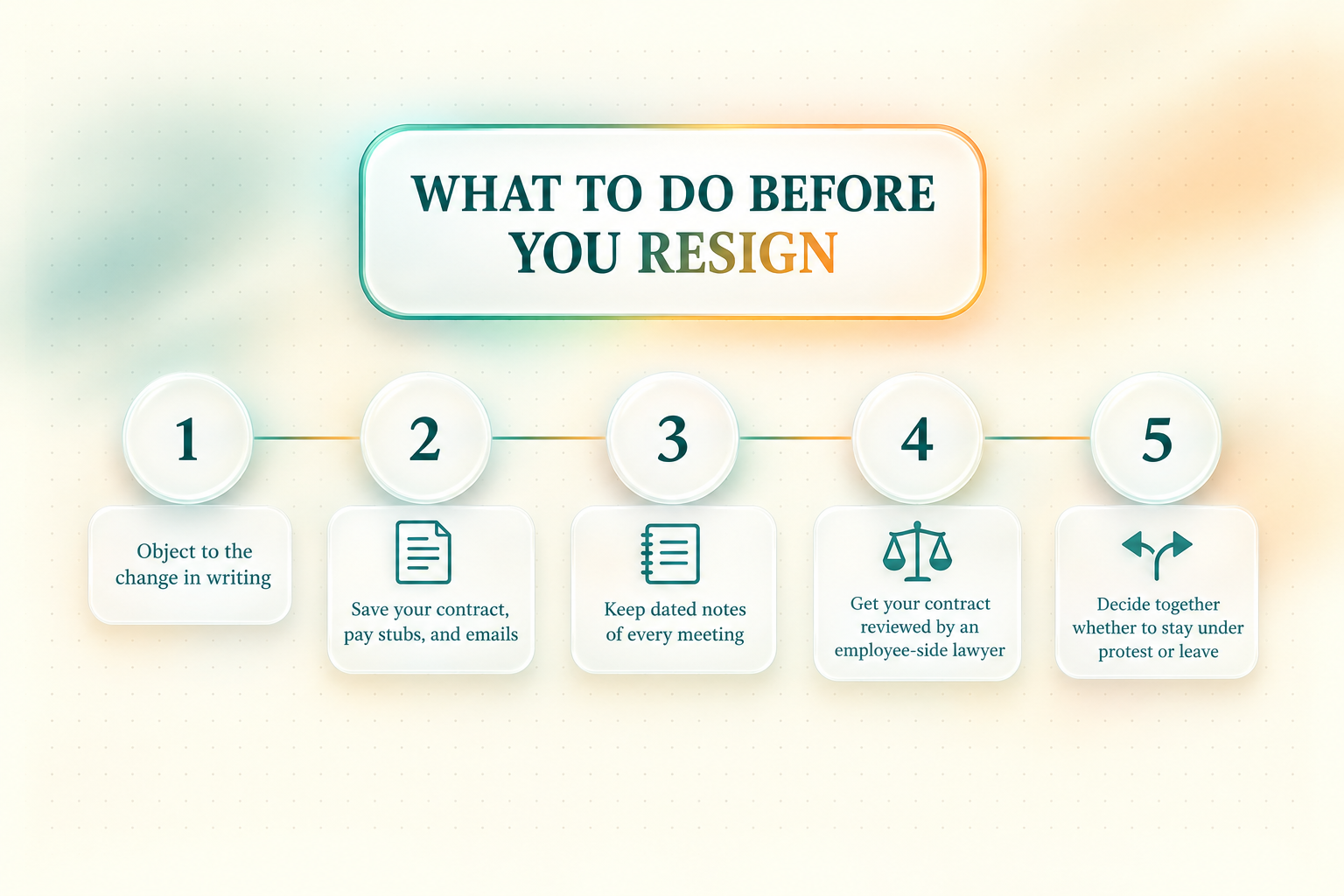
- Do not resign on the spot. Objecting in writing, keeping records, and getting advice before you walk out protects both your claim and your duty to mitigate.
- Who we act for. Mirza Law acts only for employees, never for employers, and reviews your contract and any offer before you sign anything.
What counts as constructive dismissal in Ontario?
Constructive dismissal happens when your employer makes a fundamental change to an essential term of your job without your agreement, or treats you in a way that shows it no longer intends to honour the employment contract. You were not handed a termination letter, but the law treats the change as a termination, and you can claim severance.
The Supreme Court of Canada set the modern test in Potter v. New Brunswick Legal Aid Services Commission, 2015 SCC 10. There are two branches: a single unilateral act that breaches an essential term, or a series of acts that, taken together, show the employer no longer intends to be bound by the contract.
The Employment Standards Act also recognizes it. Under section 56(1)(b), an employee who is constructively dismissed and resigns within a reasonable period is treated as terminated for ESA purposes. We explain the law in plain language in our guide to when quitting counts as being fired in Ontario.
Which workplace changes most often amount to constructive dismissal?
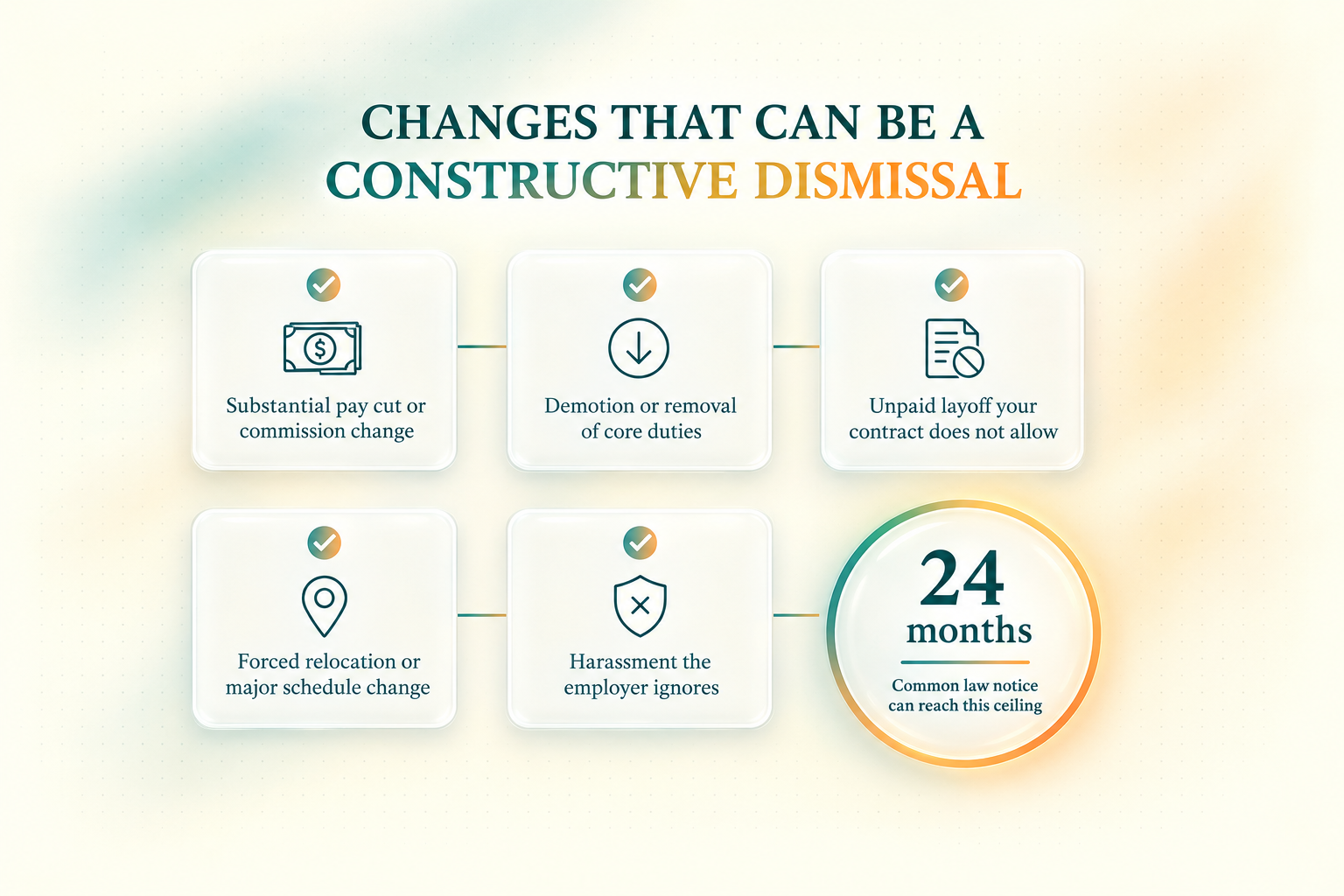
The most common triggers are a substantial pay cut, a demotion, removal of core duties, a forced relocation, a major shift in hours or schedule, an unpaid layoff your contract does not permit, and a workplace so hostile that no reasonable person could stay.
Layoffs deserve special mention. The ESA permits a temporary layoff of up to 13 weeks in any 20 consecutive weeks, or up to 35 weeks in 52 in limited cases, but only if your contract allows layoffs at all. If it does not, a layoff can be a constructive dismissal from day one. We break this down in our guide to your rights when you are laid off in Ontario.
A toxic workplace is the second branch of the Potter test. Sustained harassment, humiliation, or an employer that ignores a formal complaint can show it no longer intends to honour the contract, even if your pay and title never changed.
Can my employer legally cut my pay, reduce my hours, or demote me?
Only if your contract clearly allows the change or you agree to it. Employers have some room for minor adjustments within normal management rights. There is no fixed legal percentage, but Ontario courts have repeatedly treated pay cuts of 15 to 20 percent or more as substantial, while a modest change to duties or schedule usually is not.
A clause that says your employer can change your duties or compensation at its discretion does not automatically save it. Courts read those clauses narrowly, and a clause that lets the employer go below ESA minimums anywhere is void in its entirety under Waksdale v. Swegon.
In Farber v. Royal Trust Co., the Supreme Court found that a regional manager demoted to a branch role with a large loss of income had been constructively dismissed even though the employer called it a restructuring. The label the employer uses does not decide the case.
How is constructive dismissal different from wrongful dismissal?
Wrongful dismissal is when your employer ends your job and fails to pay the notice or severance you are owed. Constructive dismissal is when the employer never says the word fired but changes the job so fundamentally that the law treats you as terminated. Once constructive dismissal is proven, the remedy is the same: reasonable notice and severance.
The practical difference is proof. In a wrongful dismissal case, the termination is admitted and the fight is about the amount. In a constructive dismissal case, you must first prove the dismissal happened, then argue the amount.
That is why employers often prefer to push people out rather than fire them. A resignation looks voluntary on paper. If you were pressured into quitting, read our guide on when a forced resignation is really a termination.
Should I quit before I claim constructive dismissal?
Not before you get advice. You generally do have to treat the contract as ended within a reasonable period, but resigning without a written objection can look like a voluntary departure and cost you Employment Insurance and severance. Object in writing, state that you are working under protest, and have the change reviewed before you leave.
There is a second reason to be careful. Under Evans v. Teamsters Local Union No. 31, 2008 SCC 20, a dismissed employee may have to accept the employer's offer to keep working, or return to work, to mitigate losses if the environment is not hostile or humiliating. Walking out without a plan can reduce your damages.
We look at the change, your contract, and the atmosphere at work before telling you whether to stay under protest or leave. The answer is different for a pay cut at a respectful employer than for a harassment campaign.
How much severance can a constructive dismissal claim be worth?
The same as a termination without cause. The ESA floor is one week of notice per year of service, capped at 8 weeks, plus statutory severance of up to 26 weeks for employees with five or more years at employers with a payroll of at least 2.5 million dollars.
Courts set common law notice using the Bardal factors: your age, length of service, the character of your position, and how hard it will be to find comparable work. The Ontario government's guide to termination of employment sets out the statutory minimums, but a senior employee in their fifties with long service will usually be owed far more than the floor.
There is no weeks-per-year rule, no matter what an offer letter says. Our Ontario severance calculator uses the same factors courts use to show you a realistic range before you speak to anyone.
How long do I have to bring a constructive dismissal claim?
You generally have two years from the date you discovered the claim to sue under Ontario's Limitations Act, 2002, and one year to file a Human Rights Tribunal application if discrimination is involved. The bigger risk is condonation: if you keep working under the new terms for months without objecting, a court can find you accepted them.
The Limitations Act, 2002 sets the outside deadline, but the reasonable period to respond to a change is much shorter and depends on the facts. Weeks are usually safe. Many months without any objection are not.
The Ontario Court of Appeal in Pham v. Qualified Metal Fabricators Ltd., 2023 ONCA 255, confirmed that simply waiting during a layoff is not automatically condonation, but the safest course is to object in writing as soon as the change lands.
How do I prove constructive dismissal and what evidence should I keep?
Keep your employment contract and any offer letter, your original job description, every email or memo announcing the change, pay stubs from before and after, your written objection and the employer's reply, dated notes of meetings and comments, and medical records if the situation affected your health. The goal is a clear before-and-after picture.
Save documents to a personal device or email before access is cut off, but do not take confidential business records that are not about you. Taking the wrong files can hand the employer a cause argument.
If harassment is part of the claim, keep a dated log of each incident and any complaint you made under the employer's policy. A complaint that was ignored is strong evidence under the second branch of the Potter test.
What does a constructive dismissal lawyer in Toronto do, step by step?
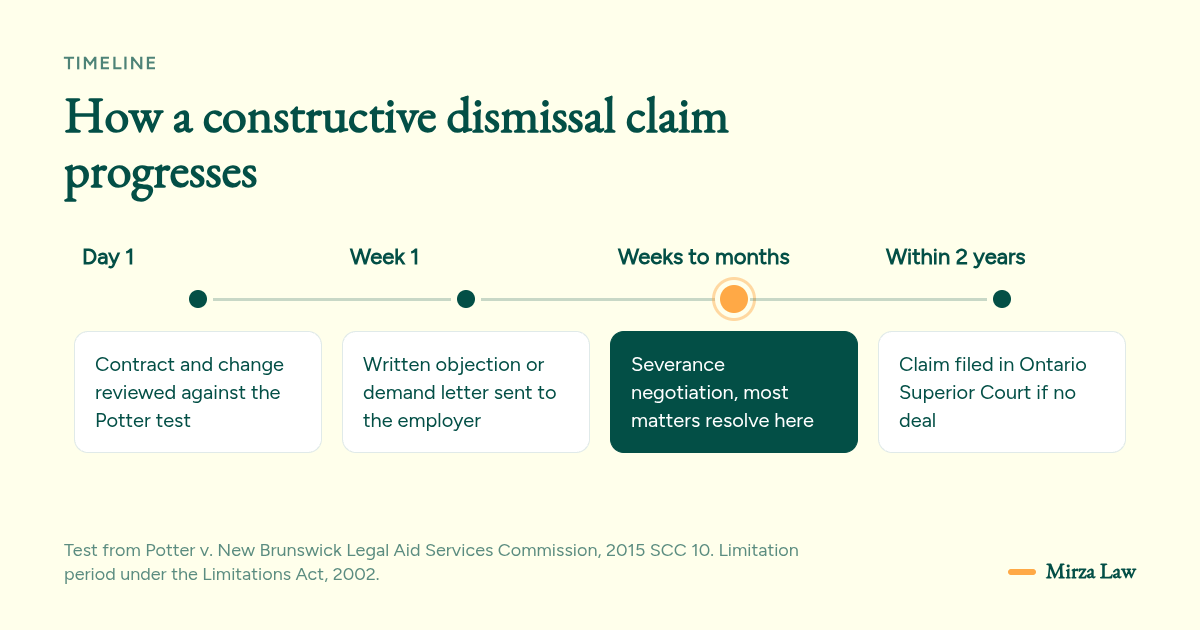
First, we review your contract and the change to confirm whether it meets the legal test. Second, we send a written objection or demand letter setting out your position and what you are owed. Third, we negotiate a severance package. Fourth, if the employer refuses, we start a claim in the Ontario Superior Court. Most matters resolve before trial.
Timelines vary. A demand letter usually goes out within days of our review. Negotiations commonly take weeks to a few months. Litigation in Ontario can take well over a year, which is why a strong file and an early objection matter so much.
At every stage we also check for void termination clauses. Since the Court of Appeal's 2024 decision in Dufault v. Ignace, clauses allowing termination at any time or in the employer's sole discretion fail, which can unlock months of extra notice.
How much does a constructive dismissal lawyer in Toronto cost?
Employee-side firms in Toronto bill in three ways: an hourly rate, a flat fee for a contract or offer review, or a contingency fee where the lawyer takes a percentage of the recovery. Ontario's Solicitors Act requires any contingency agreement to be in writing, so a firm offering no win no pay should hand you the agreement before starting.
Some large firms publish their model. Samfiru Tumarkin advertises a free first consultation, and Monkhouse Law is known for contingency arrangements; confirm current terms on each firm's site. We discuss how we bill on the first call so you can decide before any work begins.
The Solicitors Act also lets you ask the court to review a contingency agreement, which is a useful protection no matter which firm you choose.
Why hire Mirza Law for a constructive dismissal claim in Toronto?
We act only for employees and never for employers, so our advice is never shaped by a corporate client on the other side. We review the termination clause and any severance offer before you sign anything and give you a plain-language notice range you can act on. We handle claims under both Ontario and federal law.
Because constructive dismissal is governed by provincial and federal law, the same rules apply whether you work in downtown Toronto, North York, Scarborough, Etobicoke, or Mississauga. We act for employees across the GTA and Ontario.
We also handle long-term disability denials, which matters because a pushed-out employee is often also dealing with an insurer. If an offer is already on your desk, start with our guide on what to check before you sign a severance offer.
How did we decide what to recommend in this guide?
We compared the ESA minimums, the Supreme Court tests in Potter and Farber, and recent Ontario appellate decisions against the fee models each employee-side firm publishes on its own website. We recommend based on which side a firm acts for and whether it reviews the contract before you sign, not on awards or directory rankings.
How do you get started with Mirza Law?
If your job changed and you are not sure whether to stay, leave, or sign, contact us at mirzalegal.com to book a consultation before you resign or accept anything. We review your contract, the change, and any offer, then give you a plain-language view of what the claim is worth and what to do next.
What do people also ask?
Do I have to quit before I can claim constructive dismissal in Ontario?
You generally have to treat the contract as ended within a reasonable period, but you should not resign before getting advice. Object in writing, state you are working under protest, and have the change reviewed. In some cases you may need to keep working to mitigate your losses.
How much compensation can I get for constructive dismissal in Toronto?
The same as a without cause termination. ESA minimums cap notice at 8 weeks and severance at 26 weeks, but common law reasonable notice is measured in months and can reach 24 months depending on your age, tenure, position, and job prospects.
What is the difference between constructive dismissal and wrongful dismissal?
Wrongful dismissal is being let go without the notice or severance you are owed. Constructive dismissal is being pushed out through a fundamental change to your job without being formally fired. Once proven, the remedy is the same reasonable notice and severance.
How do I prove constructive dismissal?
Keep your contract, job description, every document announcing the change, pay stubs before and after, your written objection, dated notes of meetings, and any medical records. The test is whether a reasonable person would see the change as substantially altering an essential term of the job.
Is a temporary layoff constructive dismissal in Ontario?
It can be. The ESA allows layoffs of up to 13 weeks in 20, or 35 weeks in 52 in limited cases, but only if your contract permits layoffs. If it does not, a layoff can be a constructive dismissal from the first day, as Ontario courts confirmed in COVID-era cases such as Coutinho v. Ocular Health Centre.